Top

Asia-Pacific leads a wider crypto uptake as legal and security risks persist

Markets·September 08, 2025, 12:22 AM

A new report indicates that the global use of cryptocurrency is not only growing but also quickening, with the Asia-Pacific (APAC) region setting the pace. According to the sixth Chainalysis Global Crypto Adoption Index, released on Sept. 2, India has emerged as the new leader in overall adoption across 151 countries. The index analyzes where value is being transferred, how new users are entering the ecosystem, and which areas are experiencing the most rapid expansion.

https://asset.coinness.com/en/news/c9648faf8aca5c5ec2d477de452bb449.webp
Photo by Naveed Ahmed on Unsplash

India leads global crypto adoption

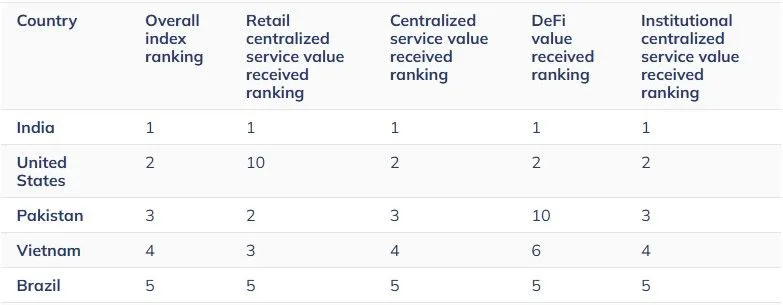
India now holds the top spot in the overall index, with the U.S. following in second place. The APAC region demonstrates significant momentum, with Pakistan (3rd), Vietnam (4th), Indonesia (7th), and the Philippines (9th) all securing positions in the top ten. Further down, South Korea and Japan are ranked 15th and 19th, respectively.
https://asset.coinness.com/en/news/519be038ed3cf599185eea1151ab10e2.webp
2025 Global Crypto Adoption Index Top 20 Source: Chainalysis

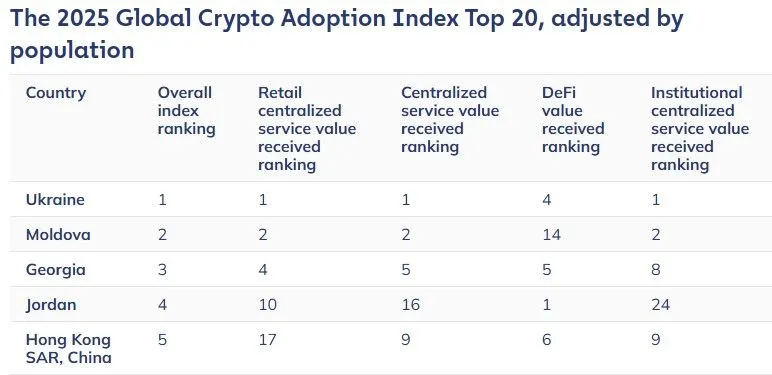
The picture changes when the data is adjusted for per capita GDP, which highlights grassroots movements. By this measure, Ukraine ranks first, followed by Moldova, Georgia, and Jordan. Hong Kong comes in fifth, Vietnam sixth, while Singapore and South Korea rank 16th and 18th, respectively.
https://asset.coinness.com/en/news/0b943ed6bf741d298814dda5ca151e6e.webp
2025 Global Crypto Adoption Index Top 20 (Pop. adjusted) Source: Chainalysis

Regional transactions surge as APAC gains ground

On-chain transaction data confirms a shift in economic gravity. In the year ending June 2025, APAC's transaction value soared by 69% year-over-year, climbing from $1.4 trillion to $2.36 trillion. While Europe ($2.6 trillion) and North America ($2.2 trillion) still handle larger absolute volumes, growth is accelerating nearly everywhere. APAC's growth rate more than doubled from 27% to 69%, while Latin America's rose from 53% to 63%.


In terms of capital entering the crypto market via centralized exchanges, the U.S. leads as the largest fiat on-ramp, processing over $4.2 trillion. This is approximately four times the volume of South Korea (over $1 trillion), while the EU recorded just under $500 billion. Asset preferences also show regional variations; Bitcoin accounted for 47% of purchases in the U.K. and 45% in the EU, but just over 20% in South Korea. 


India's top ranking aligns with the latest domestic developments, such as the Independence Day launch of the Bitcoin Policy Institute India, which aims to focus on sovereign mining, policy, and education.


Legal and security challenges in India

However, this rapid growth is accompanied by notable legal and security hurdles. In a high-profile case, an Indian anti-corruption court sentenced 14 individuals, including 11 police officers, to life in prison for a 2018 kidnapping and crypto extortion scheme.


In another development, creditors of India's crypto exchange WazirX approved a new restructuring plan over a year after a $234 million hack allegedly linked to North Korea’s Lazarus Group. An earlier proposal was rejected by the Singapore High Court in April. The revised plan shifts oversight of recovery tokens—representing outstanding balances—from WazirX’s Singapore entity to Zanmai India, regulated by India’s financial authority, with repayments funded by profits and recovered assets. Some 150,000 creditors, representing $206 million in claims, voted between July 30 and Aug. 6 as WazirX also moved operations to a Panama-based unit called Zensui. Separately, on April 16, India’s Supreme Court dismissed a petition from 54 hack victims, ruling it lacked authority to legislate on crypto policy.


While India’s headlines highlight the frictions of rapid growth, the broader picture is clearer. The Chainalysis index illustrates a global crypto market expanding across all income levels for varied reasons. In developed nations, clearer regulations and institutional involvement are key drivers. In many emerging economies, factors like remittances and access to U.S. dollars via stablecoins are more prominent.

 

More to Read
View All
Policy & Regulation·

Jul 31, 2023

Busan City Houses Two Foreign Financial Firms on the Road to Becoming Blockchain, Fintech Hub

Busan City Houses Two Foreign Financial Firms on the Road to Becoming Blockchain, Fintech HubThe city of Busan said Monday that it has chosen two financial companies, UIB Korea and Lina One, as the new occupants of Decacorn-Space — an office space on the 63rd floor of the Busan International Finance Center (BIFC) — in an effort to position the southern port as the nation’s blockchain and fintech hub.Busan has been running an open call for foreign financial institutions to move into the recently renovated space since June. After a rigorous two-step evaluation process, UIB Korea and Lina One were selected, the city said.This comes as part of Busan’s efforts to further develop the BIFC and become a major financial powerhouse in Korea.“We have been relocating public financial institutions, fostering financial experts, and exploring new growth drivers such as fintech, blockchain, and digital innovation,” the city’s mayor Park Heong-joon explained.Photo by Minku Kang on UnsplashAbout UIB Korea and Lina OneUIB Korea, or UIB Insurance Brokers, is the Korean branch of UK-based UIB Group — a global insurance broker that offers risk management advisory services. In particular, the firm is set to work with other domestic companies such as DB Insurance and Meritz Fire & Marine Insurance to establish a consortium for providing insurance products and consulting services.Meanwhile, Lina One is the Korean branch of Chubb Group, the world’s largest publicly traded property and casualty insurance company. One of the firm’s major goals is to promote the insurance information technology market in Busan.Notably, both companies aim to leverage their digital capabilities, experience, and competitiveness to achieve similar goals, which include digitizing insurance for various partners, ranging from maritime and industrial companies to regional banks, fintech companies, and individuals. In turn, their efforts are expected to expand Busan’s network with the larger global financial community and present the city as an ideal spot for international conferences.On the road to becoming a financial hubDespite considerable challenges such as the withdrawal of foreign financial institutions from Korea and the impact of COVID-19 on international travel, the city has continuously made efforts in collaboration with the Busan Finance Center to attract international financial institutions through events like investor relations meetings and local networking activities.To support the successful landing of these companies in Busan, the city will also offer one-stop services such as business model development support and residential settlement consultations.Once settled, UIB Korea and Lina One are expected to generate significant synergy with partner firms such as local financial holding company BNK Financial Group during the third phase of the development of the BIFC whose objective is to house innovative financial workspace by 2025.“It is crucial for us to attract more competent domestic and foreign financial institutions that will have a great impact on the city’s financial economy,” Mayor Park emphasized.

news
Web3 & Enterprise·

Sep 21, 2023

Xangle and CertiK Team Up to Promote Mass Adoption of Web3

Xangle and CertiK Team Up to Promote Mass Adoption of Web3CrossAngle, the operator of the virtual asset data analysis platform Xangle, announced on Wednesday that it has teamed up with CertiK, a global blockchain security ranking platform, to promote the mass adoption of Web3 technologies and contribute to the formation of a secure and transparent blockchain ecosystem.Photo by Shubham’s Web3 on UnsplashStrengthening security and data insightsCertiK is a security-focused ranking platform for analyzing and monitoring blockchain protocols and DeFi projects. Through this new partnership, Xangle will gain access to Skynet, CertiK’s Web3 security analysis platform that monitors and visualizes on-chain and off-chain data with cutting-edge technology, along with other API data. In turn, CertiK will receive access to Xangle’s cryptocurrency reference price API and on-chain data analyses.CertiK’s industry analysis reports will also be regularly featured on Xangle’s research platform. Xangle’s research reports are well-regarded throughout the industry and have been featured on local and international financial information platforms such as Bloomberg Terminal, CoinMarketCap, Yonhap Infomax, and FnGuide.Positive outlooks“We are delighted to partner with CertiK, a global leader in Web3 security. We are already anticipating great synergy with our strong capabilities in on-chain data analysis,” said Jake Lim, Chief Business Development Officer (CBDO) of Xangle. “We believe that this collaboration between our two companies will accelerate the mass adoption of Web3 technologies.”Jason Jiang, Chief Business Officer (CBO) of CertiK, added that the partnership is expected to not only enhance security and transparency in the blockchain ecosystem but also help set new industry standards.This partnership between CertiK and Xangle reflects the growing importance of security and data analysis in the rapidly evolving Web3 landscape, as both companies work together to drive its widespread adoption.

news
Policy & Regulation·

Jun 16, 2023

SEC Opposes Motion to Dismiss Terraform Labs Lawsuit

SEC Opposes Motion to Dismiss Terraform Labs LawsuitLawyers representing the United States Securities and Exchange Commission (SEC) have responded to a motion to dismiss the lawsuit filed by Dentons, the lawyers representing Singapore-based Terraform Labs and its Founder Do Kwon.Photo by Miguel Á. Padriñán on PexelsCourt filingAccording to its arguments, set out in a court filing lodged to the District Court of the Southern District of New York on Thursday, the SEC’s counsel claims that the additional documents provided by Dentons lack sufficient grounds for dismissing the case.It claims that the internal SEC emails presented by Dentons are irrelevant to the current lawsuit. The SEC asserts that the parameters of an “investment contract” are clearly defined by the Howey test and argue that TerraUSD ($UST) should be classified as a security.The reliance by US regulators on the Howey test, a legal test case that implicated citrus grove contracts that date back to 1946, has proven to be controversial. Naturally, there could have been no consideration of the digital innovation that digital assets present today almost eighty years ago. Notwithstanding that, the SEC maintains that the principle factors of what constitutes an investment contract are covered by the case regardless.During the court hearing held on June 15, Dentons submitted supplementary documents to strengthen their motion to dismiss the lawsuit. The primary focus of the hearing was to determine whether the digital assets developed by Terraform Labs should be categorized as securities based on the criteria of an “investment contract.”Dentons maintains that the algorithmic stablecoin, $UST, should not be considered a security and emphasizes its practical purpose rather than its classification as an investment contract. To support their motion, Dentons included additional documents such as the US House Financial Services Committee hearing on digital asset regulation and stablecoin issuance, the SEC’s request for a restraining order against Binance.US, and the Hinman emails from the SEC vs. Ripple lawsuit.Judge to decideThe defense lawyers highlighted what they perceive as a “regulatory gap” in classifying crypto assets as securities, particularly as the US Congress engages in discussions about regulatory frameworks for digital assets and stablecoin issuance. Furthermore, they argued that the SEC is exceeding the scope of securities laws and relying on internal emails related to “investment contracts” to determine the security status.A decision on the motion to dismiss will be arrived at by July 14. Judge Jed Rakoff, who is presiding over the case, will be responsible for that, once he’s weighed up the merits of the arguments presented by both parties.It is noteworthy that Dentons has previously represented Kwon in challenging the US SEC’s subpoena during the investigation of the Mirror Protocol in 2021, as well as in a class-action lawsuit in the Singapore High Court in 2022. The law firm also provides representation to Terraform Labs in other legal matters.In a separate development, the Basic Court in Podgorica, Montenegro, has granted bail for Kwon and former Terra Chief Technology Officer Han Chang-joon. However, Kwon has recently been taken into custody for extradition in Montenegro while the court deliberates on South Korea’s extradition request for the Terra founder.As the legal proceedings continue, the outcome of the motion to dismiss will have significant implications for the ongoing dispute between Terraform Labs, Do Kwon, and the SEC.

news
Loading
