Live Feed
Today, December 30, 2025
13:57
While the issue of quantum computing is gaining attention in the cryptocurrency market, digital asset manager Grayscale has assessed that it is unlikely to have a tangible impact on asset prices by 2026, according to CoinDesk. In a recent report, Grayscale noted that quantum computers could theoretically break current cryptographic standards and derive private keys from public keys, thereby threatening blockchain security. However, the firm stated that it would take considerable time for this theory to become a practical reality. Grayscale concluded that in the long term, most blockchains, including Bitcoin, will need to transition to quantum-resistant cryptography. While a blockchain's ability to counter quantum threats may become a valuation metric in the future, the report suggests the short-term impact on market value will be insignificant.
13:43
Overtake (TAKE) announced on its official X account that a recent sharp price drop was not the result of a security breach or hacking. The statement follows a 10-minute period in which the token plunged approximately 70%, as previously reported by CoinNess. The project's team said it believes the crash is linked to a large-scale liquidation in the derivatives market and is closely monitoring the situation. It also confirmed that all wallets managed by the foundation and team remain secure.
13:39
Chinese investors have poured $188 million into companies related to the digital yuan following an announcement by the People's Bank of China (PBOC) that it will allow interest payments on central bank digital currency (CBDC) wallets, DL News reported. Approximately 30% of the investment was directed to Lakala, a provider of hardware wallets and merchant payment infrastructure. The PBOC previously announced new guidelines, effective Jan. 1, to strengthen the digital yuan's infrastructure and governance by including it in deposit reserves and classifying wallets based on liquidity.
13:37
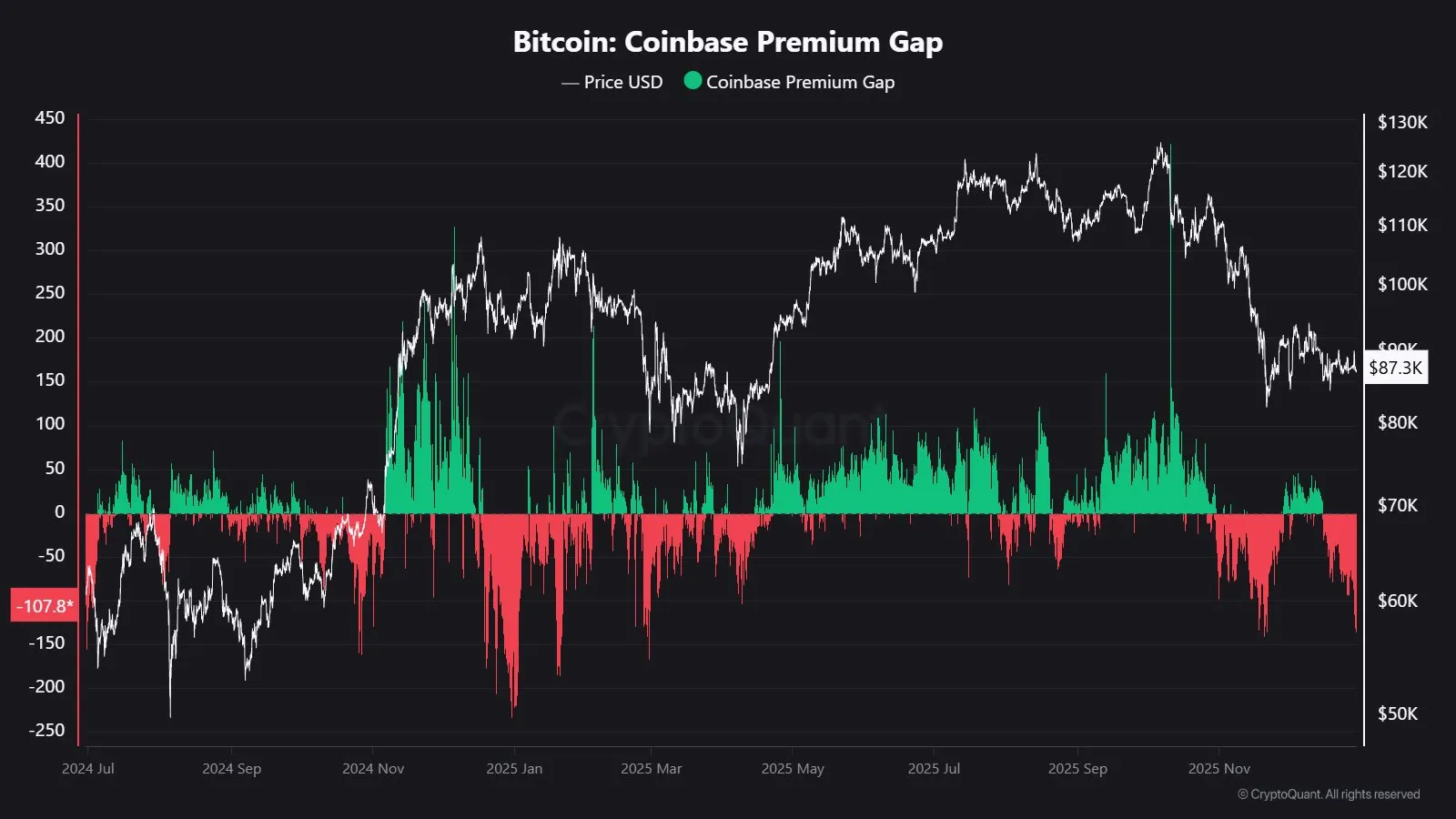
The Coinbase Premium has dropped to a level seen only about five times a year, according to CryptoQuant contributor and analyst martuun. The Coinbase Premium is an indicator that shows the difference between the Bitcoin price on Coinbase and its price on other global exchanges. The analyst noted that the premium is currently at -$122, adding that such an extreme discount has only been observed on about five occasions this year.
13:24
Industry experts forecast that stablecoins will become a core component of global financial infrastructure by 2026, serving as the underlying "plumbing" for both decentralized and traditional finance, Cointelegraph reports.
The year 2026 is expected to be pivotal for regulated, dollar-backed stablecoins, with greater regulatory clarity driving mainstream adoption across banking, fintech, and corporate and retail payment networks. Use cases are projected to expand into B2B settlements, treasury operations, and payroll. In emerging markets across Africa, Asia, and Latin America, stablecoins are also anticipated to see rapid adoption for daily payments, remittances, and wealth preservation.
However, challenges remain. Divergent national regulatory frameworks could increase systemic risk, market polarization, and liquidity fragmentation. Tokenized deposits are also expected to emerge as a key competitor, potentially replacing stablecoins in areas requiring high regulatory stability as banks innovate with permissioned ledgers.
Experts also foresee a shift toward on-chain finance, with institutional investors expected to deploy an estimated $230 billion in currently idle, non-yield-bearing stablecoins into DeFi-based solutions.
13:00
Bitcoin's drop of over 2.6% on Dec. 29, which occurred shortly after it reclaimed the $90,000 level, is being analyzed as a classic bear trap. According to Cointelegraph, crypto investor James Bull, who has around 173,000 followers on X, suggested that the price action could be a "Christmas bear trap." He predicted a significant rebound in January 2026, similar to patterns observed over the past four years.
Bull explained that last year, Bitcoin fell 8.5% between Dec. 26 and Dec. 31, 2024, only to rally 12.5% between Jan. 1 and Jan. 6, 2025. Another analyst, known as 'Bitcoin Therapist,' added that if the two-year halving cycle pattern is broken, Bitcoin could reach a new all-time high in the first quarter of 2026, which would complete what the analyst called the largest bear trap in history.
Meanwhile, Cointelegraph noted that based on the daily chart, BTC is forming a symmetrical triangle pattern. If the price closes a daily candle above the pattern's upper trendline and continues to rise, the next target could be the $107,400 level.
12:50
Cypherpunk Technologies, a digital asset financial firm backed by the Winklevoss brothers, has purchased an additional 56,418 ZEC, valued at $29 million, according to Wu Blockchain. This latest acquisition brings the company's total holdings to 290,062 ZEC, which accounts for 1.76% of the token's circulating supply. Cypherpunk CEO Will McEvoy said the company aims to expand its ZEC holdings to 5% of the total circulating supply.
12:38
Global cryptocurrency exchange Binance has suspended card-based withdrawals for users in Ukraine starting this week, according to local media reports. The suspension affects withdrawals via cards such as Visa and Mastercard for Ukrainian users who accessed the exchange through the fiat payment service Bifinity. Binance clarified that the change in payment methods applies only to Ukrainian users who utilized the Bifinity service.
12:33
According to CoinNess market monitoring, Overtake (TAKE) plummeted more than 70% in approximately 10 minutes. The sharp decline began around 12:20 p.m. UTC on Dec. 30, with the price falling from about $0.32 to a low of $0.11116. The token is currently trading at $0.12298, down 70.47%, according to Binance Alpha.
12:27
The number of smart contracts deployed on Ethereum reached an all-time high of 8.7 million in the fourth quarter of this year, crypto analyst Joseph Young stated on X. He noted that this follows several consecutive quarters of growth and likely reflects genuine ecosystem expansion rather than inflated metrics. Young attributed the growth to the expansion of Layer 2 networks, increased issuance of Real-World Asset (RWA) tokens, broader stablecoin adoption, and advancements in wallet and intent infrastructure.
12:27
XRP's short-term trajectory depends on its ability to defend the $1.85 support level, according to an analysis by Watcher.Guru. The outlet noted that with 1 billion XRP scheduled to be unlocked from escrow in January, the release could create short-term downward pressure, as the asset is barely holding above this key support.
For a bullish scenario to remain viable, XRP must maintain the $1.85 level, see trading volume recover around the $2.00 mark, and break through the downtrend resistance at $2.08. Meeting these conditions could invalidate the current bearish structure. Conversely, if XRP breaks below $1.85 before January, the next support level is likely to be $1.77, and strong selling pressure could push the price down to $1.60. The analysis concluded that the escrow unlock could amplify a negative cycle by creating both technical and psychological burdens.
12:18
The optimistic year-end Bitcoin price predictions from so-called industry experts for 2025 were almost all incorrect, CoinDesk reported. The media outlet noted that forecasts from traditional finance analysts and executives at firms like Fidelity, BlackRock, and JPMorgan, as well as from prominent Bitcoin bulls, were wide of the mark. Analyses from research institutions such as VanEck and Fundstrat also proved inaccurate. While a few experts lowered their price targets during the year, very few predicted a price below $100,000. CoinDesk concluded that 2025 served as a reminder of an old market truth: Bitcoin defies all predictions and breaks technical charts. It emphasized that while making predictions in the crypto industry is easy, being correct is rare.
11:42
Bitcoin's long-term holders (LTHs) have shifted to a net accumulation phase for the first time since July, according to CoinDesk, citing on-chain analytics firm checkonchain. Addresses that have held BTC for at least 155 days have net-purchased approximately 33,000 BTC over the past 30 days. The firm noted that this cohort had been one of the largest selling groups in the market this year, offloading more than one million BTC as the cryptocurrency's price fell by around 36% since October. However, checkonchain also explained that since it takes about 155 days for a short-term holder to be reclassified as a long-term one, buying pressure from the last six months may now be offsetting the selling pressure.
11:41
While gold and silver prices have surged this year, significantly outpacing Bitcoin's annual gains, multiple analysts predict BTC will follow gold's upward trend next year, according to CoinDesk. Investors have favored precious metals like gold as a store of value to hedge against the depreciation of fiat currencies. Gold has risen approximately 70% year-to-date and silver has jumped about 150%, while Bitcoin has lagged behind.
Gold's price has remained above its 200-day simple moving average (SMA) for 750 trading days, marking its second-longest bull run on record. However, many crypto analysts anticipate that Bitcoin will mirror gold's rally in the coming year, repeating a historical pattern where its price movements lag behind the precious metal. The analysis suggests that gold's price action has historically preceded Bitcoin's by about 26 weeks, with gold's sideways consolidation last summer seen as corresponding to Bitcoin's current trading pattern.
10:32
Binance has announced it will list BREVUSDT perpetual futures on its pre-market at 10:45 a.m. UTC today. The contract will support up to five times leverage.
10:28
The story-based Unleash Protocol has suffered a hack resulting in losses of $3.9 million, blockchain security firm PeckShield reported on X. The attacker bridged the stolen funds to Ethereum and subsequently deposited them into the crypto mixer Tornado Cash.
10:13
Russia's Ministry of Justice is proposing to strengthen criminal penalties for illegal cryptocurrency mining, according to Wu Blockchain. Under the proposed amendments, violators could face fines of up to 1.5 million rubles (approximately $16,800) or up to two years of forced labor. In cases involving large-scale profits or links to organized crime, penalties could include up to five years in prison.
09:50
A total of 368 institutions worldwide hold over $185 billion (268 trillion won) in cryptocurrency, according to Santora, formerly IntoTheBlock. Corporations account for 73% of these holdings.
09:50
Cryptocurrency analyst Ali Martinez, who has approximately 164,000 followers on X, has projected that XRP could fall to $0.80. He explained that on-chain activity on the XRP Ledger has sharply contracted, with daily active addresses recently dropping from 46,000 to 38,500, suggesting a decline in network participation and interest. Martinez also noted that on-chain data indicates whales have become sellers, offloading more than $40 million in XRP over the past few days. He concluded that if this downward pressure continues, XRP could lose its key support at $1.77, and a break below that level could lead to a decline toward $0.80.
09:44
Crypto trader Mister Crypto, who has approximately 143,000 followers on X, stated that according to on-chain data, Ethereum (ETH) whales have been buying the asset since the second half of 2025, while retail investors have been selling. He added that investors should follow the flow of smart money, referring to the whales. CoinNess previously reported that Ethereum whale addresses have accumulated around 120,000 ETH since Dec. 26. Currently, wallets holding more than 1,000 ETH control approximately 70% of the total ETH supply, a proportion that has been increasing since the end of 2024.
09:38
Most altcoins will not survive through 2026, according to crypto trader Michaël van de Poppe. In a report by BeInCrypto, van de Poppe warned that the assumption of an inevitable recovery for all altcoins is dangerous, noting that the past year has been harsher for most than 2022. He suggested that a major consolidation could begin next year, driven by failed tokenomics, poor financial management, and excessive price declines.
However, van de Poppe stated that exceptions will exist, with projects showing a large disparity between fundamentals and price likely to survive long-term. He identified projects with rising on-chain activity, expanding Total Value Locked (TVL), growing trading volume, and increasing fee revenue—despite falling prices—as having a high probability of long-term success. He cited Arbitrum (ARB), Aave (AAVE), and Near Protocol (NEAR) as examples, adding that Arbitrum's ecosystem has grown by 200% even as its price has hit new lows.
08:43
South Korea’s Financial Services Commission (FSC) is pursuing strict new regulations to overhaul the governance structure of the country's four largest virtual asset exchanges, KBS reported. The measures are reportedly part of the forthcoming second phase of virtual asset legislation, which also covers stablecoin issuance requirements and market legalization.
The FSC stated that there is an issue with a small number of founders and shareholders exercising excessive control over exchange operations. To address this, the commission plans to establish a major shareholder eligibility review system comparable to the one for Alternative Trading Systems (ATS) under the Capital Market Act. The FSC has proposed limiting a major shareholder's ownership stake to between 15% and 20%.
If the government's plan is implemented, it could directly impact Dunamu, the operator of the Upbit exchange. Dunamu Chairman Song Chi-hyung holds a stake of around 25%, meaning he would be forced to sell up to 10% of his shares. The regulatory push comes as Dunamu is pursuing a de facto merger with Naver Financial through a comprehensive stock swap, raising the possibility that the proposed cap could become a significant variable in the deal.
08:34
Institutional investors are increasingly extending options strategies, once primarily used for Bitcoin, to the altcoin market to manage price volatility and generate additional returns, CoinDesk reported, citing crypto derivatives trading firm STS Digital. The firm explained that institutions are now applying various strategies to altcoins, such as covered calls, which involve buying an asset while selling a corresponding call option. Other tactics include selling put options to bet against sharp downturns, hedging downside risk, and buying call options to prepare for a potential rally. According to STS Digital, investors are adopting these strategies to control their exposure while minimizing the risk of forced liquidations, such as the event that triggered a price crash on Oct. 10.
08:18
Demand for stores of value and a clearer regulatory environment are expected to drive a cryptocurrency bull market next year, according to Zach Pandl, head of research at U.S. digital asset manager Grayscale. In an appearance on CNBC, Pandl stated that macroeconomic factors remain the most powerful investment driver, Cointelegraph reports. He explained that concerns over rising government debt, persistent fiscal deficits, and the devaluation of fiat currencies are pushing investors to seek alternatives to traditional assets. Pandl noted that this environment is fueling demand for Bitcoin, which is increasingly seen as a store of value. He added that while there is still progress to be made, the regulatory environment for crypto-related businesses has improved significantly, which could also positively impact the market.
08:13
According to CoinNess market monitoring, BTC has risen above $88,000. BTC is trading at $88,004.42 on the Binance USDT market.
