Top

Myanmar Government in Exile Backs Crypto Bank Launch

Policy & Regulation·July 21, 2023, 12:36 AM

Myanmar is on the cusp of a financial revolution as the National Unity Government (NUG), the country’s exiled shadow government, introduces the Spring Development Bank (SDB), a crypto-based financial institution.

With a mission to bestow long-awaited financial freedom and digitized sophistication upon the nation’s citizens, the SDB aspires to reshape Myanmar’s financial landscape.


Built on Polygon

The bank derives its name from the Spring Revolution, an opposition movement that bravely challenges the ruling military junta. The goal of the SDB is to bring “freedom and democracy to the 55 million citizens of Myanmar,” a lofty ambition that reflects the NUG’s determination to empower its people through innovative means.

Constructed on the Polygon Network, the SDB aims to revolutionize domestic and international payments, making them faster and more efficient. But the bank’s vision extends beyond just payments. Following a recent press conference, bank officials revealed plans to offer a diverse range of financial products, including fixed deposits, currency exchange services, cross-country remittances, and even digital gold savings options.


Reaching the Burmese diaspora

Notably, the SDB’s reach extends beyond Myanmar’s borders to the two-million-strong Burmese diaspora residing abroad. This diaspora frequently sends money back to their homeland, but the current remittance fees can soar as high as 30%. The bank intends to alleviate this burden, reducing the costs associated with sending money back to Myanmar.

The Spring Development Bank operates under the licensing and regulation of the Interim Central Bank of Myanmar, which is under the control of the NUG. U Calvin, the bank’s CEO, emphasized that this launch marks the initial step towards restoring financial independence to Myanmar.

The bank’s emergence comes amid Myanmar’s complex relationship with cryptocurrencies. While there is no specific legislation addressing cryptocurrencies, the Central Bank of Myanmar issued a ban on them in 2020, and the military junta later proposed a cybersecurity law that criminalized their usage in January 2022.
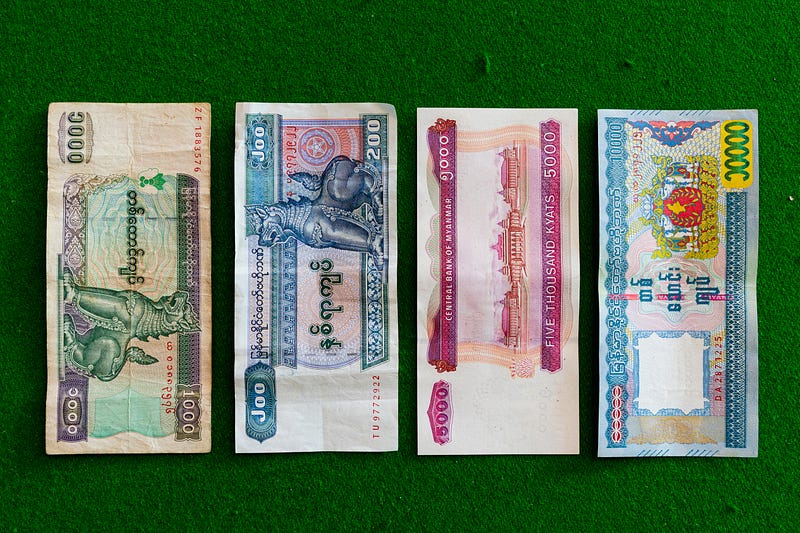
Photo by Dan Gold on Unsplash


July soft launch

A soft launch of the SDB is scheduled for July 22, with 1,000 private beta users and 100 relationship managers. The bank expects to achieve a full launch in late August, with the goal of attracting 100,000 active users within the first six months of operation.

Despite these regulatory challenges, Myanmar’s people have turned to cryptocurrencies as an escape from their dire financial situation. Since the February 2021 coup, the country’s economy has suffered significantly, with the World Bank estimating an alarming 18% annual contraction. Fading trust in the traditional banking system, controlled by the military, has further crippled the financial market.

The Myanmar kyat (MMK) plummeted to an all-time low of 2,200 against the US dollar (USD) in September 2021, down from 1,330 in February 2020 (currently 1 USD = 2,100 MMK).

The SDB’s arrival signals a glimmer of hope amidst these trying times, offering a beacon of financial opportunity for the citizens of Myanmar. With the support of the NUG, the bank is looking to take an innovative approach to better serve Burmese citizens, both at home and abroad.


More to Read
View All
Web3 & Enterprise·

Sep 27, 2023

Sejong Telecom to Collaborate with KOREIT for Security Token Products

Sejong Telecom to Collaborate with KOREIT for Security Token ProductsSejong Telecom said Wednesday that it is going to work with the Korea Real Estate Investment and Trust (KOREIT) to jointly develop security token products.Through this agreement, Sejong Telecom aims to transform trust products that are discovered by KOREIT into security tokens and then list them on BBRIC — an integrated real estate investment and income distribution service developed and operated by the Sejong Telecom Consortium — in order to attract investors.Photo by NordWood Themes on UnsplashRevolutionizing real estate investmentsBBRIC utilizes blockchain technology to ensure the transparency and security of financial products and provides a crowdfunding-style real estate indirect investment platform that is easily accessible to the general public, thus expanding the accessibility of fractional investments and allowing anyone to acquire information and engage in trading. It has also obtained information security management system (ISMS) certification, further enhancing measures for investor protection.“Security token transactions that are conducted online require security, confidence in product value, and transparency of transactions. BBRIC has consistently demonstrated its security and transparency as well as the investment value of its listed security tokens,” said Park Hyo-jin, Head of Sejong Telecom’s blockchain division.KOREIT is a leading comprehensive real estate and finance company. Leveraging its long-standing expertise and professionalism, it has been enhancing its competitiveness in various business areas, including land trusts, land trust-led urban improvement projects, and real estate investment trusts (REITs).“We will work together with KOREIT to find underlying assets for security tokens and select secure and reliable products with high investment value to offer to investors,” Park added.Further efforts to advance BBRICSejong Telecom also recently signed a business agreement with Hyosung TNS, the infrastructure and finance arm of South Korean conglomerate Hyosung Group, to promote BBRIC and develop security token services.

news
Web3 & Enterprise·

Jul 20, 2023

WEMIX Listed on Crypto Exchange CoinDCX, Strengthening Presence in India

WEMIX Listed on Crypto Exchange CoinDCX, Strengthening Presence in IndiaWEMIX, the utility coin of blockchain game platform WEMIX Play, has now been listed on India-based cryptocurrency exchange CoinDCX, according to a press release. WEMIX Play is operated by South Korean gaming company Wemade.Photo by Naveed Ahmed on UnsplashWEMIX/USDT & WEMIX/INREstablished in 2018, CoinDCX earned unicorn status two years ago, becoming the first Indian crypto exchange to accomplish this feat. With a current valuation of approximately $2.5 billion, CoinDCX offers trading support for over 80 cryptocurrencies and provides decentralized financial (DeFi) services to a customer base of 15 million global users. CoinDCX users can trade WEMIX against USDT and INR, where USDT stands for a stablecoin issued by crypto giant Tether and INR for Indian Rupee.WEMIX made its debut on the Indian market in February through its listing on Bitbns, another cryptocurrency exchange. The token’s addition to another trading platform in India indicates the growing presence of the WEMIX ecosystem in the region.India’s Web3 landscapeIndia is a prominent market for non-fungible tokens (NFTs) and blockchain technology. As of April, investments in the Indian Web3 ecosystem had reached $1.3 billion. The country also boasts the world’s third-largest talent pool for Web3 development. Currently, more than 450 Indian startups are making their mark on the global stage, demonstrating expertise in DeFi services, gaming, NFTs, and metaverses.Looking ahead, WEMIX aims to further expand its reach by pursuing listings on additional crypto exchanges. This strategy will enable gamers worldwide to trade the WEMIX token with their respective fiat currencies.

news
Policy & Regulation·

Dec 27, 2023

Worldcoin withdraws verification service from Indian market

Worldcoin, the startup co-founded by OpenAI CEO Sam Altman, has encountered setbacks in its eye-scanning initiatives just six months after its international expansion. A recent report by TechCrunch indicates that the company’s signature orb eye-scanner is no longer available to users in the Indian market. According to that report, the Worldcoin Foundation clarified that its activities have also been suspended in France and Brazil. The company clarified that its offerings in those markets were only intended to be limited-time product previews as opposed to long-term roll-outs.Photo by Big G Media on UnsplashTemporary service haltIn India, the World App is experiencing widespread adoption, but the orb-verified proof of personhood services has been temporarily halted. The pause aims to allow the protocol to develop and implement a bespoke, safe and orderly process to meet the growing demand. The setback comes after Tools for Humanity, the organization behind Worldcoin, announced the expansion of World ID, its digital identity program linked to iris scans, in July. The startup had ambitious plans, intending to make 1,500 orbs available in over 35 cities globally. Recently, the company unveiled a program offering $5 million in grants to developers utilizing its eye-scanning technology. Regulatory investigationsSam Altman and his co-founders established Worldcoin in 2020 to help individuals prove their digital identity amidst the rise of AI. Over the years, Worldcoin has secured $250 million in funding from notable venture capitalists, including Andreessen Horowitz. However, the startup has faced regulatory challenges, including investigations by French and German regulators and an Argentinian government agency. Altman, himself, has navigated recent challenges. In November, the OpenAI board temporarily removed him as CEO, reinstating him two weeks later. More recently, Fortune reported that Altman quietly received $75 million from the University of Michigan for a new venture capital fund, raising questions about transparency, particularly following the launch of OpenAI’s signature product, ChatGPT. Asian tourIn recent weeks, the project development team behind Worldcoin had engaged in a tour of Asia. The objective of that mission was to gather market feedback prior to engaging in greater efforts to expand the reach of its World ID verification system within the region. To gauge market receptiveness to its product offering, the tour included meetups in major Asian cities such as Hong Kong, Seoul, Singapore and Tokyo. Up until mid-November, the Asian region accounted for 1.4 million World App sign-ups.The introduction of World ID 2.0 by the company on Dec. 13 led to a surge in the price of WLD. Over the course of the 48 hours that followed, it jumped from $2.47 to $4.23, a 71% increase. At the time of writing, the token unit price stood at $3.66. As Worldcoin navigates these challenges, the cryptocurrency industry will closely monitor developments, recognizing the broader implications for the startup’s innovative approach to digital identity verification.

news
Loading