Top

Myanmar Government in Exile Backs Crypto Bank Launch

Policy & Regulation·July 21, 2023, 12:36 AM

Myanmar is on the cusp of a financial revolution as the National Unity Government (NUG), the country’s exiled shadow government, introduces the Spring Development Bank (SDB), a crypto-based financial institution.

With a mission to bestow long-awaited financial freedom and digitized sophistication upon the nation’s citizens, the SDB aspires to reshape Myanmar’s financial landscape.


Built on Polygon

The bank derives its name from the Spring Revolution, an opposition movement that bravely challenges the ruling military junta. The goal of the SDB is to bring “freedom and democracy to the 55 million citizens of Myanmar,” a lofty ambition that reflects the NUG’s determination to empower its people through innovative means.

Constructed on the Polygon Network, the SDB aims to revolutionize domestic and international payments, making them faster and more efficient. But the bank’s vision extends beyond just payments. Following a recent press conference, bank officials revealed plans to offer a diverse range of financial products, including fixed deposits, currency exchange services, cross-country remittances, and even digital gold savings options.


Reaching the Burmese diaspora

Notably, the SDB’s reach extends beyond Myanmar’s borders to the two-million-strong Burmese diaspora residing abroad. This diaspora frequently sends money back to their homeland, but the current remittance fees can soar as high as 30%. The bank intends to alleviate this burden, reducing the costs associated with sending money back to Myanmar.

The Spring Development Bank operates under the licensing and regulation of the Interim Central Bank of Myanmar, which is under the control of the NUG. U Calvin, the bank’s CEO, emphasized that this launch marks the initial step towards restoring financial independence to Myanmar.

The bank’s emergence comes amid Myanmar’s complex relationship with cryptocurrencies. While there is no specific legislation addressing cryptocurrencies, the Central Bank of Myanmar issued a ban on them in 2020, and the military junta later proposed a cybersecurity law that criminalized their usage in January 2022.
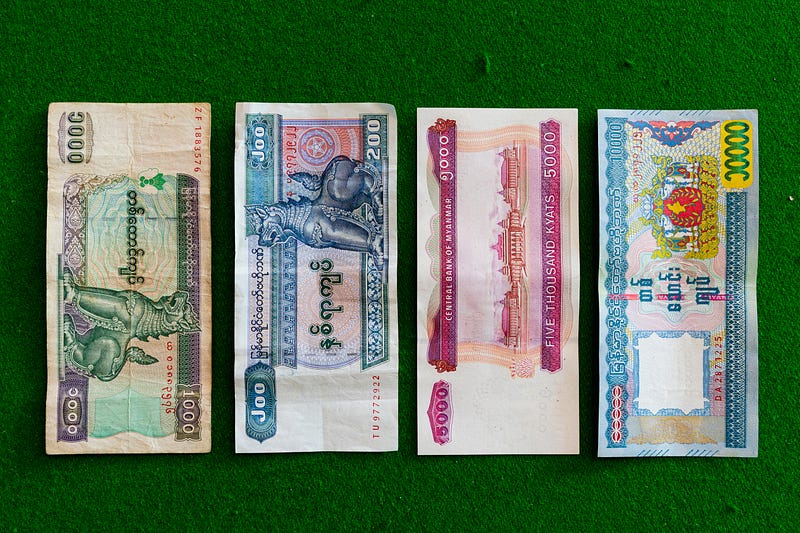
Photo by Dan Gold on Unsplash


July soft launch

A soft launch of the SDB is scheduled for July 22, with 1,000 private beta users and 100 relationship managers. The bank expects to achieve a full launch in late August, with the goal of attracting 100,000 active users within the first six months of operation.

Despite these regulatory challenges, Myanmar’s people have turned to cryptocurrencies as an escape from their dire financial situation. Since the February 2021 coup, the country’s economy has suffered significantly, with the World Bank estimating an alarming 18% annual contraction. Fading trust in the traditional banking system, controlled by the military, has further crippled the financial market.

The Myanmar kyat (MMK) plummeted to an all-time low of 2,200 against the US dollar (USD) in September 2021, down from 1,330 in February 2020 (currently 1 USD = 2,100 MMK).

The SDB’s arrival signals a glimmer of hope amidst these trying times, offering a beacon of financial opportunity for the citizens of Myanmar. With the support of the NUG, the bank is looking to take an innovative approach to better serve Burmese citizens, both at home and abroad.


More to Read
View All
Web3 & Enterprise·

Aug 23, 2023

Coinone Boosts Crypto Account Security with Naver Two-Factor Authentication

Coinone Boosts Crypto Account Security with Naver Two-Factor AuthenticationCoinone, one of South Korea’s leading crypto exchanges, announced on Wednesday that it has added Naver as another channel for two-factor authentication (2FA) when signing up for an account. This move aims to enhance security and convenience for users by introducing another option for the second step of authentication in addition to KakaoTalk and one-time password (OTP) authentication.Photo by Franck on UnsplashCombatting social engineering attacks“As the popularity of investing in virtual assets is on the rise, attempts to gain unauthorized access to accounts through smishing and phishing have also increased. We hope that users can use Coinone services in a safer, more convenient manner by using Naver as an easy authentication channel,” said Cha Myunghun, CEO of Coinone.All users are required to go through 2FA when signing up for a Coinone account in order to simultaneously protect their credentials and conduct deposits, withdrawals, and transactions. Users must verify themselves with their phone number first, then once more through an additional channel like KakaoTalk, Naver, or OTP authentication.Using KakaoTalk or Naver is easy and convenient since most Koreans already have both of these apps on their phones, and it takes a relatively short amount of time to complete.Extra benefitsUsers can register for Naver authentication on both the Coinone website and the app. Once they do, they can verify themselves through the Naver app without a separate login. These users can be granted more benefits such as increased withdrawal limits, the exchange said. Those who have verified their bank accounts for storing Korean won can have a withdrawal limit of up to 500 million won (approximately $373,000).

news
Web3 & Enterprise·

Sep 22, 2023

Korean Metaverse Platforms Face Uncertain Future Amidst Mounting Challenges

Korean Metaverse Platforms Face Uncertain Future Amidst Mounting ChallengesSeveral Korean metaverse platforms, which had promised to usher in a new world bridging online and offline experiences, have found themselves in premature jeopardy, according to industry observations. Various companies that had earmarked metaverse platforms as their future growth driver failed to establish an effective revenue structure to bring this to fruition, leading to speculation that there are limits to successfully developing this branch of business.Photo by GuerrillaBuzz on UnsplashDwindling popularityMetaverse platforms first garnered significant attention during the COVID-19 pandemic, but interest has waned since then — in Google Trends, the keyword “metaverse” has been showing a clear decline since reaching its peak in November of 2021.The actual usage rates of such platforms have also been low. According to the Korea Information Society Development Institute, last year’s usage rate was a mere 4.2%, and some local government-funded platforms had only about 200 daily visitors despite considerable budget sizes.As a result, companies struggling with financial difficulties have opted to downsize their operations, strategizing for mid- to long-term approaches to improving efficiency until an era of metaverse popularization arrives.Roadblocks for small and large companies alikeAccording to industry sources on Friday, platforms like Cytown, developed by social networking space Cyworld, have shut down after just a year, while Kakao Games’ collaborative metaverse venture Colorverse and Com2us Group’s Com2Verse have entered into restructuring phases.Com2verse’s decision comes just two months after the official release of its all-in-one metaverse platform. The company plans to provide three months’ salary to those applying for voluntary resignation and prioritize hiring new faces when expanding the workforce in the future. The scale of voluntary resignation has not been disclosed.The restructuring process will affect all employees except those involved in core functions such as development and services. Employees opting for voluntary resignation will also have the option to transfer to other subsidiaries under Com2us Group.Founded in April of last year, Com2Verse recorded an operating loss of KRW 8.3 billion (approximately $6.2 million) in the first half of this year. Its parent company, Com2us, also recorded consecutive deficits, starting with an operating loss of KRW 19.4 billion in last year’s fourth quarter, followed by losses of KRW 14.8 billion and KRW 5.6 billion in this year’s first and second quarters, respectively. Despite maintaining a stable revenue in its game business, the company faced challenges due to the poor performance of its subsidiary companies and the mounting labor costs needed for accelerating new business endeavors.Com2us has thus determined that it would be difficult to boost revenue and improve cost structure in the short term. Hence, the company chose to restructure its organization while retaining key personnel working under the Convention Center, an event platform on Com2Verse, which is expected to drive the business forward.Com2us emphasized that its commitment to the metaverse market remains unchanged, stating, “Given the current situation of local and international metaverse industries, we believe that significant time and investment will always be necessary. Therefore, we have decided that choosing our priorities and focusing on them is the best way to respond to long-term market changes.”Similarly, Kakao Entertainment had signed a memorandum of understanding (MOU) last year with Neptune, a game developer in which Kakao Games owns a 35% share, and Colorverse, a metaverse company in which Neptune owns a 44% share, to jointly work on an open three-dimensional metaverse platform also called Colorverse. However, Colorverse has also undergone restructuring since earlier this year to reduce its workforce after it posted an operating loss of KRW 11.5 billion last year.Industry analysts have attributed Colorverse’s business slump to the departure of Namkoong Whon, the former CEO who had pinned his hopes on a metaverse as one of the conglomerate’s promising enterprises.Korean game developer NCSOFT had also said that it is building its own metaverse platform dubbed “Miniverse,” which allows various types of online gatherings from community meetups and study groups to remote classes and work. The company had even conducted a welcome presentation for new employees through Miniverse, but news regarding the project has been scant since then.As these major corporations have been struggling to overcome such hurdles, smaller startups have undoubtedly been facing increasingly dire circumstances as well, with some even resorting to unexpected suspensions of service operations without prior notice. Others have promoted themselves as metaverse platforms and issued virtual assets that can be used within the virtual world, but in many cases, these assets have proven to be of little benefit or use.“A revenue structure that can generate income from metaverse platforms has not yet been established. With the gradual decline in remote education, meetings, and telecommuting after the easing of the pandemic, the value of metaverse platforms has also decreased. Also, factors like increased information technology (IT) labor costs and the overall state of the global economy are influencing business momentum,” an industry insider commented.

news
Web3 & Enterprise·

Aug 22, 2023

Blockchain Experts from Ethereum, Solana, and More to Visit Seoul for Upbit D Conference

Blockchain Experts from Ethereum, Solana, and More to Visit Seoul for Upbit D ConferenceDunamu, the fintech company operating South Korea’s leading crypto exchange Upbit, has unveiled the lineup of international speakers for the upcoming sixth annual Upbit D Conference (UDC). Scheduled to take place on November 13, the conference will bring together global blockchain specialists from notable projects like Ethereum and Solana to explore the latest trends and insights in the industry as well as future prospects.Photo by Terren Hurst on UnsplashThe roster of speakers includes renowned figures such as Tom Teman, Product Manager at Ethereum Foundation; Roger Ver, Founder of Bitcoin.com; and Wally Yu, Solutions Architect at Chainlink Labs. Korean speakers, such as Sehyeon Oh, Executive Vice President of telecommunications giant SK Telecom, are also set to attend.Empowering Korea’s blockchain landscapeSince its inception in 2018, UDC has grown to become Korea’s central blockchain conference. Conceived as a means to contribute to the domestic blockchain ecosystem without focusing on generating profit, the conference has consistently garnered praise for its in-depth presentations from global experts and a wide variety of sessions.Under the theme coined “All That Blockchain,” this year’s conference is open to anyone interested in blockchain, Dunamu said. The “D” in UDC stands for various keywords related to blockchain, including digital assets, decentralization, and developers. However, the focus of the conference has evolved beyond just technology, now encompassing areas such as policy, finance, technology, culture, and societal trends.Event detailsThe conference will be conducted in a hybrid — both online and offline — format, allowing a higher level of participation without the constraints of time and place. Though it will be hosted at the Grand Walkerhill Seoul hotel, anyone anywhere can tune in live through the official UDC YouTube channel. Simultaneous interpretation will also be provided in Korean and English.Dunamu will kick off registrations for both online and offline attendance starting from 10:00 AM KST on September 11. Due to the limited venue capacity, offline tickets will be available on a first come, first served basis.

news
Loading