Top

Coinone’s recent addition of USDT/KRW trading pair expected to reduce Kimchi premium

Markets·December 01, 2023, 9:01 AM

Coinone, a major South Korean cryptocurrency exchange, listed USDT, a stablecoin pegged to the US dollar on the platform’s Korean won-denominated market on Thursday (local time). Its listing price was KRW 1,289.

Tether Limited, the company behind USDT, asserts that their stablecoin is “backed 100% by Tether’s reserves.” These reserves comprise a variety of real-world assets such as U.S. Treasuries, overnight reverse repurchase agreements, corporate bonds and precious metals. According to CoinMarketCap, USDT’s market capitalization stands at $89 billion, ranking it third in the cryptocurrency market, just behind Bitcoin and Ethereum.
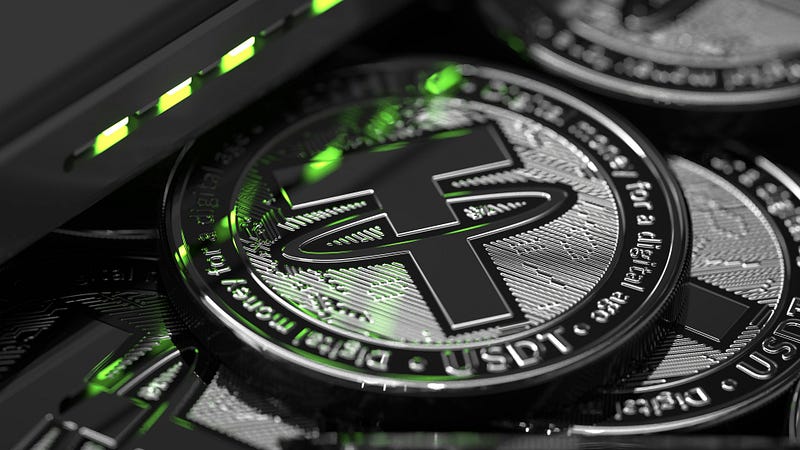
Photo by DrawKit Illustrations on Unsplash


First to list USDT/KRW trading pair

Despite the significance of USDT in the cryptocurrency market, Korean exchange users have faced the limitation of not being able to purchase the stablecoin using Korean won, although these exchanges did offer markets denominated in USDT. This limitation has prompted Koreans to turn to foreign cryptocurrency services for acquiring USDT. With Coinone’s latest move, the platform has become the first to facilitate USDT/KRW trading among the nation’s five fiat-to-crypto Korean exchanges — Upbit, Bithumb, Coinone, Korbit and Gopax.

Regarding this development, Kwon O-hoon, Managing Partner at the law firm Cha and Kwon, told local news outlet Decenter that there seem to be no particular legal concerns with the crypto exchange’s engagement in USDT transactions. This perspective stems from the absence of stablecoin regulations in the country.


Reducing the Kimchi premium

According to Decenter, crypto experts anticipate that the introduction of USDT/KRW trading will help in reducing the Kimchi premium, a term referring to the discrepancy in cryptocurrency prices on South Korean exchanges compared to those in foreign exchanges.

For instance, according to data from CoinNess, the average price of BTC on Korean exchanges is around KRW 51,177,250. This is about 2.34% higher than its average price on foreign exchanges, which stands at KRW 50,005,909. This difference means that users on Korean exchanges need to pay an additional KRW 1,171,340 to buy one BTC, compared to what they would pay on international platforms.

However, the newly added trading pair will streamline transactions between exchanges, making it simpler for investors to engage in arbitrage. This ease of transfer is expected to lead to more balanced pricing across different markets, reducing the Kimchi premium.

In light of this development, Jo Dong-hyeon, CEO of blockchain company Undefined Labs, said various institutions and blockchain projects will likely find USDT increasingly useful as a store of value, given USDT facilitates easy transfers between different exchanges.

More to Read
View All
Policy & Regulation·

Jan 14, 2025

Indian Railways to issue NFT train tickets for world’s largest religious festival

Indian Railways (IR), the state-owned manager of India’s railway network, plans to issue non-fungible token (NFT)-based train tickets to transport pilgrims to Maha Kumbh Mela, the world’s largest religious festival. The Hindu festival is of particular significance given that it only occurs once every 144 years. ChainCode Consulting partnership According to a report published by Indian news outlet Pune.news on Jan. 13, IR has collaborated with ChainCode Consulting, a Bangalore-headquartered enterprise blockchain development and consulting firm, to provide the digital tickets. The Polygon blockchain has been chosen as the network upon which the NFT tickets will be minted. The tickets will then be made available to end users via NFTtrace, a real-world assets (RWA) tokenization and traceability platform run by ChainCode Consulting.Photo by Choong Deng Xiang on UnsplashLong-running collaborationService users and railway personnel will be free to check the validity of tickets on the public blockchain. This announcement is just the latest installment of a long-running collaboration between ChainCode Consulting and IR. In March 2024, a similar project was pursued by both parties. On that occasion, the collaboration involved the release of a series of NFT tickets for use on a train line running from Lucknow, the capital of the Indian state of Uttar Pradesh, to the Indian capital, New Delhi.  In that instance, NFTs were minted on the Hyperledger blockchain. A previous collaboration, earlier in 2024, saw NFTs minted on Polygon for digital tickets covering journeys to the sacred Hindu city of Ayodhya. Commenting on the choice of Polygon relative to this latest collaboration, Alok Gupta, CEO of ChainCode Consulting, stated: “By partnering with IRCTC and leveraging the Polygon blockchain, we are enabling a digital-first experience that complements the spiritual and traditional significance of the Mahakumbh while introducing a new level of engagement through NFTs.” Polygon is an Ethereum ecosystem scaling network. With that, it has fast throughput and low gas fees and it's on this basis that it’s understood that Polygon was chosen in this instance. Aishwary Gupta, global head of payment and fintech at Polygon Labs, the key developer behind the Polygon blockchain, told Cointelegraph that public blockchains are playing an important role in doing away with middlemen and intermediaries.  The Polygon Labs executive stated that at both state and central government levels in India, Polygon has been used on a number of projects. He added: ”With its low cost and high throughput, we are sure that the NFTs being issued around Maha Kumbh Mela would be yet another great success.” $94 billion market opportunityTicketing remains one of the proposed use cases for blockchain technology that has the potential to gain traction. That potential hasn’t gone unnoticed by ticketing industry leader Ticketmaster. In 2023 the company rolled out token-gated ticket sales. The feature enables artists to reward fans who hold NFTs with access to exclusive pre-sale events, prime concert seating and many other incentives and rewards. NFT technology offers a solution to a number of issues experienced within the events industry, including ticket scalping, fake tickets and security issues. The live events business is a $94 billion industry, underscoring the opportunity available to be exploited by innovative NFT-based ticketing startups. 

news
Web3 & Enterprise·

Mar 14, 2024

OKX and KuCoin lead $9M investment into UXLINK

UXLINK, a Web3 social network headquartered in Singapore, has announced a successful funding round raising $9 million, supported by a mix of private crypto and publicly listed companies including OKX and KuCoin. UXLINK announced details of the funding round in a social media post published to X on March 13. The startup, known for its innovative approach to social networking merging with transactions, has seen its user base grow to 3.5 million users. Among the investors contributing to this round are OKX Ventures, Web3Port Foundation, Cypher Capital, KuCoin Ventures, Gate Labs and Matrixport Ventures. ZhenFund, 7UPDAO, Signum Capital, ECV and GGV Capital were also participants. In a blog post Dora Yue, Founder of OKX Ventures, expressed enthusiasm about UXLINK's concept, stating:"This innovative concept merges social networking and transactions, creating a robust ecosystem where people can fully leverage their digital assets."Photo by Towfiqu barbhuiya on UnsplashAcquaintance-based social networkingYue described UXLINK as a game-changer in the field of Web3 social infrastructure. The project differentiates itself by relying on acquaintance social networking. Other Web3 social protocols such as Farcaster, Nostr, Cyberconnect and Lens Protocol are structured around one way follower relationships between key opinion leaders (KOLs) and followers. By contrast UXLINK takes a different approach, building a social network by placing emphasis on the existing social relationships of users with acquaintances. The idea is that real-life acquaintances are established through trust and implicate a much deeper personal connection by comparison with opinion leaders and followers. Speaking to that unique approach, pseudonymous crypto trader and investor Bull Flash stated on X on March 13: “Forget one-sided connections! UXLINK focuses on REAL-WORLD social interactions. Users can connect with each other AND with dApps in real-time through innovative Groups – a game-changer for web3. UXLINK is more than just a platform – it's a MOVEMENT.” Potential for further fundingWhile the exact valuation post-funding remains undisclosed, UXLINK indicated a potential for further funding rounds before its token generation event, signaling continued investor interest in its growth trajectory. With the freshly secured capital, UXLINK aims to introduce the "Social Liquidity Chain," leveraging Optimism and EigenDA technologies to support third-party developments. This initiative is expected to enhance the platform's capabilities and foster a more dynamic user experience. Since its establishment in April 2023, UXLINK has seen rapid adoption, hosting more than 75,000 decentralized groups. The vast majority of its users are located in Southeast Asia, the Middle East, Europe, South Asia and Africa. The platform's unique approach to social finance, facilitated by its Web3 "UXGroups” on Telegram, emphasizes bridging real-world trust dynamics with decentralized applications. In addition to being an investor in the company, last month the OKX Wallet was integrated with UXLINK in an effort to improve user experience, allowing UXLINK users to manage their Web3 assets more efficiently. UXLINK's successful funding round underscores growing investor confidence in the potential of Web3 social networks and belief in their ability to revolutionize traditional social interactions and financial transactions. As the platform continues to expand and innovate, it is positioning itself to make further strides in reshaping the landscape of digital social interactions and finance. 

news
Policy & Regulation·

Apr 09, 2025

DLD partners with regulator in Dubai to integrate tokenized property

The Dubai Land Department (DLD), a government agency responsible for the registration of real estate in Dubai and the promotion of real estate investments, has signed an agreement with the Virtual Assets Regulatory Authority (VARA), a local regulator, to better integrate tokenized real estate within existing systems. In a statement published on the DLD website on April 6, the government agency set out further details on the collaboration. The purpose of the agreement is to better accommodate fractional ownership of Dubai real estate through tokenization. Photo by Precondo CA on UnsplashLinking fractional ownership to DLD registryTo that end, a governance system will be put in place in order to link the DLD’s land and property registry with tokenized, fractional ownership of property. The parties believe that this approach will lead to greater operational efficiency for stakeholders such as property management firms. Furthermore, greater accommodation of tokenized ownership will lead to enhanced liquidity within the Dubai real estate market.  As a consequence of this improved liquidity and facilitating a more seamless approach in terms of operational efficiency for property management firms, it’s believed that a greater share of global investment in local real estate can be achieved. Broadening the investor baseFractional ownership via tokenized real estate opens the market up to a broader range of potential investors. On this basis, the collaboration can play a role in contributing towards the objectives of Dubai’s Real Estate Strategy 2033, which sets out to boost the local property sector’s contribution towards gross domestic product (GDP). That initiative targets a real estate market value of AED 1 trillion ($272 billion). The DLD said that the initiative also feeds into the broader objectives of the Dubai Economic Agenda (D33), a ten-year plan that has been set out to double Dubai’s economy by 2033, through focusing on innovation, achieving competitiveness at a global level and sustainable growth. Helal Almari, the director general of Dubai’s Department of Economy and Tourism, commented on the partnership, stating that it reflects the future-focused innovation, which he claims Dubai has already become associated with. He added: “Real Estate and Virtual Assets are key pillars of the D33 Economic Agenda D33 and by joining forces DLD and VARA will be creating the blueprint for RE 2.0 in a Decentralised Future Economy.” Almari expressed the belief that putting legal safeguards in place to recognize fractional ownership rights where real estate is concerned will facilitate “more inclusive economic participation” in this market sector.  The DLD recently launched a real estate tokenization pilot project in collaboration with VARA and the Dubai Future Foundation (DFF). At that time, DLD Director General Marwan Ahmed Bin Ghalita recognized the potential that tokenization can bring to the real estate sector. He stated: “By converting real estate assets into digital tokens recorded on blockchain technology, tokenization simplifies and enhances buying, selling, and investment processes.”Last month, Scott Thiel, founder and CEO of Dubai-based real-world asset (RWA) token marketplace Tokinvest, outlined that RWA asset tokenization in the United Arab Emirates (UAE) is gaining momentum. Commenting on this latest development, Thiel said that it’s a demonstration that “the future of real estate investment is onchain.”

news
Loading