Top

MUFG pushes into tokenized finance as Japan enters a new political chapter

Web3 & Enterprise·October 10, 2025, 8:08 AM

Japan’s largest bank is stepping deeper into digital assets at a moment of political change. Mitsubishi UFJ Financial Group (MUFG) and its securities arm Mitsubishi UFJ Morgan Stanley Securities (MUMSS) have launched a blockchain-based business, according to CoinDesk Japan. The move puts the country’s biggest lender at the center of a fresh push to bring regulated finance onto distributed ledgers while retail investors gain a new way to buy and trade tokenized products.


MUMSS has begun offering bond security tokens, marking its formal entry into the security token market. At the same time, the firm introduced ASTOMO, a trading venue for retail investors built with Japanese fintech company Smartplus. The system will debut with real estate-backed security tokens. Individuals can invest from 100,000 yen (about $655) through a smartphone app. Under the partnership MUMSS will select and source the digital securities. Smartplus will run account management and build and operate the trading system using its Brokerage as a Service (BaaS) platform.


MUFG also revealed that it has started preparing a public offering of subordinated bonds in token form. The bank intends the instruments to qualify as Tier 2 capital under international rules. The offering is expected to be the first of its kind for Japan’s banking sector. MUFG has submitted an amended securities registration statement to the Director General of the Kanto Local Finance Bureau in advance of the sale.

https://asset.coinness.com/en/news/be06f1046e701aec74df006d47cae03e.webp
Photo by Asm Arif on Pexels

Takaichi’s victory sparks interest in Japan’s crypto path

The corporate steps arrive as conservative lawmaker Sanae Takaichi rises to lead the ruling Liberal Democratic Party. She won the party election on Oct. 4 and is set to become Japan’s first female prime minister, with lawmakers expected to make the formal choice in the middle of this month. 


Several industry voices see her leadership as supportive of digital assets, according to Cointelegraph. Elisenda Fabrega, general counsel at tokenization platform Brickken, said Takaichi’s victory might reshape how Japan perceives and regulates digital assets, reinforcing the country’s commitment to clear and reliable crypto laws.


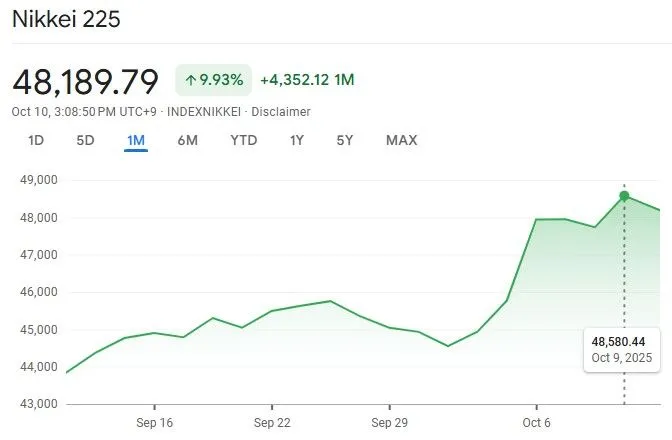
Maarten Henskens, chief operating officer at Startale Group and head of the Astar Foundation, chimed in to say that a looser monetary stance under Takaichi could keep liquidity flowing and drive greater investor interest in alternative assets such as cryptocurrencies. That optimism has already spilled into Japan’s equity markets. The Nikkei index has continued to soar since the leadership vote, reaching a record high of 48,580.44 on Oct. 9.


Not all signals point in the same direction. A BeInCrypto report published before the election noted market predictions that Takaichi might also back tighter oversight. The report cited her March proposal to build a framework that lets financial institutions, including crypto exchanges, share information on suspicious transactions. That system would support faster account freezes.
https://asset.coinness.com/en/news/6e7246730a2833f909aa086f96680fe2.webp
 Nikkei 225 Index Source: Google Finance

Loose fiscal tone brings new pressures for Bitcoin

From a broader economic view, the picture looks more complex. CoinDesk reported that Takaichi’s preference for easy Abenomics-style policies could weigh on Bitcoin in the short term. Expansionary fiscal measures tend to increase bond supply and drive yields higher, which often curbs risk appetite by raising borrowing costs and making assets like stocks and cryptocurrencies less appealing. Her stance has also reduced expectations for a Bank of Japan rate hike, weakening the yen and strengthening the U.S. dollar. The stronger dollar has cooled Bitcoin’s momentum, while gold has continued to attract investors seeking stability.


MUFG’s blockchain venture arrives at a turning point for Japan. The bank’s push into tokenized assets shows how traditional finance is adapting to digital change just as new leadership tests the balance between innovation and control. Whether this marks the start of a broader transformation will depend on how policy, regulation, and investor confidence evolve together in shaping Japan’s financial future.

 

More to Read
View All
Markets·

Jan 09, 2024

Philippines leading charge in Asia amid global bitcoin payment surge

Bitcoin's global merchant acceptance witnessed a substantial surge, growing by 174% throughout 2023, with the Philippines proving itself in leading the way within the Asian region.Photo by rc.xyz NFT gallery on UnsplashRegion facing regulatory restrictionsThat’s according to BTC Map, a provider of bitcoin merchant mapping services. The data, derived from BTC Map's open-source mapping data via OpenStreetMap, revealed that the number of venues accepting bitcoin payments surged from 2,207 at the beginning of the year to 6,126 by the year's end. This diverse array of businesses included restaurants, bars, shops and various services. The expansion of bitcoin vendors is a global phenomenon, with concentrations notably observed in Europe, the United States and Latin America. The Philippines stands out in Asia with hundreds of vendors, while regulatory restrictions in East Asia, especially China, have limited adoption. While it's great to see a high level of direct adoption among Filipino merchants, it's easy to understand why this level of adoption hasn’t been matched within Asia’s largest market. China has had a long-standing ban on cryptocurrency trading, mining or its use as a means of payment. Despite the ban, it appears that crypto trading is still alive and well in China, although beneath the surface. With mining too, while the sector shrank considerably once a ban was imposed, there is believed to be a significant ongoing level of bitcoin mining occurring still within China’s borders. However, when it comes to vendors, this is likely to be an activity that is far too visible to the authorities and with that, China’s 1.4 billion citizens are not getting the opportunity to buy goods and services with the world’s leading cryptocurrency. Compounding matters, the Chinese authorities have been working diligently on a myriad of projects to bring about day-to-day retail use of the country’s central bank digital currency, the digital yuan. Those efforts are not likely to be aligned with an accommodation of or tolerance of bitcoin payments. The increase in merchant listings showcased a slight decline from the peak in September, which reached 6,590 merchants. BTC Map's platform allows businesses and users to tag locations accepting bitcoin payments, with the rise in numbers potentially attributed to increased user contributions to the database. This surge in bitcoin adoption globally occurred against the backdrop of the cryptocurrency's price volatility throughout the year. Despite potential limitations in data collection due to its reliance on volunteer contributions, the overall trend indicates a growing acceptance of bitcoin. Ongoing challenges to adoptionA panel of bitcoin leaders at the Plan B conference in October discussed the challenges and opportunities of global bitcoin adoption. Notably, they highlighted the difficulty of onboarding new users and merchants, particularly in diverse cultural contexts. In El Salvador, where bitcoin is legal tender, obstacles persist in convincing merchants to accept bitcoin payments. Geographically, concentrations of bitcoin-accepting vendors were more prevalent in Central and South America, while Africa and Asia demonstrated fewer such establishments. The United States and Europe led in the global count of crypto-friendly merchants. The panel stressed the importance of education in overcoming these challenges, emphasizing the need for user-friendly applications to facilitate mainstream adoption, moving away from complex technologies. As bitcoin continues its global expansion, the industry recognizes the vital role education and user-friendly solutions play in fostering broader acceptance. 

news
Policy & Regulation·

Sep 19, 2023

JPEX Exchange Scandal Sees Crypto Regulation Under Scrutiny in Hong Kong

JPEX Exchange Scandal Sees Crypto Regulation Under Scrutiny in Hong KongWhile Hong Kong has been developing steadily as a crypto sector hub, the focus in the Chinese autonomous territory has turned towards regulation after a recent scandal involving an unlicensed cryptocurrency exchange.Photo by Ihor Saveliev on UnsplashOngoing investigationYesterday we reported on some arrests relative to problems experienced at crypto exchange JPEX. The fallout continues on Tuesday, with the Hong Kong police now understood to have arrested eight individuals, including social media influencers who promoted the exchange and JPEX employees, on allegations of fraud. This illicit activity in and around the JPEX exchange has affected over 1,600 investors, implicating more than $150 million in assets.JPEX, in response to mounting pressure, announced the suspension of trading on its platform. In a statement, the exchange mentioned ongoing negotiations with third-party market makers to address liquidity shortages. However, JPEX also accused an unidentified third-party market maker of maliciously freezing funds, further complicating the situation.Politicians and regulators speak outResponding to the incident via a press conference on Tuesday, Hong Kong’s Chief Executive, John Lee, emphasized the significance of investing in virtual assets through licensed platforms. Lee stated:“This incident highlights the importance that when investors want to invest in virtual assets, then they must invest on platforms that are licensed.” He also pledged that the Securities and Futures Commission (SFC) would closely monitor the situation to ensure investor protection.Elizabeth Wong, the Head of the SFC’s fintech unit, revealed that an investigation was underway to determine whether JPEX had violated anti-money laundering laws. The SFC had already declared JPEX unlicensed, prompting numerous complaints from investors who were unable to withdraw their virtual assets or experienced unexplained reductions in their balances.Assets frozenHong Kong authorities have taken decisive action against those involved in the scandal. They have frozen bank accounts valued at 15 million Hong Kong dollars ($1 million) and seized three properties valued at 44 million Hong Kong dollars. The police have reported receiving 1,641 complaints related to JPEX, involving a staggering $1.2 billion Hong Kong dollars. By last Wednesday, the SFC had received in excess of 1,000 complaints and at that point, they notified the general public.The JPEX scandal has drawn attention to the need for stronger cryptocurrency regulations in Hong Kong, a region that has become attractive to cryptocurrency firms since mainland China banned cryptocurrency transactions in 2021. In mainland China, trading cryptocurrencies on foreign exchanges from within the country remains illegal.Hong Kong’s response to cryptocurrency regulation has evolved. Beginning on June 1, the SFC started accepting applications from cryptocurrency exchanges, allowing licensed operators to serve retail investors, provided they understand the associated risks. Previously, only professional investors had access to such exchanges. Currently, only two exchanges in Hong Kong, OSL Exchange and Hashkey Exchange, have received approval to operate.As Hong Kong reevaluates its approach to cryptocurrency regulation, the crypto sector will hope that it strikes a balance between fostering innovation and protecting investors from fraud and market manipulation.

news
Web3 & Enterprise·

Jul 07, 2023

Korea Fintech Industry Association Establishes Council for Security Tokens

Korea Fintech Industry Association Establishes Council for Security TokensThe Korea Fintech Industry Association (KORFIN) has recently held a successful kickoff meeting to launch the Fintech Council for Security Tokens. Comprised of 18 members specializing in security token-related fields, including blockchain technology and fractional investments, the council aims to expand its membership by inviting more enterprises interested in security token projects.Current participants in the council include The Seed Partners, a venture capital firm; Lucentblock, a blockchain-based real estate securities platform provider; and Leadpoint System, a blockchain tech developer.Photo by Ethan Brooke on UnsplashActivities for ecosystem growthThe purpose of the council is to foster the growth of the security token ecosystem by undertaking various activities. These activities encompass engaging in discussions to strengthen the security token industry, conducting research on policy development, and seeking expert consultations.Promoting innovationLee Keun-ju, the President of KORFIN, expressed the association’s commitment to supporting fintech companies in realizing their innovative ideas in the industry. In line with this commitment, KORFIN will organize a range of events, including educational courses and seminars, to facilitate knowledge sharing and enable fintech companies to establish valuable business network connections.Growing enthusiasmSince the Korean Financial Services Commission (FSC) authorized the issuance and trading of security tokens in February, the interest in security tokens has gained momentum within the country. This growing enthusiasm aligns with the global trend, as highlighted in a 2022 report by Boston Consulting Group (BCG) and Singaporean investment platform ADDX, which projected that the global market for illiquid tokenized assets would hit $16 trillion by 2030.

news
Loading