Top

MUFG pushes into tokenized finance as Japan enters a new political chapter

Web3 & Enterprise·October 10, 2025, 8:08 AM

Japan’s largest bank is stepping deeper into digital assets at a moment of political change. Mitsubishi UFJ Financial Group (MUFG) and its securities arm Mitsubishi UFJ Morgan Stanley Securities (MUMSS) have launched a blockchain-based business, according to CoinDesk Japan. The move puts the country’s biggest lender at the center of a fresh push to bring regulated finance onto distributed ledgers while retail investors gain a new way to buy and trade tokenized products.


MUMSS has begun offering bond security tokens, marking its formal entry into the security token market. At the same time, the firm introduced ASTOMO, a trading venue for retail investors built with Japanese fintech company Smartplus. The system will debut with real estate-backed security tokens. Individuals can invest from 100,000 yen (about $655) through a smartphone app. Under the partnership MUMSS will select and source the digital securities. Smartplus will run account management and build and operate the trading system using its Brokerage as a Service (BaaS) platform.


MUFG also revealed that it has started preparing a public offering of subordinated bonds in token form. The bank intends the instruments to qualify as Tier 2 capital under international rules. The offering is expected to be the first of its kind for Japan’s banking sector. MUFG has submitted an amended securities registration statement to the Director General of the Kanto Local Finance Bureau in advance of the sale.

https://asset.coinness.com/en/news/be06f1046e701aec74df006d47cae03e.webp
Photo by Asm Arif on Pexels

Takaichi’s victory sparks interest in Japan’s crypto path

The corporate steps arrive as conservative lawmaker Sanae Takaichi rises to lead the ruling Liberal Democratic Party. She won the party election on Oct. 4 and is set to become Japan’s first female prime minister, with lawmakers expected to make the formal choice in the middle of this month. 


Several industry voices see her leadership as supportive of digital assets, according to Cointelegraph. Elisenda Fabrega, general counsel at tokenization platform Brickken, said Takaichi’s victory might reshape how Japan perceives and regulates digital assets, reinforcing the country’s commitment to clear and reliable crypto laws.


Maarten Henskens, chief operating officer at Startale Group and head of the Astar Foundation, chimed in to say that a looser monetary stance under Takaichi could keep liquidity flowing and drive greater investor interest in alternative assets such as cryptocurrencies. That optimism has already spilled into Japan’s equity markets. The Nikkei index has continued to soar since the leadership vote, reaching a record high of 48,580.44 on Oct. 9.


Not all signals point in the same direction. A BeInCrypto report published before the election noted market predictions that Takaichi might also back tighter oversight. The report cited her March proposal to build a framework that lets financial institutions, including crypto exchanges, share information on suspicious transactions. That system would support faster account freezes.
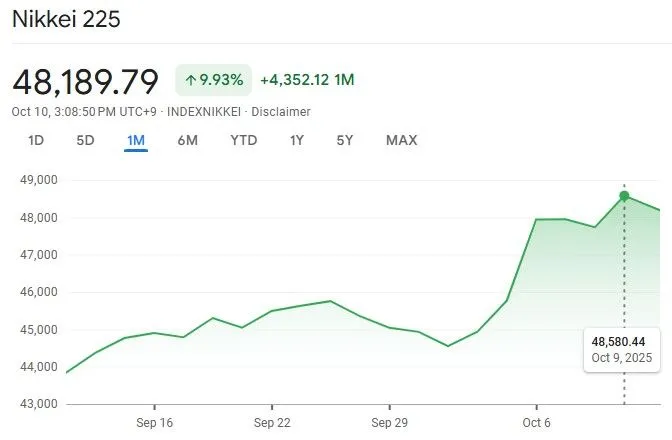
https://asset.coinness.com/en/news/6e7246730a2833f909aa086f96680fe2.webp
 Nikkei 225 Index Source: Google Finance

Loose fiscal tone brings new pressures for Bitcoin

From a broader economic view, the picture looks more complex. CoinDesk reported that Takaichi’s preference for easy Abenomics-style policies could weigh on Bitcoin in the short term. Expansionary fiscal measures tend to increase bond supply and drive yields higher, which often curbs risk appetite by raising borrowing costs and making assets like stocks and cryptocurrencies less appealing. Her stance has also reduced expectations for a Bank of Japan rate hike, weakening the yen and strengthening the U.S. dollar. The stronger dollar has cooled Bitcoin’s momentum, while gold has continued to attract investors seeking stability.


MUFG’s blockchain venture arrives at a turning point for Japan. The bank’s push into tokenized assets shows how traditional finance is adapting to digital change just as new leadership tests the balance between innovation and control. Whether this marks the start of a broader transformation will depend on how policy, regulation, and investor confidence evolve together in shaping Japan’s financial future.


 

More to Read
View All
Policy & Regulation·

May 30, 2023

Bybit Gets Outline Approval to Operate in Kazakhstan

Bybit Gets Outline Approval to Operate in KazakhstanBybit, the cryptocurrency spot and derivatives trading platform, is expanding its operations with a recent “in-principle” approval from the Astana Financial Services Authority (AFSA) in Kazakhstan. This approval allows Bybit to operate as a digital asset trading facility and custody services provider at the Astana International Financial Centre (AIFC).Photo by Engin Akyurt on PexelsExpanding area of operationsBen Zhou, the co-founder and CEO of Bybit, expressed his belief in the promising potential of the Commonwealth of Independent States (CIS) region for the growth of the crypto industry. He also emphasized Bybit’s commitment to complying with local regulations, following the recent scrutiny the company faced in Japan for operating without proper registration.To obtain permanent authorization to serve the local market, Bybit must fulfill certain pre-conditions specified in the in-principle approval and complete the application process. In April, it emerged that the company had established its global headquarters in Dubai, where it has already secured “in-principle” approval to operate a virtual assets business. Bybit has also been active in Hong Kong and is in the process of obtaining a license to trade in the Chinese autonomous territory.Debit card and lending servicesAs well as a geographical expansion, in recent months Bybit has also been expanding its service offering. On May 2, the exchange announced the introduction of crypto lending services for its users. This addition allows users to lend and borrow cryptocurrencies through the Bybit platform, providing them with more opportunities to maximize their holdings.Earlier this year, Bybit collaborated with Mastercard to launch a new debit card tailored for cryptocurrency payments. This partnership aimed to bridge the gap between traditional financial systems and the growing crypto ecosystem, allowing users to spend their cryptocurrencies seamlessly in everyday transactions.Kazakhstan’s crypto strategyKazakhstan got off to a difficult start with crypto. Once crypto miners were banished from China, many of them moved operations to Kazakhstan, putting pressure on the local power grid.The local administration has since gotten to grips with the industry, restricting crypto miners’ access to cheap electricity. Bybit’s decision to offer services in Kazakhstan aligns with the country’s current efforts to position itself as a regional hub for crypto, mining, and blockchain.In February, local officials implemented a mandate that requires 75% of revenue generated from crypto mining to be sold through a crypto exchange, with the aim of combating tax evasion.CBDC developmentFurthermore, Kazakhstan has been actively exploring the development of a central bank digital currency (CBDC) and is currently in the pilot phase of its implementation. The introduction of a CBDC can potentially revolutionize the country’s financial landscape, offering faster and more efficient digital transactions while maintaining regulatory oversight.Bybit’s pre-approval in Kazakhstan signifies the company’s strategic expansion into a region with a favorable regulatory environment for cryptocurrencies. As the crypto industry continues to evolve, partnerships between traditional financial institutions and crypto exchanges, like the collaboration between Bybit and Mastercard, demonstrate the increasing integration and acceptance of digital assets in mainstream financial systems.

news
Policy & Regulation·

Jun 02, 2023

Crypto.com Scores MPI License in Singapore

Crypto.com Scores MPI License in SingaporeIn a significant move for the Web3 industry, the Monetary Authority of Singapore (MAS) has granted online crypto trading platform, Crypto.com, a Major Payment Institution (MPI) license. This regulatory development showcases Singapore’s commitment to welcoming innovation and embracing the potential of the Web3 sector.Photo by Timo Volz on PexelsLicensing milestoneCrypto.com made the exciting announcement on Thursday, revealing that it has received the MPI license from the MAS, the country’s central bank and financial regulator. With this license in hand, Crypto.com can now provide its Digital Payment Token (DPT) services to residents of Singapore.This achievement follows the in-principle approvals granted to Crypto.com by the MAS in June of the previous year, further highlighting the company’s adherence to regulatory standards and its dedication to operating within the guidelines set by financial authorities.Community reactionThe news of the license has garnered positive reactions within the crypto community. Many members see the Singaporean government’s decision as a significant endorsement of the Web3 industry. ‘Aravind,’ a Twitter user, expressed this sentiment, stating, “Singapore government giving out a license is itself a massive plus for the Web3 Industry,” adding that it's probable the process to obtain the license has been hard fought, and likely two years in the making.Interestingly, another community member drew comparisons between Crypto.com’s successes and the challenges faced by global crypto exchange, Binance. While Binance has encountered difficulties in various jurisdictions, Crypto.com has been praised for its steady progress and forward-looking approach.Yet another Twitter user chimed in along similar lines, stating: “Whilst Binance seems to be losing ground, Crypto.com seems to be slowly doing things right and building for the future.”Binance has recently faced setbacks, such as its diminishing presence in the Australian and Canadian markets and trading restrictions imposed in certain European countries. Reports have even surfaced suggesting that Binance plans to lay off 20% of its staff in June.However, it’s important to note that Binance has not given up, as evidenced by its recent expansion into Thailand, where it established a regulatory-compliant platform. The exchange has also taken steps to ensure compliance in Japan through the creation of another regulatory-compliant platform.Additional licensesCrypto.com has set up its headquarters in Singapore, and it is in good company there with leading crypto firms Kraken and Coinbase also maintaining offices in the city state. The company has taken a truly global strategy, having marketed heavily in recent years. It maintains offices in nine other locations, including Miami, Dublin, London, Seoul, Malta, Sofia, Hong Kong and Shenzhen, as well as Kadıköy in Turkey.The crypto trading platform has received a Minimal Viable Product (MVP) preparatory license from the Virtual Assets Regulatory Authority (VARA) in Dubai, alongside firms like Komainu, Hex Trust, and GC Exchange. The company has also successfully pursued digital asset licensing in France, Australia, and the United Kingdom.Crypto.com’s acquisition of the MPI license in Singapore marks a significant milestone for the company and the broader Web3 industry. With Singapore embracing innovation and offering a favorable regulatory environment, Crypto.com is well-positioned to continue its growth and contribute to the advancement of the digital payment token ecosystem.

news
Web3 & Enterprise·

Nov 19, 2024

OKX enables zero-fee SGD transfers in Singapore

Seychelles-headquartered global crypto exchange OKX outlined on Nov. 18 that it will offer instant, zero-fee Singaporean dollar (SGD) deposits and withdrawals into and out of the exchange platform for customers resident in Singapore.Photo by Peter Nguyen on UnsplashDBS partnershipIn a press release published by GlobeNewswire on behalf of OKX, the company outlined that it has been in a position to enable this feature for its Singapore-based customers due to a collaboration with Singapore’s largest bank, DBS Bank. OKX Singapore CEO Gracie Lin said that “working with DBS to provide payment rail infrastructure in Singapore provides customers with secure and seamless access to digital assets.” As DBS is one of 27 banks that participate in PayNow, a real-time payment system that falls under the Fast and Secure Transfers (FAST) service in Singapore, OKX customers who are also customers of a bank that participates in the PayNow scheme, can effect those SGD deposits and withdrawals in real time. Lin added that OKX is working towards the addition of more features in an effort to further enhance the customer experience. The new offering takes OKX a step further towards integrating with the local traditional finance system (TradFi).  Singpass integrationAdditionally, the exchange has also integrated Singpass verification. Singpass is a digital identity system that enables Singaporean residents to access private sector and government services online. Back in March, the company acquired in-principle approval (IPA) from the Monetary Authority of Singapore (MAS) in respect of a Major Payments Institution (MPI) license. Continuing that shift towards regulatory compliance, it followed up with the acquisition of a full MPI license from MAS in September. The company is now one of 29 crypto sector firms to have been licensed by MAS in Singapore. While a particular effort has been made in Singapore, OKX has been making similar in-roads elsewhere. Last month, it launched its service in the United Arab Emirates (UAE), having received full licensing from Dubai’s Virtual Assets Regulatory Authority (VARA). Making further progress in October, OKX partnered with UK-headquartered multinational bank Standard Chartered for institutional crypto custody. Both Singapore and the UAE are seen by the company to be strategic crypto hubs. However, its efforts in expanding its offering globally has also taken it into other markets. In February OKX launched OKX TR, a specialized crypto exchange platform catering to the specific needs of the Turkish market. In an emailed response to Reuters, DBS Bank’s Head of Digital Assets, Evy Theunis, commented on its partnership with OKX:”DBS has been actively fostering a responsible and innovative digital asset ecosystem in Singapore for several years now. Working with OKX deepens the bank's wide-ranging involvement in this space." DBS has been following its own path as a pioneering TradFi entity getting further involved in cryptocurrency, blockchain and tokenization. Last month it launched DBS Token Services for institutions, integrating tokenization and smart contracting capabilities within its existing conventional services. 

news
Loading