Live Feed
New
Today, April 20, 2026
07:20
According to CoinNess market monitoring, BTC has risen above $75,000. BTC is trading at $75,016.15 on the Binance USDT market.
07:19
Iran has decided to continue negotiations with the United States, Al Jazeera reported on April 20. Ebrahim Azizi, chairman of the National Security and Foreign Policy Committee of the Iranian Parliament, stated that the decision does not mean Iran will negotiate at any cost. He also emphasized that it does not imply an acceptance of any approach taken by the other side.
07:06
Hong Kong-regulated crypto exchange HashKey is partnering with Shanghai Commercial Bank (SCB) to launch a Visa credit card, HashKey Exchange CEO Livio Weng announced at the Hong Kong Web3 Carnival. The card is the first to be issued by a licensed digital asset exchange in partnership with a bank. Registrations will open on May 11. Payments will be made in fiat currency, with users having the option to make repayments in either cryptocurrency or fiat.
07:03
Binance has announced it will list five new spot trading pairs at 8:00 a.m. UTC on April 21. The new pairs are 币安人生/USDT, 币安人生/USD1, ENJ/USDT, GIGGLE/USDT, and ORDI/USDT.
06:37
An address associated with crypto financial services firm BIT (formerly Matrixport), which had been dormant for one year, withdrew 6,383 ETH ($14.49 million) from OKX, Onchain Lens reported. The address now holds a total of 18,383 ETH ($41.82 million).
06:01
BTC perp long/short ratios on top exchanges by open interest
The following are the 24-hour long/short ratios for BTC perpetual futures on the world’s three largest crypto futures exchanges by open interest:
Overall: 48.59% long, 51.41% short
- Binance: 48.83% long, 51.17% short
- OKX: 48.13% long, 51.87% short
- Bybit: 48.88% long, 51.12% short
05:22
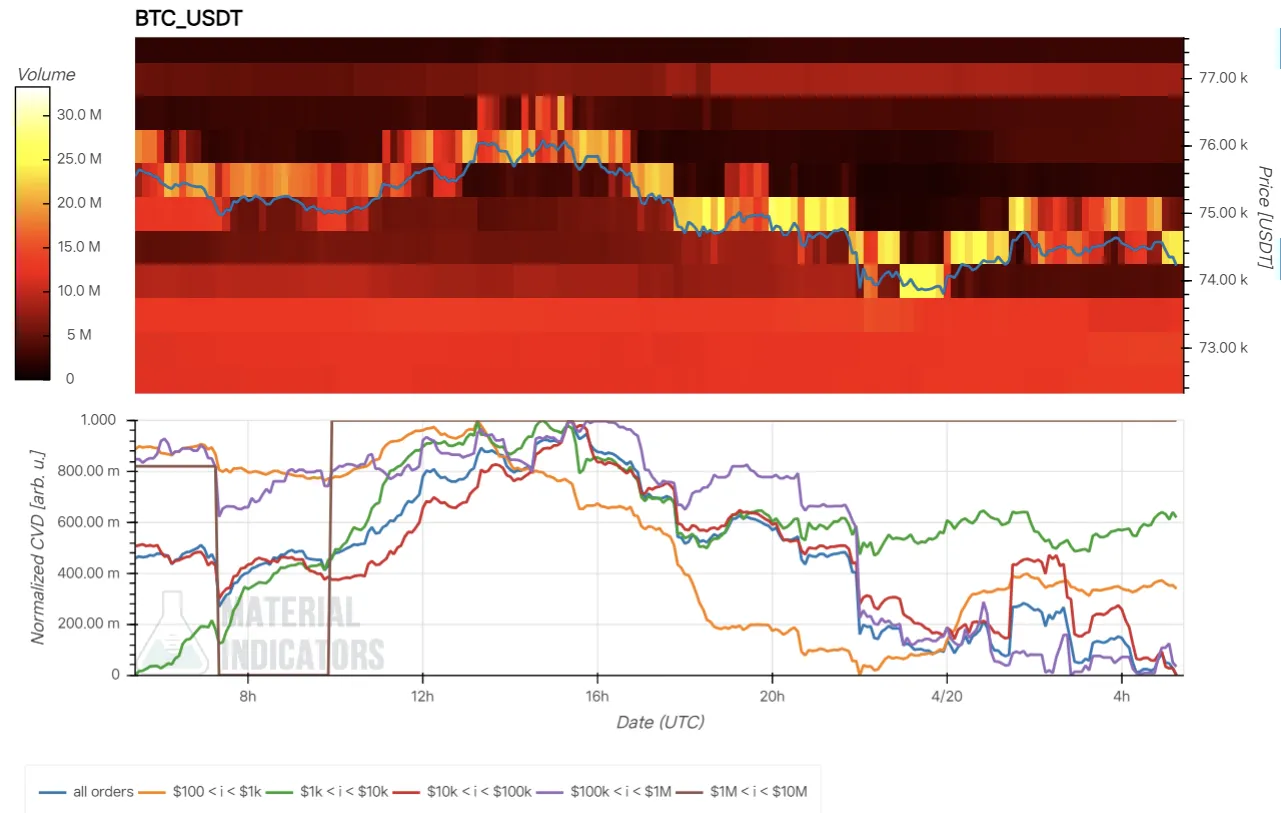
The Spot Cumulative Volume Delta (CVD) chart provides an analysis of the order book for the BTC/USDT spot trading pair. The upper section displays a Volume Heatmap, while the lower section shows the CVD.
- The upper Volume Heatmap tracks the volume of trades at specific price levels. The background color becomes brighter when the price remains in a certain range for an extended period or moves significantly. Brighter-colored areas may act as potential support or resistance levels.
- The lower Cumulative Volume Delta (CVD) indicator represents buy and sell orders categorized by trade size. As buy orders increase, the corresponding colored line rises. The yellow line tracks orders between $100 and $1,000, while the brown line tracks large orders between $1 million and $10 million.
05:12
Ethereum (ETH) founder Vitalik Buterin outlined a four-year roadmap for the network at the Hong Kong Web3 Festival, highlighting enhanced scalability and quantum security as key goals, PA News reported. Short-term tasks include raising the gas limit to improve scalability, extending the EVM with Zero-Knowledge proofs (CKEVM), and supporting smart contract wallets and quantum-resistant signatures via account abstraction.
Buterin added that by 2028, the plan is to reduce transaction finality time to between 10 and 20 seconds and introduce zkVM technology, which would allow even low-spec devices to verify the chain directly. He stressed that Ethereum's fundamental goal is to be the world's most secure and decentralized blockchain, rather than competing on speed with high-frequency trading platforms.
05:02
On-chain analyst ZachXBT, who previously alleged price manipulation in RaveDAO (RAVE), has now turned his criticism to Memecore (M).
On X, he challenged the project to provide data justifying its position as a top-20 cryptocurrency with a $6 billion market capitalization and to explain why insiders hold over 90% of the M supply.
The analyst has recently posted a series of warnings about tokens that have surged in price, such as RAVE, alleging that their teams hold the majority of the supply to manipulate prices. He had previously flagged suspicious price movements in other tokens, including SIREN, MYX, COAI, PIPPIN, and RIVER.
Following ZachXBT's comments, M fell from the $3.4 level and is currently trading at $3.18, down 8.29% from yesterday.
05:02
Binance CEO Richard Teng announced on X that weekend trading volume for the exchange's perpetual futures linked to traditional assets surged by approximately 300% between January and March. He highlighted that trading volume reached $8.1 billion over the weekend of Feb. 28 to March 1. Teng added that Binance now enables 24-hour access to traditional asset markets.
05:00
South Korean crypto exchange Upbit announced it will list PIEVERSE for trading against the South Korean won (KRW), Bitcoin (BTC), and Tether (USDT). The listing is scheduled for approximately 7:00 a.m. UTC on April 20.
04:52
The two leading global stablecoin issuers, Circle and Tether, are moving to secure trademarks in South Korea in a bid to preemptively capture the market, Electronic Times Internet reported. According to data from the Korea Intellectual Property Rights Information Service (KIPRIS) on April 20, Circle has filed for a total of 11 trademarks in the country. These filings have been concentrated in the last two years, with three this year and eight last year. Tether has also filed for a total of six trademarks, with two this year and two last year.
04:42
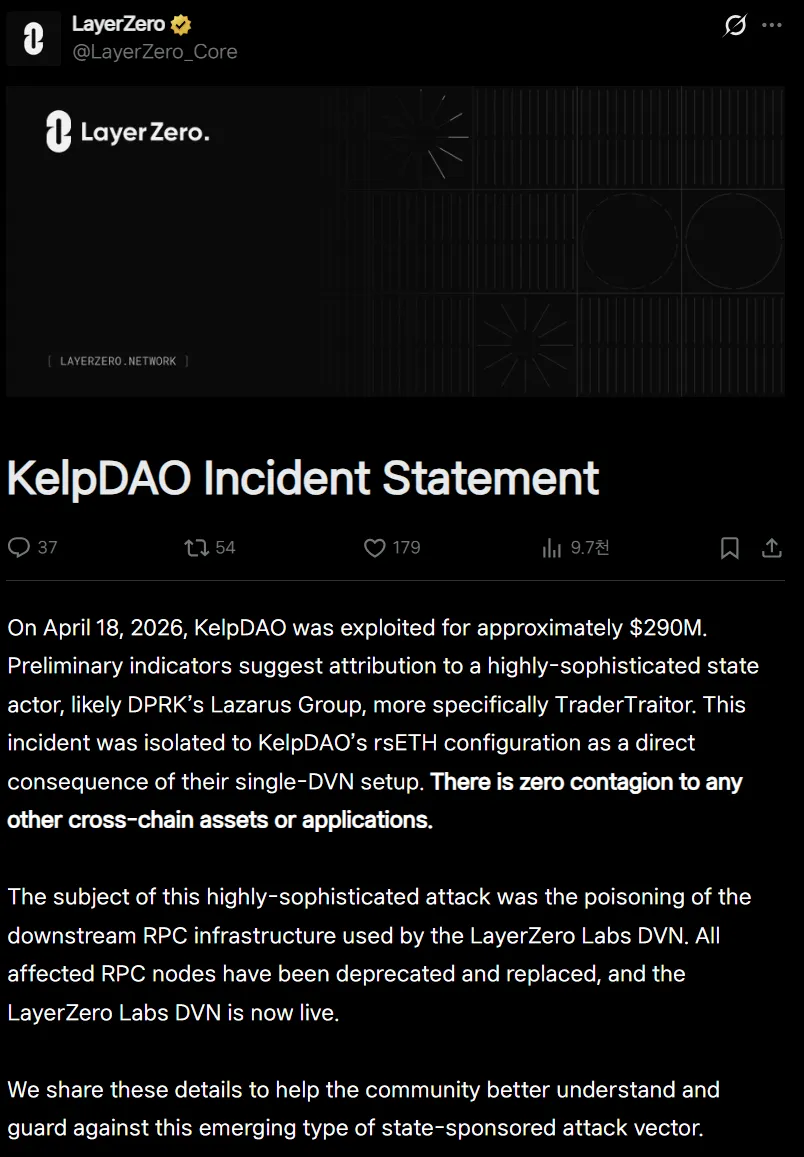
LayerZero (ZRO) announced on its official X account that it believes the North Korean hacking group Lazarus is behind the recent exploit of Kelp DAO's rsETH. LayerZero was the cross-chain bridge utilized by the hackers in the incident yesterday.
According to the company, the attackers used a sophisticated method to compromise the underlying RPC infrastructure of LayerZero Labs' Decentralized Verification Network (DVN). They hacked two independent RPC nodes, replaced them with malicious binaries, and launched a distributed denial-of-service (DDoS) attack on normal nodes to redirect the system to the compromised ones. The estimated damages are $290 million.
LayerZero stated that it had previously recommended Kelp DAO use a multi-DVN setup with multiple validators, but Kelp DAO's decision to maintain a single-validator structure left its defense system vulnerable. The incident was described as a security configuration issue with a specific application, not a flaw in the protocol itself, and no other assets or applications were affected. LayerZero has since replaced the compromised RPC nodes, restored normal service, and is working with authorities worldwide to track the stolen funds.
04:33
Crypto industry losses from hacks have surpassed $600 million so far in April, marking the highest monthly total since February 2025, BeInCrypto reported. According to data from DeFiLlama, this month's losses are roughly 3.7 times the $165 million lost during the entire first quarter. Hacks on KelpDAO (around $290 million) and Drift (around $285 million) accounted for about 95% of the total.
04:12
The DeFi fund outflow that began after the KelpDAO rsETH bridge hack has now spread to the Solana ecosystem, Wu Blockchain reported. The report noted a surge in both deposit APY and utilization rates across the USDC pools of Kamino (KMNO), a Solana-based automated liquidity management protocol. Notably, the Prime Market USDC pool, valued at approximately $178 million, has reached 100% utilization, completely depleting its available liquidity. Utilization rates for other major vaults, including the Stakehouse USDC vault and the LockawayX RWA USDC vault, have also surpassed 95%.
03:30
Asian Web3 research and consulting firm Tiger Research has highlighted that recurring hacks and a fund recovery rate of under 10% are eroding trust in the industry. According to its report, social engineering accounted for 74.7% of hacks in the first quarter of this year, making human error the primary attack vector over code vulnerabilities. The report explained that the on-chain nature of these thefts makes them difficult to reverse, often resulting in permanent losses. While centralized exchanges can absorb such damages through reserves and coordinated efforts, DeFi's response capabilities are limited. Tiger Research emphasized that attracting institutional investment requires prioritizing the development of robust incident response structures and responsible operating systems over purely technological solutions.
03:26
An address labeled as a strategic partner of LayerZero (ZRO) deposited 855,000 ZRO, worth approximately $1.42 million, to Binance about 30 minutes ago, according to EmberCN. The deposit was part of a larger transfer totaling 1.21 million ZRO ($1.97 million) that was sent to 52 different addresses.
EmberCN noted that LayerZero was the cross-chain bridge used by a hacker in yesterday's rsETH exploit, and the price of ZRO has fallen 18% since the incident.
03:02
South Korean crypto exchange Bithumb has announced it will temporarily suspend deposits and withdrawals for Xai (XION) to support an upcoming network upgrade. The suspension will begin at 10:00 a.m. UTC on April 21.
02:56
An over-the-counter (OTC) whale address starting with 0xd4584, previously known for buying hundreds of millions of dollars in ETH and cbBTC, has withdrawn 98,032 wstETH ($272 million) and 3,000 cbBTC ($221.6 million) from the crypto lending platform Aave, Lookonchain reported.
The on-chain tracker noted that the whale appeared to have difficulty withdrawing ETH from Aave following the hack of KelpDAO's rsETH bridge. The whale also lost 237 ETH ($540,000) while swapping some of the bridged ETH. The address still holds about 10,000 ETH ($22.8 million) on Aave.
The KelpDAO exploit over the weekend resulted in the theft of over $290 million in assets, and it was previously reported that more than $10 billion in funds had been withdrawn from Aave amid the fallout.
02:52
The following shows estimated liquidation volumes and position ratios for major crypto perpetual futures over the past 24 hours:
- BTC: $125 million liquidated (83.44% longs)
- ETH: $126 million liquidated (85.66% longs)
- RAVE: $23.88 million liquidated (50.74% longs)
02:44
Prediction market platform Polymarket is seeking to raise an additional $400 million at a target valuation of $15 billion, The Information reported. The company's valuation is believed to have surged several-fold in recent months amid a spike in demand for predictions related to real-world assets (RWA) and political events. This new fundraising effort is in addition to a $600 million investment round last month that included participation from Intercontinental Exchange, the parent company of the New York Stock Exchange (NYSE).
02:37
Hanwha Investment & Securities is joining the Canton Network (CC), a blockchain infrastructure utilized by global financial institutions, Dailian reported. The Canton Network is described as the only finance-specific open blockchain, featuring interoperability that facilitates the free movement of assets and collaboration between financial institutions. The two companies plan to explore opportunities for cooperation in various financial areas and build a strategic partnership to adapt to the digital transformation trend within the global financial market.
02:34
DeFi lending platform Fluid (FLUID) has launched an aWETH repayment feature designed to assist Ethereum (ETH) borrowers with liquidity and risk management, the project announced on X. According to Fluid, the feature allows ETH borrowers to convert their collateral into wstETH or weETH, thereby securing immediate liquidity and reducing their risk of liquidation. The platform added that even when borrowers have other outstanding debts, only the ETH collateral is converted, while the original debt structure remains unchanged.
01:20
DeFiLlama founder 0xngmi said on X that Kelp DAO has three potential post-hack measures to consider after suffering a $292 million (116,500 rsETH) exploit over the weekend.
The options are:
- Distributing the loss across all users, resulting in an 18.5% asset reduction for everyone.
- Concentrating the loss on rsETH holders by reducing the value of rsETH on Layer 2 networks to zero.
- Rolling back assets using a previous snapshot and compensating only for the stolen funds, a measure considered difficult to implement due to subsequent asset movements.
All three scenarios are expected to create risks for Aave, potentially forcing it to sell AAVE tokens or incur bad debt. Aave has currently frozen rsETH across its V3 and V4 protocols and has also frozen its WETH reserves. Aave founder Stani Kulechov stated that the incident was a hack of an external bridge, not Aave itself, and that the team is working to minimize further damage.
01:09
China has held its de facto benchmark interest rates steady for the 11th consecutive month. The People's Bank of China (PBoC) announced it is maintaining the one-year Loan Prime Rate (LPR), the benchmark for general loans, at 3.0%. The five-year LPR, which serves as the reference for mortgages, will remain at 3.5%. The PBoC has kept the rates frozen for 11 months since lowering both the one-year and five-year LPRs by 10 basis points in May of last year.
