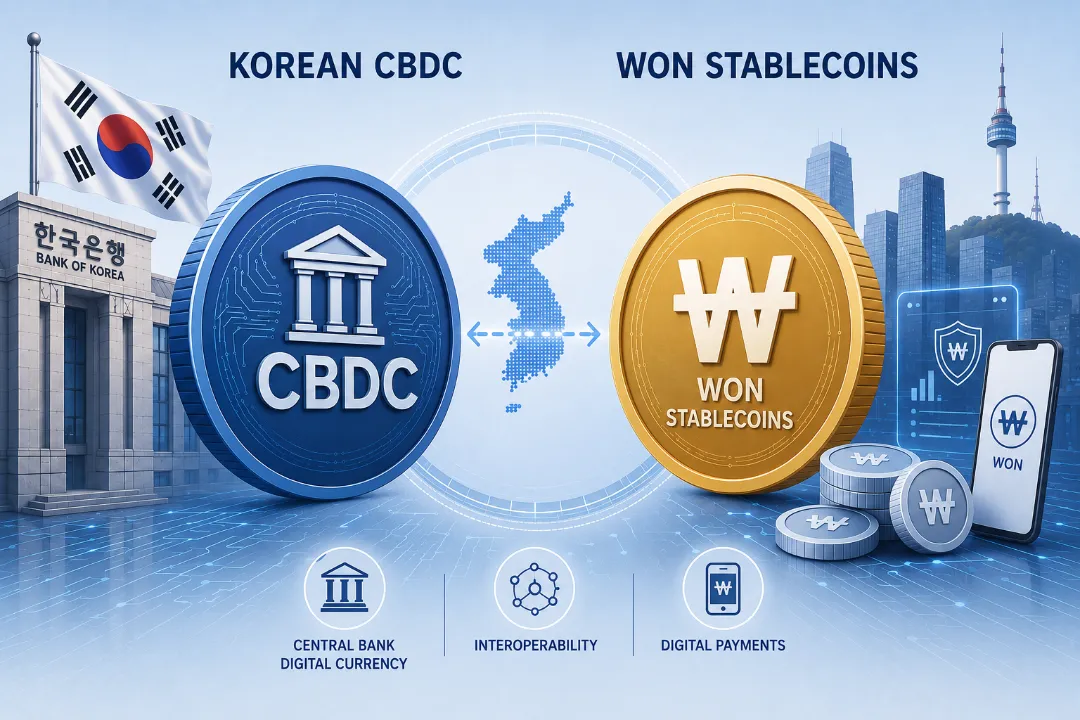
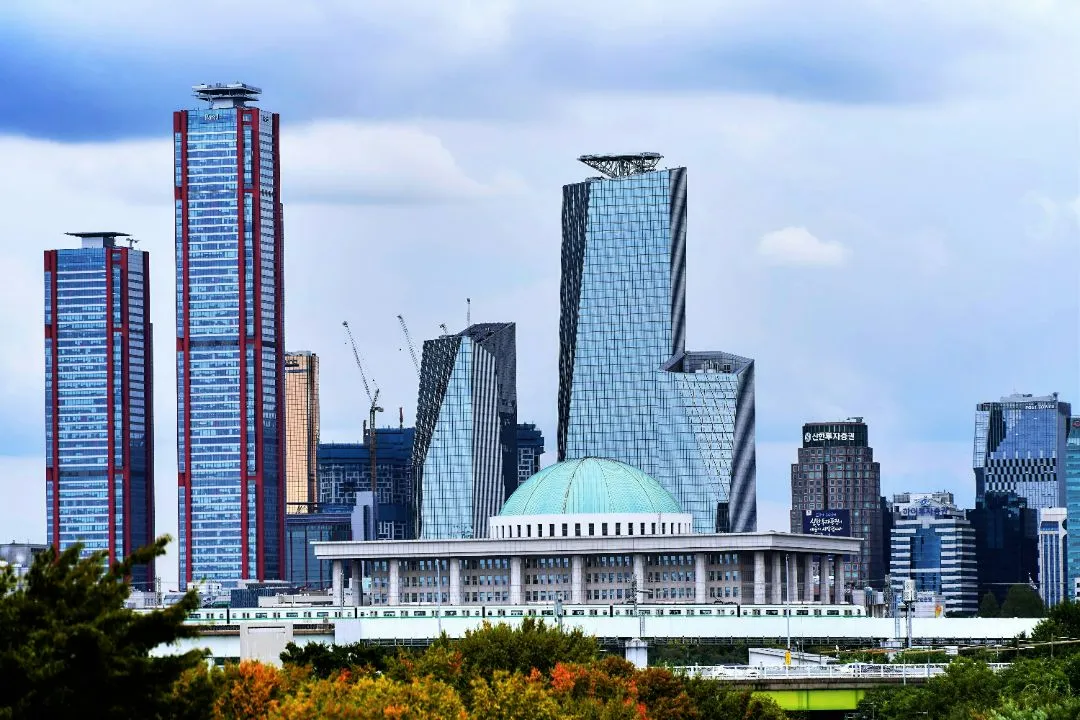
South Korea is building payment rails for a tokenized won on two tracks, one led by banks extending a central bank digital currency pilot, the other by card issuers testing stablecoins, with no law yet to govern either. The Korea Internet & Security Agency and the Ministry of Science and ICT said last week they had begun a project to extend the Bank of Korea's CBDC pilot, Project Hangang, into retail payments, according to a report by local outlet Digital Asset.Ilustration generated with ChatGPTThe Korea Financial Telecommunications and Clearings Institute, which operates the country's interbank payment network, will lead the consortium of nine commercial banks, eight payment gateways and two large organizations that will pilot the payments. It will connect existing payment infrastructure to Project Hangang on a 9.6 billion won ($6.6 million) budget. The pilot tested deposit tokens, a tokenized form of commercial bank deposits backed by a wholesale CBDC. The design avoids building anything new. Consumers would pay through bank-issued deposit token wallet apps, with a physical card under consideration, and merchants would keep their existing terminals. The stated aim is faster settlement and lower fees for small merchants. The government also plans to use deposit tokens for public spending, starting with a pilot for official expenses and later a treasury model linked to dBrain, the nation’s digital budget accounting system. Card issuers defend the railsSeparately, Newspim reported the Credit Finance Association and nine card issuers, including Samsung Card, Shinhan Card, KB Kookmin Card and Hyundai Card, on July 22 concluded a joint proof of concept for won-denominated stablecoins. Run on a test network, it examined whether authorization, settlement and cancellation functioned when a won stablecoin was routed through existing card rails, and whether smart contract-based terminals and QR payments could also handle loyalty points and government-issued vouchers. The tests come as the card business faces mounting pressure. Net income at the eight card companies fell 8.9% last year to 2.36 trillion won ($1.6 billion), as merchant fee income declined despite rising card spending. With 3.09 million merchants, or 95.7% of the total, on preferential fee rates in the first half, and wallet-based stablecoin payments raising the prospect of transactions that bypass card networks altogether, issuers have reason to secure a role in whatever comes next. Their pitch is that they already own the hard part. "Issuers would have to build payment infrastructure from scratch to circulate a stablecoin," a card industry official said. Bolting a settlement function onto existing card rails, the industry argues, would also let issuers apply the fraud detection and anti-money laundering systems already running on those networks. Legislation still stalledDigital assets featured in a reform agenda announced last week by Kim Min-seok, a lawmaker and former prime minister running for leadership of the Democratic Party. "I believe we need financial reform, and one of its key aims should be to establish our sovereignty over digital assets," Kim told a news conference, according to another Digital Asset report. His agenda included passage of the Digital Asset Basic Act, a legal framework for won stablecoins, rules for issuing and trading security tokens, and investor protection. The act, covering stablecoin issuance and digital asset service providers, is targeted for passage this year. Work on the bill had been due to start after party and government consultations in March but was postponed indefinitely, with the crisis in the Middle East among the reasons cited.
Japan's parliament passed landmark legislation on July 15 reclassifying cryptocurrencies as financial products under the Financial Instruments and Exchange Act, removing them from the Payment Services Act framework that had treated them as a means of settlement. According to CoinPost, the reform introduces insider-trading rules to the sector for the first time, raises penalties for unregistered dealing, and clears the way for domestic crypto ETFs. Under the changes, crypto exchange operators will be redesignated as "crypto asset trading businesses," and unregistered sales will carry prison terms of up to 10 years and fines of up to 10 million yen ($61,000), up from three years and 3 million yen. Gains will move from comprehensive taxation (where combined income and residence taxes can reach 55%) to a separate flat tax of around 20%, with losses eligible for a three-year carryforward, though those tax measures take effect only once the amended law is in force. If enforcement falls in fiscal 2027, the new rate would apply from Jan. 1, 2028.Photo by Kanchanara on UnsplashWeak yen drives crypto adoptionThe overhaul lands as Japanese companies increasingly turn to cryptocurrency as a treasury asset, with the yen's prolonged weakness pushing them to diversify their cash strategies, SBI VC Trade, the crypto exchange arm of financial conglomerate SBI Holdings, said. The exchange said it is seeing greater uptake of SBIVC for Prime, its service for corporate and large-lot clients, from companies looking to hold and use crypto. It is also fielding more business from listed firms that distribute Bitcoin (BTC) or XRP to shareholders through benefit programs, a practice the company said is spreading in Japan. The comments accompanied SBI VC Trade's announcement that its registered accounts topped 2 million as of July 6, double the 1 million it reported in 2025. The Tokyo-based firm attributed the growth in part to its April 2026 merger with fellow SBI Group exchange BitPoint Japan and to its stablecoin business. SBI VC Trade is Japan's only registered electronic payment instruments trading firm, the license category covering stablecoins. The company began offering USDC, the first U.S. dollar-denominated stablecoin available in Japan, in March 2025. In June 2026 it added JPYSC, which it describes as the country's first yen-denominated trust-type stablecoin, along with Ripple's dollar-pegged RLUSD, and launched a stablecoin lending service. The exchange plans to merge its two service brands around the end of December 2026. Separately, SBI Crypto, the group's mining unit, said it will shut down its mining pool on July 31. The pool will stop accepting mining shares at 7 a.m. Japan time, and the company urged customers to keep directing hashrate to the pool until the cutoff so that all eligible shares are included in the final payout. SBI Crypto said it has held discussions with other pool operators, some of which may offer preferential terms to migrating clients. Metaplanet expands into securitiesIn another sign of crypto's deepening ties with Japanese finance, Siiibo Securities, an online platform for privately placed corporate bonds, has changed its name to Metaplanet Securities after joining the Metaplanet group, the Tokyo-listed company known for its large BTC treasury. Siiibo, which holds a Type I financial instruments business license, said it plans to build a platform combining BTC and finance, developing products for retail investors that draw on its new parent's BTC management expertise while continuing to serve yield-seeking investors. Remixpoint discloses crypto yieldsListed energy and crypto firm Remixpoint, meanwhile, disclosed returns on its digital asset holdings as of the end of June. The company said it has earned a cumulative 9.95 BTC, worth roughly 108 million yen based on monthly average rates, from lending its BTC. Staking of altcoins has generated about 27.9 million yen in total, comprising roughly 10.1 million yen from ETH and 17.8 million yen from SOL, the company said, adding that it will continue building a financial structure that generates recurring income.
South Korea's central bank governor has called for tokenizing government bonds and other assets, telling global peers that moving sovereign debt onto a shared digital ledger could reinforce monetary policy and financial stability. Speaking at the European Central Bank's annual forum in Sintra, Portugal, Bank of Korea Governor Hyun Song Shin said central banks should look beyond tokenizing money and deposits to assets such as government bonds and equities, according to Korea Economic Daily TV. He made the case in a paper titled "A unified ledger in practice: lessons from Project Hangang," based on the BOK's pilot of the same name. Shin described a unified ledger as a blueprint for a future monetary system: central bank money, bank deposits and assets sharing one programmable platform. In an asset trade, payment and settlement sit on that single platform and clear at once, so ownership changes hands the instant payment is made.Photo by Markus Winkler on UnsplashTokenized bonds as a policy toolIn the pilot's first phase, launched in October 2023, the BOK and commercial banks issued a wholesale central bank digital currency and tokenized bank deposits to test the concept, which is drawn from the Bank for International Settlements. Shin said the exercise showed deposit tokens could serve as a new means of payment, and that programmable rules could stop funds being misused the moment a transaction is made. Putting sovereign bonds on such a ledger, he added, would reinforce the bank's key mandates of monetary policy and financial stability. A second phase, due in the second half of this year, will apply those programmable features to government spending, beginning with electric-vehicle charging subsidies and public-sector expenses. Shin also floated linking the system to Project Agora, a cross-border settlement effort backed by seven central banks, to clear foreign-exchange and securities trades in a single step and widen international use of the Korean won. Regulators eye exchange banking rulesBack home, the Financial Services Commission (FSC) moved on two fronts of its own. The regulator has begun canvassing won-based exchanges and their partner banks about the practice of tying each exchange to a single bank for real-name accounts, Financial News reported. At issue is whether the current setup could handle an influx of institutions as authorities prepare to open the market to companies. Currently, crypto exchange Upbit works only with Kbank, and Bithumb only with KB Kookmin. Regulators are now weighing whether to loosen this one-to-one arrangement, letting one exchange use several banks or one bank serve several platforms, and separately whether to route crypto services through securities firms' trading apps. The FSC also referred two manipulation cases to prosecutors, Maeil Business Newspaper reported. In the first, a whale spent tens of billions of won (tens of millions of dollars) to corner about half the global supply of a token listed at home and abroad, pumping its price on an overseas venue over roughly two months before using arbitrage to lure Korean buyers. The trader lost money offshore but booked bigger gains at home, concentrating the damage on local investors. In the second, a trader loaded up on a domestically issued "kimchi coin," then used an API to fire repeated buy and sell orders within a single second and posted inflated bids to push the price up before selling into the demand. The FSC urged investors not to chase coins that spike without clear cause, warned of pump-and-dump schemes, and said it would step up disclosure of activity by large holders and sharpen alerts for trading concentrated in a few accounts.
South Korea's financial regulator is seeking to allow institutional participation in the cryptocurrency market this year, calling the move a prerequisite for the next phase of digital asset legislation aimed at reshaping a market now dominated by retail traders. Speaking at a judicial training program at the Seoul Southern District Court, Shim Won-tae, an official in the Virtual Asset Division of the Financial Services Commission's (FSC) Digital Finance Policy Bureau, said corporate participation in the crypto market was among the agency's priorities for the year, according to Herald Business. A market limited to retail investors would be at odds with the planned second phase of crypto legislation, he said, describing broader institutional access as a necessary first step.Photo by Mohammad Dadkhah on UnsplashStock token tax rules under reviewThe comments come as policymakers weigh the tax treatment of security tokens. A Ministry of Economy and Finance official said that the government currently regards stock tokens as securities, which could allow them to be taxed under the existing Capital Markets Act if the FSC adopts the same view, Bloomingbit reported. The outlet said taxation could begin later this year if the FSC clarifies the status of stock tokens in a planned July update to security token guidelines and implementing rules. Market conditions have added urgency to the debate. At a National Assembly forum on June 11 marking the first anniversary of the Lee Jae-myung government, Hong Sung-kook, who chairs the ruling Democratic Party's National Economic Advisory Council, flagged two urgent risks: the recent sharp sell-off in the crypto market, which counts an estimated 10 million Korean investors, and a weaker won, according to Digital Asset. He also warned of inflation risks from a prolonged Iran war and a semiconductor boom. South Korea should work to stabilize equities, real estate and digital assets, and prepare for policy shifts by the Trump administration after the war, he said. LG turns to Arbitrum for adsIn a sign of corporate blockchain adoption, LG Electronics is developing an Arbitrum-based network to automate the buying and selling of advertising, Fortune reported. The platform records ad inventory and user-response data on-chain and lets software settle transactions on its own. LG ran a pilot with a Japanese advertising agency and plans to weigh commercialization of the ad platform in the second half of this year. Arbitrum co-founder Steven Goldfeder described it as software running the advertising market. Investor sentiment, meanwhile, stayed bearish. In CoinNess and Kratos's weekly survey of South Korean investors, conducted June 9–12, 65.7% expected Bitcoin to fall in the week ahead, up from 58.8% in the prior poll, while 13.7% looked for gains, down from 17.7%, and 20.6% expected sideways trading, down from 23.5%. Bearish expectations held the majority, and both the bullish and sideways camps thinned from a week earlier. Asked whether Bitcoin had bottomed after it briefly slipped below $60,000 on June 6, the largest share (38.8%) said it had not and expected further declines. Another 28.6% allowed for a short-term rebound but not a trend reversal, 20.1% judged the bottom was in and called it a buy-the-dip opportunity, and 12.5% were unsure. According to CoinMarketCap data at publication time, Bitcoin was trading at $63,456.42, down 0.23% over the past week.
South Korea’s crypto market, long known for frenzied retail trading and the Kimchi premium, is losing some of its speculative heat as local demand weakens and regulators tighten their grip on the sector.Photo by Ciaran O'Brien on UnsplashThe shift is showing up in the Kimchi premium, the price gap that once saw crypto assets trade higher on Korean exchanges than overseas. That premium has now turned negative, meaning digital assets are cheaper on Korean platforms than on global exchanges. Retail sentiment has soured alongside it: a weekly CoinNess and Kratos survey found that 58.8% of respondents expect Bitcoin to fall or crash in the coming week, up from 28.6% a week earlier. Only 17.7% expect a price surge, down from 36%, while 23.5% expect sideways trading. Weak market, thin liquidityInvestors blamed the persistent negative premium on several factors. The largest specific cause, cited by 25.4% of respondents, was broader market weakness and liquidity outflows. Another 22.7% said a strong stock market has reduced the appeal of crypto, while 16.5% pointed to limitations of local crypto exchanges. The remaining 35.4% said all of these factors are working together. South Korean exchanges are also becoming late-stage listing venues rather than early platforms. According to IOSG Ventures, Coinbase, Binance Futures, and Bybit often lead early price discovery, while Upbit and Bithumb tend to wait for broader market validation before adding new assets. IOSG found that 85% of Bithumb’s listings came after comparable listings on major global platforms, while Upbit listed assets an average of 28 days after their first overseas debut. The lag reflects lengthy regulatory reviews and a preference for more established projects. Regulation is shifting as well. According to SBS News, the Financial Intelligence Unit (FIU) under the Financial Services Commission (FSC) has decided against a proposed blanket reporting rule for crypto transfers above 10 million won, or about $6,500, to foreign virtual asset service providers (VASPs) or personal wallets. Instead, local VASPs must operate their own internal, risk-based anti-money laundering (AML) controls. Police probe Polymarket usersLaw enforcement is also targeting decentralized prediction markets. Local law firm Jonjung reported on a blog post that the Gangwon Provincial Police Agency has launched an investigation into South Korean Polymarket users over possible violations of the country’s gambling laws. Ahn Chang-bo, managing partner at the law office, said police are tracking crypto transaction records to identify and summon users. However, he noted that whether participation in Polymarket violates South Korea’s gambling laws remains unsettled, as prosecutors have not taken a definitive position and courts have yet to rule on the issue. South Korea remains a major crypto market, but the tone has changed. Local demand has weakened, exchanges are slower to list new tokens, and authorities are taking a closer look at both compliance and emerging platforms such as Polymarket.
South Korea’s cryptocurrency industry is entering a politically sensitive stretch as investors, exchanges, and regulators confront a mix of tax uncertainty, shrinking trading volumes, and growing scrutiny over crypto-linked money laundering. At the center of the debate is the government’s plan to begin taxing crypto gains in January 2027 after three previous delays. Under the current plan, annual crypto profits exceeding 2.5 million won ($1,650) would be taxed at 22%. The framework was first formalized in 2020, but implementation was postponed several times amid concerns over investor protection, market readiness, and political resistance. According to the Hankyoreh newspaper, opposition has intensified after lawmakers scrapped the country’s financial investment income tax, which would have applied to gains from stocks and funds. Critics argue that taxing crypto while most retail stock investors remain exempt from capital gains tax creates an uneven playing field.Photo by Tara Winstead on PexelsCrypto tax petition advancesA public petition calling for the abolition of crypto taxation has already gathered more than 54,000 signatures, clearing the threshold for review by a National Assembly committee. The petitioner argued that the issue needs a full reconsideration, including the possibility of scrapping the tax altogether. The opposition People Power Party has also proposed legislation to abolish the crypto tax, saying it would be inconsistent to impose a separate income tax on crypto assets after eliminating the broader financial investment tax. The ruling Democratic Party, meanwhile, is expected to take up the issue more seriously after the June 3 local elections. The government says there has been no change to its position and that crypto taxation is still scheduled to begin next January. But it has ruled out, at least for now, any renewed discussion on the financial investment income tax, fueling claims that the tax system is treating crypto investors unfairly. The tax dispute comes as Korean crypto exchanges are already grappling with a steep drop in trading activity. Retail investors have been shifting money into equities, drawn by a strong KOSPI rally and momentum in chip and AI stocks, draining activity from the crypto market. According to CoinMarketCap data cited by ETNews, Upbit’s average daily trading volume in the first quarter stood at about $1.55 billion, down 38.8% from the second half of last year. Bithumb’s first-quarter daily average was roughly $647 million, a 44.4% drop over the same period. The decline continued after the first quarter. From Jan. 1 to May 20, Upbit’s average daily volume fell to about $1.38 billion, down 45.5% from the second half of 2025. Bithumb’s average dropped to about $600 million, widening its decline to 48.5%.That slowdown has hit earnings. Dunamu, the operator of Upbit, reported first-quarter operating revenue of 234.6 billion won and operating profit of 88 billion won ($58 million), down 55% and 78% year-on-year, respectively. Bithumb posted revenue of 82.5 billion won ($55 million) and operating profit of just 2.9 billion won ($2 million), down 57.6% and 95.8%, while swinging to a net loss of 86.9 billion won ($58 million). The structural problem is that Korean exchanges still rely heavily on retail spot-trading fees. Unlike major global exchanges, domestic platforms have limited room to expand into derivatives, institutional custody, stablecoin payments, and other higher-margin businesses. Rising compliance costs, including customer verification and anti-money-laundering (AML) upgrades, are adding to the burden. USDT dominates $77M laundering caseSeparately, Korean police said they apprehended 149 suspects accused of laundering about 117 billion won ($77.5 million) through a network linked to a China-based laundering group in Shenzhen, according to the Seoul Economic Daily. Seven suspects were formally arrested, and police said all suspects identified so far are Korean nationals. USDT accounted for 72% of the funds moved, while bogus gift-card operations made up 19% and ordinary bank transfers 9%. Authorities said the scheme used accounts opened under other people’s names and overseas crypto exchanges to make the funds harder to trace. Meanwhile, sentiment among Korean crypto investors remains mixed but not entirely bearish. A weekly survey by CoinNess and Kratos found that 34.1% of respondents expected Bitcoin to rise or surge this week, while 36.3% expected sideways movement and 29.6% expected a decline. Asked whether the crypto market could recover this year, 38.5% said the current downturn looked like a healthy correction with room for a rebound, while 29.7% said the market would not only recover but also set new highs. Combined, 68.2% of respondents expected some form of recovery this year. Still, pessimism remains. Another 17.7% said the crypto market had peaked and was unlikely to rebound, while 14.1% said they had already left the market and no longer had expectations. At the time of publication, Bitcoin (BTC) was trading at $76,677.43, up 0.1% over the past week, reflecting a largely range-bound market.
Japan's institutional embrace of blockchain technology is accelerating on multiple fronts, with a flurry of developments in the first week of May signaling that the country's financial establishment is moving to bring digital asset infrastructure into mainstream markets.Photo by Paris Bilal on UnsplashGovernment bonds go on-chainCiting Nikkei, Nada News reported on May 7 that a group of major Japanese banks and brokerages plans to tokenize Japanese government bonds by the end of 2026. The project would issue JGBs as security tokens on a blockchain and use stablecoins for settlement, potentially allowing 24-hour trading and same-day settlement. The project is expected to focus first on the repo market, where financial institutions use government bonds as collateral for short-term lending. Japan represents roughly 10% of the global repo market. Progmat, a digital asset infrastructure company, will coordinate the industry group behind the project. Participants include Japan’s three megabanks (Mitsubishi UFJ Bank, Sumitomo Mitsui Banking Corporation, and Mizuho Bank), Daiwa Securities, SBI Securities, Tokio Marine Holdings, BlackRock Japan and State Street Trust & Banking. The group plans to publish a report on legal and tax issues by October. SBI moves to acquire bitbankSeparately, financial conglomerate SBI Holdings said on May 1 that it submitted a letter of intent to acquire a controlling stake in bitbank, one of Japan’s largest crypto exchanges, and make it a consolidated subsidiary. The announcement followed SBI’s merger of BitPoint Japan into SBI VC Trade in April. SBI said the proposed acquisition comes as Japan considers bringing digital assets under the Financial Instruments and Exchange Act. On April 10, the cabinet approved an amendment bill that would for the first time regulate crypto assets as financial products, including a ban on insider trading based on undisclosed information. In payments, Aptos signed a memorandum of understanding (MOU) with NETSTARS, the Tokyo-based operator of the StarPay cashless payment platform. Aptos will participate as a blockchain partner in NETSTARS’ StarPay-X project, which aims to add stablecoin and other Web3 payment options to existing point-of-sale infrastructure.
A recent survey of South Korean crypto investors showed a modest shift toward a more positive short-term view on Bitcoin, although market data since the poll was released has yet to strongly support that outlook. The regular survey, conducted last week by CoinNess and Cratos, found that 44.8% of Korean respondents expected Bitcoin to rise or surge this week, up from 35.2% in the previous survey.Photo by Jievani Weerasinghe on UnsplashThe share of respondents expecting Bitcoin to move sideways fell to 28.3% from 33%, while those forecasting a decline or sharp drop decreased to 26.9% from 31.8%. The figures indicate that bullish responses increased from the previous week, while neutral and bearish responses declined. However, with several days having passed since the survey was released, Bitcoin’s price action has so far offered a more cautious picture. At the time of writing, Bitcoin was trading at $77,085.07, down 1.14% from a week earlier, according to CoinMarketCap. The survey also showed that investors remain wary of the broader market environment. Asked how recent macroeconomic uncertainty and market volatility had affected the difficulty of crypto investing, 40.5% said it became “much more difficult,” and 35.3% said it became “somewhat more difficult.” That means roughly three-quarters of respondents said crypto investing has become harder than before. Another 16.6% said conditions were little changed, while 7.6% said investing became easier. GIWA Chain targets cross-border financeWhile retail investors appear cautious about the near-term market backdrop, major Korean firms are continuing to push ahead with blockchain projects tied to cross-border finance. Dunamu, the operator of Upbit, South Korea’s largest crypto exchange, said it has signed a memorandum of understanding (MOU) with Hana Financial Group and POSCO International to develop services for overseas remittances, payments, and corporate treasury management. The project brings together Dunamu’s layer-2 blockchain, GIWA Chain, Hana Financial Group’s foreign exchange network, and POSCO International’s global supply-chain platform. The companies said the collaboration will focus on faster international transfers, more efficient corporate fund management, and new digital finance services. The firms also plan to test whether some processes currently handled through the SWIFT network can be moved onto GIWA Chain. Coinone sanctions put on hold by courtOn the regulatory front, a court has temporarily halted enforcement of sanctions against crypto exchange Coinone, after the Korea Financial Intelligence Unit (FIU) ordered a fine and partial business restrictions over alleged anti-money laundering (AML) violations. The measures had been set to take effect on April 29. According to the Maeil Business Newspaper, the court said the stay would remain in effect until May 29 while it considers Coinone’s request to suspend the sanctions. It stressed that the decision was provisional and did not constitute a final ruling on the request. Earlier this month, the FIU, South Korea’s financial intelligence agency under the Financial Services Commission (FSC), imposed a KRW 5.2 billion ($3.52 million) administrative fine on Coinone for alleged violations of the country’s financial transactions law. The regulator also ordered a three-month restriction on virtual asset transfers for new customers, covering both deposits and withdrawals.
South Korea is taking new steps to bring cryptocurrencies more firmly into its legal, financial, and payment systems, with recent developments pointing to both wider institutional adoption and continued regulatory caution.Photo by Traxer on UnsplashCrypto status comes under reviewA research institute affiliated with South Korea’s judiciary has recommended amending the Civil Act to give cryptocurrencies clearer status as property. Digital Asset reported that the Judicial Policy Research Institute made the proposal in a February paper, arguing that the law should reflect how digital assets are already controlled, traded, and contested in legal disputes, even though the current Civil Act is built around physical objects. The institute said the lack of clear property status can create uncertainty in cases involving custody, hacking, bankruptcy, and asset recovery. It also called for a legal concept of “control” over digital assets, similar to possession in the physical world. The recommendation does not change the law on its own, but it strengthens the case for crypto legislation that deals not only with market oversight and investor protection, but also with ownership and legal remedies. Crypto holdings are also set to be included in government debt-relief screening. According to Yonhap News, the Financial Services Commission said a revised Credit Information Use and Protection Act passed the National Assembly, allowing government-backed debt relief agencies to review applicants’ deposits, securities, cryptocurrencies, income, and property records when assessing repayment capacity. The measure is intended to reduce the risk of applicants hiding assets while seeking public support and to improve fairness in debt-relief programs. Payment pilots meet regulatory limitsIn payments, fintech platform Toss has signed an agreement with KOMSCO, South Korea’s state-run mint and identity-document agency, to develop blockchain-based payment infrastructure, according to Yonhap Infomax. The partnership will initially focus on linking Toss’s payment network with public-sector payment infrastructure, before exploring tokenized payment tools such as deposit tokens and stablecoins. The deal pairs one of Korea’s largest consumer fintech platforms with a public agency that already runs municipal voucher programs and digital gift certificates. Regulators, however, remain cautious about token projects launched before a broader legal framework is in place. Aju Business Daily reported that the Korea Insurance Institute has not yet received approval from the Financial Services Commission for proposed changes that would allow it to issue a token tied to its training programs and establish or invest in an AI subsidiary. The institute says the plans are still under regulatory review, but the delay reflects concerns over whether token issuance fits its role as a training body for insurance professionals.
Japan is moving to pull its cryptocurrency market firmly inside the regulated financial system. A bill approved by the cabinet this month would reclassify digital assets as financial products, while separate developments in blockchain infrastructure and corporate treasury strategy suggest the shift extends well beyond Tokyo's rulebook. The cabinet approved the bill on April 10 to amend the Financial Instruments and Exchange Act, according to Nikkei. The legislation would bring cryptocurrencies under the regulated financial system and mark a departure from the previous framework, which had largely treated them as payment instruments under the Payment Services Act.Photo by Louie Martinez on UnsplashTighter rules take shapeIf enacted, the new rules could take effect as early as 2027. They would prohibit insider trading based on undisclosed information, require issuers to file annual disclosures, and redesignate licensed firms from "crypto-asset exchange operators" to "crypto-asset trading operators." Penalties for operating an unregistered business would also be stiffened, with maximum prison terms raised to 10 years from three and fines increased to 10 million yen ($63,000) from 3 million yen ($19,000). The changes align with the government's broader effort to strengthen market integrity, transparency, and investor protection. The regulatory tightening comes as firms work to build compliant blockchain infrastructure. SBI Ripple Asia, a joint venture between SBI Holdings and Ripple, announced on April 7 that it had completed development of a token issuance system based on the XRP Ledger. The company described the project as financial infrastructure for issuing and managing prepaid payment instruments as tokens on a public blockchain. Such instruments, regulated under current Japanese law, could be handled via apps, websites, and APIs. SBI Ripple Asia added that it completed regulatory registration on March 26 as an issuer of third-party prepaid payment instruments. Corporate treasuries expand crypto betsListed companies are also increasing their exposure to digital assets. WIZE, a Tokyo-listed firm formerly known as Mobcast Holdings, reported holdings of 24,597 SOL as of April 10, valued at roughly $3.13 million (about 498 million yen). The company had announced in October 2025 that it would begin building a Solana reserve, and the latest disclosure suggests corporate crypto holdings in Japan are expanding beyond Bitcoin (BTC).Metaplanet remains the most aggressive example of the trend. Chief Executive Simon Gerovich said on X that the company purchased 5,075 BTC in the first quarter and now holds 40,177 BTC, acquired for a cumulative 623.37 billion yen ($3.92 billion) at an average purchase price of 15,515,598 yen ($97,600) per coin.
As South Korea’s cryptocurrency market rapidly evolves, authorities are working to keep the nation's regulatory framework up to speed. Recent initiatives aim to provide clearer guidelines across the sector, encompassing tax policy adjustments, seized assets, and bank-backed digital tokens.Photo by André François McKenzie on UnsplashGovt tightens control over seized cryptoAccording to Yonhap News, the government has approved a new framework for managing roughly 78 billion won ($54 million) in crypto held by the public sector. The move is aimed at imposing clearer controls over digital assets that state agencies hold, including tokens seized or frozen during investigations. Under the new rules, crypto taken from personal wallets must be transferred immediately into agency-controlled cold wallets kept offline. Sensitive access data, including private keys and recovery phrases, must be split among at least two people rather than left in the hands of a single official. That push for tighter custody comes as South Korea also explores new forms of digital money. A bank-issued product known as a deposit token is emerging as a possible middle ground between private stablecoins and a central bank digital currency, or CBDC. Deposit tokens are digital assets backed by bank deposits. They can function like stablecoins in payments, but they are issued by banks rather than crypto firms. The idea is gaining attention as legal uncertainty around stablecoins drags on. South Korea’s central bank has already moved its CBDC pilot, Project Hangang, into a second phase. The Digital Times reported that two more lenders, Kyongnam Bank and iM Bank, have joined the seven banks that participated in the first round: KB Kookmin, Shinhan, Hana, Woori, NH NongHyup, IBK, and Busan Bank. In practice, the emerging view is that deposit tokens may not compete directly with a future CBDC so much as complement it, especially in everyday payments and settlement where banks already have distribution, compliance, and customer infrastructure. Tax gaps persist as market expandsEven as the payments debate advances, tax policy remains underdeveloped. South Korea is set to begin taxing crypto assets in January 2027, but the National Tax Service still does not have detailed standards for several common types of crypto income, according to the Herald Business. Those include staking, lending, airdrops, hard forks, NFTs, and decentralized finance. In a written reply to a lawmaker’s office, the agency said it is still collecting overseas legislative examples and expert views on what should count as taxable crypto income and how acquisition costs should be calculated. That gap is especially important for offshore activity. Profits earned through overseas exchanges are difficult to track outside the 56 jurisdictions participating in the Crypto-Asset Reporting Framework (CARF), an OECD-developed international regime for sharing tax information on crypto assets. The result is growing concern over uneven tax treatment and the possibility that capital could shift abroad if enforcement remains patchy. At the same time, global stablecoin issuers are trying to deepen ties with Korean institutions. Tether, the company behind stablecoin USDT, has returned to South Korea again this year after visiting in 2025. The Aju Business Daily reported that it has been in talks with players including KB Financial Group and local exchange Coinone, looking for ways to expand trading activity and circulation. Tether has argued that its network could help broaden Korea’s crypto ecosystem, while also promoting its new dollar-pegged stablecoin, USAT, as compliant and secure. The sector’s operational risks are also still visible at the exchange level. Bithumb has begun legal proceedings to freeze assets as it tries to recover seven Bitcoin that it failed to claw back after an erroneous payout during a promotional event in February. At the time, the unrecovered amount was worth about 700 million won ($483,000). The move points to a likely civil suit. According to an industry source cited by Chosun Biz, some customers refused to return the funds, arguing that the mistake was the company’s fault. Legal opinion in South Korea, however, appears to be broadly in Bithumb’s favor if the dispute ends up in court.
The market capitalization of South Korea's cryptocurrency market stood at 87.2 trillion won ($57.4 billion) at the end of last year, marking an 8% decline from 95.1 trillion won ($62.6 billion) at the end of June 2025. A survey released on March 25 by the Financial Intelligence Unit (FIU) and the Financial Supervisory Service (FSS), covering 27 virtual asset service providers, found that the number of listed crypto assets in Korea rose to 712 at year-end—up 9% (59 assets) from 653 in June.Photo by Daniel Bernard on UnsplashTrading activity declines, listings increaseAverage daily trading volume on won-denominated crypto exchanges fell 15% to 5.4 trillion won ($3.6 billion), from 6.4 trillion won in the first half of 2025. New listings rose 10% to 227, while delistings jumped 50% to 54, including cases where the same coin was delisted from multiple platforms. The average transaction fee rate stood at 0.16%. Operating profit at the exchanges fell 38% to 395.8 billion won ($261 million), down from 635.2 billion won ($418 million) in the first half. Data on retail investors show that men in their 30s remain the largest group of crypto users in South Korea, with 2 million accounts. Overall, 74.2% of the country’s 11.13 million accounts—equivalent to 8.26 million users—held less than 1 million won (about $660) in digital assets. Only 10% (1.12 million accounts) held 10 million won ($6,600) or more, while just 1.5% (170,000 accounts) held over 100 million won ($65,800). By age group, users in their 30s and 40s each accounted for 27%. They were followed by those in their 50s (19%), under-30s (19%), and users aged 60 and older (9%). Survey shows investors remain waryRecent survey data points to cautious sentiment among retail investors. In a weekly survey of Korean investors conducted last week by CoinNess and Cratos, 36.9% of respondents reported “fear” or “extreme fear,” compared with 30.8% who were neutral and 32.3% who were optimistic. Despite the overall caution, short-term sentiment turned slightly more optimistic. The survey found that 38.3% of respondents expect Bitcoin to rise this week, up from 35.6% the previous week. Those expecting prices to move sideways accounted for 22.5% (down from 23.1%), while 39.2% expect a decline (down from 41.3%). With macroeconomic uncertainty rising and speculation growing over a possible April rate hike by the Federal Reserve, respondents were split on how monetary policy would affect digital assets. When asked about the Fed’s rate outlook for the year, the largest share (30.3%) said Bitcoin would rise regardless of interest rates. Another 26.5% expected rates to remain unchanged, 19.9% expected a cut, and 12.4% a hike. The remaining 10.9% said Bitcoin would fall regardless of rate decisions.
The Korea Insurance Institute (KII), an incorporated association that trains insurance professionals, has initiated a phased process to become South Korea's first institution to hold Bitcoin (BTC), while the national tax agency is moving to enlist private crypto custodians following a recent security breach, local media reported.Photo by Kanchanara on UnsplashThe non-profit KII has established a digital asset review committee to establish internal regulations for managing cryptocurrencies as institutional holdings, Yonhap Infomax reported. The move is designed to prepare for an upcoming legal framework governing Korean won-backed stablecoins. While retail crypto investment is legal in South Korea, corporate and institutional participation remains tightly restricted. However, the institute noted that KII could still acquire digital assets through an existing regulatory channel, as non-profit organizations are permitted to hold crypto wallets. The newly established committee will draft guidelines covering crypto operations, risk management, accounting and tax standards, and internal controls. Once the regulatory framework is in place, KII plans to spend its stablecoins to acquire BTC and Ethereum (ETH). Ha Tae-keung, president of KII, said the launch of the digital asset review committee could mark a new milestone for innovation in asset management within the finance and insurance industry. He added that the institute would seek to serve as a working model for a new financial system shaped by artificial intelligence and digital assets. Tax agency seeks custodians to manage cryptoIn parallel government developments, the National Tax Service (NTS) is pushing to select custody providers to manage confiscated digital assets as early as the first half of this year, according to a ZDNet Korea report. The policy shift follows a security breach late last month, when confiscated cryptocurrency was stolen on two occasions after a mnemonic seed phrase was inadvertently disclosed in an NTS press release detailing on-site asset seizures from tax evaders. To prevent future breaches, an NTS task force launched earlier this month is developing comprehensive manuals for the confiscation, storage, and sale of digital assets. The group is also developing criteria for selecting custodians, including security standards, company size, and required insurance coverage under the Virtual Asset User Protection Act. A source familiar with the matter told ZDNet Korea that the NTS is assessing security standards and other key criteria ahead of selecting a custodian, adding that not all providers meet the strict requirements for government appointment. The NTS task force is also preparing to set up a dedicated digital assets division to oversee crypto issues, with final details to be determined in consultation with the Ministry of the Interior and Safety.
Japan’s Financial Services Agency (FSA) is moving to tighten penalties and enforcement against unregistered cryptocurrency operators, Nada News reported, citing the Nikkei newspaper.Photo by Traxer on UnsplashTo bolster investor protection amid a rise in issues related to highly speculative memecoins, the FSA plans to submit legislative amendments to an upcoming extraordinary Diet session. The revisions will transfer crypto asset regulations from the Payment Services Act to the Financial Instruments and Exchange Act. Under the new framework, criminal penalties for operating an unregistered crypto exchange or soliciting over-the-counter derivatives will increase dramatically. Offenders will face up to 10 years in prison or fines of up to 10 million yen ($63,000), or both, marking a sharp increase from the current maximum penalties of three years’ imprisonment or 3 million yen in fines. Regulatory oversight will also expand. The Securities and Exchange Surveillance Commission will gain the authority to pursue criminal investigations—allowing for on-site inspections and evidence seizures—replacing the current reliance on warning letters and civil injunctions. Additionally, the official legal designation for compliant businesses will change from “cryptoasset exchange service providers” to “cryptoasset trading service providers.” Binance to launch Japan equities USDT perpWhile Japanese regulators focus on ring-fencing domestic investors from unregulated digital assets, global crypto platforms are expanding their offerings tied to the country's traditional financial markets. Illustrating this trend, Binance announced it will launch a USDⓈ-M perpetual contract for EWJUSDT, which tracks the iShares MSCI Japan ETF, on March 19 at 13:30 UTC. The BlackRock-managed ETF provides exposure to large- and mid-cap Japanese equities. This blurring of the lines between traditional Japanese equities and crypto derivatives underscores a wider transformation within the digital asset ecosystem. Beyond trading, blockchain-based assets are increasingly serving as core financial infrastructure, a trend reflected in the growth of the stablecoin sector. Stablecoin market hits $300BAccording to an XWIN Research Japan post on CryptoQuant, on-chain data shows active addresses using ERC-20 stablecoins are surging. Backed by a roughly $300 billion market capitalization dominated by USDT and USDC, stablecoins are gaining ground as a foundational layer of the global economy. XWIN Research Japan outlined how these assets are tailored to distinct regional needs: functioning as digital dollars in high-inflation economies like Nigeria, facilitating remittances in India and the Philippines, and providing institutional liquidity in the U.S. Supported by its own shifting regulatory landscape, Japan is also gaining traction in this stablecoin space. Yen-pegged stablecoins like JPYC are emerging as practical payment tools designed to bridge traditional Japanese finance with global blockchain networks. JPYC Inc., the issuer of the JPYC stablecoin, recently raised 1.78 billion yen ($11.9 million) in Series B funding led by Asteria and partnered with LINE NEXT to integrate its stablecoin into a wallet based on the LINE Messenger platform.
The South Korean government and the ruling party may postpone agreement on a unified proposal for the Digital Asset Basic Act, legislation that would include regulations on stablecoins. The bill represents the second phase of the country’s cryptocurrency regulatory framework, following the first phase that took effect in 2024 to strengthen investor protection.Photo by KS KYUNG on UnsplashAccording to Edaily, the two sides had planned a policy consultation on March 5 to finalize the draft. The meeting was later pushed back to this week but is now unlikely to take place, potentially delaying the government’s plan to complete stablecoin legislation by this month. The Digital Asset Basic Act is a comprehensive bill to regulate the crypto market, including issuance, distribution, disclosure, and listing of virtual assets. South Korea has more than 13 million crypto investors, and market participants see the legislation as a step toward reducing regulatory uncertainty. Meanwhile, the rapid rise of dollar-denominated stablecoins such as USDT and USDC has raised concerns that a slow regulatory response could undermine the country’s monetary sovereignty. Toss eyes dual role in KRW stablecoinsAmid ongoing debate over stablecoin regulation, Viva Republica, the operator of the payments app Toss, is preparing to move into the issuance and distribution of won-denominated stablecoins. At the 2026 Blockchain Meetup Conference last week, Seo Chang-whoon, corporate development director at Viva Republica, said Toss hopes to take on both roles in the stablecoin ecosystem, according to ZDNet Korea. “Toss would like to try serving both as a stablecoin issuer and as a distribution platform,” Seo said. The company is considering joining a consortium to issue a won-based stablecoin, which could include Toss, its financial affiliates, and traditional banks. Toss also plans to expand the token’s use through a dApp store, and indicated it may work with blockchain firms as it develops the business. Global firms are also studying the market potential for Korean won-backed stablecoins. DWF Ventures said in a report last week titled “South Korea’s KRW Stablecoin Opportunity” that a won-denominated stablecoin could offer meaningful benefits to domestic markets. The report argued that such a token could help reduce reliance on the U.S. dollar and curb capital outflows, while improving capital efficiency by allowing reserves to generate yield. With about 98% of South Koreans using digital payments, adoption could come quickly, the report said, adding that the system could also strengthen authorities’ ability to monitor and curb illegal activity. Survey finds modest optimism around BitcoinAmid growing expectations around stablecoin policy, a recent survey of South Korean crypto investors showed cautious optimism about Bitcoin’s price outlook this week. According to a weekly poll conducted last week by CoinNess and Cratos, 27.3% of respondents said they expect Bitcoin to rise or surge this week, up from 24% a week earlier. 32.2% predicted the price would move sideways, up from 28.1% the previous week, while 30.5% expected a decline or sharp drop, down from 47.9% a week earlier. When asked about market sentiment, 37% of respondents said they felt fear or extreme fear, while 32.2% described sentiment as neutral, and 30.8% said they were optimistic or extremely optimistic. Asked why they invest in cryptocurrencies, 33.9% of respondents said they see crypto as the only path to upward mobility. Another 32.5% cited confidence in the long-term value of Bitcoin and blockchain technology, while 25.5% pointed to its role as a hedge against instability in traditional finance. The remaining 8.1% cited volatility and 24/7 trading. According to CoinMarketCap data, Bitcoin was trading at $72,634.39 at the time of writing, up 9.34% over the past week.
South Korea and Canada have agreed to strengthen cooperation against cyber threats, including North Korea’s theft of virtual assets, following their inaugural cyber policy consultations.Photo by Hermes Rivera on UnsplashAccording to News1, South Korea’s foreign ministry announced that the talks took place at its Seoul headquarters. Both sides agreed on the need for closer coordination to effectively counter cybercrimes—such as North Korea-linked crypto theft and online scams—as well as emerging cyber threats driven by artificial intelligence. They also committed to exploring concrete avenues for bilateral cooperation. The delegations exchanged views on response mechanisms for the recent surge in cyber intrusions, sharing case studies on how such incidents have been handled. They also agreed to strengthen prevention efforts by improving information sharing and speeding up communication across multiple channels when incidents occur. The foreign ministry noted that the meeting marks a significant step toward enhanced cybersecurity cooperation, as the two nations share policy approaches and explore practical collaboration under their comprehensive strategic partnership. Bithumb staff form labor unionMeanwhile, employees in the crypto sector are beginning to organize to safeguard their rights. An exclusive report by NewsWhoPlus revealed that a labor union has been established at Bithumb, one of South Korea’s major crypto exchanges. The union has affiliated with the Federation of Korean Public Trade Unions, which operates under the umbrella of the Federation of Korean Trade Unions. The union stated it will serve as a forum to discuss and improve employee welfare and working conditions. In response, Bithumb said it is reviewing reports of the union’s formation to gather more details. The company emphasized its respect for employees’ rights and affirmed it will respond in accordance with relevant laws and procedures. Industry readies for stablecoin oversightElsewhere in the industry, companies are proactively positioning themselves for regulatory shifts. As South Korea’s Digital Asset Basic Act—the second phase of the country’s crypto legislation, which is expected to address assets like stablecoins—begins to take shape, businesses are moving early to prepare for the anticipated changes. Edaily reported that Lambda256, an affiliate of Upbit operator Dunamu, is forming a strategic consultative group focused on stablecoins. To this end, the company has signed a tripartite memorandum of understanding (MOU) with the law firm Yulchon and SAS Korea. Under the agreement, the partners will combine their expertise in blockchain technology, legal services, and data analytics. They aim to establish a joint framework to navigate key legal and regulatory issues surrounding stablecoins and other digital assets. This cooperation will encompass anti-money laundering (AML) protocols, financial crime prevention, internal controls, risk management, and the legal structuring of related product offerings. On the financial and regulatory front, the partners plan to refine practical AML compliance and internal control measures for financial institutions. By continuously analyzing shifts in digital asset regulations and broader market trends, they intend to develop practical compliance frameworks that financial firms and other businesses can readily adopt.
LINE NEXT, the U.S.-based Web3 subsidiary of LY Corporation, has launched its global stablecoin wallet, Unifi. The service is now publicly available through the LINE messaging app.Photo by Shubham Dhage on UnsplashThe platform consolidates core stablecoin operations—including deposits, storage, payments, and transfers—into a single interface. Users can onboard using existing social logins from LINE, Google, Naver, or Apple. At launch, Unifi only supports USDT, with plans to integrate additional stablecoins in the future. The service currently offers an annual percentage yield of 4% to 5% on deposited assets. Non-custodial wallet integrates stablecoins into LINEDesigned as a non-custodial wallet, Unifi enables users to retain control over their private keys and manage their own assets. The platform also supports direct fiat conversions. Through a partnership with fintech firm SentBe, Unifi utilizes an off-ramp solution from Triple-A, a Singapore-licensed Digital Payment Token provider, enabling users to convert and withdraw stablecoins directly to personal bank accounts. To expand the wallet's utility, LINE NEXT has integrated its existing Dapp Portal and Mini Dapps into the Unifi ecosystem. This allows users to spend stablecoins across various gaming, social, and content applications, as well as earn rewards through in-app activities. The rollout follows a January memorandum of understanding (MOU) between LINE NEXT and JPYC Inc., the issuer of the yen-pegged stablecoin JPYC, to explore broader stablecoin integration and regional use cases. PayPay seeks U.S. IPO after Binance betLY Corporation is expanding its presence in financial services through another subsidiary, PayPay, which has been moving into the crypto sector. According to a report cited by CoinDesk, PayPay is preparing for a listing on the Nasdaq and is seeking a valuation of more than $10 billion. The company plans to price its shares between $17 and $20 and issue 55 million shares, potentially raising up to $1.1 billion. The proposed ticker symbol is PAYP. In October last year, PayPay acquired a 40% stake in Binance Japan, expanding its presence in the digital asset market. The initial public offering had been scheduled for March 9 but was postponed amid market volatility linked to developments in Iran. Separately, Japanese-listed firm Metaplanet, which has been accumulating Bitcoin, has not purchased additional BTC for eight weeks, according to an X post by SoSoValue. According to its fiscal 2025 earnings report, the Japanese company posted a net loss of 95 billion yen ($605 million) for the year, while generating revenue of 8.9 billion yen ($58 million). The firm currently holds 35,102 BTC at an average purchase price of $107,716 per coin. With Bitcoin trading slightly below $70,000, the holdings imply an unrealized loss of about $1.32 billion, or roughly 35% below the average acquisition cost.
South Korea’s Financial Services Commission (FSC) is set to exclude stablecoins from the list of digital assets corporations will be permitted to trade under forthcoming corporate crypto trading guidelines, according to a report by Herald Business.Photo by DrawKit Illustrations on UnsplashThe guidelines will outline the conditions under which listed companies and registered professional investment firms can buy and sell digital assets for investment or treasury management purposes. As regulators move to prevent speculative or indiscriminate investment in the early stages of opening the market to corporations, they have opted to limit the scope of permitted assets. Consequently, U.S. dollar-pegged stablecoins such as USDT and USDC are expected to be excluded from the approved list. Authorities plan to release the trading guidelines after the Digital Asset Basic Act is finalized. This move partly reflects regulatory constraints: stablecoins are not currently classified as cross-border payment instruments under South Korea’s Foreign Exchange Transactions Act. The law requires payments and receipts involving such instruments to be processed through authorized foreign exchange banks, leaving stablecoins outside the regulated framework. Companies seek stablecoins for FX hedgingThis exclusion, however, does not entirely prevent companies from trading stablecoins. Firms can still access them through overseas channels, including external wallets like MetaMask or over-the-counter platforms operated by exchanges such as Coinbase. Currently, South Korean companies cannot open corporate crypto accounts domestically, making it difficult to use digital assets for formal trade settlement. Nevertheless, payments in stablecoins are sometimes still handled through individual or offshore accounts. Given these workarounds, some listed companies with large international trade exposure have petitioned regulators to allow stablecoins under the proposed corporate investment guidelines, according to people familiar with the matter. Advocates argue that stablecoins like USDC can be easily traded on exchanges and track the U.S. dollar in real time, making them a highly effective tool for managing foreign-exchange risk. As the industry awaits this regulatory clarity, the impact is already rippling into the traditional financial sector. Kbank—the banking partner of Upbit, Korea’s largest crypto exchange—recently debuted on the KOSPI benchmark index after two previously failed attempts to go public. According to Bridgenews, Korea Investment & Securities initiated coverage on March 6 with a “neutral” rating, noting that regulatory uncertainty and rising lending competition could limit the bank's near-term growth. However, the brokerage added that the lender’s valuation could improve if it successfully expands its crypto business alongside clearer regulations. Baek Doo-san, an analyst at Korea Investment & Securities, noted that Kbank’s valuation could see re-ratings if the Digital Asset Basic Act and policies promoting the stablecoin industry are implemented quickly. He said that despite potential overhang risks, faster policy progress could drive multiple expansion, adding that the bank could then be valued in line with its peers’ price-to-book ratios. Survey shows persistent market fearThese shifting regulatory sands come at a time when the broader crypto market remains under pressure. According to a weekly survey of South Korean investors conducted by CoinNess and Cratos last week, 24% of respondents expect Bitcoin to rise or surge this week, up from 10.3% in the previous survey. Another 28.1% expect the market to move sideways, compared with 25.5% a week earlier, while 47.9% predict a decline or sharp drop, down from 64.2%. Although bullish sentiment has ticked upward from the previous week, bearish expectations still dominate the overall landscape. When asked about broader market sentiment, 43.4% of respondents said they felt fearful or extremely fearful. About 35.4% described sentiment as neutral, and only 21.2% reported feeling optimistic or extremely optimistic. With safe-haven markets facing renewed uncertainty amid geopolitical tensions between the U.S. and Iran, the survey also explored how a potential correction in South Korea’s stock market might affect cryptocurrencies. The largest share of respondents, 39.7%, believed it would be negative for crypto. Meanwhile, 23.6% said it would benefit Bitcoin exclusively, 23.4% felt it would be positive for the broader crypto market, and 13.3% expected it to have no impact.
Japanese regulators are scrambling to police a chaotic fringe of opportunistic crypto projects, even as the country’s traditional banking heavyweights and global exchanges race to establish themselves in a rapidly expanding digital asset market.Photo by Aditya Anjagi on UnsplashOn the regulatory front, authorities are considering a criminal investigation into “Sanae Token,” a token named after Prime Minister Sanae Takaichi, DL News reported. Issued in late February on the Solana blockchain, the token was created by NoBorder, a video production team and decentralized autonomous organization led by Japanese entrepreneur and YouTuber Yuji Mizoguchi. As of late January, NoBorder had not obtained a crypto exchange license and reportedly had not applied for one. Takaichi says govt never authorized tokenBefore reports of the investigation emerged, Takaichi said in a March 2 statement on X that she had no knowledge of the project and that the government had not authorized it. She added that the clarification was necessary to prevent the public from being misled. According to Phantom wallet data, the token has a total supply of 1 billion and is currently trading at $0.00415291, giving it a market capitalization of roughly $4.2 million. The Financial Services Agency (FSA) is conducting voluntary interviews with involved parties to establish the facts. As regulators move to curb opportunistic actors exploiting a nascent but expanding market, established global crypto firms are continuing to deepen their presence in the region. Crypto exchange Binance plans to secure five additional regulatory licenses in Asia this year, according to Nikkei Asia. The exchange currently holds licenses in Japan, Australia, India, Indonesia, New Zealand, and Thailand. It is also expected to gain a South Korean license through its planned acquisition of local exchange Gopax. Binance aims to expand its total number of licensed jurisdictions to more than 20 by securing further approvals across Asia. TradFi deepens crypto pushJapan’s traditional financial institutions are also accelerating their blockchain efforts. South Korean news outlet Newspim reported that Bank of Japan Governor Kazuo Ueda announced plans to technically verify a blockchain-based system that would digitize a portion of current account deposits for settlements. Made at FIN/SUM 2026, a major fintech event co-hosted by Nikkei and the FSA, the comments suggest the central bank is moving beyond merely studying a central bank digital currency and may begin experiments linking its funds directly to blockchain infrastructure. Further underscoring this institutional push, Cointelegraph reported that Mitsubishi UFJ Financial Group (MUFG), one of Japan’s three largest banks, will conduct a joint stablecoin pilot program alongside Mizuho Bank and Sumitomo Mitsui Banking Corporation.
One in every two South Koreans has experience investing in cryptocurrency, Herald Business reported, citing a recent survey. The findings from the Korea Financial Consumers Protection Foundation’s (KFCPF) 2025 Virtual Asset User Survey were presented at a financial academic conference in Seoul on Feb. 27. The survey showed that people in their 30s were more likely to have invested in cryptocurrency than any other age group. Participation also rose notably among women and older adults. In particular, the average investment amount among older investors increased by roughly 2.3 times compared with 2023.Photo by Precondo CA on UnsplashCryptocurrencies ranked second among preferred investment vehicles, trailing stocks but ahead of real estate and bonds. About half of crypto investors access exchanges at least three times a week, the survey found. Around 40% have used additional exchange services, including crypto lending. Investors with less than 1 million won ($680) in holdings accounted for 25.3% of respondents. They also accounted for a disproportionately large share of reported financial damages, including losses stemming from exchange bankruptcies or hacks. Many were found to invest without fully understanding the risks involved. Experts urge stronger investor safeguardsLee Jung-min, a researcher at the Korea Financial Consumers Protection Foundation (KFCPF), said there has been a recent increase in debt restructuring applications from investors overwhelmed by interest payments and loans tied to crypto trading. She called for stronger safeguards to curb excessive investment hype and restore market confidence, as well as clearer legal guidelines on how user assets should be returned in cases of exchange failures or hacks. Citing the foundation’s research, Lee said many small-scale investors—particularly those with less than 1 million won ($680) in holdings or those who relied on online trading tip groups—had suffered financial harm. With disputes over small transactions rising, she added that regulators are considering a binding dispute resolution framework for small claims that could eventually be extended to crypto trading. Kim Eun-mi of the Korea Inclusive Finance Agency (KINFA) warned that the crypto market’s high volatility and information gaps pose heightened risks to financially vulnerable groups. She underscored the need for stronger safeguards, similar to those in place for vulnerable borrowers in traditional finance, and added that greater transparency over how policy loan funds are used would help authorities determine whether such programs are being diverted into crypto investments. KINFA CEO Kim Eun-kyung added that while the number of crypto participants has surpassed 10 million, consumer protection measures have not kept pace with the market’s rapid growth. Experts are calling for stronger financial education for older adults with limited knowledge of digital assets and low-income young people. Jung Dae, head of the Korean Academy of Financial Consumers, said 2024 figures from the Seoul Bankruptcy Court show particularly high rates of personal rehabilitation and bankruptcy among people in their 50s and 20s, driven largely by failed post-retirement businesses in the former group and heavy spending on online gaming and crypto investments in the latter. He urged policymakers to pair targeted interventions with rigorous research. Crypto complaints jumpComplaints related to cryptocurrency surged in South Korea last month, as Bitcoin fell about 45% below its October peak. Cases categorized as “virtual currency” jumped from just 68 in December to 2,054 in February—more than a 30-fold increase—and were 55.5 times higher than a year earlier, according to SBS Biz, citing data released Feb. 27 by the Korea Consumer Agency and the National Council of Consumer Organizations. Analysts said the spike in crypto-related cases was largely linked to a promotional campaign by a trading platform that changed the terms of its API-linked subsidy program midway, triggering a wave of investor inquiries. Meanwhile, a weekly survey of Korean investors conducted by CoinNess and Cratos points to deepening pessimism in the market. Just 10.3% of respondents expect Bitcoin to rise this week, down from 15.5% a week earlier, while 64.2%—up from 52.8%—predict further declines. More than 61% said they feel fearful or extremely fearful, and only 11.2% expressed optimism. Still, despite mounting bearish sentiment and online claims that the crypto boom is over, 60.9% said they see extreme pessimism as a potential buying opportunity.
JPYC Inc., the issuer and operator of the Japanese yen stablecoin JPYC, announced it is set to raise 1.78 billion yen ($11.4 million) in a funding round led by Asteria Corporation. The proceeds will be used to upgrade systems and applications, expand the company's workforce, and bolster services related to the issuance, redemption, and settlement of its stablecoin. The firm also plans to explore new business opportunities through strategic investments as stablecoins shift from early-stage experimentation to wider commercial use. Currently available on Avalanche, Ethereum, and Polygon, JPYC intends to add support for additional blockchain networks and broaden its use cases.Photo by Possessed Photography on UnsplashUniversities ramp up blockchain trainingSeparately, blockchain education initiatives are advancing in Japanese academia. The Endowed Chair for Blockchain Innovation at the University of Tokyo’s Graduate School of Engineering will launch a new blockchain application practice program in the 2026 academic year. The hands-on track will complement the university's existing public lecture series. The program will bring together students from diverse fields—including finance, cryptography, art, and product design—to collaborate on practical projects. Interdisciplinary teams will develop new concepts, with selected groups eligible for an entrepreneurship support initiative starting in September. Organizers noted the program aims to cultivate advanced talent while remaining platform-neutral. These developments coincide with the Japanese government’s broader push to integrate digital assets into the financial sector. In a video message at the “MoneyX 2026” crypto and Web3 conference on Feb. 27, Finance Minister Satsuki Katayama stated that the government is advancing efforts to support the broader adoption of stablecoins and tokenized deposits. According to CoinPost, Katayama indicated the Financial Services Agency (FSA) will back pilot projects under its payment platform (PP) initiative in the securities settlement sector. These projects will test recording the transfer of rights for government bonds, corporate bonds, and equities on blockchain infrastructure, linking settlements to stablecoin payments. New crypto bureauKatayama also announced plans to launch a new FSA bureau dedicated to digital financial assets as early as this summer, significantly expanding the agency’s organizational capacity. She urged industry participants to leverage the PP framework, particularly for regulatory interpretation support during proof-of-concept trials. Meanwhile, Hong Kong authorities are signaling further policy measures to strengthen the city’s crypto investment landscape. In his latest budget speech, Financial Secretary Paul Chan said the number of single-family offices in the city has exceeded 3,300 and outlined plans to refine the tax regime—including for digital assets—to attract more capital. The proposed revisions would expand the scope of what qualifies as a "fund," bringing certain single-investor vehicles under the definition. The changes would also classify digital assets, precious metals, and specific commodities as eligible investments for tax incentives. The government plans to table an amendment bill in the first half of the year, targeting implementation in the 2025/26 year of assessment.
The cryptocurrency market has come under renewed pressure as escalating global tariff tensions converge with growing stress in the private credit sector, though a South Korean analyst suggests that prospects for a rebound remain intact. According to Etoday, Yang Hyun-kyung, a researcher at iM Securities, noted that risk assets staged a brief rally after the U.S. Supreme Court ruled that President Donald Trump’s reciprocal tariffs, imposed under the International Emergency Economic Powers Act (IEEPA), were unlawful. However, the relief proved short-lived as tariff fears reignited following the announcement of a 10% levy and a subsequent proposal to increase it to 15%.Photo by Markus Winkler on UnsplashLiquidations surge amid private credit jittersYang observed that market volatility intensified as concerns in the private credit market resurfaced after Blue Owl Capital halted redemptions for its Blue Owl Capital Corporation II (OBDC II) fund and initiated a $1.4 billion asset sale. Yang highlighted that $420 million in liquidations hit the crypto market as Asian trading opened on Feb. 23. This included $386 million in long positions and $34 million in shorts, signaling a swift deleveraging. These pressures are reflected in current price levels. According to CoinMarketCap, Bitcoin, the world’s largest cryptocurrency, is trading just below $65,000, down 1.13% over the past 24 hours. The token remains approximately 49% below the all-time high recorded in October. Bitcoin’s decline has widened valuation losses among digital asset treasury (DAT) firms. Yang estimated that Strategy, which holds 717,131 BTC, is sitting on roughly $7.89 billion in unrealized losses. Yang added that a potential shift toward monetary easing ahead of the U.S. midterm elections, combined with reduced regulatory uncertainty from the crypto market structure bill known as the Clarity Act, could serve as short-term catalysts for a rebound. Binance focuses on regulatory alignment in KoreaDespite the market slump, crypto firms are deepening their presence in South Korea. In an interview with ZDNet Korea, Binance Head of APAC SB Seker stated that the company’s focus is not on increasing its ownership stake, but on establishing a compliant, trusted, and sustainable operation in the country. Binance currently holds a 67.45% stake in Gopax, operated by Streami, after securing regulatory approval to become its largest shareholder. Addressing the issue regarding GoFi—Gopax’s DeFi product designed to generate returns for users—Seker said any repayments of unpaid customer funds must comply with Korean commercial law and satisfy relevant legal and administrative procedures. He added that discussions with regulators are ongoing and the company cannot unilaterally set a repayment schedule. Seker also noted that Binance plans to work closely with authorities to advance its business in areas such as institutional investment and stablecoins. Regulators reiterate exchange ownership capsAs the digital asset sector evolves, South Korea is moving to tighten oversight. MoneyToday reported that financial authorities have notified the heads of the country’s five largest crypto exchanges—Upbit, Bithumb, Korbit, Coinone, and Gopax—of their intention to introduce caps on the ownership stakes of controlling shareholders. The notification is widely viewed as a precursor to the government’s release of the Digital Asset Basic Act, often described as the second phase of the country’s crypto regulatory framework. The Financial Services Commission has maintained that a single largest shareholder’s stake in a crypto exchange should be limited to between 15% and 20%. At the meeting, officials outlined key elements of the forthcoming bill and reaffirmed their intention to enshrine the ownership cap in law. Representatives from the five exchanges and the Digital Asset eXchange Alliance (DAXA), the industry body to which the platforms belong, reportedly raised concerns about the proposal.
Japanese financial conglomerate SBI Holdings has announced plans to issue security token (ST) bonds targeted at individual investors, marking the firm’s first foray into this bond format. The instruments will be issued and managed on the “ibet for Fin” blockchain platform led by BOOSTRY, bypassing the conventional management system operated by the Japan Securities Depository Center (JASDEC). Trading is scheduled to commence on March 25 via the proprietary trading system (PTS) operated by the Osaka Digital Exchange. As an incentive, Japanese investors—both individuals and corporations—who acquire the ST bonds will receive XRP tokens corresponding to their subscription amounts. These benefits will be offered to Japanese bondholders whose subscriptions are confirmed by SBI Holdings and who hold an account with SBI VC Trade, where they must complete the necessary procedures by noon on May 11.Photo by Kanchanara on UnsplashBitcoin lendingIn a parallel move within the Japanese digital asset sector, Remixpoint, a publicly listed energy management firm, has begun lending its 1,411 Bitcoin holdings through SBI Digital Finance. Positioning Bitcoin as a strategic asset to bolster its financial base, Remixpoint aims to generate yield from the cryptocurrency rather than relying solely on capital appreciation. The lending program is set to launch on Feb. 24, with interest rates determined by market conditions and loan terms. Despite these corporate initiatives to expand into digital assets, the broader market continues to face significant headwinds. Asian investors remain wary amid the current downturn, and expectations for a near-term recovery remain subdued. Bearish mood dominatesA weekly survey of South Korean investors conducted by CoinNess and Cratos last week showed that bearish sentiment remained entrenched. Only 15.5% of respondents said they expected Bitcoin to rally this week—down from 18.3% in the prior survey—while 52.8% anticipated a decline or steep drop. The share forecasting sideways consolidation rose to 31.7%. Sentiment indicators further reflect this caution, with 57.4% of respondents describing the market mood as “fearful” or “extremely fearful,” compared with just 14.2% expressing optimism. Regarding potential support levels, the largest group of respondents (33.6%) projects that Bitcoin could retest the $50,000 range, while 21.2% anticipate a drop below that threshold. According to CoinMarketCap, XRP is trading at $1.33, down 6.47% over the past 24 hours. Since July, the token has declined 62.54% from $3.55. Bitcoin is trading near $65,070.83, down 4.29% over the same period. It remains 48.21% below its all-time high of $126,198.07, recorded in October.
A Hong Kong-based entity has emerged as the largest new shareholder of BlackRock’s spot Bitcoin exchange-traded fund (ETF), according to a recent regulatory filing.Photo by Kanchanara on UnsplashAs of Dec. 31, the firm held roughly 8.79 million shares of the iShares Bitcoin Trust ETF (IBIT), valued at $436 million, per a Form 13F disclosure filed with the U.S. Securities and Exchange Commission (SEC). The filing identifies the shareholder as "Laurore" and the reporting individual as Zhang Hui. While the entity is listed as Hong Kong–based, the document provides no further details regarding the company’s background or sources of capital. Because Form 13F filings disclose institutional equity holdings only at the end of each quarter, the specific timing of Laurore's accumulation of the IBIT stake remains unclear. Workaround for Chinese Bitcoin restrictionsJeff Park, Chief Investment Officer at ProCap Financial, noted on X that the entity appears to lack a public footprint. He observed that the filer’s name is common in China, suggesting limited traceability, and added that the “Ltd.” designation may indicate an offshore structure often utilized to access U.S. markets. Park further suggested that because IBIT is the firm's sole disclosed holding, Laurore likely functions purely as a $436 million Bitcoin exposure vehicle rather than a diversified fund. He theorized that this structure might reflect Chinese capital seeking regulated Bitcoin exposure via a U.S.-listed ETF, potentially signaling early indications of institutional capital flight. This disclosure arrives amidst a prolonged downturn for Bitcoin. The cryptocurrency is currently trading near $67,000, representing a decline of about 47% from its Oct. 7 peak of $126,000. Analysts split as BTC trades 47% below peakMarket analysts have offered diverging outlooks on Bitcoin’s next move. According to CoinDesk, Bloomberg Intelligence analyst Mike McGlone stated on X that he has raised his downside target for Bitcoin to roughly $28,000, up from a previous $10,000, arguing that this revised level better aligns with historical price distribution. This update follows McGlone's earlier warning that a continued crypto selloff could signal broader financial stress, and that Bitcoin could fall toward $10,000 if U.S. equities peak and a recession ensues. Conversely, Chase Guo, a former Binance executive, predicts Bitcoin will reach a new all-time high this year. As reported by BeInCrypto, Guo argues that this move will be driven by liquidity dynamics rather than fundamentals, with capital flows, market positioning, and consensus playing decisive roles. Guo believes a liquidity squeeze, fueled by derivatives exposure and capital rotation, could push prices beyond previous highs. Against the backdrop of Bitcoin’s fixed supply, he suggests that even modest institutional or sovereign inflows could exert an outsized impact on price.
Major Japanese securities firms are moving deeper into the cryptocurrency market, underscoring the rapidly evolving nature of Japan’s financial sector. According to DL News, citing Nikkei, Nomura Holdings, Daiwa Securities Group, and SMBC Nikko Securities are exploring plans to launch their own crypto exchanges as Japan edges closer to regulatory approval of crypto exchange-traded funds (ETFs).Photo by Jakub Żerdzicki on UnsplashETFs could spur demandNomura is expected to lead its effort through Laser Digital, its Swiss-based crypto subsidiary, and plans to pursue a domestic exchange license and launch its service by year-end. The move comes after Laser Digital trimmed its crypto positions following third-quarter losses. Despite the setback, Nomura has reiterated its long-term commitment to digital assets. SMBC Nikko Securities, meanwhile, has established a dedicated decentralized finance (DeFi) unit to assess new business opportunities in blockchain-based financial services. The firms are positioning themselves ahead of what they expect to be a surge in demand if Tokyo lifts restrictions on crypto ETFs. Japan is reportedly working toward approving such products by 2028. In preparation, the Financial Services Agency is considering classifying digital assets as eligible for inclusion in investment trusts—a key step toward broader institutional adoption. Institutional appetite is already building. A November Nikkei survey found that six major firms—including SBI, Nomura, and Daiwa—are developing crypto investment offerings in expectation of eventual approval by the Tokyo Stock Exchange. The 2028 rollout hinges in part on tax reform. The government is weighing a shift from the current progressive tax regime, which can impose rates of up to 55% on crypto gains, to a flat 20% rate—aligning digital assets with the taxation of traditional equities. Authorities find that a two-year buffer is needed to ensure exchanges and oversight bodies can implement the new rules effectively. SBI to acquire Singapore’s CoinhakoIn parallel, SBI Holdings is expanding its regional footprint. The financial services group announced that its Singapore-based subsidiary, SBI Ventures Asset, has signed a letter of intent with Coinhako to pursue a majority acquisition of the virtual asset service provider. The two sides aim to combine their capabilities to deliver integrated services spanning traditional finance and digital assets for both retail and institutional clients. Details of the proposed capital injection and share purchases from Coinhako’s existing shareholders remain under negotiation and subject to regulatory approval. Amid the industry’s expansion, traditional finance is increasingly weighing stablecoins against Bitcoin. According to The Crypto Basic, Lee Hardman, a currency analyst at Japan’s MUFG Bank, said that stablecoins may prove more effective than Bitcoin as a medium of exchange, a unit of account, and a store of value. Their price stability has been cited as a key advantage, as reduced volatility lowers transaction risk for merchants and consumers.