Live Feed
New
Today, October 26, 2026
11:06
Cardano has incorporated the core code for Leios into its main development strategy as it seeks to expand network transaction capacity by up to 15 times, CryptoSlate reported. According to a development report, Praos2, which combines the existing consensus protocol with Leios, along with LeiosNotify and LeiosFetch, which support information exchange between nodes, have been integrated. Some features needed for additional transaction processing are still under development. Cardano plans to use Leios to raise initial transaction capacity by three to five times, then expand it by up to 10 to 15 times through further adjustments.
11:05
Cointelegraph outlined three key themes to watch in the Bitcoin market this week:
- Macro issues including elevated oil prices, the U.S. benchmark interest rate decision and the FOMC press conference
- Weakness in South Korea’s KOSPI and softness in AI stocks
- Whether Bitcoin can recreate an "Uptober" rally, which would require about a 4% gain from current price levels
11:00
Tron-based blockchain oracle network WinkLink said it completed the first round of buybacks and burns for its WIN token. A total of 67.35 billion WIN was burned in the round, worth about $3.59 million at the time of the burn. According to CoinMarketCap, WIN was trading at $0.00006583, up 5.44%.
10:50
Bitcoin has posted three straight weekly losses for the first time since May, raising concerns about further declines, according to The Crypto Basic.
Crypto trader and analyst That Martini Guy said a similar pattern appeared in May, when Bitcoin gave back all of its gains from early in the second quarter. Another analyst, CryptoLinus, identified $80,700 as a key support level and said BTC had closed above that range on the daily chart for 37 straight days. As selling pressure builds, a break below that level could send BTC down to $75,000, CryptoLinus said. According to CoinMarketCap, BTC was trading at $80,287, up 0.21%, at the time of writing.
10:40
Vanguard’s FTSE All-World ex-US Small-Cap ETF (VSS) has added 4.5 million shares of Bitcoin treasury company Metaplanet for the first time, Bitcoin Treasuries reported. The stake is valued at about $7.5 million. The addition expands indirect exposure to Bitcoin treasury companies for investors in the ETF through Metaplanet shares.
10:40
The market capitalization of SECZ, a stock token issued by tokenized securities platform Securitize, fell by more than half in less than a month, Cointelegraph reported, citing Token Terminal data.
SECZ’s market cap dropped from a peak of $430.4 million on Sept. 28 to $208.6 million as of Oct. 25. Over the same period, the combined market cap of tokens tracking shares of USDC issuer Circle rose around 20% to $383.6 million, allowing Circle to reclaim the top spot in the tokenized equities market, according to the report.
As of Oct. 25, the total market capitalization of the tokenized stock market stood at around $3.3 billion.
10:25
Cryptex Finance has submitted a sixth amended S-1 registration statement to the U.S. SEC for the Cryptex BAGZ ETF, a multi-cryptocurrency spot ETF, CoinGape reported. The Cryptex BAGZ ETF is designed to track 24 tokens selected from an index made up of 36 cryptocurrencies. Its holdings are divided into five themes, with BTC, ETH, SOL, XRP and ADA accounting for as much as 51.7% combined, while Layer 1 and Layer 2-related assets including AVAX, NEAR, APT and LINK make up about 22.25%.
10:23
The issuer of yen-pegged stablecoin JPYC warned that scammers have been impersonating company employees to solicit cryptocurrency investments or offer free access to AI-based automated trading systems. The company said it does not conduct any such recruitment or solicitation and has no connection to the services in question. It also stressed that users should not respond to suspicious offers or provide personal information or transfer funds, even if the company name, official website URL, or phone number is used.
10:10
Indian cryptocurrency exchange CoinDCX said on its official blog that a security incident involving its wallet infrastructure led to losses of about 15.99 million USDT.
After hacking allegations involving a CoinDCX-linked wallet surfaced in the crypto community on Oct. 22, CoinDCX CEO Sumit Gupta denied the claims, saying the activity was tied to a legacy wallet address compromised in last year’s hack. CoinDCX has now reversed that position four days later. In a notice issued today, the exchange added that it will fully cover the lost funds.
Previous related news
10:09
U.S. XRP spot ETFs posted about $4.25 million in net inflows last week, reversing back into positive territory after one week, Crypto Briefing reported. XRP spot ETFs had previously logged net inflows for 13 straight weeks before seeing $1.84 million in net outflows the previous week. The move contrasted with outflows from BTC, ETH and SOL spot ETFs last week. XRP spot ETFs recorded net inflows of $709,000 on Oct. 21 and $3.55 million on Oct. 22.
10:09
As the South Korean government moves to revise an enforcement decree under the Foreign Exchange Transactions Act to strengthen oversight of cross-border virtual asset transfers, industry participants have called for changes to the original draft, Edaily reported.
The Korea Web3 Blockchain Association, or KWBA, submitted its opinion to South Korea’s Ministry of Economy and Finance on Oct. 26. The ministry had earlier issued a legislative notice on Oct. 7 for revisions to the enforcement decree following amendments to the Foreign Exchange Transactions Act on June 2. Oct. 26 was the deadline for public comment.
KWBA said it supports the overall direction of bringing cross-border virtual asset transfers into foreign exchange authorities’ monitoring system, while recommending a review of revisions to several provisions in light of the industry’s level of preparedness and the compliance burden.
09:57
Billionaire entrepreneur and former crypto supporter Mark Cuban said in a recent interview that he sees the current market as a bubble, though unlike the internet bubble, nearly all assets are now trading like meme stocks, including Bitcoin.
Cuban said stocks such as Micron, Google and Apple are all trading like meme stocks, pointing to sharp price swings on minor news. He said a stock can fall 18% simply because a company misses market expectations by one cent, even though the company’s intrinsic value has not changed by 18%.
He added that investors are no longer buying based on the net present value, or NPV, of future cash flows, but are instead trading stocks like collectible baseball cards. For that reason, Cuban said he views the current stock market as a bubble, while adding that he does not know what will cause it to burst.
Separately, Cuban said in May that he had sold most of his Bitcoin holdings after concluding that cryptocurrencies were not properly serving as a hedge against declines in fiat currency values and geopolitical instability.
Previous related news
09:54
Aviva Investors is launching a tokenized share class of its sterling liquidity fund on the XRP Ledger, according to Ripple. The fund is Aviva Investors’ largest, with about £22 billion in assets under management, and the launch expands its tokenized fund lineup following the July debut of a tokenized U.S. dollar liquidity fund. Investors will receive the same protections as in the existing fund, which was first launched in 2002. The product is limited to professional investors.
09:42
Gotchi Labs, a consumer AI platform designed for everyday use, said through its official channel that it released an official white paper on Oct. 25 that outlines the platform’s technical architecture, product ecosystem, and long-term development strategy.
In the white paper, Gotchi Labs set out a plan to build a consumer AI ecosystem that provides personalized information, recommendations, and practical support across daily life areas including health, shopping, exercise, and productivity. In line with that direction, the company plans to connect specialized AI services by sector and gradually expand support tailored to users’ real-life contexts.
The white paper added that Gotchi Labs has secured around 612,000 registered users through its in-house health and wellness service Sleepagotchi, which is already in operation, and is expanding its distribution base through blockchain-based mobile ecosystems including Seeker and Jambo. Building on that foundation, the company plans to expand into shopping and commerce, exercise and fitness, productivity and daily life, and personalized AI.
09:28
Blockchain gaming project ArchLoot said on its official blog it plans to permanently burn 44,583,346 AL tokens locked in three ecosystem pools, currently worth about $57,646.
The tokens set to be burned include 30 million AL from the ECO pool, 10,416,673 AL from the treasury pool and 4,166,673 AL from the reserve pool.
Separately, AL was placed on Bithumb’s delisting watchlist on Oct. 16. According to CoinMarketCap, AL was trading at $0.001293, down 0.54%.
09:22
A whale that accumulated $8.09 million worth of altcoins in early October added another $2.7 million over the past 10 days, lifting the total position to $10.79 million, according to ai_9684xtpa. The cumulative unrealized loss currently stands at about $1.904 million.
The holdings consist of 2.55 million ZRO, 6.3 million WLD, 5.77 million BAT and 20 million CHIP. Unrealized losses by asset were estimated at $970,000 for ZRO, $568,000 for WLD, $288,000 for BAT and $77,000 for CHIP.
09:21
Hong Kong-listed asset manager Bitfire Group said its third-quarter cryptocurrency trading volume reached $342 million, up 362.2% from the previous quarter. Of that total, about $117 million came in September.
The firm said digital asset assets under management stood at about $221 million, up 60.1% from the previous quarter and about 700% from a year earlier.
09:21
Crypto community platform Cobak said it will begin a CBK token migration on Nov. 2 to improve the token’s long-term stability and compatibility.
The migration will run from 12:00 a.m. UTC on Nov. 2, 2026, through 2:59 p.m. UTC on May 1, 2027. Eligible assets are legacy CBK, legacy Polygon-based CBK and legacy CC, with a 1:1 migration ratio.
Cobak said the move will reduce centralized elements in the existing contract, strengthen decentralization and shift to a simpler, standardized ERC20-based new contract.
09:19
Consensys issued security guidance for operators of Besu, Teku and Web3Signer, as leaked private keys tied to certificates from certification authority eMudhra could allow server impersonation or unauthorized validator signing requests in some environments, The Defiant reported. Java does not check certificate revocation by default, meaning certificates forged with the leaked keys could still be accepted as valid in unpatched environments. No real-world exploitation has been reported so far.
09:10
DeFi protocol JUST shared key project updates for the third quarter of 2026 and October. Across five rounds, cumulative buybacks and burns totaled about 1,881,973,007 JST, equal to 19.01% of the initial maximum supply, with about $118.15 million used for JST buybacks and burns.
JUST said all of JustLend’s previously accumulated protocol revenue reserves were used to fund JST buybacks and burns. JUST DAO recently upgraded the JST buyback-and-burn mechanism and plans to shift future buyback and burn funding to a sustainable ecosystem revenue base. Starting in the fourth quarter of 2026, about $20.34 million will be deployed for buybacks across four rounds, while maintaining a minimum treasury reserve of $50 million. JustLend’s total value locked stood at more than $7 billion at the end of the quarter, while GasFree processed about 21.24 million transactions in the third quarter.
09:04
Whale Alert reported that 251,114,730 USDT has been transferred from Binance to an unknown wallet. The transaction is valued at about $251 million.
09:01
Bithumb announced a temporary suspension of digital asset deposits and withdrawals from 8:00 a.m. UTC on Oct. 31 to 6:00 p.m. UTC on Nov. 1 for a monthly inspection.
08:54
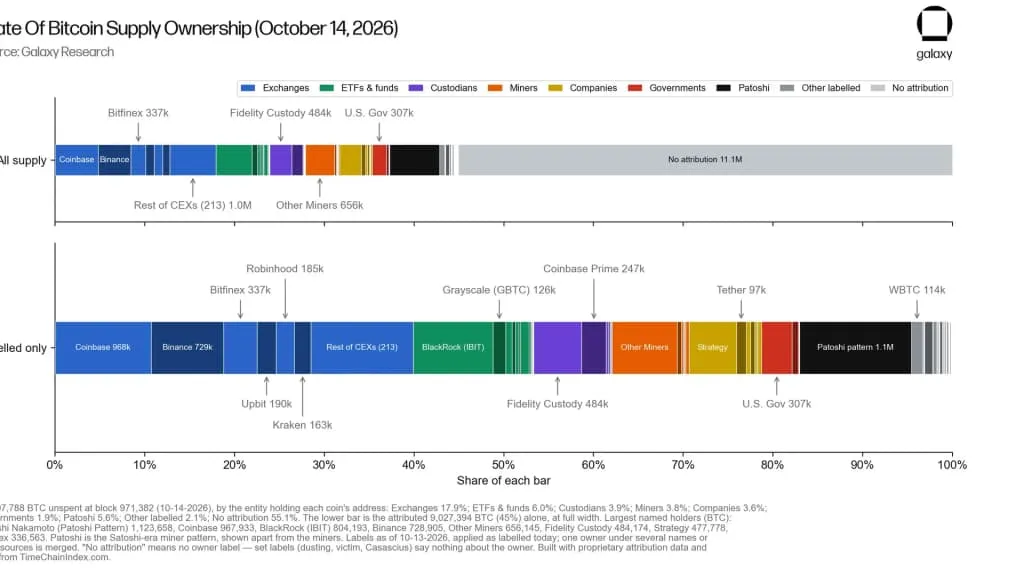
About 11.1 million BTC, or 55% of the 20.1 million Bitcoin mined so far, is held in wallets not linked to exchanges, funds or governments, according to Galaxy Research, CoinDesk reported. Galaxy Research interpreted the data as showing that more than half of Bitcoin’s total supply remains at unidentified addresses even after substantial ownership transfer to institutions, indicating self-custody is still common.
CoinDesk added that the addresses also include cases where keys were lost, holders died, or custody addresses such as over-the-counter trading desks are difficult to track. The known 45% is held by exchanges, spot ETFs, the U.S. government and Bitcoin creator Satoshi Nakamoto, the report said.
08:46
Soneium, an Ethereum layer-two project being jointly developed by Sony and Startale, announced plans on Oct. 26 to introduce tokenized intellectual property and issue its own SONEIUM token.
In an official X post, Soneium said "Soneium" plans to connect creators, fans and investors through tokenized IP. It said its official tokenized IP platform, the Soneium Portal, will support IP discovery and investment, while also rolling out IP Vault for investment in music copyright catalog funds and IP Bond to tokenize K-pop concert royalties. Soneium added the SONEIUM token is being designed as the economic base layer linking creators, IP owners, developers, fans and investors across the ecosystem, with a detailed issuance schedule to be announced later.
Previous related news
08:44
On-chain analyst Axel Adler Jr. said the profit margin for Bitcoin short-term holders with holding periods of under six months, relative to their average purchase price, fell to 5.9% from 8.7% over the past week.
In a blog post, Adler said the average purchase price for short-term holders stood at $76,000 as of Oct. 25, up $1,100 from a week earlier. Adler said if BTC falls below $76,000, short-term holders would enter loss territory on average. Adler added that the group’s average purchase price was 1.56 times that of long-term holders at $48,600, up from 1.36 times in mid-August.
Adler said the 30-day moving average crossed above the 90-day moving average on Sept. 17 in an indicator tracking the ratio between the two groups’ average purchase prices. Adler added that the same ratio had declined for an extended period before the 30-day moving average crossed above the 90-day moving average in May 2019 and February 2023, and the downtrend ended around those signals at the time.