Live Feed
New
Today, October 23, 2026
12:02
Ethereum blockchain explorer Etherscan has launched a beta feature to detect address poisoning scams, Crypto Briefing reported.
The outlet said the tool compares wallet addresses shown on the same page and displays a warning when it finds similar-looking addresses. It explained that address poisoning is a scam in which attackers send small-value or zero-value transactions from fake addresses resembling a victim’s real counterparty, leaving those records in the transaction history. Victims may then mistake the fake address for the real one and copy and paste it into a transfer. Crypto Briefing added that the absence of a warning does not guarantee an address is safe, and users should verify the full recipient address before sending funds rather than checking only the first and last few characters.
12:01
Bitcoin has held around $82,000 while spot ETF inflows continue, but implied volatility has fallen to its lowest level in three years and selling by long-term holders has persisted, according to a CoinNess analysis citing Bitwise.
Bitwise said BTC’s key downside support levels appear to be $74,800, the average cost basis for short-term holders, and $77,600, the market-wide average cost basis. Bitwise added BTC’s implied volatility has dropped to an extremely low level, and while spot ETFs saw net inflows of $1.074 billion this week, the asset has continued to trade sideways as profit-taking by long-term holders has increased and distributed selling has emerged.
11:55
Nasdaq-listed Hong Kong brokerage Futu said on its official X account it has opened BNB deposit and withdrawal services for eligible professional investors only. Futu plans to build an ecosystem spanning traditional securities and cryptocurrencies.
11:36
Bitcoin’s 90-day realized volatility recently stood at about 38%, roughly in line with Nvidia shares but about 1.6 times higher than gold, according to a CoinDesk analysis.
As of Oct. 22, gold’s volatility was 23.5%, the U.S. S&P 500 index was 11%, and the euro/U.S. dollar exchange rate was 4.6%, CoinDesk said. BTC was more than three times as volatile as the S&P 500 and about eight times as volatile as the euro/U.S. dollar pair, while remaining close to Nvidia at 37%. CoinDesk explained that realized volatility measures how sharply an asset’s price moves over a given period. BTC’s 90-day volatility has averaged 58% since 2020, peaked at 134% in June 2020, and fell to a record low of 27.5% in September 2025. While Bitcoin’s price swings have eased significantly from past levels and are now closer to large-cap tech stocks, the asset still has not matched the stability of gold or major fiat currencies.
11:27
Crypto trader Killa said investors can miss larger profit opportunities if they close winning Bitcoin positions too early while BTC repeatedly swings within a range.
In a post on X, Killa pointed to a past case in which the price tested around $62,600 at least 10 times before moving higher. When the price repeatedly fails to break above a previous high, investors lose conviction in existing positions and begin short-term trading within the range, Killa said. While that approach can generate small gains, it can also leave traders sidelined when the price finally breaks out of the range and makes a larger move. Killa added that focusing on the broader trend is far more advantageous than reacting to every small price fluctuation.
11:26
Centrifuge, a real-world asset tokenization protocol, announced the launch of an institutional tokenization infrastructure supporting 13 chains. The fund’s cumulative tokenized assets stand at about $3.5 billion, with total deposits at roughly $1 billion, according to Crypto Briefing.
11:24
U.S. midterm elections could alter the policy environment, but cryptocurrency prices themselves are likely to follow broader macroeconomic factors, according to an HTX Research analysis.
HTX Research said volatility, pullbacks and wider price dispersion among individual cryptocurrencies are more likely before and after the election than a rally driven by a specific political narrative. The research firm added that while the election outcome could change the pace of crypto-related regulation and legislation, markets should watch liquidity indicators from around the election period through the first half of next year.
11:13
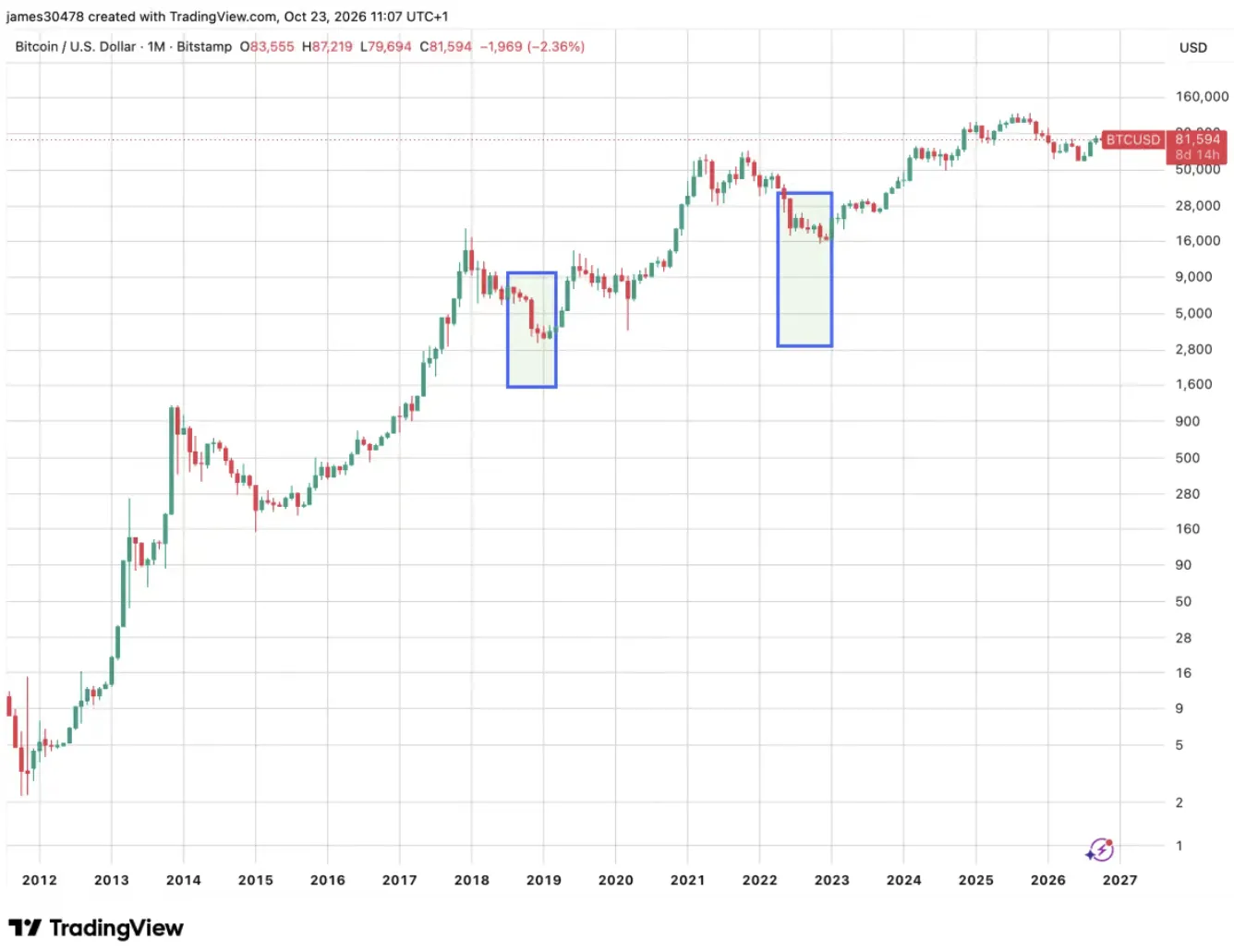
Bitcoin did not follow its past pattern of marking a bear-market bottom shortly after U.S. midterm elections, instead hitting this year’s low on July 1, 125 days before the Nov. 3 election, and then rebounding about 40%, CoinDesk reported.
According to the analysis, BTC marked bear-market lows 71 days, 38 days, and 13 days after the 2014, 2018, and 2022 midterm elections, respectively. This year, however, BTC fell to $57,850 on July 1 and had recovered to about $81,455 as of Oct. 22. CoinDesk added that technology stocks have at times weakened around midterm elections, but the pattern has not been consistent, and Bitcoin’s historical weakness around midterms appears to be more closely tied to its own market cycle than to the elections themselves.
11:06
Traditional finance institutions are moving decisively into the crypto derivatives market, according to a joint report by Glassnode and quant hedge fund Fasanara Digital. The report included the verbatim English phrase "major exchanges" and said perpetual futures tied to underlying assets such as equities, gold, and crude oil are rising rapidly, while crypto-native perpetual futures are expanding into traditional asset trading. That shift is creating direct competition between major exchanges and conventional futures exchanges and brokerages, the report said, adding the derivatives trend has entered a stage of structural entrenchment rather than simple speculation, although round-the-clock trading conditions and leverage risk management remain essential.
10:57
Bloomberg senior commodity analyst Mike McGlone said sharp run-ups followed by pullbacks in assets including Bitcoin, gold and silver this year could spread to other commodity markets by year-end.
In a post on X, McGlone said prices had surged and then retreated this year in U.S. natural gas, BTC, gold, silver, platinum, palladium, lead, nickel and iron ore. He added corn and copper were the next commodities facing elevated downside risk, and said the trend could affect agricultural and metals markets as well as the broader global economy. McGlone also said U.S. stocks may need to remain resilient to prevent a broader chain of declines across commodity markets.
10:38
An anonymous whale deposited 4,000 BTC worth $327 million to Binance and Deribit through two addresses over the past five hours, according to Lookonchain. Such exchange deposits are typically interpreted as intended for selling.
10:33
AI infrastructure credit risks are spreading, weighing on both U.S. stocks and the crypto market, QCP Capital said in a recent report.
QCP Capital said market concerns over debt-reliant companies are spreading across the broader cloud infrastructure industry. The firm added that fiscal risks in European countries including Germany and France have come into focus, while renewed conflict in the Middle East has sent oil prices to a five-month high, adding to inflation uncertainty.
It also said expectations for a Federal Reserve rate cut in December have weakened, driving flows into safe-haven assets such as U.S. Treasuries. Bitcoin, it added, has yet to break away from its role as a risk asset and is weakening alongside U.S. stocks. QCP Capital said funding risks for AI infrastructure companies and demand for safe-haven assets will be key drivers of price volatility going forward.
10:26
Ethena’s synthetic dollar stablecoin USDe will be supported on OKX Wallet and X Layer, OKX’s Ethereum layer-two network. According to Ethena, USDe can be used on X Layer through the decentralized lending protocol AAVE v3. A looping feature allowing users to repeatedly deposit and borrow USDe on OKX Wallet is also set to be added later.
10:21
Raffles Family Office, a family office firm with operations in Singapore and Hong Kong, is building wealth management services aimed at Asia’s newly wealthy cryptocurrency elite, Fortune reported. The firm said traditional financial systems have limits in accommodating large-scale stablecoin holdings and is offering tailored wealth management services.
Fortune added many of Asia’s emerging billionaires amassed wealth in the technology and cryptocurrency industries, making them younger and more risk-tolerant than traditional wealthy clients in the West. As a result, wealth managers are accelerating revamps of services and products to reflect demand from clients with crypto holdings.
09:54
Marinade, a Solana-based liquid staking protocol, announced it had 7.94 million SOL staked as of the third quarter, worth $825 million. That was up 21.2% from the previous quarter. The protocol also said third-quarter revenue came to about $1 million as validator settlement income increased.
09:30
On-chain analyst Axel Adler Jr. said Bitcoin has logged net exchange outflows for a month, while buying and selling pressure in the futures market remains balanced.
In a blog post, Adler said the 30-day average daily net outflow from exchanges recently stood at 1,500 BTC, down by half from a week earlier. Adler explained the sharp drop in the 30-day average was a calculation effect after a large outflow recorded on Sept. 22 dropped out of the measurement window, rather than a result of rising exchange inflows. In the futures market, Adler said the 30-day average of a positioning index measuring the balance between buying and selling pressure was 0.3, indicating no clear directional bias. Adler added that if exchange net outflows continue and the index remains above zero, buying pressure could strengthen, while the opposite scenario could increase selling pressure.
09:03
Bae Kyung-hoon, South Korea’s deputy prime minister for science and ICT minister, stressed the importance of a token economy in the AI era and the need to introduce blockchain, Edaily reported.
Speaking during a comprehensive parliamentary audit by the Ministry of Science and ICT on Oct. 23, Bae said an AI-based society should ensure no citizen faces discrimination or excessive concentration of wealth, while promoting economic and social balance through AI. In that context, Bae said the token economy would be important. Bae added that the token economy concept needs to incorporate blockchain and said the government is designing AI for everyone with all such possibilities left open.
08:57
A total of 2,797.74 BTC worth $228.78 million was deposited to Binance, according to CryptoQuant. The deposit was valued at around 305.8 billion won.
08:34
Aave said on its official website that the first lending market operated by an external institution has launched on Aave V4. Institutional DeFi platform Sentora has opened three lending markets on the Ethereum network and will oversee collateral selection and risk management. Users can borrow the stablecoins RLUSD, PYUSD, and OUSD in those markets using cryptocurrencies as collateral.
08:32
KOSDAQ-listed Billiance plans to remove cryptocurrency issuance, trading and brokerage, along with NFT production and sales, from its business objectives, according to Digital Asset.
Billiance said in a filing yesterday it plans to discuss the matter at an extraordinary shareholders' meeting on Nov. 6. The company is a KOSDAQ-listed entertainment firm engaged in businesses including artist management. It previously pursued an NFT business under the name Blueberry NFT, later became Blade Entertainment, and changed its name to Billiance in 2024.
08:24
NEAR Protocol could enter a more sustained rebound if it breaks above $5.4, according to a U.Today analysis. The outlet said NEAR’s key resistance stands between $5.4 and $5.6, and a daily close above that range could open the way for a retest of $6.
On the downside, U.Today said support is near $4.8, where short-term moving averages are clustered, and a break below that level could send the token down to $4.3, its 50-day moving average. The outlet added NEAR’s relative strength index had been in overbought territory above 85, but has since fallen to around 50, leaving room for further gains. With trading volume declining, whether NEAR breaks below support or above resistance is likely to determine its next direction.
08:16
New York Attorney General Letitia James said she has asked a court to order NovaTechFx founders Cynthia Petion and Eddy Petion to pay $1.3 billion in damages and disgorgement in connection with a cryptocurrency pyramid fraud case. The couple recruited investors by promising high returns to Haitian immigrants and religious communities.
Investors entrusted more than $1 billion in cryptocurrency to NovaTech between August 2019 and April 2023, but less than $26 million was actually traded on NovaTech’s platform, James said.
Separately, prosecutors said they reached an agreement with four top promoters to recover about $6 million for victim relief and bar them from future securities, commodities, and cryptocurrency activities.
Previous related news
08:08
UK-listed digital services firm Smarter Web Company has bought an additional 20 BTC worth about $1.63 million, bringing its holdings to 2,850 BTC valued at $323.65 million, according to Bitcoin Treasuries.
08:03
TRON has deployed the required network upgrade GreatVoyage-v4.8.2.4, focused on improving stability in rare exception scenarios and optimizing smart contract data storage and metadata management. TRON expects the upgrade to reduce the risk of block synchronization disruptions and help maintain stable network performance.
07:37
A wallet believed to be linked to the CYS hacker transferred 300 ETH worth about $721,140 and 30.4 BNB worth about $22,590 to Tornado Cash, PeckShield reported. Tornado Cash is an Ethereum-based mixing protocol designed to obscure cryptocurrency deposit and withdrawal records, making it difficult to trace transaction histories between senders and recipients.