Live Feed
New
Today, October 23, 2026
14:19
The U.S. SEC announced its main regulatory priorities for fiscal 2027 examinations and compliance oversight, saying it will review areas including tokenization and cybersecurity. Key examination areas include retail investor protection, private funds and private credit, broker-dealer trading, anti-money laundering compliance, operational resilience, cybersecurity, and customer information protection. The review will cover more than 34,000 registered entities, including investment advisers, investment companies, broker-dealers, clearing agencies, and other market participants.
14:02
Cysic said it plans to burn 7.2 million CYS from the foundation’s holdings by the end of October to offset tokens that were illicitly minted in a recent cross-chain bridge hack. The move is intended to align token supply with the project’s existing tokenomics, and Cysic said it will disclose the on-chain record once the burn is complete. Earlier, the bridge exploit caused about $727,000 in losses on Oct. 17, according to the project.
Previous related news
14:00
China aims to complete most of its national blockchain network by 2030, Cointelegraph reported.
According to the outlet, a five-year plan released on Oct. 23 by the Central Cyberspace Affairs Commission of the Chinese Communist Party calls for broader blockchain adoption in trade and finance in the Yangtze River Delta and in manufacturing and agriculture in the Chengdu-Chongqing region. The plan also includes strengthening technical standards and expanding blockchain use in data circulation and trading. The national blockchain network was included in a national development plan in March and was also identified as a policy task in a joint policy released on Oct. 9. China bans cryptocurrency-related businesses while continuing to support blockchain technology development.
13:45
The U.S. October services purchasing managers’ index, or PMI, came in at 57.9, matching the market forecast of 57.9, while the manufacturing PMI rose to 56.0, above expectations of 55.4.
A PMI reading above 50 indicates expansion, while a reading below 50 signals contraction. The Federal Reserve uses the data as one reference point when assessing economic momentum and price pressures for interest-rate decisions. Readings above forecasts can support consideration of holding rates steady or raising them, or delaying rate cuts, to prevent overheating, while weaker-than-expected readings can support consideration of rate cuts to bolster the economy. Beyond whether the headline index beats or misses estimates, the size of the gap versus forecasts and detailed price indicators can also affect markets.
13:38
James Wynn, a well-known trader on Hyperliquid, resumed trading after 49 days by opening a 40x leveraged BTC short position worth 0.4947 BTC, or about $40,500, according to Lookonchain. The liquidation price is $82,671.48. Wynn was previously liquidated on a 1.86 BTC long position in September.
13:33
Prediction market platform Kalshi plans to launch futures products in December tied to the U.S. Consumer Price Index and core inflation measures, according to Bloomberg. To design the contracts and attract large institutional investors, Kalshi has hired former Barclays trader Michael Ashton, who is known as an inflation specialist.
13:33
The three major U.S. stock indices opened lower today.
- S&P 500: -0.42%
- Nasdaq: -0.22%
- Dow Jones: -1.05%
13:28
Interpol said a cybercrime crackdown carried out with 21 countries led to 1,462 arrests and the recovery of $105 million, according to Decrypt. The operation ran from June 29 to Aug. 31, 2026.
In Angola, authorities uncovered two illegal cryptocurrency mining sites and seized more than 2,000 mining machines as well as six illegal power-conversion facilities worth $1 million. In Nigeria, authorities tracked $2.4 million in proceeds from investment fraud, and a substantial portion was found to have been laundered through cryptocurrency transactions.
13:19
Franklin Templeton has received Nasdaq approval to list two ETFs that reinvest dividends from U.S. stocks into Bitcoin-related products, CoinGape reported.
According to an SEC filing, the funds are the Franklin U.S. Equity Bitcoin DRIP Index ETF (FBEQ) and the Franklin U.S. Innovation Bitcoin DRIP Index ETF (FIBT). The two ETFs will initially allocate 95% of assets to U.S. equities and 5% to BTC-related products. FBEQ will invest in 500 large-cap U.S. stocks, while FIBT will target 100 Nasdaq-listed innovation-focused companies. Regular and special dividends generated by the stock holdings will then be invested in BTC-related products instead of being used to buy additional shares or paid out in cash. The BTC allocation will be reset to 4.5% if it rises above 5% during quarterly rebalancing, while also remaining capped at 20% between rebalancing periods. BTC exposure will be gained through exchange-traded products, or ETPs, among other instruments, and both ETFs carry a 0.09% management fee.
13:11
Aptos announced the addition of privacy features to its mainnet that allow users to selectively protect identity, transfer amounts and transaction intent. The rollout includes Keyless Accounts, which let users create wallets with Google or Apple accounts; Confidential APT, which uses zero-knowledge proofs to encrypt balances and transfer amounts; and an Encrypted Mempool, which encrypts transaction data until block finalization to defend against maximum extractable value, or MEV.
13:10
Crypto wallet provider Phantom will begin supporting trading in Kalshi prediction market contracts for U.S. users starting today, according to The Block. Users will be able to trade Kalshi contracts directly in the Phantom app, and the rollout will expand gradually over the coming weeks.
Trading will be restricted in some areas as Kalshi is in legal disputes with several state governments over its opposition to the application of state gambling laws based on federal regulation. Phantom general counsel Kevin Jacobs said the Commodity Futures Trading Commission's jurisdiction is clear and saw no issue as long as Phantom's support model meets the conditions for CFTC enforcement relief. Phantom plans to comply with state-by-state rules while the disputes continue.
13:05
CryptoQuant CEO Ki Young Ju said it may be time to sell stocks and commodities facing bearish outlooks and rotate into Bitcoin. According to analyst consensus data Ju shared on X, the stocks with some of the most bearish outlooks include KB Home, Citigroup, T-Mobile, Eversource Energy, Oracle and CoreWeave, while platinum and silver rank among the commodities with the weakest outlooks. He added, "it may be time to sell these assets and rotate into BTC."
13:00
Bitcoin derivatives trading volume on the Chicago Mercantile Exchange reached $326.7 billion in the third quarter, while Ethereum derivatives volume totaled $118.8 billion, bringing overall cryptocurrency trading volume to $469.5 billion. CME’s total third-quarter revenue also hit a record high of $1.737 billion.
12:41
Vet, an XRP Ledger community leader and validator, argued that broad XRPL usage and adoption should come first, with any XRP price gains following as a result.
In a post on X, Vet said XRPL has supported multiple assets since 2012. XRP is used not only for reserves, account maintenance and fees, but also for auto-bridging on the network’s decentralized exchange, allowing trades between assets. Vet added that XRP does not depend on a specific issuer, can be transferred by anyone, and unlike other tokens, cannot be frozen. As XRPL sees wider use across payments, tokenization, credit and trading, more transactions may use XRP as a bridge asset, Vet said.
12:30
Bitcoin has remained relatively resilient despite volatility across risk assets, supported by a recovery in spot buying, improving stock-market sentiment and short covering, according to a CoinShares analysis.
As market attention shifted from the AI narrative to corporate earnings, BTC showed relatively strong resilience despite weak results from some companies, CoinShares said. CoinShares added inflation pressures have persisted, with both the Consumer Price Index and Producer Price Index coming in above expectations, while the market sees an 83% chance of another Federal Reserve rate hike in December. Improving spot demand is supporting the downside, but inflation pressure and rate-hike concerns are also limiting further gains, CoinShares said.
12:16
Cryptocurrency self-custody still finds it difficult to deliver both strong security and ease of use, Cointelegraph reported. The outlet said self-custody gives users direct control over assets by managing private keys themselves, but complex security procedures remain a barrier to broader adoption. Multi-signature wallets, which require multiple private keys to approve transactions, can improve security, although key management and recovery processes are more complex. Seedless wallets, which remove the need for a recovery phrase, are easier to use, but users could permanently lose funds if all devices storing their private keys are lost.
In that regard, Foundation CEO Zach Herbert said wallet funds can still be drained if users are tricked into approving malicious transactions, even without their private keys being stolen.
12:02
Ethereum blockchain explorer Etherscan has launched a beta feature to detect address poisoning scams, Crypto Briefing reported.
The outlet said the tool compares wallet addresses shown on the same page and displays a warning when it finds similar-looking addresses. It explained that address poisoning is a scam in which attackers send small-value or zero-value transactions from fake addresses resembling a victim’s real counterparty, leaving those records in the transaction history. Victims may then mistake the fake address for the real one and copy and paste it into a transfer. Crypto Briefing added that the absence of a warning does not guarantee an address is safe, and users should verify the full recipient address before sending funds rather than checking only the first and last few characters.
12:01
Bitcoin has held around $82,000 while spot ETF inflows continue, but implied volatility has fallen to its lowest level in three years and selling by long-term holders has persisted, according to a CoinNess analysis citing Bitwise.
Bitwise said BTC’s key downside support levels appear to be $74,800, the average cost basis for short-term holders, and $77,600, the market-wide average cost basis. Bitwise added BTC’s implied volatility has dropped to an extremely low level, and while spot ETFs saw net inflows of $1.074 billion this week, the asset has continued to trade sideways as profit-taking by long-term holders has increased and distributed selling has emerged.
11:55
Nasdaq-listed Hong Kong brokerage Futu said on its official X account it has opened BNB deposit and withdrawal services for eligible professional investors only. Futu plans to build an ecosystem spanning traditional securities and cryptocurrencies.
11:36
Bitcoin’s 90-day realized volatility recently stood at about 38%, roughly in line with Nvidia shares but about 1.6 times higher than gold, according to a CoinDesk analysis.
As of Oct. 22, gold’s volatility was 23.5%, the U.S. S&P 500 index was 11%, and the euro/U.S. dollar exchange rate was 4.6%, CoinDesk said. BTC was more than three times as volatile as the S&P 500 and about eight times as volatile as the euro/U.S. dollar pair, while remaining close to Nvidia at 37%. CoinDesk explained that realized volatility measures how sharply an asset’s price moves over a given period. BTC’s 90-day volatility has averaged 58% since 2020, peaked at 134% in June 2020, and fell to a record low of 27.5% in September 2025. While Bitcoin’s price swings have eased significantly from past levels and are now closer to large-cap tech stocks, the asset still has not matched the stability of gold or major fiat currencies.
11:27
Crypto trader Killa said investors can miss larger profit opportunities if they close winning Bitcoin positions too early while BTC repeatedly swings within a range.
In a post on X, Killa pointed to a past case in which the price tested around $62,600 at least 10 times before moving higher. When the price repeatedly fails to break above a previous high, investors lose conviction in existing positions and begin short-term trading within the range, Killa said. While that approach can generate small gains, it can also leave traders sidelined when the price finally breaks out of the range and makes a larger move. Killa added that focusing on the broader trend is far more advantageous than reacting to every small price fluctuation.
11:26
Centrifuge, a real-world asset tokenization protocol, announced the launch of an institutional tokenization infrastructure supporting 13 chains. The fund’s cumulative tokenized assets stand at about $3.5 billion, with total deposits at roughly $1 billion, according to Crypto Briefing.
11:24
U.S. midterm elections could alter the policy environment, but cryptocurrency prices themselves are likely to follow broader macroeconomic factors, according to an HTX Research analysis.
HTX Research said volatility, pullbacks and wider price dispersion among individual cryptocurrencies are more likely before and after the election than a rally driven by a specific political narrative. The research firm added that while the election outcome could change the pace of crypto-related regulation and legislation, markets should watch liquidity indicators from around the election period through the first half of next year.
11:13
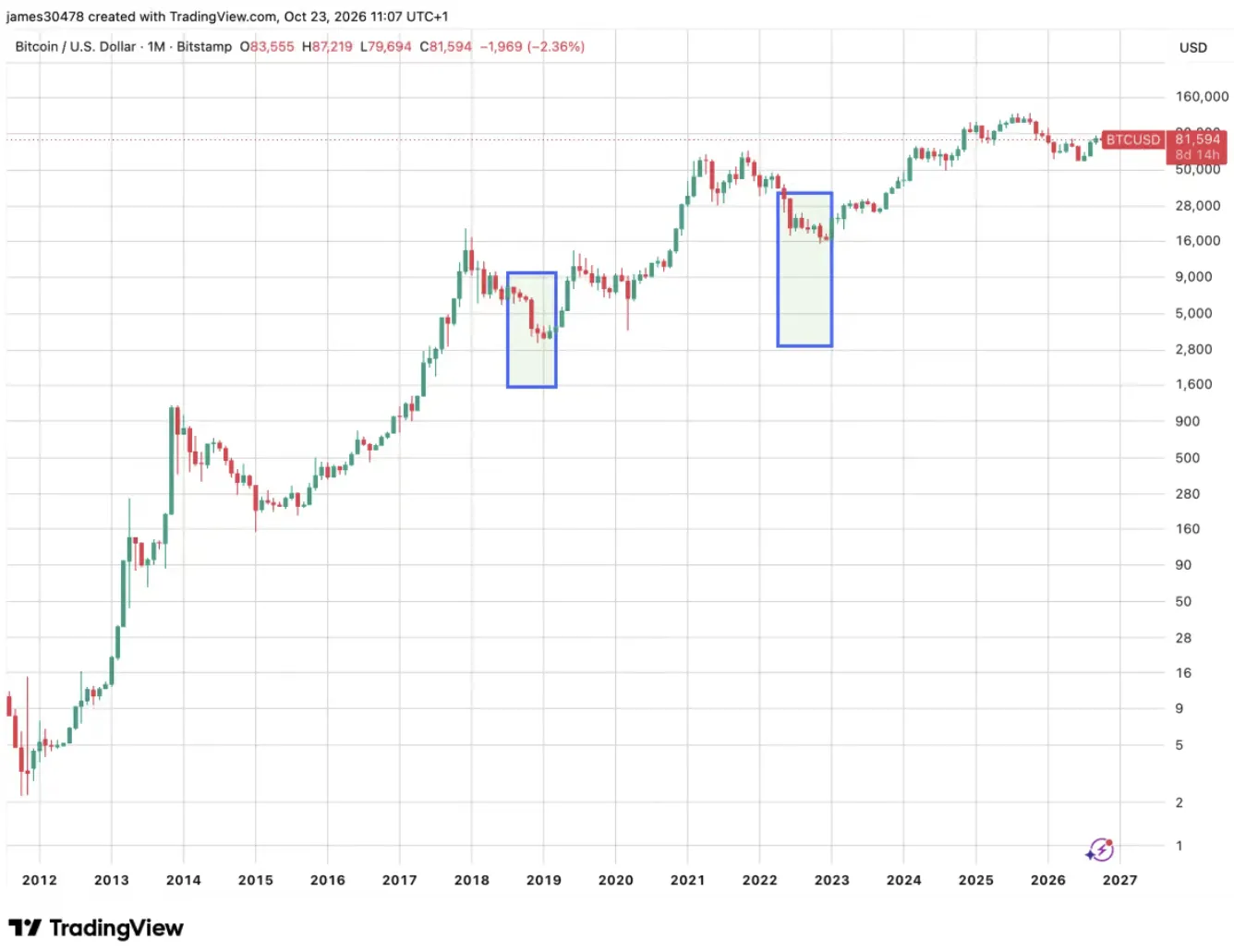
Bitcoin did not follow its past pattern of marking a bear-market bottom shortly after U.S. midterm elections, instead hitting this year’s low on July 1, 125 days before the Nov. 3 election, and then rebounding about 40%, CoinDesk reported.
According to the analysis, BTC marked bear-market lows 71 days, 38 days, and 13 days after the 2014, 2018, and 2022 midterm elections, respectively. This year, however, BTC fell to $57,850 on July 1 and had recovered to about $81,455 as of Oct. 22. CoinDesk added that technology stocks have at times weakened around midterm elections, but the pattern has not been consistent, and Bitcoin’s historical weakness around midterms appears to be more closely tied to its own market cycle than to the elections themselves.
11:06
Traditional finance institutions are moving decisively into the crypto derivatives market, according to a joint report by Glassnode and quant hedge fund Fasanara Digital. The report included the verbatim English phrase "major exchanges" and said perpetual futures tied to underlying assets such as equities, gold, and crude oil are rising rapidly, while crypto-native perpetual futures are expanding into traditional asset trading. That shift is creating direct competition between major exchanges and conventional futures exchanges and brokerages, the report said, adding the derivatives trend has entered a stage of structural entrenchment rather than simple speculation, although round-the-clock trading conditions and leverage risk management remain essential.