Live Feed
New
Today, October 28, 2026
06:57
U.S. spot Bitcoin ETFs recorded a net inflow of $176 million on Oct. 27, marking a second straight trading day of net inflows, according to Farside Investors.
- BlackRock IBIT: +$151.5 million
- Fidelity FBTC: +$24.5 million
06:56
U.S. spot Ethereum ETFs recorded a net outflow of $60.2 million on Oct. 27, marking a second consecutive trading day of net withdrawals, according to SoSoValue.
- BlackRock ETHA: -$93.3 million
- Fidelity FETH: +$28.6 million
- Grayscale Mini ETH: +$4.5 million
06:52
A hacker who stole large amounts of cryptocurrency from users who bought Ledger hardware wallets through Southeast Asian distributor CryptoBilis on Oct. 9 deposited another 1,200 ETH worth about $2.78 million into Tornado Cash on Oct. 27, according to blockchain security firm Salus.
The hacker first sent 600.1 ETH each from a wallet holding the stolen funds to two new wallets, then used those wallets to deposit 100 ETH at a time into Tornado Cash in six transactions each, for 12 transactions in total. Ledger said on Oct. 11 it had found an unauthorized hardware component inserted into one of the affected devices. On-chain analytics firm Bitquery estimated total losses from the incident at about $102 million.
06:36
Predict.fun, a prediction-market platform backed by Binance, has unveiled the tokenomics for its native token PREDICT.
The total supply is fixed at 1 billion PREDICT, with 16% of the supply set to unlock at the token generation event. The full supply is scheduled to unlock over five years. For the Season 1 airdrop, 70 million tokens, or 7% of total supply, have been allocated.
Eligible users can choose either to receive 35% of their allocation immediately or 100% over 12 months. Users who do not choose a claim method within one month after claims open will lose eligibility to receive the tokens. The airdrop claim date is set to be announced within the next 24 hours.
PREDICT will be distributed as rewards to users who participate in trading, liquidity provision, and community activities. Token allocation is as follows:
- Ecosystem and community: 51.95%
- Early investors: 26.05%
- Core contributors: 10%
- Foundation treasury: 8%
- Liquidity: 4%
Previous related news
06:35
Nasdaq-listed Canadian crypto miner Hive Digital Technologies (HIVE) said it entered into a roughly $129 million loan agreement to expand its artificial intelligence infrastructure. Through its subsidiary BUZZ HPC, the company will borrow the funds for three years at a fixed 9% annual rate and plans to use them to buy AI infrastructure including Nvidia GPUs.
The infrastructure will be deployed under a three-year contract with Canadian AI company Cohere. According to BitcoinTreasuries.net, Hive currently holds 150 BTC.
06:29
Stable, a layer-one blockchain focused on stablecoin payments, said it plans to upgrade its mainnet to v1.9.0 on Oct. 31.
The upgrade is focused on introducing additional safeguards for transaction execution and improving network reliability and fund safety in the staking process, it said.
06:14
Bitcoin’s daily transaction count rose by roughly twofold from about 372,000 in January 2025 to 700,000-800,000 in October 2026, but the increase appears to reflect improved transaction-processing efficiency more than a rise in actual demand, according to a Crypto Briefing analysis.
Crypto Briefing said more low-value transactions using SegWit, which separates signature data from transaction data to take up less block space, allowed more transactions to be recorded in a single block. Transactions of less than 0.01 BTC now account for about 80% of total activity, while block space utilization has reached about 98%. Even so, average transaction fees had fallen to about $0.32 by late October. The outlet said if demand had truly surged, competition for block space would likely have pushed fees higher.
It also noted miners’ fee income is declining despite the rise in transaction volume. If mining rewards continue to shrink and fee revenue remains weak, maintaining Bitcoin network security over the long term could become more difficult.
06:14
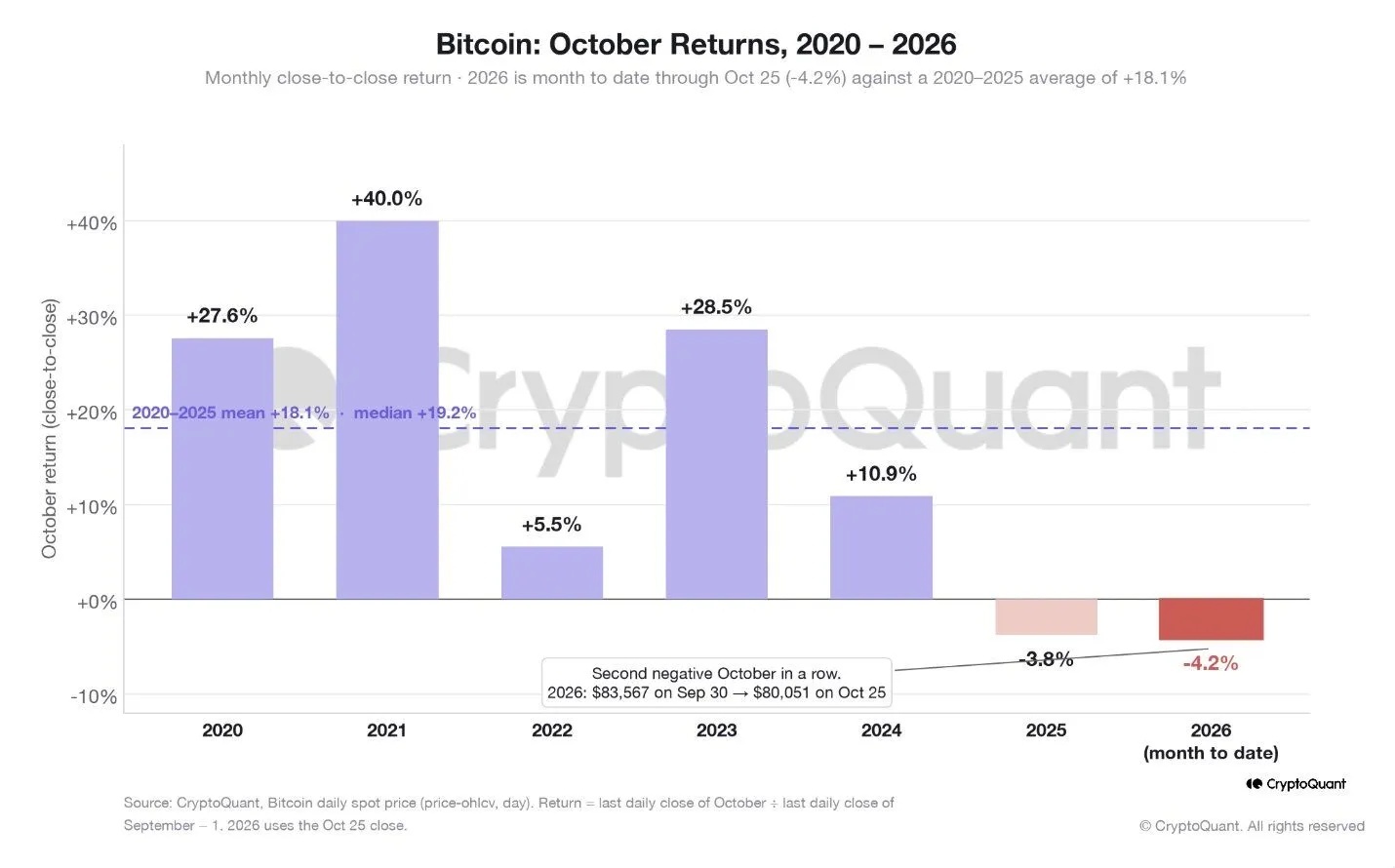
Cointelegraph reported that “Uptober,” the pattern of crypto gains in October that held from 2019 through 2024, is at risk of failing for a second consecutive year. Although October has not ended, if the monthly candle closes at current levels, the market would post a negative monthly candle with a roughly 4.2% decline, making this October another losing month after last year. Meanwhile, BTC was trading at $80,796.71, up 1.21% over the past 24 hours, according to CoinMarketCap.
06:09
South Korean police have launched a preliminary investigation into newly confirmed hacking incidents at Mirae Asset Global Investments, Daishin Securities and crypto exchange Bithumb, Newsis reported on Tuesday.
South Korea’s National Office of Investigation said it had opened a pre-indictment probe into the additional cyberattacks affecting the financial sector. A police official said authorities were confirming further hacking damage and examining possible links to earlier hacking cases in the financial industry.
Previous related news
06:06
The following are the 24-hour long/short ratios for BTC perpetual futures on the world’s three largest crypto futures exchanges by open interest:
Overall: 50% long, 50% short
- Binance: 48.99% long, 51.01% short
- OKX: 50.81% long, 49.19% short
- Bybit: 52.02% long, 47.98% short
06:05
Tether’s stablecoin USAT, launched for the U.S. market, is a separate token from USDT with a different issuer and legal liability structure, U.S. crypto lawyer Kelman Law said, according to Bitcoin.com.
Bitcoin.com said Anchorage Digital Bank, a federally chartered U.S. bank, is the sole issuer of USAT, while Tether supports the token’s technology, branding, distribution and strategy. Cantor Fitzgerald was designated as the reserve custodian and a primary dealer, the outlet said.
The outlet explained that USAT was designed to align with the GENIUS Act, a U.S. stablecoin bill, but has not yet received issuance approval. It added that the issuer regulatory framework under the GENIUS Act is scheduled to take effect on Jan. 18, and that the U.S. Office of the Comptroller of the Currency had not yet opened the related application process as of Oct. 27, 2026.
06:00
Large-scale access attempts from North Korean internet protocol ranges were detected in hacking attempts targeting the financial sector, Yonhap News TV reported. It is the first official confirmation of attacks involving North Korean IPs since a hacking incident affecting the financial industry became known earlier this month.
According to the financial industry, South Korean financial authorities on Oct. 21 shared an official notice through the Financial Security Institute’s integrated monitoring system, FIRST, with financial companies including cryptocurrency exchanges. The notice warned of scan-type access attempts targeting the financial sector from North Korean IPs.
Authorities said they detected a large volume of signs indicating multiple North Korean IPs had been continuously attempting scan-type access against the financial sector since 6:00 p.m. UTC on Oct. 20.
Previous related news
05:51
A securities filing tied to Anthropic’s IPO shows the U.S. government sold 4,453,900 seized FTX Series B shares in the AI company for $627 million, according to BeInCrypto. The sale proceeds were transferred to the FTX bankruptcy estate for creditor repayments.
Anthropic, the developer of Claude, bought the shares from the U.S. government in October 2025 at $140.9676 per share and then resold them at the same price to nine private investors. If Anthropic’s valuation reaches $1.5 trillion, the stake would be worth about $3.94 billion, the report said. The company is seen as potentially commanding a valuation of as much as $2 trillion.
Previous related news
05:40
Two vulnerabilities have been found in Bitcoinjs-lib, a Bitcoin application development library, that could understate actual mining fees and bypass safeguards, CryptoSlate reported.
The flaws arise during the handling of partially signed Bitcoin transactions, or PSBTs, a method defined in BIP-174 for passing transaction data and signatures between clients. In a demonstration case, the actual fee was 900 million satoshis, but the library calculated it as 200 satoshis, and no default fee-rate warning was triggered during signature verification or transaction extraction. Another issue showed that if all amount records for confirmed inputs were missing, the fee calculator treated those inputs as zero. BitcoinJS has released patched versions 5.2.2, 6.1.9 and 7.0.4, and recommended that developers update the library and validate PSBT inputs.
05:26
Moody’s has assigned Ripple’s dollar-pegged stablecoin RLUSD an A2 long-term deposit credit rating and a P-1 short-term deposit credit rating, the highest short-term tier, The Defiant reported.
The rating applies only to RLUSD issued directly by Ripple subsidiary Standard Custody & Trust Company (SCTC) on the XRP Ledger and Ethereum networks. Moody’s said RLUSD reserves are made up mainly of highly liquid assets including short-term U.S. Treasuries and cash, and viewed positively the issuer’s target of maintaining a 103% reserve collateral ratio. It added that if the issuer were to go bankrupt, token holders do not have direct ownership rights over the reserves, which could delay redemptions.
05:22
An anonymous Polymarket account, swisstony, generated about $12.25 million in profits from sports betting, the Financial Times reported. Based on the FT’s analysis of 1.2 million Polymarket user accounts and around 170 million betting records since April 2026, swisstony posted the largest profit among the accounts reviewed. The account’s cumulative wagers totaled about $657 million, with an average return of 1.86%, as the gains were built by consistently reinvesting capital. The account has not placed any new bets over the past two months, however, and its identity remains unknown. Separately, 68% of accounts that placed bets of more than $100 recorded losses.
05:19
South Korean exchange Bithumb announced a temporary suspension of KLY withdrawals due to an issue on the Klayer network.
05:11
Payward, the parent company of cryptocurrency exchange Kraken, has obtained in-principle approval from Kazakhstan’s Astana Financial Services Authority (AFSA) to operate a local crypto business, NewsBTC reported.
The approval covers operations by Payward Kazakhstan within the Astana International Financial Centre (AIFC), including a digital asset trading platform, investment product trading, and asset custody services. Payward plans to let local users access the order book and liquidity of its existing global trading network. No specific launch timeline was disclosed.
05:05
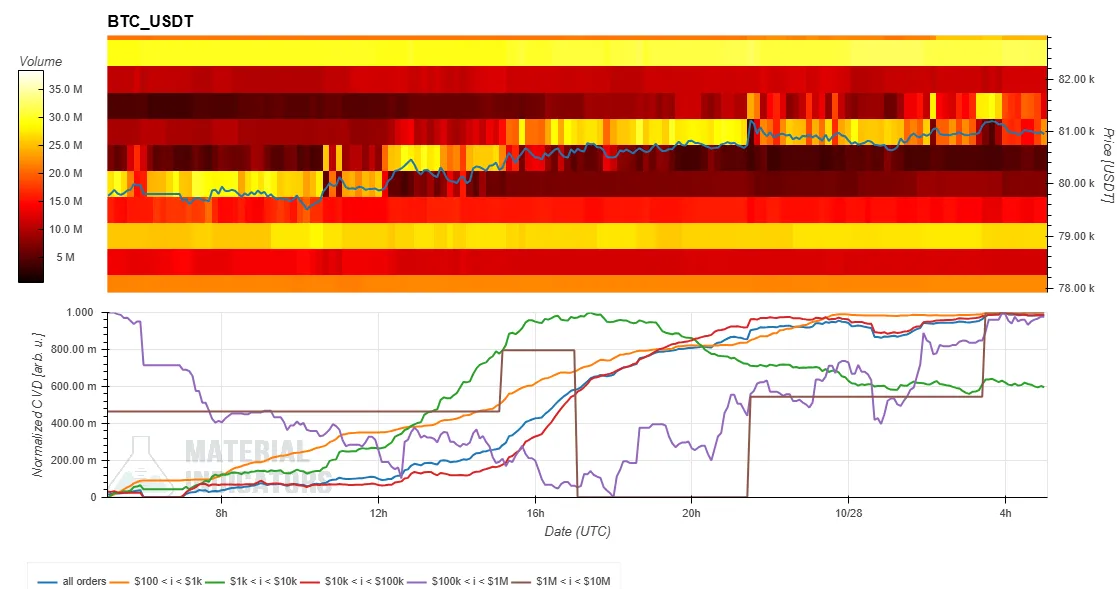
The spot CVD chart for the BTC/USDT spot trading pair is an order-book analysis chart in which the upper panel shows the volume heatmap and the lower panel shows cumulative volume delta, or CVD.
- The upper volume heatmap tracks trading volume at each price level, and the background color becomes brighter when the price stays in a specific range for an extended period or makes a large move. Brighter areas may act as support or resistance.
- The lower CVD indicator reflects buy and sell orders by order size, and the line for each color rises as buying orders increase in that bracket. The yellow line represents orders worth $100 to $1,000, while the brown line is based on large orders worth $1 million to $10 million.
04:23
USDC circulating on Circle’s layer-1 blockchain Arc has surpassed $1 billion, Arc said on its official X account.
04:14
Robinhood CEO Vlad Tenev said regulatory uncertainty around tokenization in the U.S. could limit the entry of large-scale assets into the market, Cointelegraph reported. During the company’s third-quarter earnings call, Tenev said the U.S. SEC’s temporary exemption for security tokens was a positive step, but added clients may hesitate to commit large amounts of capital because it is difficult to predict how the regulatory environment will evolve over the next five years. Tenev said additional rulemaking or legislation is needed to secure long-term regulatory stability.
04:09
South Korea’s Financial Supervisory Service has sent an on-site inspection team to South Korean crypto exchange Bithumb after a hacking breach was confirmed, and is reviewing the circumstances of the incident and the company’s response, Money Today Broadcasting reported.
The regulator plans to escalate the on-site inspection into a formal examination if violations of the law are uncovered during the process, according to the report.
Previous related news
04:08
Prediction market platform Kalshi will cap monthly deposits at $2,500 for users ages 18 to 20 under a new policy aimed at preventing excessive risk-taking by younger users, Cointelegraph reported.
04:00
Tokenized money is seeing broader adoption among global large companies, according to a DBS survey of 422 executives and finance chiefs at companies with annual revenue of at least $500 million. The survey found 88% of respondents had already adopted tokenized money such as stablecoins or were running pilot programs.
Among them, about two-thirds said they had moved into full deployment or live operations in some regions. By use case, stablecoins were the most widely used at 63%, followed by deposit tokens at 53% and tokenized money market funds at 52%. The findings suggest companies are increasingly using multiple forms of tokenized financial products rather than relying on a single instrument.
03:57
Former Messari analyst Tulip King argued that crypto holders lack the legal protections available to equity investors, making long-term token buybacks necessary for projects.
King said on X that shareholders can exercise voting rights and hold companies legally accountable, while crypto holders generally lack those rights. Even when a project generates revenue, token holders often do not own any stake in the company that receives that profit, King said, adding that holders are ultimately left relying on promises from project teams. As a result, teams have a moral responsibility to show long-term alignment with token holders through buybacks even without a legal obligation, King said.
King added that buybacks can help lift prices by reducing circulating supply and support prices during market downturns, although those effects can compound over time only if the project’s business remains sustainable.