Live Feed
New
Today, October 24, 2026
13:34
Jeff Yan, founder of decentralized perpetual futures trading platform Hyperliquid (HYPE), said U.S. crypto regulation should target the companies that actually operate trading services rather than blockchains themselves. Yan said establishing a framework that places compliance obligations on trading service operators could open a path for U.S. users to legally access Hyperliquid.
12:55
Pump.fun, a Solana-based memecoin issuance platform, generated $1.98 million in protocol revenue over the past 24 hours, surpassing Hyperliquid’s $1.96 million, according to DefiLlama data. Pump.fun ranked third in 24-hour revenue, behind Tether at $17.28 million and Circle at $6.88 million.
12:37
Bitcoin Magazine said on X that BTC’s realized cap is rising, which it viewed as a sign that new money is entering the market. The outlet added that, historically, gains in realized cap have signaled the start of a new bull market.
Realized cap is a market capitalization metric based on the price at which each BTC last moved on-chain, rather than the current market price. A rise in the indicator means Bitcoin’s on-chain valuation is increasing, and it is used as one gauge of fresh capital inflows.
12:34
Solayer’s payment service Solayer Pay has introduced direct stablecoin deposits across five blockchains: Solana, Ethereum, Arbitrum, BNB Chain, and Base.
Users can top up Solayer Pay balances with supported stablecoins such as USDC and USDT held on those networks without a separate bridging process, according to Solayer. The topped-up balance can be used through virtual and physical payment cards in supported regions, while mobile wallet integration and person-to-person transfers are also available. Solayer said Solayer Pay card users now exceed 45,000.
12:23
Bitcoin wallet Electrum has released version 4.8.3 to fix a critical security vulnerability and urged all users to update. In a post on X, Electrum said, "this update resolves a major security issue," and strongly recommended all users upgrade to the latest version.
12:13
Apex Group founder and CEO Peter Hughes said a delay in advancing the U.S. CLARITY Act could push digital asset companies toward Asia, the Middle East and Bermuda, according to a CoinDesk interview.
Hughes said companies would look for solutions in other regions if U.S. regulatory uncertainty persists, adding that jurisdictions moving faster to establish regulatory frameworks could benefit. He also said the European Union’s Markets in Crypto-Assets regulation, or MiCA, remains slow to evolve and overly restrictive, making Europe less likely to benefit from the U.S. legislative delay.
The U.S. Senate previously failed to pass the CLARITY Act in September after the bill did not secure the 60 votes needed for consideration. Separately, Hughes said tokenized money market funds could accelerate blockchain adoption by institutional investors. He said tokenized MMFs can offer higher yields than traditional bank deposits and can also be used to raise funds against held assets as collateral.
11:40
Ethereum co-founder and Consensys founder Joseph Lubin said in a CNBC interview that AI and cryptocurrencies will ultimately converge into a single system.
Lubin said AI can provide creativity and expertise but cannot generate trust on its own, adding that blockchain can help address that limitation. He said blockchain could be used in workflows where one AI agent assigns tasks to another, verifies the results, and then makes payment. Lubin added that Ethereum’s decentralized protocols provide the trust foundation needed for such transactions and could evolve into core payment infrastructure for transactions between AI agents.
On U.S. crypto regulation, Lubin said congressional legislation is being delayed, but added that he expects regulatory clarity to emerge through the SEC and the CFTC.
11:35
Tether, the issuer of the USDT stablecoin, said it is working with 15 Bitcoin mining-related companies including Bitmain, Bitdeer, Canaan and F2Pool to build MDK, an open-source Mining Development Kit.
Tether said MDK is designed to connect mining rigs and mining pool management systems from different manufacturers through a common interface, allowing multiple mining environments to be managed through a single program. Using MDK, the company said, developers can build systems that use AI to monitor mining equipment, detect problems and optimize performance, automating operational tasks. Participating companies plan to develop and maintain functions that let existing equipment integrate with MDK without requiring hardware replacement.
11:30
A wallet tied to crypto investment firm Abraxas Capital has recorded $193 million in cumulative profit and loss from trading perpetual futures on Hyperliquid, setting a record high. The wallet now has the highest cumulative perpetual futures profit on Hyperliquid.
Still, the position is hedged with spot holdings, so the full $193 million should not be viewed as net realized profit. The wallet currently holds about $207.44 million in USDC, with cumulative trading volume of $5.43 billion and open interest of $725 million.
11:28
Hong Kong-based stablecoin payments firm RedotPay has acquired Japanese cryptocurrency exchange BTCBOX. Through the acquisition, RedotPay plans to offer crypto services that comply with local Japanese regulations.
BTCBOX was founded in 2014 and was registered as a Japanese cryptocurrency exchange operator in September 2017. The exchange fully suspended services in January after a customer data leak and resumed them in stages from August. RedotPay plans to provide BTCBOX with funding and technical support.
11:24
Aave lowered the utilization threshold at which USDT borrowing rates begin rising sharply to 92% from 94% in the Ethereum core market. The utilization rate refers to the share of deposited USDT that has been lent out.
Under the change, borrowing costs will climb faster once 92% of total deposits are loaned out. The structure can curb excessive borrowing demand by raising loan costs, while also encouraging additional inflows through higher deposit yields.
At a 94% utilization rate, the annual borrowing rate rises to 7% from 4.5%, and it climbs to 14.5% if utilization reaches 100%. According to risk management firm LlamaRisk, lowering the threshold to 92% from 94% would leave about 57.84 million more USDT unlent, based on total deposits of about 2.8922 billion USDT.
11:12
Motley Fool, a U.S. investment research firm, said Solana is a more attractive investment than XRP, citing stronger network activity, transaction-processing capacity, and stablecoin usage.
Solana processed 3.18 billion non-vote transactions in September, while stablecoin supply on the network stood between $17.3 billion and $17.5 billion and daily active stablecoin addresses reached 888,000, according to the firm. By contrast, XRP Ledger recorded 222.4 million transactions in the second quarter of this year, and its stablecoin market was valued at $1.11 billion.
11:07
Bloomberg said it has incorporated the Basel Committee on Banking Supervision’s crypto prudential standards into its cryptocurrency investment risk analytics service for banks and asset managers.
The update allows financial institutions to identify and classify risk exposure not only from directly held cryptocurrencies, but also from indirect crypto investments made through funds, stocks, and derivatives. Users can also review the basis for each asset classification, with the related data available through the Bloomberg Terminal and the company’s enterprise data services.
08:57
Layer-1 blockchain Initia said an attack exploiting a script-caching bug in Initia’s MoveVM occurred at around 2:59 p.m. UTC on Oct. 23, according to the project’s official X account.
The attacker bypassed security checks, forged the MoveVM state and allocated WETH, iUSD and USDC to the attacker’s own accounts without posting actual collateral, Initia said. It added that the total supply of those tokens did not change, no native INIT tokens were minted and INIT’s total supply was unaffected.
Before the network was halted, the attacker bridged out assets worth about $2.7 million, including 105 WETH and about 1.4 million AUSD0 through LayerZero and about 1.08 million USDC through Noble and CCTP, the post said. The stolen funds were then swapped into 1,135.52 ETH and are now being held at an Ethereum mainnet address beginning with 0x358.
Initia said the team is applying a security patch for the vulnerability and expects to complete the work and an audit within days. It added that recovery efforts are underway with security partners. Initia’s L1 and rollups remain offline, and the team plans to release a post-incident analysis report after the network safely resumes.
Previous related news
08:53
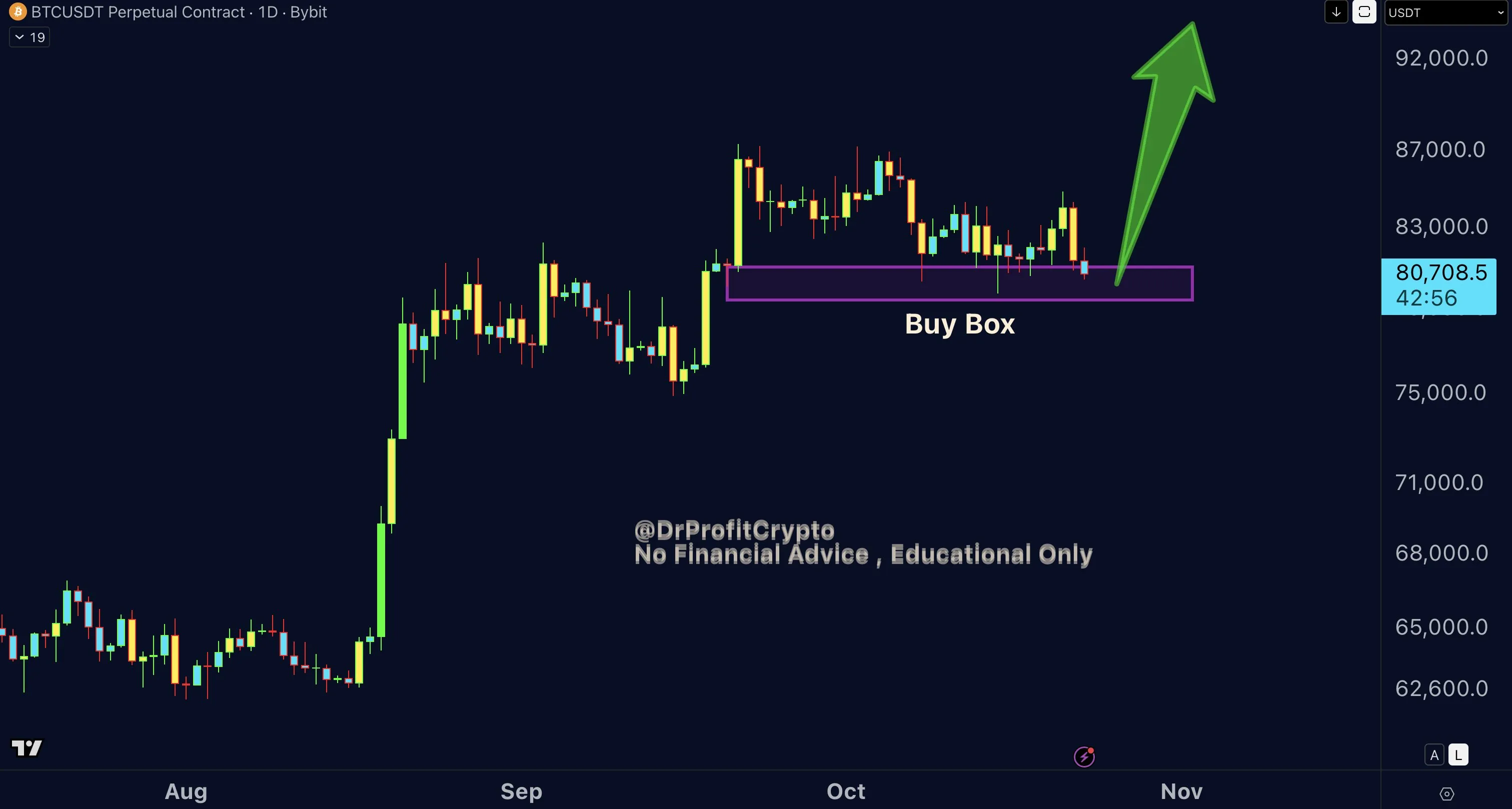
Crypto analyst Doctor Profit said long positions in Bitcoin should be accumulated whenever the price reaches a supply-zone range near $80,000. Doctor Profit added, "개인적으로 8만 달러 부근 매물대에 닿을 때마다 매수하고 있다. 해당 구간은 패닉셀을 위한 것이 아니라 추가 매수를 위해 존재한다".
Previous related news
07:38
A total of 46,928.46 BTC flowed into major centralized exchanges over the past seven days, according to CoinGlass. By exchange, Binance recorded the largest net inflow at 37,394.58 BTC, while Kraken and Coinbase Pro saw net inflows of 3,019.97 BTC and 1,447.9 BTC, respectively.
07:10
The following are the 24-hour long/short ratios for BTC perpetual futures on the world’s three largest crypto futures exchanges by open interest:
Overall: 49.48% long, 50.52% short
- Binance: 48.96% long, 51.04% short
- Bybit: 47.51% long, 52.49% short
- Gate: 49.44% long, 50.56% short
06:27
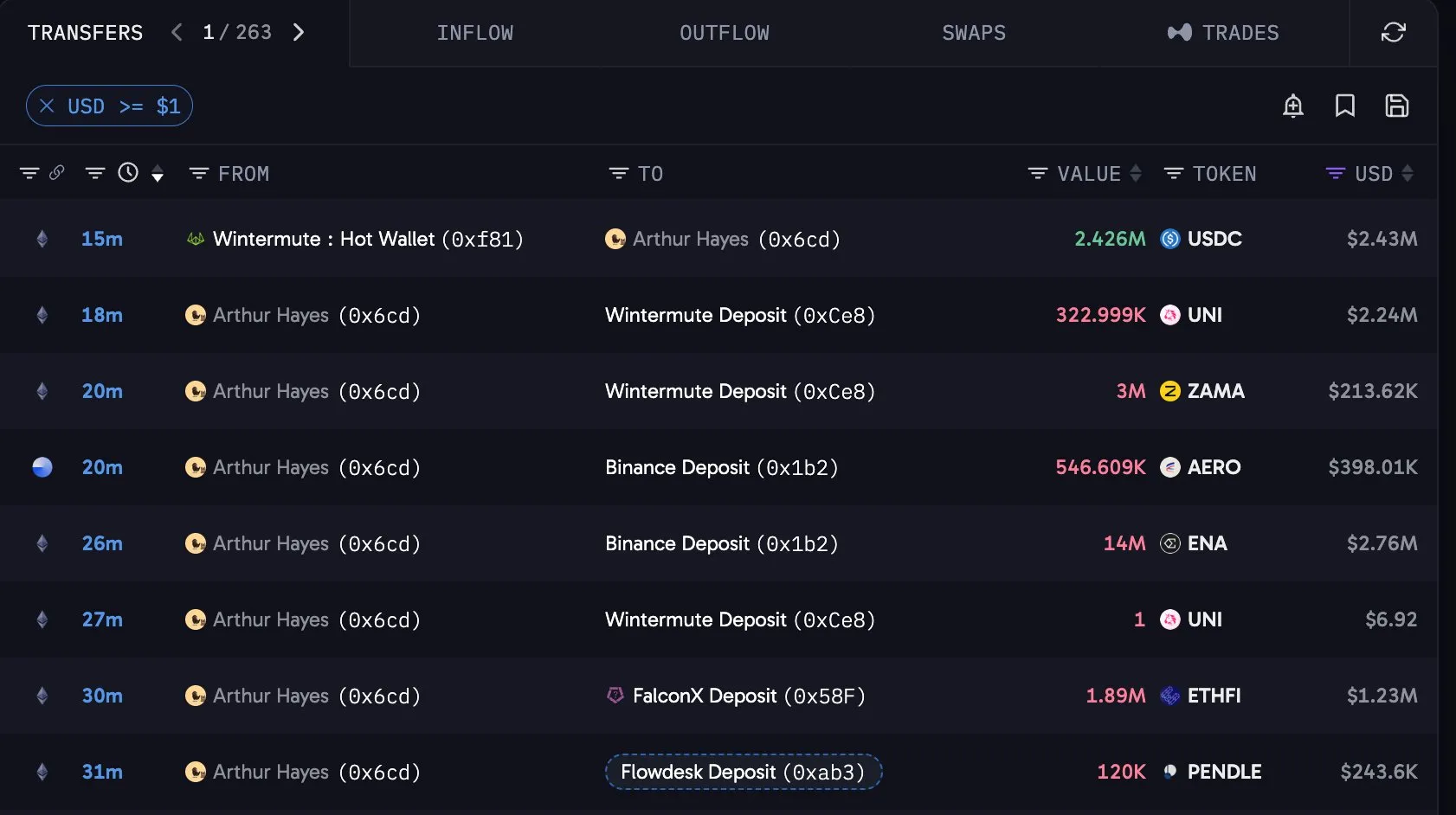
BitMEX co-founder and Flop Labs CEO Arthur Hayes sold about $22.28 million worth of altcoins, according to on-chain records. Hayes made multiple transfers today to OTC desks including Flowdesk, FalconX and Wintermute, depositing 6,400 ETH worth about $15.2 million, 14 million ENA worth about $2.76 million, 323,000 UNI worth about $2.24 million, 1.89 million ETHFI worth about $1.23 million, 546,609 AERO worth about $398,000, 120,000 PENDLE worth about $244,000 and 3 million ZAMA worth about $214,000. Deposits to trading venues are typically seen as sales-related transfers.
Hayes said he had taken profits on all directional positions held by his fund Maelstrom, including ETH, ENA, UNI and other altcoins. Hayes added that a pullback appeared necessary before further gains and said macroeconomic and geopolitical conditions looked unstable, prompting him to wait on the sidelines for a clearer signal.
06:18
Franklin Templeton added about $150 million worth of shares in its tokenized money market fund to the XRP Ledger, CoinDesk reported.
The move increased sgBENJI, the fund’s token on XRPL, to about 193 million from roughly 48 million. Based on a per-share price of $1.039 recorded in trading on Oct. 22, the total value is about $200 million. All sgBENJI on XRPL is currently held in a single wallet, although it has not been confirmed whether the wallet holds assets for a single investor or pools assets from multiple clients. sgBENJI represents shares in a fund that invests in short-term U.S. dollar-denominated debt securities and money market instruments.
06:09
Crypto asset manager Grayscale said in a recent report that rising token supply at some cryptocurrencies could erode the economic benefits passed on to holders.
Grayscale presented a valuation framework that evaluates both protocol revenue and the scale of value returned to token holders. Under the framework, token holder yield is calculated by adding staking rewards and buybacks, subtracting the value of newly issued tokens, and dividing the result by circulating market capitalization. Among the protocols covered in the analysis as of Oct. 20, HYPE posted the highest token holder yield at 8.0%, while CRV had the lowest at -5.5%. On an adjusted yield basis, CAKE ranked first at 14.4%. Grayscale added that new token issuance and unlocks can offset the effects of buybacks and staking rewards, and said protocol revenue should be assessed separately from the economic benefits attributable to token holders.
06:04
Bitdeer said it sold all 283.4 BTC it mined this week. The company reduced its Bitcoin holdings to zero on Feb. 20 and has since continued to liquidate all newly mined BTC into cash.
Previous related news
05:56
BitMEX co-founder and Flop Labs CEO Arthur Hayes said in a recent interview that tokens with high fully diluted valuations and low circulating supply structures are being shunned by investors and are now hard to pump even on Binance.
Hayes added that the crypto industry has long exploited tokenomics, with some projects raising development funding through ICOs, VC private sales and presales, then selling their holdings after protocol launches and token unlocks, leaving retail investors with losses. At the same time, Hayes said projects such as Hyperliquid (HYPE) have achieved real product-market fit, return revenue to token holders and can avoid selling pressure tied to large token unlocks.
05:49
Weekly notional trading volume in cryptocurrency-related event contracts on major prediction market platforms Kalshi and Polymarket reached a record $2.7 billion last week, Bloomberg reported.
Short-term contracts tied to whether assets such as Bitcoin would rise or fall after a set period led trading activity, with per-contract volume on Kalshi's 15-minute Bitcoin price prediction contracts at times exceeding $1 million. Trading volume in longer-dated crypto prediction markets also increased noticeably. Kalshi's year-end Bitcoin price prediction contract recorded $42 million in volume, while Polymarket's comparable year-end Bitcoin contract reached about $78 million.
05:43
The following shows estimated liquidation volumes and position ratios for major crypto perpetual futures over the past 24 hours:
- BTC: $90.87 million liquidated (89.3% longs)
- IRYS: $68.55 million liquidated (86.4% shorts)
- ETH: $60.91 million liquidated (82.6% longs)
05:37
Crypto exchange HTX has added Russia to its list of restricted jurisdictions. Under revised terms of service, Russian users and companies operating locally may face service restrictions, and HTX may take steps including account closures and withdrawal limits.
HTX did not disclose when the restrictions will take effect or whether existing users will be given a grace period.
Earlier, Bitget added Russia, Belarus and Kazakhstan to its prohibited service regions and advised users to withdraw assets by Oct. 21, while MEXC said it would exit the Russian and Belarusian markets from Oct. 20 for regulatory compliance.
Previous related news