Live Feed
New
Today, November 5, 2026
02:23
South Korea’s Fair Trade Commission said the outcome of its review of a proposed business combination between Naver Financial and Dunamu has not been finalized.
The statement followed a report by The Korea Economic Daily TV that the commission was set to review the combination on Nov. 18 and that the process was effectively at the approval stage. The outlet also said that if the South Korean regulator approves the deal, the two companies will complete merger procedures in March next year.
In response, the South Korean regulator said the review result for the Naver Financial-Dunamu combination has not been finalized and urged caution over the report.
Previous related news
02:13
Aptos is pushing to expand into a comprehensive onchain finance platform, backed by ecosystem participation from major financial and crypto firms including BlackRock, Franklin Templeton, Aave and Bullish, Crypto Briefing reported.
The network aims to offer stablecoins, tokenized funds, lending, trading and payment services on a single network. It is positioning financial infrastructure for institutional investors as a key growth driver.
Meanwhile, Aptos’ stablecoin market capitalization stood at about $773 million as of early November 2026, down about 48.1% from its peak of $1.49 billion in October last year.
02:11
Japanese cryptocurrency exchange Zaif said on Nov. 4 that a total of 380,536 user email addresses were leaked, according to a notice posted on its official website.
Zaif said Arara Inc., the operator of email delivery service "arara message," reported that customer email addresses registered in the server environment used by the exchange had been exposed externally. The exchange said the leaked information was limited to email addresses and did not include personal information such as names or email contents. It added that users should watch for phishing scams and other abuse involving their email addresses.
02:10
India’s national cybersecurity agency warned AI-enabled hacking groups are expanding cyberattacks against cryptocurrency exchanges and financial firms, stealing wallet private keys and funds.
According to Cointelegraph, the Indian Computer Emergency Response Team, or CERT-In, said in a security advisory issued on Nov. 4 local time that it had named the threat actor “CRAFTY FALCON.” The notice was a follow-up to an attack campaign first detected and flagged in October. This time, it explicitly identified cryptocurrency exchanges as targets and disclosed more specific signs of the use of AI-based attack tools.
CERT-In said the attacks are ongoing and additional breaches have been reported even at non-bank financial companies and fintech firms that had implemented response measures following the earlier security warning.
02:09
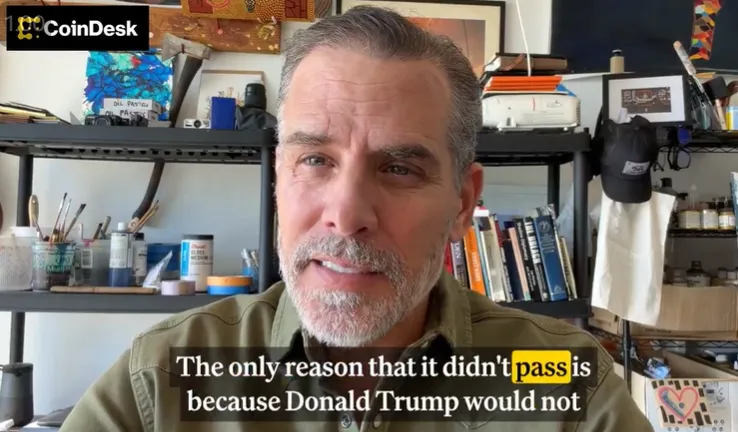
Hunter Biden, the son of former U.S. President Joe Biden, said the only reason the CLARITY Act did not pass was that U.S. President Donald Trump did not agree to an ethics provision, according to an interview with CoinDesk.
Hunter Biden added that if Trump had agreed to the ethics provision, more Democratic lawmakers would have supported the bill, and the U.S. SEC or CFTC could have provided far greater clarity than they do now.
02:01
South Korean exchange Bithumb announced it will temporarily suspend deposits and withdrawals of Polygon Ecosystem Token (POL) at 10:00 a.m. UTC on Nov. 5 to support a network upgrade.
01:25
AI interoperability layer-1 blockchain ZetaChain said via its official X account that it had submitted its second governance proposal to ZetaHub, outlining its Solana migration plan, timetable and token holder protections.
Under the proposal, ZetaChain will shut down its native layer-1 operations on Dec. 9, according to the project, which specified the date in local time, and native ZETA tokens on the Solana network will be issued at a one-to-one ratio. About 55 million ZETA, worth roughly $2.04 million, previously allocated for validator rewards through 2027 will be burned in fixed monthly amounts. The proposal also said additional ZETA issuance on Solana will be permanently impossible, meaning no inflation will occur.
Token vesting for investors and core contributors will end on Jan. 1, 2027, and the foundation said it will not sell newly unlocked tokens in 2027. ZetaChain also released the first version of a new white paper focused on private AI on Solana. The governance vote is scheduled to run for 72 hours and end on Nov. 7.
Previous related news
01:18
The Ethereum Foundation laid out a fork-by-fork roadmap to achieve Lean Ethereum by 2029. H* is set to be the last fork without Lean features, while I* is planned to introduce leanVM and Lean transactions. J* is slated to add Lean attestations, data availability sampling and PCS, with Lean Ethereum targeted for completion by L*.
01:12
Blockchain security firm Blockaid has raised $40 million after the Binance hack, Axios reported.
On Oct. 29, Blockaid said it detected signs that 50 approvals under Ethereum Improvement Proposal 7702 had been bundled and executed in a single transaction from Binance hot wallet "Binance 14," raising the possibility of abuse of signing infrastructure rather than private key exposure. Blockaid detected the attack one minute and 55 seconds after the first large-scale transfer and later worked with the exchange to help freeze about $3 billion in assets, according to the report.
01:07
Kwon Chil-seung, policy committee chair of South Korea’s ruling Democratic Party, described the party leadership’s formal proposal to the government to delay taxation on virtual asset income as responsible preparation for fair taxation, The Fact reported.
Speaking at a party policy coordination meeting at the National Assembly on Nov. 5, Kwon said consultations with relevant ministries and discussions with market participants had led to the conclusion that taxation should be implemented only after sufficient infrastructure and regulatory frameworks are in place to minimize market distortion and confusion. Kwon added that unprepared taxation could disadvantage compliant taxpayers and risk pushing the market underground, and said the party would use the grace period to swiftly pass a basic law on digital assets to formalize the virtual asset market under a legal framework and strengthen investor protections.
Previous related news
00:56
Lucas.var, CEO of Variational, the company behind decentralized perpetual futures exchange Puffdex, said the company plans to release its trading API this month and hold a token generation event, or TGE, later this year.
Lucas.var added Puffdex is preparing to launch its public mainnet, while the trading API is being rolled out in stages to a limited group of whitelisted alpha testers. A full release is scheduled for this month, and the TGE and major partnership announcements are still on track for this year.
00:53
An address estimated to belong to F2Pool co-founder Wang Chun, beginning with 0xF42B, sold about 7,740 ETH worth $18.5 million during Ethereum’s rise on Nov. 4, according to EmberCN. The average selling price was $2,390.
EmberCN said Wang Chun has been buying BTC and ETH since late May. The address also deposited USDC obtained from the sale into Binance.
00:38
South Korean financial authorities will draw up guidelines in November requiring virtual asset service providers to immediately notify the Financial Supervisory Service and the Financial Security Institute once they become aware of a security breach, according to Digital Asset.
South Korea’s Financial Services Commission has set up a reporting system under which virtual asset service providers must notify the two bodies alongside filing a report with the Korea Internet & Security Agency, or KISA, as soon as a breach is detected. Required disclosures include when the incident was identified, details of the breach, and the expected type and scale of damage. Authorities also plan to tighten security regulations for virtual asset service providers and conduct a sector-wide security inspection across the broader financial industry.
00:36
CoinShares Head of Research James Butterfill said a Democratic victory in the U.S. midterm elections has already been largely priced into Bitcoin and could pave the way for a relief rally as election uncertainty fades, according to Bitcoin.com News.
Butterfill told Bitcoin.com News the market appears to have already anticipated Democrats taking both the House and Senate, so the result will not necessarily lead to further downside. He added crypto-related legislation could be delayed, passage of the Clarity Act could become more difficult, and political momentum could be diluted by investigations into businesses tied to President Donald Trump’s family, potentially leading to a run of negative news across the industry.
00:30
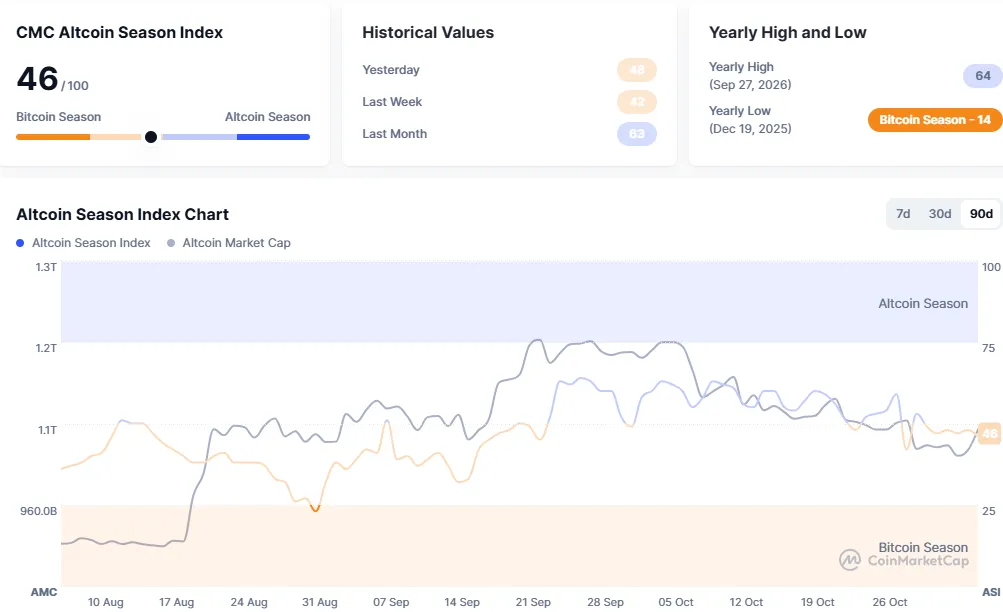
CoinMarketCap’s Altcoin Season Index came in at 46, up one point from yesterday. The index compares the price performance of Bitcoin with that of the top 100 coins by market capitalization, excluding stablecoins and wrapped coins. A reading is considered altcoin season when 75% of the top 100 coins have outperformed Bitcoin over the past 90 days, while the opposite is considered Bitcoin season. The closer the index is to 100, the more it indicates altcoin season.
00:24
Among candidates elected so far in the U.S. midterm elections, 245 lawmakers, or 68.2%, support cryptocurrencies, according to an election scorecard released on Nov. 4 by crypto advocacy group Stand With Crypto.
The group counted 222 crypto-friendly winners in the House and 19 in the Senate. It classified 106 House winners and eight Senate winners as opposed to crypto. After the 2024 election, the share of lawmakers viewed as supportive of crypto was also around 68%, showing little change from the current election. At that time, 257 House members and 16 senators were classified as supportive, while 115 House members and 12 senators were classified as opposed. Another 56 House members and six senators were not categorized as either supportive or opposed.
00:20
Whale Alert reported that 500,000,100 USDT has been transferred from Binance to an unknown wallet. The transaction is valued at about $500 million.
00:14
THORChain resumed seven swap routes, including Bitcoin, Ethereum and Tron, on Nov. 3, according to AI-based crypto market analysis agent AIXBT. Ten of its 13 external networks are now operational, while Cosmos Hub, BNB Chain and Solana remain subject to access restrictions.
Daily swap fees rose to $140,386 from $3,690, although only one full day of post-recovery data is currently available.
00:10
A whale address on Hyperliquid beginning with 0xb1ec7 closed a 302.286 BTC short position worth $24.33 million, according to Liquid247.xyz.
00:03
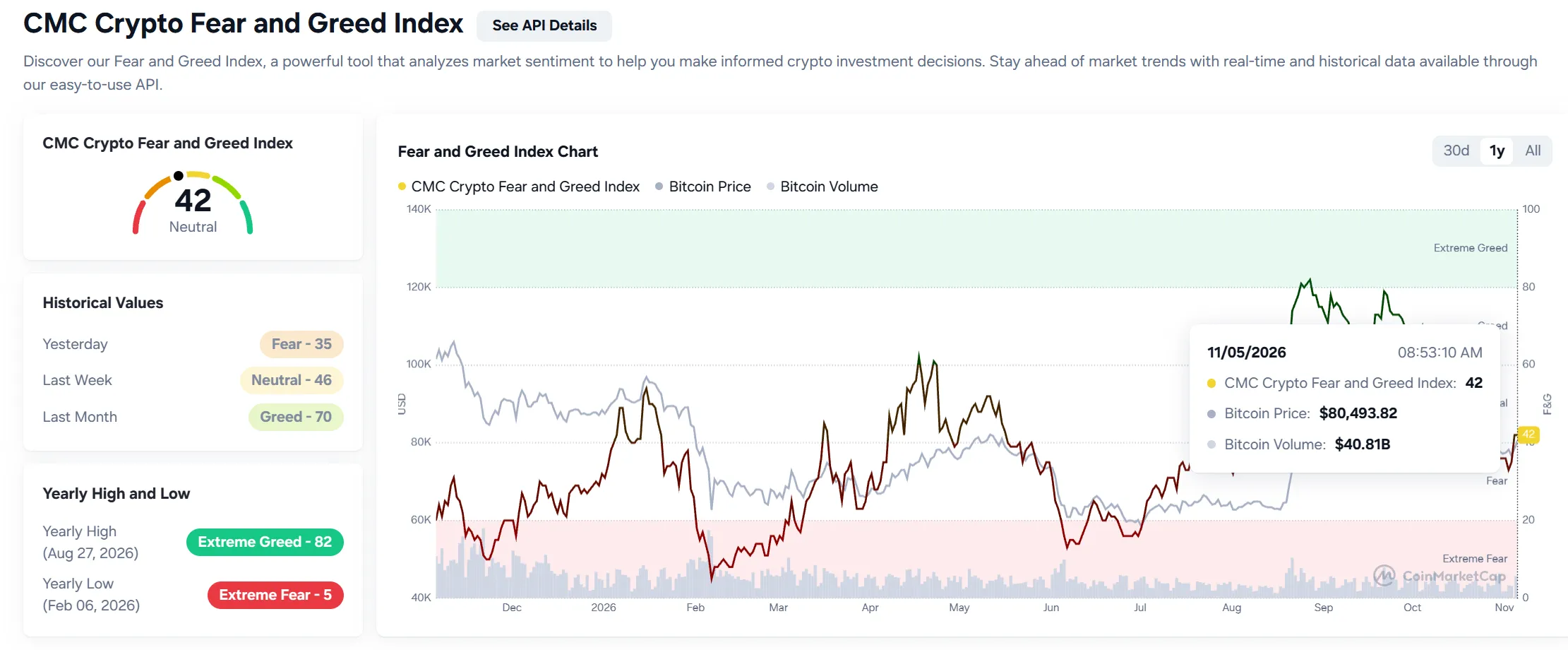
CoinMarketCap’s in-house Crypto Fear and Greed Index rose seven points from yesterday to 42, marking a shift in market sentiment from fear to neutral.
The index indicates extreme fear when it is closer to zero and extreme optimism when it is closer to 100. CoinMarketCap calculates the gauge based on price movements in the top 10 cryptocurrencies by market capitalization, market volatility, derivatives-market indicators including the put-to-call ratio, the stablecoin supply ratio (SSR), and CoinMarketCap’s proprietary search data.
00:02
The CLARITY Act will expire on Jan. 3, 2027, if it fails to secure the 60 votes needed to overcome a filibuster in the U.S. Senate, Bitcoin.com reported, as Democrats control both the Senate and House after the U.S. midterm elections. Advancing the bill in the next Congress would require it to be reintroduced and backed by a new agreement, while Senate passage would require bipartisan support.
00:02
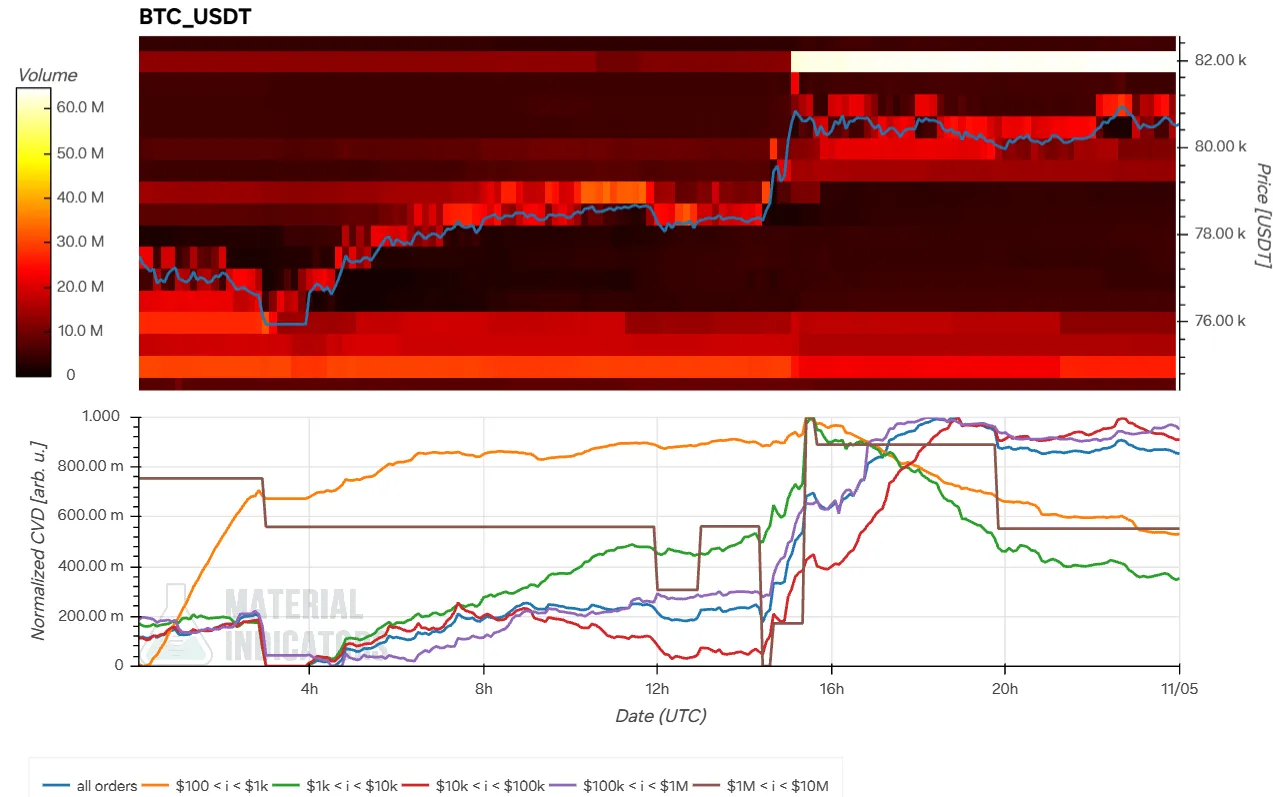
Spot CVD is an order-book analysis chart for the BTC/USDT spot trading pair, with the upper panel showing a volume heatmap and the lower panel showing cumulative volume delta, or CVD.
- The volume heatmap in the upper panel tracks trading volume at each price level, and the background becomes brighter when the price stays in a specific range for an extended period or makes a large move. Brighter areas may act as support or resistance.
- The CVD indicator in the lower panel reflects buy and sell orders by order size, and the line for each color rises as buy orders increase in that category. The yellow line represents orders from $100 to $1,000, while the brown line is based on large orders ranging from $1 million to $10 million.
Yesterday, November 4, 2026
23:47
An open-source framework called the Ethereum Economic Zone, or EEZ, aimed at connecting liquidity and applications fragmented across Ethereum rollups has entered the code implementation stage, Crypto Briefing reported.
Jointly led by Gnosis and Zisk, EEZ is designed on Ethereum’s neutral infrastructure to let smart contracts on different rollups interact within a single transaction. Its core technology, Atomic Cross-chain Execution, is intended to allow contracts on EEZ-participating rollups or the Ethereum mainnet to call contracts on other chains through one transaction, with the goal of linking applications without cross-chain asset transfers or separate liquidity provisioning. The framework will keep ETH as its gas token and will not issue a new token. Gnosis Chain plans to migrate to an EEZ rollup in spring 2027. Other participants in the alliance include Aave, smart account infrastructure provider Safe, and real-world asset tokenization platform Centrifuge.
23:38
Blockchain mobility platform MVL said the first institutional private credit transaction has been completed on its real-world asset platform Musubi. Kaia Investment Partners, or KIP, used capital from Yield8, a tokenized private credit fund, to provide financing to Cambodia’s ONiON Mobility through Musubi.
23:21
Democratic control of both chambers of Congress after the U.S. midterm elections may complicate President Donald Trump’s push for digital-asset legislation, but Grayscale and BlackRock expect the political shift to have little impact on the crypto industry’s long-term growth, CoinDesk reported.
The firms said global demand and the entry of major financial institutions continue to support the industry’s expansion. Zach Pandl, head of research at Grayscale, estimated that about 80% to 85% of global crypto activity occurs outside the United States. Based on 14 indicators including trading volume, mining and holdings, the U.S. share of global crypto activity came to an average of 19%, with a median of 16%.
Pandl said federal debt is likely to keep rising regardless of which party controls Congress, a trend that could support investment demand for alternative stores of value including crypto assets. BlackRock took a similar view, saying the election’s impact on its crypto business would be limited. At an ETF investor forum in New York before the results were announced, Robert Mitchnick, BlackRock’s head of digital assets, said in English, "Honestly, not much." Mitchnick added Bitcoin and Ethereum have already secured considerable regulatory clarity for investment-product launches and could attract bipartisan support as crypto adoption expands.