Live Feed
New
Today, November 3, 2026
02:10
South Korean President Lee Jae-myung called for a review of a government-wide “cyber security czar” body to oversee security functions across the public and private sectors, saying even the world’s largest cryptocurrency exchange had suffered a cyberattack that caused massive damage, Digital Asset reported.
At a Cabinet meeting on Nov. 3, Lee said hacking attacks exploiting security vulnerabilities had continued at home and abroad, adding that not long ago, even the world’s largest digital asset exchange suffered astronomical losses in a cyberattack believed to have been carried out by a hacking group. Lee also said discussions were needed on setting up a government-wide response body spanning both the public and private sectors, and asked officials to actively review the creation of a strong and effective cyber security czar body that could comprehensively coordinate currently fragmented security functions.
02:06
South Korea’s Financial Services Commission is conducting an urgent review of domestic cryptocurrency exchange security following the Binance hack and will also consider an industry request to broaden the conditions for temporary withdrawal restrictions, Maeil Business Newspaper reported.
Under the current Virtual Asset User Protection Act, deposits and withdrawals can be blocked only when there is a justifiable reason defined by presidential decree. Industry participants said a hack at their own exchange would likely qualify as such a reason for user protection, but it remains unclear whether the same standard applies when a breach occurs at another exchange. They asked regulators to revise the rules so exchanges can quickly restrict withdrawals even when a hack occurs elsewhere, as in the Binance case. Authorities are said to share those concerns and plan to review the matter, according to the report.
Previous related news
02:02
The U.S. SEC’s Division of Corporation Finance updated a Q&A on crypto asset classification criteria on its official website, saying token holders’ participation in governance voting alone does not make them a central governing body of a network. The division said holders would not be viewed as a central actor if there is no separate coordination agreement among participants and they do not exercise control over operations, economics, or voting rights. It added, however, that the guidance reflects the views of staff at the SEC’s Division of Corporation Finance and is not legally binding. CoinNess previously reported the division had added three questions to the related Q&A.
Previous related news
01:57
OKX founder and CEO Star Xu said the exchange has comprehensively strengthened its security and risk management systems following the recent Binance hack.
In a post on X, Xu said OKX’s security and technology risk management teams have been working around the clock since the Binance security incident, not because OKX itself was attacked, but to respond proactively to broader industry security threats. Xu said OKX is focusing on tracking the on-chain movement of stolen funds in real time and blocking money laundering through its centralized exchange and Web3 decentralized exchange aggregator.
Xu added the company is also reviewing market risk controls against liquidity shocks and cascading liquidations, analyzing vulnerabilities tied to software supply chains and AI coding agents, and checking internal access permissions and wallet infrastructure. He emphasized that no exchange is completely free from hacking risks and said continued investment and improvements in security are necessary.
01:42
Cathie Wood-led Ark Invest bought an additional $3.4 million in Coinbase (COIN) shares, $2.6 million in Circle (CRCL) shares and $645,000 in Robinhood (HOOD) shares yesterday. By contrast, it sold about $2.3 million worth of Bullish (BLSH) shares, while Bullish stock fell 5.6% today.
01:38
Bitcoin needs to hold support in the low-$70,000 range to maintain its bull market trajectory, Bloomberg Intelligence analyst Jamie Coutts said on X. Coutts said crypto market breadth, or the share of advancing tokens, had collapsed sharply after posting its strongest and most sustained outperformance in more than a year before the correction. He added that the market has fallen to oversold levels, but Bitcoin’s support in the low $70,000 range must hold.
Coutts also said tightening market liquidity is the result of years of accumulated growth in U.S. national debt. He said possible U.S. policy responses could include a drawdown in the Treasury General Account, Treasury buybacks, increased issuance of short-term Treasury bills and a revaluation of gold, adding that Bitcoin is likely to see significant volatility over the next three to six months.
01:38
Bhutan’s King Jigme Khesar Namgyel Wangchuck has signed a royal decree authorizing the creation of a central bank for Gelephu Mindfulness City, a special administrative zone set to deploy 10,000 BTC.
In a post on its official Facebook page, Gelephu Mindfulness City said the decree grants broad central banking authority to the Gelephu Financial Services Authority, which is set to transition into the Gelephu Central Bank. As an independent central bank, the Gelephu Central Bank will be responsible for monetary policy, supervision of financial institutions, management of foreign exchange reserves and payment systems. Earlier, Gelephu Mindfulness City entrusted Canadian asset manager 3iQ with managing part of its BTC holdings in July.
Previous related news
01:28
BitMEX co-founder Arthur Hayes said on X, "Dollar liquidity is being reloaded." Hayes added BTC is likely to remain weak until the Federal Reserve or banks begin expanding their balance sheets.
Expanded Fed and bank balance sheets can increase market liquidity, which typically supports investment demand for risk assets including BTC and acts as a factor behind price gains.
01:24
Tether CEO Paolo Ardoino said at the recent Plan B Forum in Lugano, Switzerland, that the USDT issuer holds about 150,000 BTC on its own balance sheet.
Ardoino said Tether held $132.4 billion in U.S. Treasury bills as of the third quarter, including repurchase agreements, while excess reserves nearly doubled to $7.95 billion from $4.1 billion at the end of the second quarter. Ardoino added that Tether’s global user base has surpassed 730 million, with about 30 million new wallets created each quarter.
He also said Tether is building a six-layer open-source infrastructure system called "Independence Stack" spanning energy, Bitcoin mining, P2P communications, finance and artificial intelligence, and said the effort would shorten what Ardoino described as a civilizational dark age.
Previous related news
01:23
Decentralized cloud computing project Akash Network (AKT) announced on its official X account that Governance Proposal 346 to migrate to the Solana (SOL) ecosystem has passed. A detailed migration schedule will be disclosed later. Akash Network had previously submitted the proposal on Oct. 27 to move from its existing Cosmos-based proprietary blockchain to the Solana mainnet.
01:14
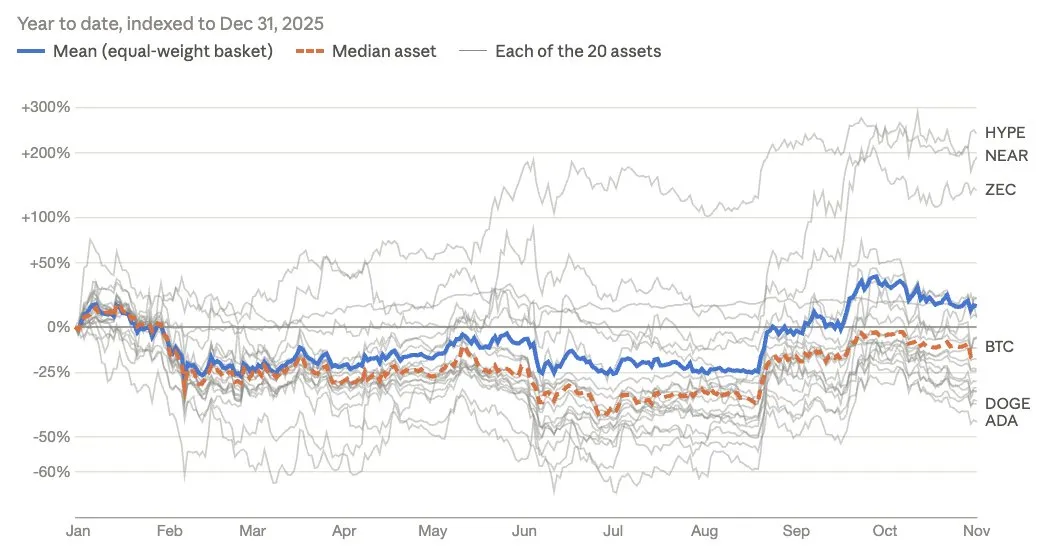
Bitwise Chief Investment Officer Matt Hougan said returns among individual cryptocurrencies have diverged sharply this year, with the average return for the top 20 tokens by market capitalization at 14% while the median return stood at -15%, according to his analysis on X.
A chart Hougan shared showed that an equal-weight investment in the top 20 cryptocurrencies at the end of last year would have returned 14% so far this year, while the token in the middle of the performance ranking posted a -15% return. HYPE and NEAR were up more than 200% this year, and ZEC had gained more than 100%, while BTC was up around 10% and DOGE and ADA were down about 30% and 40%, respectively.
00:58
Extended, a decentralized perpetual futures exchange developed by a team from UK fintech company Revolut, unveiled the tokenomics for its native token XTEN via its official X account.
XTEN will be used as a utility token in the Extended ecosystem, offering trading fee discounts, staking rewards, additional vault yield and referral rewards. The token will have a maximum supply of one billion, allocated as 30% for a community airdrop, 20% for the ecosystem, and 50% for founders, the team and investors.
The full airdrop allocation will unlock at the token generation event, while allocations for founders, the team and investors will be locked for the first 12 months. Of the ecosystem allocation, 150 million XTEN will be used for staking rewards. Around 32.9% of total supply will be unlocked at TGE, of which about 2.9% of total supply will be held in a public wallet as an ecosystem fund, putting the maximum immediately circulating supply at 30%.
00:56
World Liberty Financial generated $12.09 million in income from managing stablecoin USD1 reserves in October, according to crypto data analytics firm MSB Intel.
That exceeded the previous monthly high of $11.88 million recorded in May, marking a record monthly profit. Average daily income came to about $390,000.
00:43
Crypto market maker Wintermute said BTC faces a risk of further declines if it cannot reclaim $80,000, while identifying around $76,800, the 50-week moving average, as the next key support level.
In a market report dated Nov. 2 local time, Wintermute said the market remained weak after $1.5 billion in futures positions were forcibly liquidated following last week’s Binance hack. With BTC still below $80,000, Wintermute said it was using $78,000 as a reference point because the sell-off appears specific to the Binance incident. The firm added that the next important support level is around $76,800, which corresponds to the 50-week moving average. Wintermute also said recent dip buying was concentrated mainly in leveraged perpetual futures, with no signs of fresh capital inflows strong enough to support a rebound. It added that near-term downside risk could ease if BTC reclaims $80,000 and holds that level on buying through spot markets and ETFs. If BTC falls below the 50-week moving average as well, however, the risk of additional declines would increase.
00:31
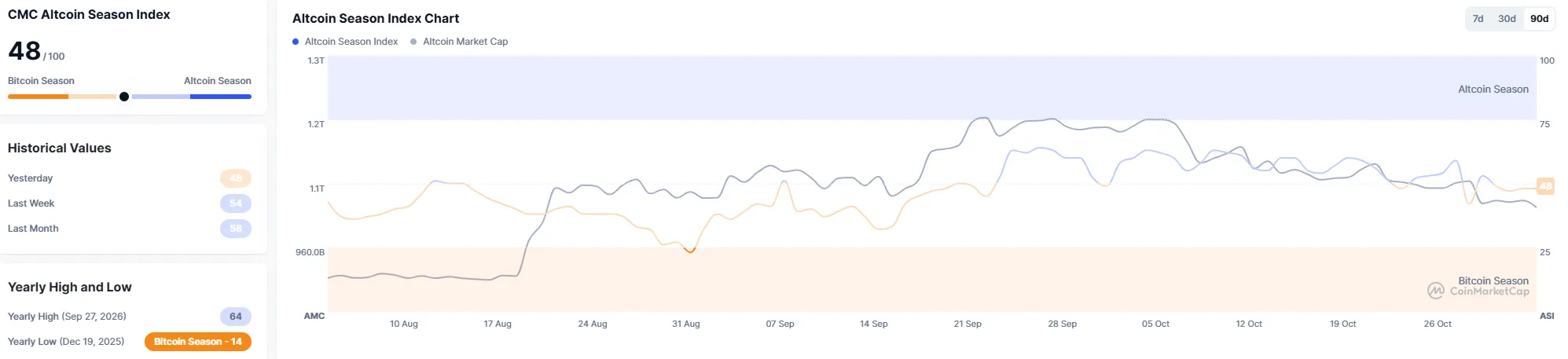
CoinMarketCap’s altcoin season index came in at 48, up one point from yesterday. The index is calculated by comparing the price performance of Bitcoin with the top 100 coins by market capitalization, excluding stablecoins and wrapped coins. An altcoin season is identified when 75% of the top 100 coins outperform Bitcoin over the past 90 days, while the opposite is considered a Bitcoin season. A reading closer to 100 indicates stronger altcoin season conditions.
00:29
Bitcoin sidechain Liquid Network announced through its official channel that it has fully restored its BTC reserves, recovering the one-to-one BTC collateral ratio for LBTC.
Liquid Network said the swap service between BTC and LBTC resumed several weeks earlier, and users can exchange the two assets at a one-to-one ratio through participating firms. The network added it plans to pursue a governance overhaul, stronger oversight, and technical and operational security measures, with details to be disclosed within the next several weeks.
00:27
Fidelity Digital Assets transferred 1,722 BTC worth $132.1 million to multiple new wallets over the past hour, Onchain Lens reported. Onchain Lens said the moves may reflect tighter security measures amid a string of recent hacks in the Web2 and crypto industries.
00:16
Cryptocurrency stolen in the Binance hack was spread across about 12,000 wallets on 11 blockchains in less than four days, Bitcoin News reported, citing blockchain analytics firm Elliptic.
According to Elliptic, the attacker stole about $6.3 billion worth of cryptocurrency on Oct. 29 and then attempted to launder the funds through more than 40,000 transactions. In the process, the attacker also used tools that make transactions harder to trace, including decentralized lending protocols and Bitcoin CoinJoin, a crypto mixing protocol. As of yesterday, about $2.85 billion of the stolen assets had been frozen, while the attacker was estimated to hold about $1.43 billion worth of BTC across 40 addresses and about $1.37 billion worth of ETH across 857 addresses. Still, only a very small portion of the assets is believed to have been converted into cash.
00:11
South Korea’s Democratic Party has conveyed its view to the party leadership that cryptocurrency taxation should be delayed again, according to Newsis.
00:08
Binance has expanded fee rebate benefits for some market makers to help secure trading liquidity after a $6.3 billion hack, Bloomberg reported, citing sources.
According to Bloomberg, Binance decided to apply the same rebate rate given to top-tier level-four market makers to level-two and level-three market makers for one week. The move was seen as aimed at encouraging smaller liquidity providers to keep trading and restoring order-book liquidity. Talos, a crypto trading infrastructure firm, said Binance’s order-book liquidity within 1% of the BTC price fell about 30% to $32 million from $45 million during the 24 hours after the hack. Meanwhile, Binance withdrawals reached $4.7 billion as of Nov. 2, Bloomberg added.
00:03
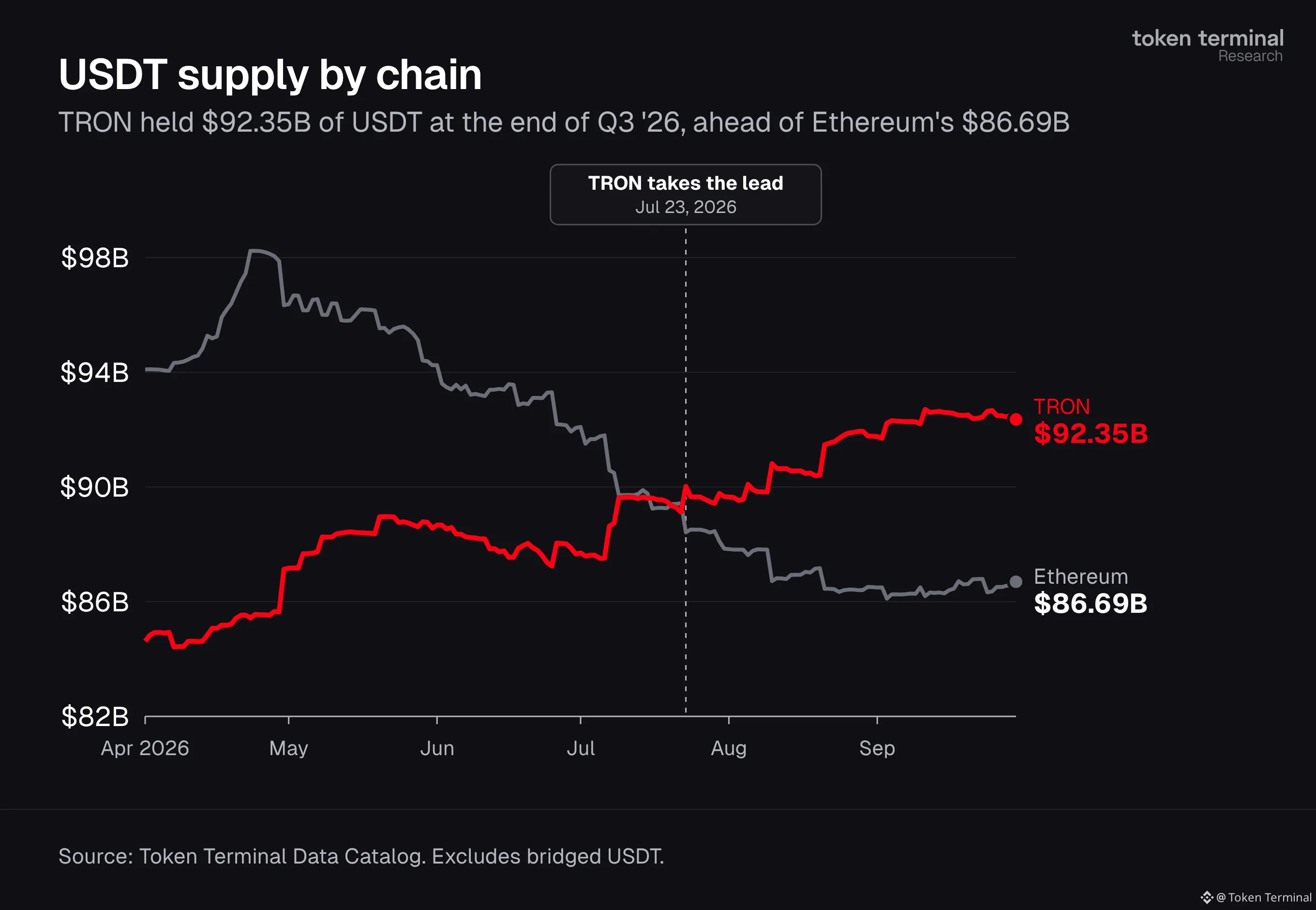
USDT circulating on the Tron (TRX) network reached $92.35 billion at the end of the third quarter of 2026, surpassing Ethereum (ETH), which stood at $86.69 billion, according to Onchain Lens. Token Terminal data showed Tron first moved ahead of Ethereum on July 23 and has maintained the lead since then. Tron’s current USDT circulating supply stands at $94.25 billion.
00:00
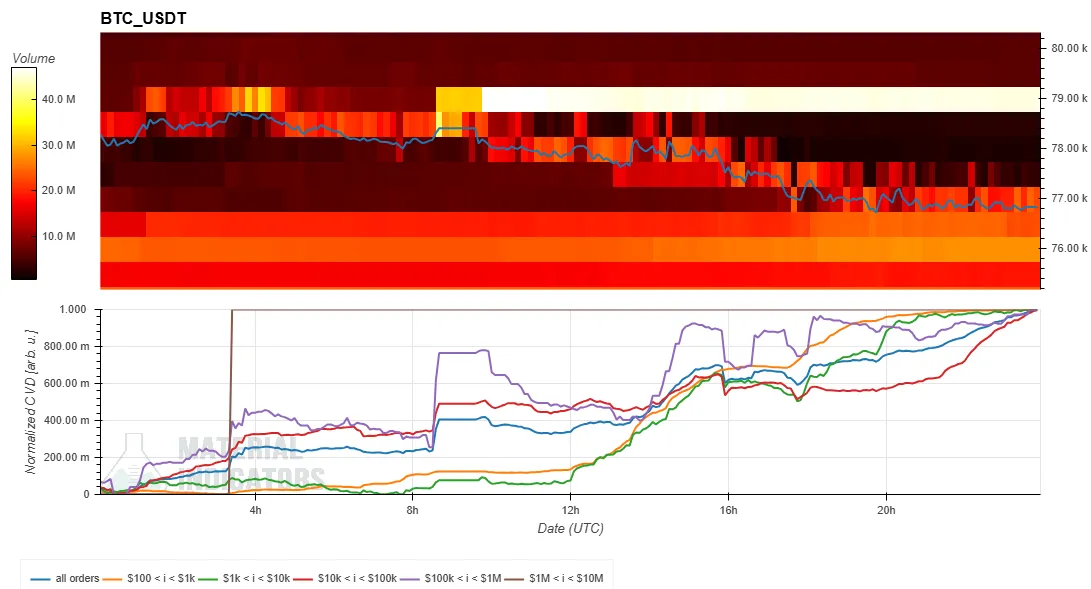
Spot CVD is an order book analysis chart for the BTC/USDT spot trading pair. The upper panel shows the volume heatmap, while the lower panel shows cumulative volume delta, or CVD.
- The volume heatmap in the upper panel tracks trading volume at each price level, and the background color becomes brighter when the price stays in a specific range for an extended period or moves sharply. Areas closer to brighter colors may act as support or resistance.
- The CVD indicator in the lower panel reflects buy and sell orders by order size, and the line for each color rises as buy orders increase in that category. The yellow line represents orders between $100 and $1,000, while the brown line is based on large orders between $1 million and $10 million.
Yesterday, November 2, 2026
23:59
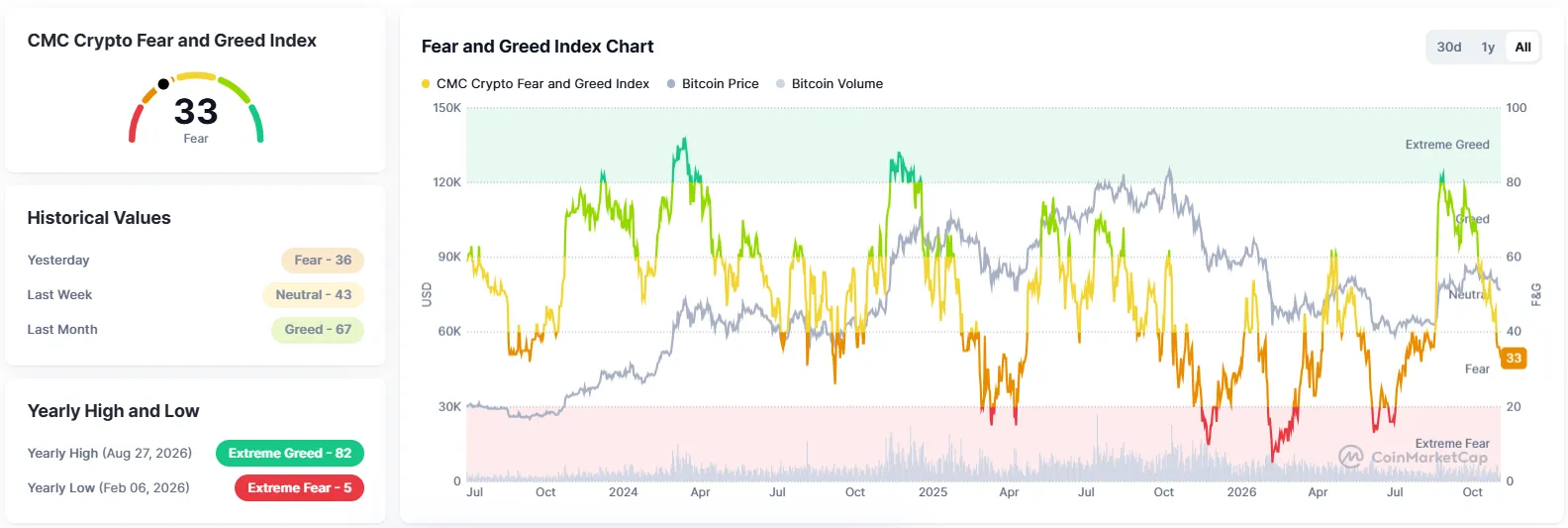
CoinMarketCap’s in-house crypto fear and greed index came in at 33, down three points from yesterday, indicating that fear remained in place. The index suggests extreme fear as it approaches zero and extreme optimism as it approaches 100.
CoinMarketCap calculates the index based on price movements among the top 10 cryptocurrencies by market capitalization, market volatility, derivatives-market data including put/call ratios, the stablecoin supply ratio (SSR), and CoinMarketCap’s own search data.
23:24
Custodia Bank, a Wyoming-chartered bank focused on cryptocurrency, has filed its final reply brief with the U.S. Supreme Court in its challenge to the Federal Reserve’s refusal to grant a master account, urging the court to stop what it described as the Fed’s tyranny over financial innovation.
The dispute follows a ruling by the 10th U.S. Circuit Court of Appeals siding with the Fed, saying a regional Federal Reserve Bank has discretion to deny a master account even to a legally eligible depository institution. Custodia countered that under the Monetary Control Act of 1980, the Fed is required to provide payment services to eligible nonmember banks, citing the statute’s use of the word "Shall."
Custodia also argued unelected officials had weaponized the power to deny access to the payments system, acting like a fourth branch of government and seriously undermining state sovereignty over bank charters and the dual banking system. In the appellate case, Judge Timothy Tymkovich also issued a strong dissent, saying the decision gave the Fed unlimited power to refuse access.
23:18
Swan Bitcoin founder Cory Klippsten warned that AI-based exploits pose a far more direct threat to the Bitcoin ecosystem than recently heightened fears over quantum computing. Klippsten said attackers weaponizing large language models were using sophisticated prompt injection to identify and exploit zero-day vulnerabilities in infrastructure and smart contracts in real time. By contrast, Klippsten said commercially viable quantum computers capable of breaking Bitcoin’s cryptography were at least a decade away, adding that pushing a quantum-resistant fork now would only create unnecessary code complexity and vulnerabilities.