Live Feed
New
Today, September 29, 2026
03:16
A hacker that attacked exchange Bitget’s hot wallet tried to launder stolen funds through cross-chain swap protocol Chainflip, but the attempt was blocked. According to on-chain tracking data, the deposit was immediately rejected at the Chainflip broker level. Chainflip did not directly freeze the stolen funds, but it refunded them to the original wallet after rejecting the deposit, thwarting the hacker’s attempt to move the assets.
Previous related news
03:00
Bithumb announced the designation of CAMP for its delisting watchlist.
02:59
The following shows estimated liquidation volumes and position ratios for major crypto perpetual futures over the past 24 hours:
- BTC: $104.16 million liquidated (74.52% longs)
- ETH: $70.31 million liquidated (63.62% longs)
- ZEC: $36.13 million liquidated (94.55% longs)
02:54
An anonymous whale has withdrawn a total of 8,605 ZEC from three exchanges since yesterday evening, Arkham reported. Six addresses linked to the whale hold a combined 65,158 ZEC, worth about $91.13 million.
02:32
Cross-chain protocol Relay said about 5,600 users were affected by sandwich attacks caused by an API security vulnerability. The incident occurred after pending order information was exposed externally before trades were executed, allowing MEV searchers to exploit the data and transaction route status to carry out the attacks.
Relay said the attackers generated about $136,000 in profit. The protocol also said it paid a $50,000 bounty to security team Outputlayer for identifying and reporting the vulnerability, and plans to fully reimburse affected users a total of about $312,000.
02:29
More than nine in 10 South Korean digital-asset investors keep their holdings on domestic exchanges, highlighting heavy reliance on exchange custody, The Herald Business reported, citing a survey by the Korea Financial Consumer Foundation.
The survey, conducted among 2,500 adults ages 19 to 69 living in Seoul, Gyeonggi Province and South Korea’s six largest metropolitan cities, showed exchange use was especially frequent among middle-aged and older investors. Among respondents who said they check exchanges at least twice a day, people in their 60s accounted for the highest share at 24.8%, followed by those in their 50s at 22.1%. That compared with 12% for respondents in their 20s and 13.6% for those in their 30s.
Reliance on exchanges was even more pronounced in asset storage, with 94.8% of investors saying they currently keep their assets on South Korean exchanges.
02:29
Strategy’s transfer of 3,568 BTC, worth about $297 million, over the past nine hours was a routine internal fund movement within Fidelity Custody rather than a sale, Arkham analyst Emmett Gallic said.
Gallic added that Fidelity treats all client BTC holdings as fungible assets and moves funds as needed, and said the addresses had already been labeled on Arkham as Fidelity-owned addresses.
02:12
Weekly card payment volume using stablecoins topped $189 million two weeks ago, setting a record high, Crypto Briefing reported. Stablecoin card payment volume has risen steadily this year.
As of July, USDC and USDT accounted for about 84% of stablecoin card payment volume, with USDC at 58% and USDT at about 26%. The average payment size was about $86, and most transactions were processed through Visa.
By card issuer, RedotPay led with about $395 million in monthly payment volume, followed by Ether.fi (ETHFI) and KAST. The three providers accounted for about 77% of total card transaction volume in the dataset. Separately, RedotPay halted all new card issuance for South Korean users in September.
Previous related news
02:02
An early Ethereum investor who bought 3,000 ETH eight years ago at $18.8 per token sold another 1,000 ETH worth $2.68 million today, according to Lookonchain. The investor still holds 1,000 ETH valued at $2.67 million.
02:02
Illia Polosukhin, co-founder of NEAR Protocol, warned the crypto industry could be pushed out of the mainstream market by indiscriminate regulation if it fails to address crime on its own and build a more mature ecosystem.
Polosukhin said it is inaccurate to claim developers of decentralized systems can do nothing to prevent crime. Banks use AI for fraud detection, Polosukhin said, but rely on centralized structures and know-your-customer checks, while KYC also fails to solve practical problems. Polosukhin added the crypto industry can use better data and talent to build systems that effectively curb criminal activity without KYC while preserving freedom for ordinary users. Polosukhin also said industry-wide cooperation could eradicate criminal activity in the crypto ecosystem, adding decentralization does not mean disorder.
01:59
Independent lawmaker Han Dong-hoon said crypto taxation should be delayed immediately, arguing a failure to act could drive South Korean investors out of domestic channels and into areas beyond the reach of tax authorities.
In a Facebook post titled "가상자산 과세 유예, 즉시 해야" at 12:45 a.m. UTC today, Han said the Democratic Party government under President Lee Jae-myung still does not appear to grasp the seriousness of crypto taxation. Han said 2027 is only three months away and a decision on a delay should be made quickly.
Han said Binance and Bybit, which are widely used by South Korean investors, are based in the United Arab Emirates, while Gate is based in the Cayman Islands and Bitget in Seychelles. Under the Crypto-Asset Reporting Framework, or CARF, the United Arab Emirates and Seychelles would only be able to conduct their first information exchange in 2028, Han said. Han added South Korean investors could leave domestic platforms over the remaining three months and move into decentralized spaces beyond the reach of tax authorities.
He said delaying taxation by at least two years would allow authorities to collect transaction data generated on overseas exchanges through CARF, while also creating more time to address second-phase virtual asset legislation. Han added that disclosing detailed crypto tax measures at year-end could trigger public backlash similar to the response to a housing tax overhaul proposal.
Previous related news
01:41
Kakao Group has unveiled a business plan to establish a won-denominated stablecoin as part of everyday financial infrastructure and proposed forming a consortium with domestic and overseas financial institutions and companies to jointly design the ecosystem, Yonhap News Agency reported.
At the opening keynote of the Next Finance Korea event held on Sept. 28 in Seoul’s Gangnam district, KakaoBank CEO Yoon Ho-young, who also serves as co-head of Kakao Group’s stablecoin task force, identified three key priorities for digital financial transformation: expanding distribution of won-denominated stablecoins, building digital-asset-based payment and settlement infrastructure, and creating a sustainable ecosystem through corporate collaboration.
Son Kyung-hee, senior vice president in charge of KakaoPay’s digital asset group, said the goal of Kakao Group’s digital asset business is to make won-denominated stablecoins easy to use in everyday services people use daily.
01:35
Near Intents, a cross-chain intent protocol built on NEAR, blocked an attempted transfer of more than $50 million linked to the Bitget hack, Cointelegraph reported.
According to Near Intents head Alex Shevchenko, a significant share of the stolen funds moved to the Ethereum network through multiple blockchains. During that process, Near Intents detected and blocked transfers worth about $50 million through its in-house security system, Shield. The blocked funds were later found to have moved to other service providers.
01:34
Strategy transferred 3,568 BTC worth about $297 million to an external address over the past nine hours, Lookonchain reported. Lookonchain added, "마이클 세일러의 Strategy가 BTC를 다시 매도하는 것인지, 아니면 새 지갑으로 자금을 옮기는 것인지 확실하진 않다".
01:33
A proposal to launch a WLFI governance participation incentive program at World Liberty Financial, the Trump family’s DeFi project, has passed. Under the proposal, holders of unlocked WLFI tokens will be eligible for rewards only if they lock up their tokens for at least 180 days and directly take part in at least one governance vote every 90 days. Delegated voting does not count toward the participation requirement. The program is set to take effect before Oct. 1. WLFI is currently trading at $0.05609.
01:32
Bitcoin layer-two payments protocol Spark has allocated a total of $210 million to BTC-backed institutional lending in partnership with Anchorage Digital.
Institutions can borrow USDC while keeping pledged collateral with a custodian. Spark provides the loan capital, while Anchorage Digital manages collateral through Atlas, a secure automated network that provides 24/7 margin monitoring, settlement and tri-party services within a regulatory framework.
01:14
According to CoinNess market monitoring, BTC has fallen below $83,000. BTC is trading at $82,999 on the Binance USDT market.
01:09
Aave founder Stani Kulechov said on X that Aave is considering a program that would add burns to its buyback plan as part of a Tokenomics 3.0 update. Aave has operated a program since last year to buy back AAVE tokens using part of protocol revenue, but burns were not included.
The AAVE buyback program has been temporarily suspended since April 19, 2026, according to the source. AAVE was trading at $149.08, down 2.76%, according to CoinMarketCap.
01:02
South Korean Democratic Party lawmaker Kim Hyun-jung of the National Assembly’s National Policy Committee will hold a policy forum today on governance and market ecosystem building for won-denominated stablecoins through overseas case studies, Edaily reported.
The event is scheduled for 1:00 a.m. UTC on Sept. 29 at the National Assembly Members’ Office Building in Yeouido, Seoul, and is being organized by the Digital Finance Law Forum. Presentations are set to include Kivalliq CEO Jan-Oliver Sell on the state of EU stablecoin regulation and a bank-backed euro stablecoin, Circle Asia-Pacific Vice President for Strategy and Public Policy David Alan Katz on U.S. stablecoin regulation and trends in the development of the dollar stablecoin ecosystem, and UniKA Chairman Ryu Chang-bo on building a desirable won stablecoin ecosystem. UniKA was described as a South Korean banking-sector stablecoin alliance.
00:47
World Assets Ltd., a subsidiary of the Worldcoin Foundation, announced it signed over-the-counter sales agreements for WLD worth a total of $49 million over the past month. All tokens sold under the deals are subject to a one-year lockup, restricting sales during that period. Some transactions have already been settled, and delivery and settlement for the remaining amount are set to be completed this week.
00:31
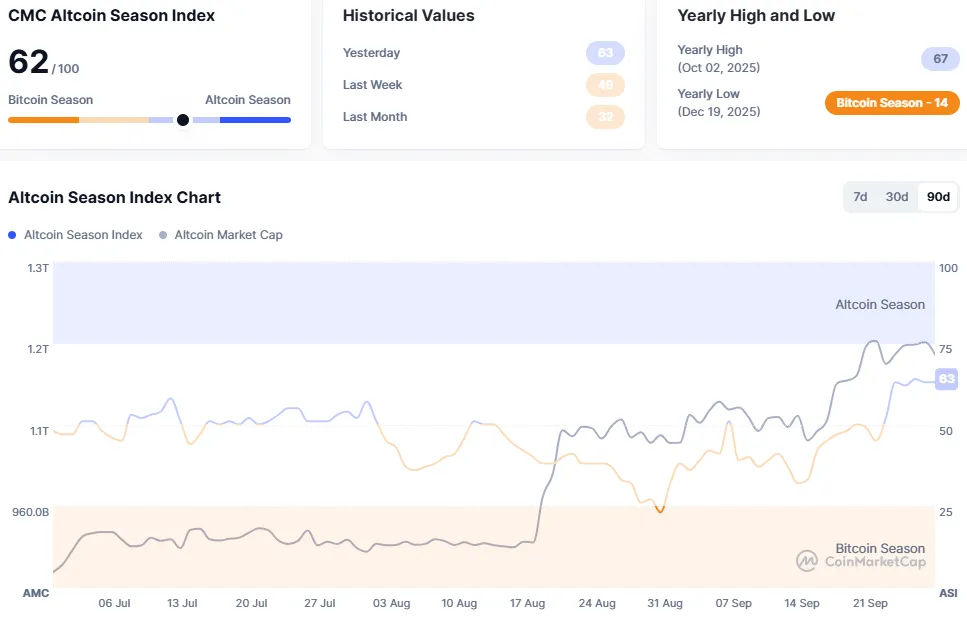
CoinMarketCap’s altcoin season index fell two points from yesterday to 62. The index is calculated by comparing the price performance of Bitcoin with that of the top 100 coins by market capitalization, excluding stablecoins and wrapped coins. A CoinNess analysis shows the market is considered to be in altcoin season when 75% of the top 100 coins outperform Bitcoin over the past 90 days, while the opposite is regarded as Bitcoin season. The closer the reading is to 100, the more firmly the market is seen as being in altcoin season.
00:27
South Korea’s Government Public Ethics Committee published the asset disclosures of eight current and former senior public officials appointed or retired in June in the official gazette on Sept. 28, showing that Seong Gi-hong, the newly appointed senior presidential secretary for public relations and communication, reported holding Bitcoin worth 71.86 million won ($53,000).
The combined assets of six newly disclosed presidential aides came to about 25.8 billion won ($19.0 million), or an average of about 4.3 billion won ($3.2 million) per person. Seong was the only aide among them to report holding Bitcoin.
00:26
Jim Ferraioli, an analyst at U.S. financial firm Charles Schwab, said at the Bitcoin Treasury Conference that Bitcoin has no central authority and its principles do not change based on who holds power or whom voters elect. From a monetary perspective, Ferraioli said, Bitcoin is fundamentally stable and unique.
00:09
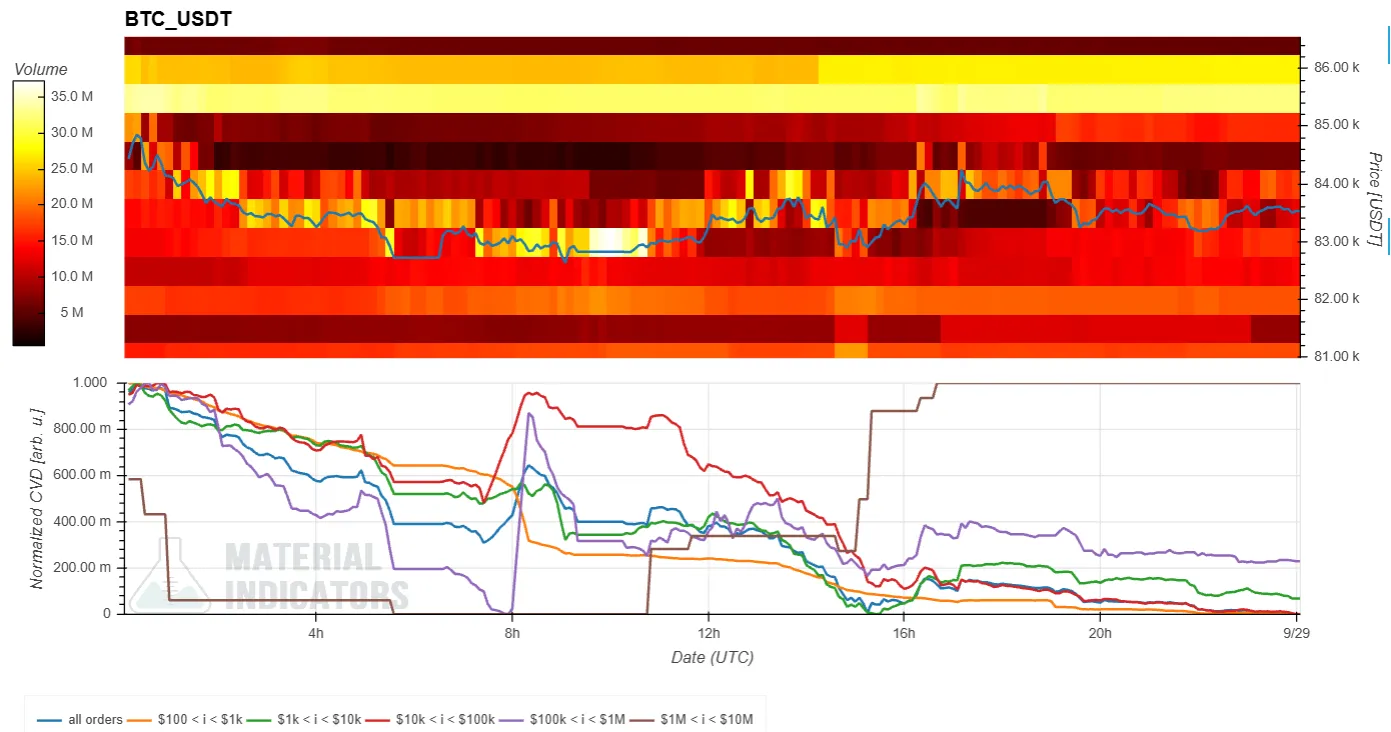
Spot CVD is an order-book analysis chart for the BTC/USDT spot trading pair. The upper section shows the volume heatmap, while the lower section shows cumulative volume delta, or CVD.
- The volume heatmap tracks trading volume at each price level. The background color becomes brighter when the price stays in a specific range for an extended period or moves sharply. Brighter zones may act as support or resistance levels.
- The cumulative volume delta indicator reflects buy and sell orders by order size. As buy orders increase, the line for the corresponding color rises. The yellow line is based on orders between $100 and $1,000, while the brown line is based on large orders between $1 million and $10 million.
00:04
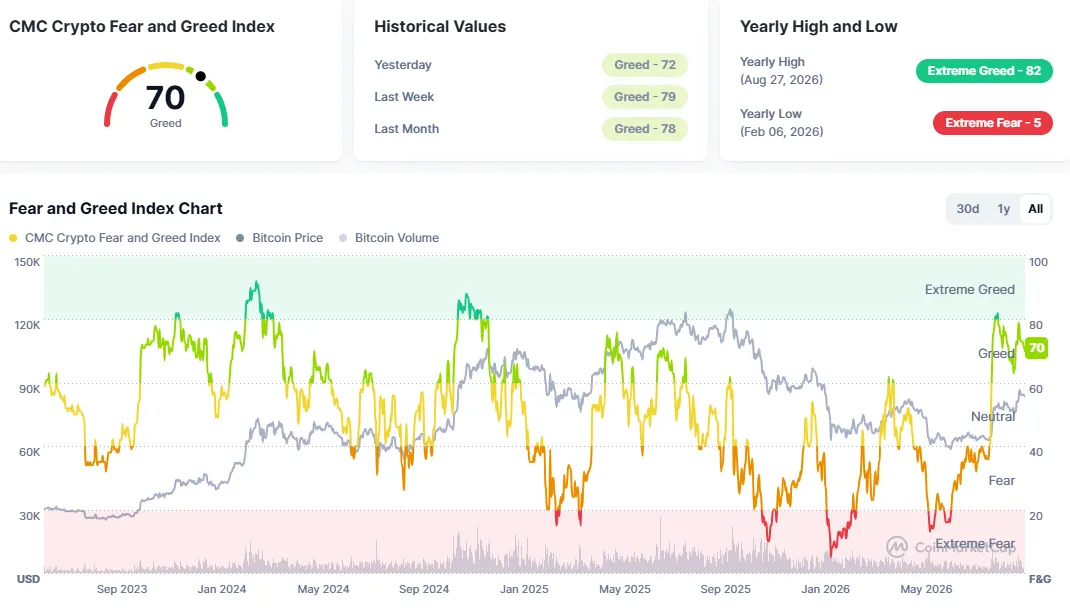
CoinMarketCap’s in-house crypto fear and greed index came in at 70, down two points from yesterday, with the market remaining in greed territory.
A reading closer to zero signals extreme fear, while a reading closer to 100 indicates extreme optimism. CoinMarketCap calculates the index based on price moves among the top 10 cryptocurrencies by market capitalization, market volatility, derivatives-market indicators including the put-call ratio, the stablecoin supply ratio, or SSR, and CoinMarketCap’s own search data.