Live Feed
New
Today, September 29, 2026
08:27
South Korean exchange Upbit announced it will suspend deposits and withdrawals for LSK at 9:00 a.m. UTC on Sept. 20 as the token migrates from the Lisk network to Ethereum.
Upbit said existing deposit addresses will become unavailable after the suspension takes effect and recommended users generate new deposit addresses after the network transition. The exchange added it will announce the timing for the resumption of deposit and withdrawal services separately.
08:21
Bitcoin long-term holders’ realized profit is currently around 72% to 78%, well below the roughly 350% recorded during market overheating in December 2024, according to a CryptoQuant analysis.
CryptoQuant added that BTC long-term holders’ realized price has continued to rise to around $48,000-$50,000. That suggests investors who bought BTC at relatively higher prices have, over time, entered the long-term holder cohort, gradually lifting the group’s average cost basis. The firm said the current market looks closer to a "mid-cycle reset" than to a cycle top. It noted that in past transitions from bull markets to bear markets, long-term holders absorbed substantial unrealized losses and MVRV came under heavy pressure, while the current market is showing a reduction in profit size rather than those kinds of extreme conditions.
08:17
An anonymous whale address starting with 0x487 withdrew 11,610 ETH worth $30.97 million from centralized exchanges over the past five hours at an average price of $2,667, according to ai_9684xtpa. Exchange withdrawals are typically interpreted as a sign of holding intent.
08:16
Hana Bank is seeking specialized staff to build its blockchain security framework and respond to related regulations, Digital Asset reported.
According to a Hana Bank job posting dated Sept. 29, the bank has separately opened recruitment for an "information security (AI and blockchain security)" role as part of its second-half 2026 NEXT CAREER hiring for experienced full-time employees, which has been under way since Sept. 22. Key responsibilities for the role include establishing and operating security frameworks for artificial intelligence and blockchain, analyzing security threats tied to AI and blockchain (Web3.0), handling compliance, and internalizing related technologies.
08:12
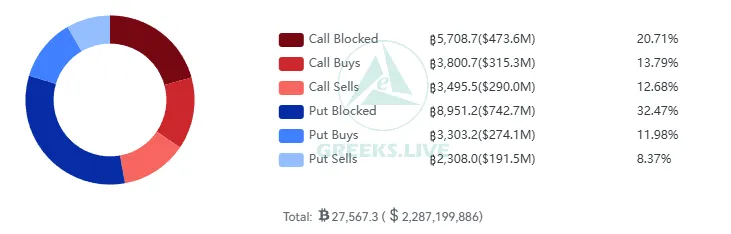
Adam, an analyst at crypto options analytics platform Greeks.live, said the recent move in Bitcoin looks closer to a rebound within an ongoing bear market than the start of a bullish reversal.
In a post on X, Adam said put option block trades, which are typically used to hedge against or bet on price declines, accounted for about one-third of activity as the market entered a correction. Adam added implied volatility across major option expiries was slightly lower than two weeks earlier and did not rise much during the latest rally, before falling to around 35%. In the options market, traders are not pricing in major volatility ahead, and some are positioning for volatility to decline again even if it ticks up slightly, Adam said. A BTC options chart Adam shared showed put option block trades at 32.47%.
07:28
Crypto payments firm MoonPay has officially launched its South Korean unit, MoonPay Korea, and plans to file as a virtual asset service provider next year, according to Edaily.
MoonPay plans to connect the payment and stablecoin infrastructure it has built in global markets with domestic financial services to roll out practical services in South Korea, including remittances, payment and settlement, and the global distribution of digital assets. Centered on MoonPay Korea, the company aims to work with local partners on service localization, financial system integration, and customer experience validation, then expand the model across Asian markets based on each country’s market environment.
07:08
Ethereum founder Vitalik Buterin has released the open-source novel 'Snowmoon,' and token ZC, based on a concept appearing in the work, saw a brief spike, Odaily reported. According to GMGN data, ZC’s market capitalization at one point reached $20.89 million before falling to about $14.34 million. Its intraday gain at one stage exceeded 41x. Some traders also issued tokens such as SNOWMOON, ZC and EMERALD based on elements in the novel, including its title, currency and AI assistant.
07:07
Profit-taking by BTC investors is declining despite the price rise, according to an analysis by on-chain analyst Axel Adler Jr.
Adler said trades locking in losses had almost consistently dominated from mid-May through Aug. 19, but realized profits began to outweigh them starting Aug. 20. Weekly realized profit reached $9.1 billion when BTC was priced at $78,600 on Aug. 26, but came to just $7.3 billion when the price climbed to $84,100 on Sept. 24. Although the price moved higher, the scale of profit-taking fell 19%, Adler said. Realized returns for short-term holders also dropped to 1% on Sept. 28 from 2.8% on Aug. 26, which Adler said suggests investors are delaying sales as they expect further upside.
06:56
According to CoinNess market monitoring, BTC has risen above $84,000. BTC is trading at $84,000 on the Binance USDT market.
06:40
Kakao Pay Securities plans to work with real-world asset tokenization firm Ondo Finance to build an overseas distribution framework for South Korean listed stocks, Financial News reported. The two companies will also conduct joint research on stock tokenization infrastructure and run a joint task force for business cooperation targeting overseas retail investors.
06:14
South Korean exchange Upbit announced the temporary suspension of deposits and withdrawals for Base-network digital assets from 9:00 a.m. UTC on Sept. 30 due to a hard fork on the Base network.
The affected assets are Aerodrome Finance (AERO), Avantis (AVNT), AWE (AWE), B3 (B3), Brett (BRETT), CARV (CARV), Cluster Protocol (CP), Citrea (CTR), Cysic (CYS), Definitive (EDGE), ELSA (ELSA), FLOCK (FLOCK), Moonbeam (GLMR), DeFi App (HOME), Impossible Cloud Network (ICNT), KAITO (KAITO), Mira Network (MIRA), OX Exchange (O), OpenGradient (OPG), Squid (QUID), Sign (SIGN), Toshi (TOSHI), Intuition (TRUST), Superform (UP2), Virtuals Protocol (VIRTUAL), Venice Token (VVV) and Zora (ZORA).
06:10
An anonymous whale address beginning with 0xc642 withdrew 18.84 million ENA worth $4.91 million from FalconX, according to Lookonchain. Exchange withdrawals are generally interpreted as a sign of holding intent.
06:00
An anonymous whale wallet starting with 0x4876 withdrew a total of 9,132 ETH worth $24.37 million from Binance over the past three hours, according to Lookonchain.
05:50
U.S. asset manager Canary Capital said it has filed an amended S-1 registration statement with the U.S. SEC for an INJ spot ETF.
05:49
Injective has launched a "stockdrop" event in which participants who burn its native INJ token can receive stock tokens as rewards, Crypto Briefing reported. The event gives users who burn INJ a chance to receive asset tokens issued based on shares such as Nvidia, AMC and Meta.
05:27
BitMEX co-founder Arthur Hayes said at Cointelegraph Connect Seoul Edition that, from the perspective of AI agents, he does not believe most existing cryptocurrencies are well suited to their purposes.
05:07
SharpLink Gaming has staked an additional 42,074 ETH worth $112.8 million, according to Lookonchain.
The company now holds 892,127 ETH and has earned 27,945 ETH in staking rewards, valued at $75 million.
05:06
U.S. spot Ethereum ETFs recorded a net inflow of $17.1 million on Sept. 28, according to Farside Investors, marking a seventh straight trading day of net inflows.
- BlackRock ETHA: +$15.4 million
- 21Shares TETH: +$1.7 million
05:05
South Korean exchange Upbit announced it will temporarily suspend HBAR deposits and withdrawals from 11:00 a.m. UTC on Sept. 29 for a Hedera network upgrade.
05:04
U.S. spot Bitcoin ETFs recorded about $31.07 million in net inflows on Sept. 28, marking the eighth consecutive trading day of net inflows, according to SoSoValue.
- BlackRock's IBIT: +$54.84 million
- Grayscale's BTC: +$10.32 million
04:39
South Korea’s financial authorities plan to step up coordination with the Bank of Korea and the Ministry of Economy and Finance as they prepare legislation to establish a legal framework for won-denominated stablecoins, News1 reported.
Speaking at a forum on the future governance and market ecosystem of won stablecoins through overseas case studies, hosted today by Democratic Party lawmaker Kim Hyun-jung, Yoo Won-gyu, an official in the virtual asset division at South Korea’s Financial Services Commission, said there appears to be broad consensus on the need for a consultative body involving the FSC, the finance ministry and the central bank. Yoo said authorities are discussing legislation in a way that would allow such a body to be formed and related policies to be closely coordinated.
Yoo added that authorities would support drafting the bill with safeguards including bankruptcy remoteness, so customer assets are managed separately and customers’ ability to recover funds is not affected even if an institution runs into problems.
04:29
South Korea’s debt relief program Saedoyak Fund under President Lee Jae-myung’s administration does not review whether borrowers hold virtual assets, meaning debt could be written off even when a borrower has the ability to repay through large crypto holdings, the Financial News reported.
The report said criticism is growing because the program has effectively left a gap in screening despite around 270 cases of hidden virtual assets having previously been uncovered under a similar debt relief scheme, the New Start Fund. Instead, the Korea Asset Management Corp. maintains it is conducting follow-up oversight through a fraudulent benefit reporting system. Under that process, if a report is filed with a hidden asset reporting center and concealed assets such as virtual assets are found, authorities can recover the amount of debt that was forgiven or seek damages. Kamco said no cases have yet been confirmed in which additional assets such as virtual assets were found after a borrower’s debt had already been canceled.
03:51
HTX chief analyst Cloud said the recent drop in Bitcoin prices looks more like a normal correction after a rebound than a trend reversal.
Cloud said elevated U.S. Treasury yields are mainly a factor weighing on valuations, while their impact on overall liquidity remains limited, adding the funding structure and holding costs of the crypto market itself have not been impaired. Cloud said the latest decline appears closer to a temporary round of position unwinding ahead of key economic data releases.
Cloud also said the decoupling, or divergence, between Bitcoin and altcoins warrants caution. As marginal liquidity shrinks, capital tends to concentrate in the most established leading asset, Bitcoin, while altcoins face a lack of additional inflows to support them and are more vulnerable to sharper declines because of their higher leverage. Cloud expects that decoupling to persist until this week’s personal consumption expenditures data and nonfarm payrolls report are released.
03:28
Spanish authorities officially announced an exemption from foreign asset reporting requirements for virtual assets held in self-custody wallets. They also said virtual assets held through overseas custodians must be reported under Form 721 only when total holdings exceed €50,000 ($53,000). In addition, assets bought and fully sold within the same year on overseas exchanges are excluded from the reporting requirement.
03:22
Ari Paul, founder of blockchain investment firm BlockTower Capital, said on X today that Coinbase concealed past hacking losses worth hundreds of millions of dollars and did not return client funds.
Paul said Coinbase had written off $25 million of BlockTower’s funds several years ago, but an investigation later led Paul to conclude the move was intended to cover up repeated large-scale hacking incidents. Paul added that tracing efforts identified at least 12 affected companies and that the total concealed losses exceeded $1 billion. Paul also said multiple legal cases are currently underway and that Paul could not disclose further details.
