Live Feed
New
Today, October 9, 2026
05:04
Solana is expected to apply an upgrade at mainnet epoch 1,053 that will reduce block production time to 200 milliseconds from 250 milliseconds, CoinDesk reported. After the change, the Solana network will offer five block production opportunities per second.
CoinDesk said the move marks the final stage of a phased reduction in block times that began at 400 milliseconds in August. The outlet explained that faster block production can reduce transaction delays and opportunities for attacks that exploit them, while also increasing validators’ voting burden and network load, which shortens transaction validity periods.
Solana mainnet is currently at epoch 1,052, with about nine hours and 38 minutes remaining until the next epoch.
04:55
Spain has approved new rules requiring identity verification for all transactions at cryptocurrency ATMs, ending anonymous use of the machines in the country, Criptonoticias reported.
The Spanish government approved Royal Decree 813/2026 on Oct. 8, local time, with the new rules aimed at significantly strengthening anti-money laundering measures in the financial sector. The main goal is to block illicit funds from moving through channels that are difficult to trace. ATM operators have been given an 18-month grace period to implement electronic identity verification systems to meet the new requirements.
04:50
Two DWF Labs affiliates have filed a roughly $141 million damages suit against crypto custodian BitGo in London’s High Court, according to Crypto Briefing.
The plaintiffs, DWF Maas and Falcon Digital, both linked to DWF Labs, argued in the complaint that BitGo released tokens before contractual lockup periods expired, triggering market price declines. The tokens cited in the claim include Falcon Finance (FF) and Yooldo (ESPORTS).
In the case of South Korean project ESPORTS, the token plunged more than 90% in May, when multiple media outlets and community channels raised allegations of a rug pull and price manipulation.
04:39
The following shows estimated liquidation volumes and position ratios for major crypto perpetual futures over the past 24 hours:
- ETH: $345.7 million liquidated (82.31% longs)
- BTC: $261.72 million liquidated (84.59% longs)
- SOL: $64.9 million liquidated (91.91% longs)
04:36
Ozzy, founder of PONS, a token launchpad in the Arbitrum-based Layer 2 Robinhood Chain ecosystem, said on X that Ozzy bought a small amount of spot BTC today for the first time since January 2023.
Ozzy added that last night’s BTC drop felt like the sharpest selloff since the FTX collapse in 2023 and said Ozzy plans to accumulate one BTC through dollar-cost averaging. Ozzy also said not many people actually hold one BTC and personally believes Bitcoin could become a symbol of wealth in the future.
04:29
Crypto trader Jason Leo, who has about 122,000 followers on X, said Bitcoin is unlikely to fall straight to $78,000 from current levels in the near term and sees even lower odds of a drop to $74,000.
Leo said BTC has corrected only about 5% even as macro headwinds have piled up, including rising U.S. Treasury yields, the possibility of another rate hike this year, and pressure from oil prices and inflation. Leo added the market’s reaction to negative factors matters more than the factors themselves. Leo also said Leo plans to reduce positions if BTC falls below $79,000 and exit all remaining long positions if the daily close finishes under $78,000.
04:20
U.S. spot Ethereum ETFs posted a net outflow of $72.5 million on Oct. 8, marking an eighth straight trading day of net outflows, according to Farside Investors.
- BlackRock ETHA: -$71.1 million
- Fidelity FETH: +$5.5 million
- 21Shares TETH: -$1.2 million
- VanEck ETHV: -$0.9 million
- Morgan Stanley MSSE: +$1.3 million
- Grayscale ETHE: -$6.1 million
04:18
U.S. spot Bitcoin ETFs posted $244.1 million in net outflows on Oct. 8, extending withdrawals to a second consecutive day, according to Farside Investors.
- BlackRock IBIT: -$5.5 million
- Fidelity FBTC: -$197.1 million
- Bitwise BITB: -$17.7 million
- ARK Invest ARKB: -$20.3 million
- Franklin Templeton EZBC: +$4.7 million
- Grayscale GBTC: -$8.2 million
04:14
Claims that global asset manager Fidelity sold $197 million worth of BTC, which some crypto community members blamed for yesterday’s sharp Bitcoin drop, lack supporting evidence and appear to stem from a misreading of on-chain transfers tied to internal asset movements, Crypto Briefing reported.
As BTC fell into the $80,000 range yesterday, some in the community pointed to an alleged $197 million Fidelity sale as the cause of the decline, according to the outlet. Crypto Briefing said currently verifiable data does not show an actual sale took place, and added the claim appears to have misinterpreted fund transfers between custody wallets for Fidelity’s institutional clients and related settlement flows linked to its spot BTC ETF business.
04:04
Thailand’s SEC has finalized new rules allowing spot Bitcoin and Ethereum ETFs to trade on the Stock Exchange of Thailand, Cointelegraph reported.
The Thai regulator announced the rules on Oct. 8 local time, saying they will take effect on Oct. 16. Initial eligibility is limited to Bitcoin and Ethereum, and crypto ETFs in Thailand will be allowed to trade only on the SET. Related products, including depositary receipts linked to overseas crypto ETFs, are not yet permitted. Thai securities firms also remain barred from brokering investments in overseas crypto ETFs for retail investors other than institutional investors and ultra-high-net-worth individuals.
Previous related news
03:03
Robinhood Crypto said on X it is considering launching Stock Tokens linked to active exchange-traded funds on Robinhood Chain with global asset manager T. Rowe Price.
T. Rowe Price has about $1.9 trillion in assets under management. Robinhood said the product could become the first stock token tied to an active ETF if launched, but added that the collaboration and product launch remain subject to legal due diligence, board approval and regulatory authorization, and have not been finalized.
02:15
An address believed to be linked to Wang Chun, co-founder of F2Pool, the world’s fourth-largest Bitcoin mining pool, sold 235.5 WBTC worth about $19.31 million and bought 7,848.5 ETH after a sharp drop in the crypto market, according to EmberCN. Wang had been buying BTC and ETH since late May. The ETH purchase was made at an average price of about $2,460 per token.
02:02
A newly created address opened a 40x leveraged long position worth 54.1 BTC, or about $4.42 million, on Hyperliquid, according to on-chain analytics account Onchain Lens.
The entry price was $81,778.6 and the liquidation price was $80,819.1. The position is currently showing an unrealized loss of about $1,200, while the address has accumulated losses of about $20,200.
02:02
According to CoinNess market monitoring, BTC has risen above $82,000. BTC is trading at $82,009.96 on the Binance USDT market.
01:55
France’s National Assembly finance committee has approved three cryptocurrency-related amendments during its review of the 2027 budget bill, according to Odaily.
The approved measures include taxation on stablecoin transactions, the introduction of an exit tax on crypto holdings, and carryforward deductions for crypto investment losses for up to 10 years. An amendment to expand France’s wealth tax on individuals to cover cryptocurrency was rejected, while provisions on mandatory reporting for self-custody wallets and fines for platforms remain under review.
The amendments have not yet been enacted into law and still require additional legislative procedures.
01:40
Animoca Brands announced a strategic partnership with global asset manager Franklin Templeton to expand real-world asset tokenization. The two companies plan to improve institutional investors’ access to tokenized assets through NUVA, an RWA vault marketplace jointly developed by Animoca Brands and Nuva Labs.
01:03
Crypto influencer Bando analyzed that the top 25 token issuers on Solana-based memecoin launchpad PUMP have so far issued around 770,000 tokens and generated a combined $128 million in profit.
00:54
According to the U.S. Attorney’s Office for the Northern District of Illinois, Empire Market co-founder Rahim Hamilton was sentenced to 40 years in prison and fined $5 million on charges of conspiracy to distribute narcotics. Hamilton also agreed to forfeit about 1,230 BTC, 24.4 ETH, and three properties.
Empire Market operated from 2018 to 2020 and processed more than $430 million in transactions, requiring cryptocurrency payments for all trades. Another co-founder, Thomas Pavey, also agreed to forfeit about 1,584 BTC and other assets, and is set to be sentenced later this month.
00:50
South Korean exchange Bithumb announced it would temporarily suspend withdrawals of Tether (USDT) on the Aptos network at 12:00 a.m. UTC today for wallet system maintenance.
00:46
An anonymous whale saw 28,716 ETH in long positions, worth about $69.69 million, liquidated during the recent crypto market plunge, according to Lookonchain. The whale has continued building additional ETH long positions after the liquidation and now holds 78,955 ETH in longs worth about $195.57 million. The liquidation prices for the positions are $2,299.09 and $2,286.28, respectively.
00:32
Hong Kong crypto exchange OSL Group has launched the market-neutral fund token PrimePlus SPC-USDGO Plus SP in partnership with digital asset technology firm 2WA, NewsBTC reported. OSL is responsible for tokenizing fund shares and providing custody for USDGO, the underlying asset, and will offer the product to qualified professional investors in Hong Kong.
00:27
Bitcoin-based life insurer Meanwhile has raised $37.5 million in a funding round led by Bain Capital Crypto, Axios reported. The round also included Hon Ventures, Framework, Pantera Capital and Apollo Global, bringing the company’s total funding to more than $180 million. The proceeds will be used to meet demand for BTC-denominated life insurance in Asia, Europe and the Middle East.
00:21
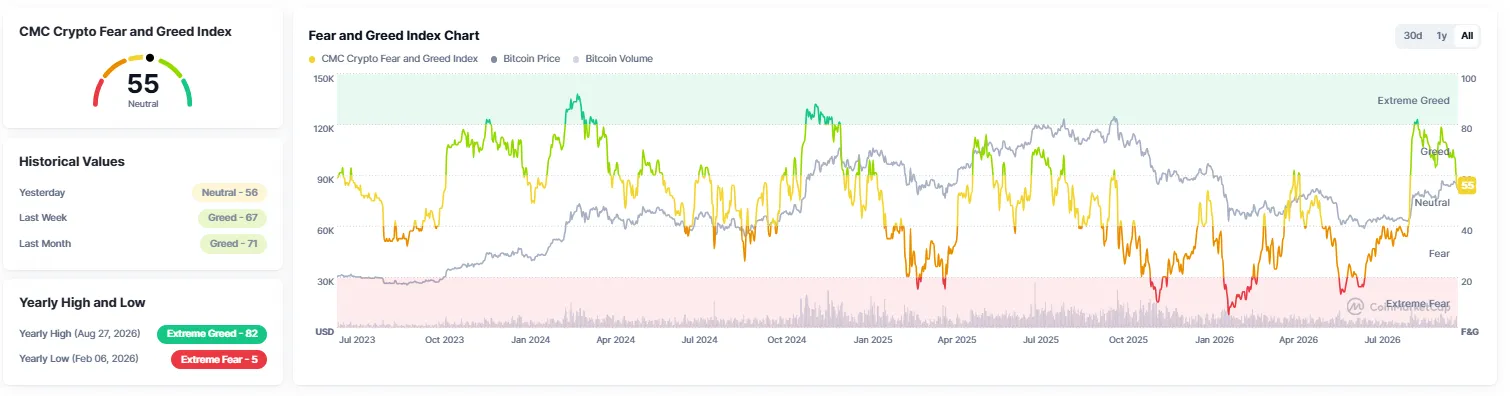
CoinMarketCap’s in-house Crypto Fear and Greed Index came in at 55, down six points from yesterday and shifting from greed to neutral.
The index indicates extreme fear when it approaches zero and extreme optimism when it nears 100. CoinMarketCap calculates the gauge based on price moves among the top 10 cryptocurrencies by market capitalization, market volatility, derivatives-market indicators such as the put-call ratio, the stablecoin supply ratio, or SSR, and CoinMarketCap’s own search data.
00:18
Jump Crypto’s Firedancer wallet has staked an additional 453,987 SOL, worth about $49.81 million, according to Onchain Lens. Firedancer is a Solana validator client developed by Jump Crypto.
00:12
Tokenizing financial assets and fund flows, including Treasuries, stocks and money market funds, could make collateral transfers more efficient and unlock tens of billions of dollars in tied-up capital, Nasdaq CEO Adena Friedman said at the Token2049 event in Singapore, CNBC reported.
Friedman said institutional interest in tokenization has risen since passage of the U.S. GENIUS Act. Friedman added a shift to 24-hour trading would require real-time risk and collateral management systems, with AI set to play a key role, while noting not all assets have the liquidity needed for around-the-clock trading.
