Live Feed
New
Today, September 30, 2026
08:55
Zcash developers have unveiled Udon as part of a network scalability upgrade. Project Tachyon is developing Udon with a long-term goal of processing 50,000 private transactions per second.
08:40
Crypto exchange Gemini has replaced its Zcash-related system software with Zebra ahead of an upgrade that will shorten ZEC’s block interval from 75 seconds to 25 seconds.
Zebra is software that tracks and verifies the Zcash network and its transaction history. It also lets new machines start up quickly using a copy of recently stored network data, removing the need to download Zcash’s full transaction history from the beginning.
08:23
Standard Chartered said Ethena’s ENA token could rise to $2 by the end of 2028.
In a report, the bank said ENA sits at the intersection of perpetual futures, tokenization and stablecoins, positioning it to benefit from growth across those segments and from a newly introduced buyback program. It also said Ethena is currently the world’s fourth-largest stablecoin issuer after Tether, Circle and Sky, and that Ethena’s USDe was the fastest stablecoin to reach a $10 billion market capitalization.
08:16
Bitwise’s U.S.-listed spot NEAR ETF, NRR, recorded $35.5 million in net inflows on its first trading day.
08:00
Bitcoin’s September rebound lifted the share of BTC supply in profit to 72%, but price momentum has weakened, on-chain analyst Axel Adler Jr. said in a blog post.
The metric measures the share of total supply last moved at prices below the current level. Adler said the ratio rose from 65% to 73.8% as BTC climbed from $76,000 to $87,000 between Sept. 17 and Sept. 27, marking the highest level since January. It later slipped to 72%, still below the long-term average of 76%, Adler added.
He said a recovery would signal continuation if momentum turns positive again and the ratio rises above 76%. If momentum turns negative and the ratio falls toward 65%, a significant portion of the supply that returned to profit in September would move back into loss, according to Adler.
07:59
Bitget CEO Gracy Chen urged THORChain (RUNE) not to provide services to addresses identified as belonging to hackers, according to Wu Blockchain. Chen argued decentralization should not serve as a justification for helping move stolen funds.
THORChain, meanwhile, maintains that its network is permissionless and open to anyone. When the protocol’s own vault was hacked in May, causing about $10.7 million in losses, the network was temporarily halted through automatic safeguards and a joint response by node operators. Even then, THORChain said it did not block the attacker’s addresses individually.
Previous related news
07:51
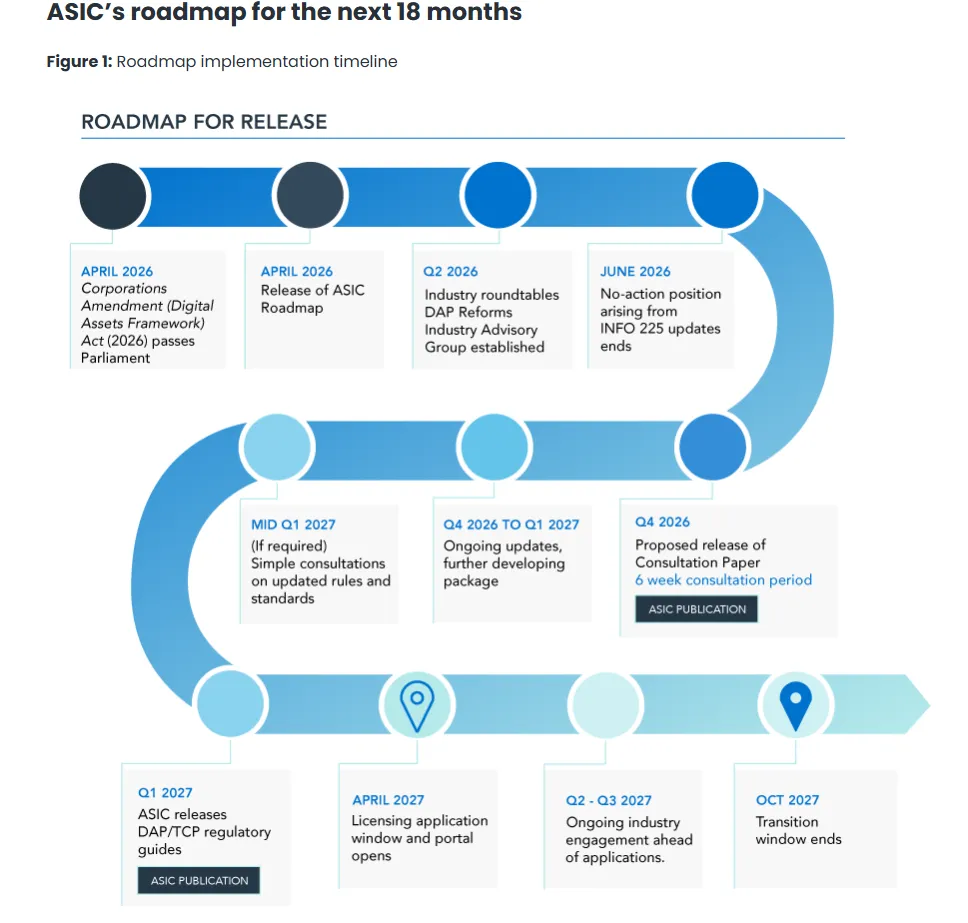
Australia’s Securities and Investments Commission has unveiled a regulatory roadmap to bring digital asset platforms and tokenized custody platforms into the financial services licensing framework. The related bill passed parliament in April, and the new regulatory regime will take effect on April 9, 2027.
ASIC plans to gather feedback on draft operational standards and guidelines in the fourth quarter of this year, before releasing final regulatory guidelines in the first quarter of 2027. Starting in April 2027, it will begin accepting license applications from service providers and set standards for asset custody, trading and settlement, financial requirements, and market integrity management.
07:44
Privacy-focused layer-one blockchain Zano said it will fully reimburse users for balances affected by a recent inflation vulnerability. The project said it applied emergency patches, including rolling the network back to its state from a month earlier, and added the network is now operating stably.
The vulnerability emerged in Hardfork 6, which was implemented in late August, and allowed an attacker to mint ZANO and the stablecoin fUSD arbitrarily. fUSD said preliminary findings showed forged fUSD was used to exchange assets worth millions of dollars. External services, including exchanges, plan to resume deposits and withdrawals after completing node updates and verifying transaction records from the past month.
07:38
Crypto exchange Bitget has begun rebuilding its Protection Fund after a hacking incident, with on-chain data showing that 2,000 BTC, worth about $166 million, was transferred from a Bitget cold wallet to the user protection fund address over the past two hours. The wallet’s total holdings have now risen to 2,484.71 BTC, or about $206 million, pushing the fund back above the $200 million mark.
Earlier, Bitget CEO Gracy Chen and other executives said the company would fully compensate hack-related losses with its own funds and rebuild the protection fund to more than $300 million within a week. The latest cold-wallet transfer appears to be part of that replenishment effort and is helping ease market concerns over a potential bank run.
07:27
Fundstrat co-founder Tom Lee said the Federal Reserve could soften its recent hawkish stance if the U.S. August core personal consumption expenditures price index comes in below market expectations, adding that such an outcome could be positive for stocks. Lee also pointed to earlier remarks by New York Fed President John Williams indicating there was no need to rush additional rate hikes.
07:14
European stablecoin issuer AllUnity said it plans to launch USDAU, a stablecoin pegged one-to-one to the U.S. dollar.
USDAU will be fully backed by segregated reserve assets and issued across six networks: Ethereum, Solana, Base, Tempo, Arkh, and Polygon. AllUnity is regulated under the European Union’s Markets in Crypto-Assets Regulation, or MiCA, and already issues the euro-denominated EURAU, Swiss franc-denominated CHFAU, and Swedish krona-denominated SEKAU. USDAU will be AllUnity’s fourth fiat-backed stablecoin.
07:12
Joseph Chalom, CEO of Ethereum treasury firm Sharplink, urged the South Korean government and National Assembly at Korea Blockchain Week 2026 to move quickly to establish a clear regulatory framework for digital assets.
In a speech, Chalom said a wait-and-see approach that leaves a regulatory vacuum in place is increasing market uncertainty, and stressed the need for bold legislative action. He added that rather than letting fears stemming from past market turmoil block innovation, authorities should put in place thorough investor protection guidelines and allow the industry to grow within the regulatory fold.
07:02
South Korean exchange Bithumb announced an extension of CORE’s delisting watchlist designation. The exchange said it is receiving explanations from the project regarding the facts behind the watchlist designation and follow-up measures, and is conducting additional review procedures, prompting the extension for a closer assessment.
07:01
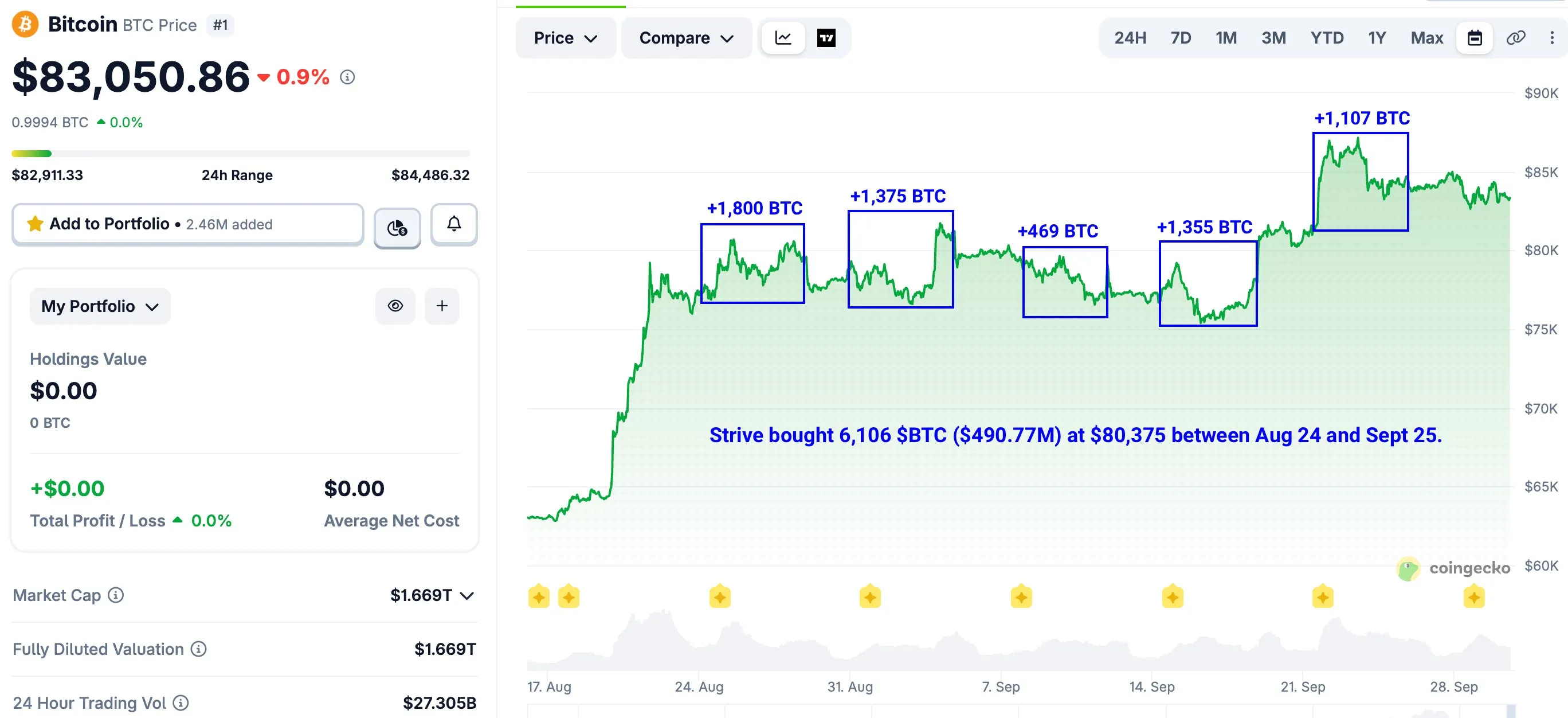
Strive added 6,106 BTC, worth about $490.77 million, between Aug. 24 and Sept. 25 at an average purchase price of $80,375, according to Lookonchain. Separate public data shows Strive has continued buying BTC and recently increased its holdings to 27,462 BTC. The company added another 1,107 BTC over the past week.
06:49
According to CoinNess market monitoring, BTC has fallen below $83,000. BTC is trading at $82,994.04 on the Binance USDT market.
06:28
Tyler Winklevoss, co-founder of Gemini, said the recent market mood around Zcash (ZEC) resembles the cryptocurrency market in 2019. At the time, the crypto market was starting to regain attention around Bitcoin after the 2018 bear market, while ZEC has shown sharp volatility this year and recently posted a notable uptrend. According to CoinGecko data, ZEC rose above $1,000 in September and climbed as high as $1,335.51 on Sept. 16. Gemini has supported ZEC trading and custody since 2018.
06:20
Former U.S. Commodity Futures Trading Commission Commissioner Brian Quintenz said at Korea Blockchain Week 2026 that passing the CLARITY Act is not the only way to overhaul the U.S. cryptocurrency regulatory framework. Quintenz said the U.S. SEC and the CFTC could use their exemptive authority to help fill regulatory gaps. Quintenz also said tokenization adoption in traditional finance has expanded this year, while crypto use cases are broadening beyond finance into entertainment, music, and social networking.
06:17
Japanese telecom company KDDI said it has launched the “αU wallet,” a cryptocurrency wallet available through its mobile payment app au PAY.
Users can exchange reward points for WBTC, ETH and the yen-denominated stablecoin JPYC, and can also buy cryptocurrencies through accounts at local exchange Coincheck and manage them directly in the wallet. Held cryptocurrencies and stablecoins can be converted into au PAY balance for merchant payments, while a staking feature is set to be added this winter.
06:11
The following are the 24-hour long/short ratios for BTC perpetual futures on the world’s three largest crypto futures exchanges by open interest:
Overall: 49.44% long, 50.56% short
- Binance: 49.62% long, 50.38% short
- OKX: 49.84% long, 50.16% short
- Bybit: 51.29% long, 48.71% short
05:43
Lu Yin, head of APAC at the Solana Foundation, described Solana as an open-source technology similar to Linux at Solana Summit Korea. Lu said Solana aims to be used for moving value in the same way the internet moves information.
05:35
Cindy Leow, co-founder of Solana-based decentralized derivatives exchange Velocity, formerly Drift (DRIFT), said Lee will step down following the exchange’s relaunch. In a post on X, Leow said Velocity has moved beyond its startup phase and now needs an executive team suited to driving full-scale growth. Leow added that Drift was attacked by North Korea in April after a six-month social engineering infiltration campaign, and later signed an agreement with Tether to compensate affected users while rebuilding smart contracts and conducting security audits. Velocity relaunched this week after completing the security audit and fully open-sourcing its code.
05:33
The probability on decentralized prediction market Polymarket that the U.S. 30-year Treasury yield will reach 6% before 2027 fell 25 percentage points over the past 24 hours to 25%.
05:10
A bill has been introduced in South Korea to give the Financial Intelligence Unit under the Financial Services Commission the authority to request preemptive transaction suspensions for cryptocurrency addresses suspected of being used in serious crimes affecting the public, Digital Asset reported.
According to the report, 11 lawmakers including Democratic Party lawmaker Park Min-kyu proposed the amendment to the Act on Reporting and Use of Specific Financial Transaction Information on Sept. 30. The bill defines serious public-harm crimes as including illegal private lending, drugs, gambling, new phishing schemes using telecommunications, and terrorism financing. It would allow investigative agencies to ask financial institutions and other entities to temporarily suspend deposits and withdrawals for seven days on accounts or addresses believed to have been used in such crimes, with the FIU chief able to extend the period up to 60 days if deemed necessary. The measure would also allow the FIU chief to request financial institutions and other entities to suspend transactions for up to 180 days on accounts and addresses tied to those crimes.
05:02
Ripple told Bitcoin.com it is no longer active in the Bank for International Settlements’ cross-border payments interoperability and extension task force. Ripple said it participated in the task force from 2023 to 2025 and is not currently involved in any other BIS task force or working group.
Earlier, BIS researchers disclosed findings on Sept. 2 from a study of a data validation system using the XRP Ledger. BIS said the research did not amount to an endorsement of XRPL or any specific company and instead examined an approach that could also be applied to other blockchains. No link has been confirmed between the end of Ripple’s task force role and the BIS research on XRPL.
05:01
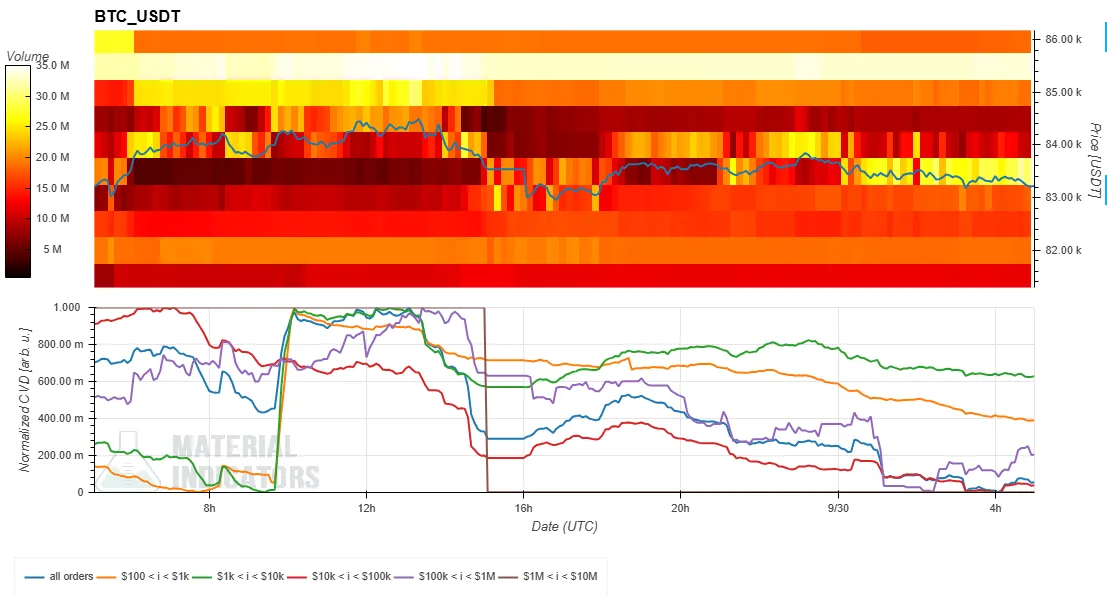
The spot CVD chart is an order book analysis chart for the BTC/USDT spot trading pair. The upper panel shows the volume heatmap, while the lower panel shows cumulative volume delta, or CVD.
- The volume heatmap tracks trading volume at each price level. The background becomes brighter when the price stays in a specific range for an extended period or makes a large move. Brighter areas may act as support or resistance.
- The cumulative volume delta indicator reflects buy and sell orders by order size. As buy orders increase, the corresponding colored line rises. The yellow line is based on orders worth $100 to $1,000, while the brown line reflects large orders worth $1 million to $10 million.