Live Feed
New
Today, October 7, 2026
12:29
Circle announced on its official blog that it has entered into a partnership with Tereina, a financial services company under German global enterprise software provider SAP, according to a statement released today.
Through the partnership, Tereina plans to introduce USDC and EURC into its payment infrastructure. The integration will begin with SAP Cloud ERP and will allow eligible SAP customers to send and receive stablecoin payments through SAP Pay without leaving their existing business applications. The two companies also plan to run proof-of-value programs for corporate clients and provide training for treasury and payments professionals as they seek to expand stablecoin adoption across enterprises.
12:26
The yield on the benchmark 10-year U.S. Treasury note rose to 5.3496%, its highest level since 2002.
12:19
Banks need separate digital asset infrastructure to use the blockchain-based ledger of the Society for Worldwide Interbank Financial Telecommunication, or SWIFT, Taurus co-founder Lamine Brahimi said, according to CoinDesk.
Brahimi said connecting to the SWIFT ledger requires a bank’s own permissioned ledger, digital asset wallet, tokenization capabilities, and smart contract functions. CoinDesk added that the SWIFT ledger serves to connect deposit tokens between banks, while each bank’s own system handles deposit management and smart contract processing. In July, SWIFT said 17 banks were preparing real-world transactions involving deposit tokens, and HSBC and Standard Chartered have since completed the first live interbank transaction, while DBS and Citi carried out cross-border payments.
12:16
Tether announced on its official blog on Oct. 7 that it signed a memorandum of understanding with the Central Bank of Kazakhstan and the Alatau City Administration (ACA), a special administrative body in Kazakhstan, according to the company.
The parties plan to jointly study issuance models and use cases for a stablecoin pegged to Kazakhstan’s national currency, the tenge, and pursue a pilot project in Alatau City. They are also reviewing the creation of an asset tokenization framework using Tether’s tokenization platform Hadron.
Tether said they also plan to run educational programs on stablecoin issuance, reserve asset management, and real-world asset tokenization.
12:13
Stablecoin payment infrastructure firm Noah said on Oct. 7 that it had closed a $38 million seed round after raising an additional $16 million from existing and new investors through its official channel.
The company said the proceeds will be used to expand its stablecoin-based cross-border remittance service, scale compliant business operations, hire talent, build infrastructure in key markets, and enter the U.S. market.
Previous related news
12:13
Whale Alert reported that 2,500 BTC has been transferred from an unknown wallet to Bitfinex. The transaction is valued at about $209 million.
11:56
Swiss crypto wallet provider Tangem has launched a physical Visa card for in-store and online payments as well as ATM withdrawals, Cointelegraph reported. Users can transfer funds directly from a self-custody wallet to the card, and if the card is frozen or canceled, remaining funds can be moved back to the wallet. The initial batch is limited to 5,000 cards, and the service is unavailable in around 20 sanctioned countries, including China, Russia, North Korea and Palestine.
11:46
Canary Capital’s spot XRP ETF, XRPC, was trading at $15.94, down 40.1% from its post-launch high, according to Finbold.
Finbold said XRPC is down 21.24% year to date but has rebounded 6.7% over the past month. The outlet added that the seven U.S. spot XRP ETFs have seen about $1.79 billion in net inflows since launch, while XRP has traded around $1.5, well below its 2025 high of about $3.65. It explained that the price impact has been limited as inflows into XRP ETFs have been smaller than those into spot BTC ETFs, and not all ETF funds are used to directly buy XRP on exchanges.
11:40
Large inflows into U.S. spot Bitcoin ETFs are key for BTC to decisively break above $87,000, CoinDesk reported.
Oliver Kading, head of marketing at institutional crypto asset management and lending infrastructure provider Tesseract Group, said current BTC price action suggests ETF-driven buying was not strong enough to offset macroeconomic pressure, even though it fueled September’s gains. Kading said inflows of more than $300 million over several trading sessions could signal a recovery in institutional demand.
Martin Lee, chief data analyst at crypto market maker DWF Labs, added that immediate large daily inflows matter more than an extended period of inflows amounting to only several hundred million dollars in total.
11:36
Upbit announced it will temporarily suspend IOTA deposits and withdrawals at 3:00 a.m. UTC on Oct. 8 due to a network upgrade.
11:30
Standard Chartered sees Ethena’s ENA rising to $1.10 by the end of 2027, with the outlook hinging on a recovery in supply of the synthetic dollar USDe, according to Crypto Briefing.
The bank set ENA price targets of $0.42 for the end of 2026, $1.10 for the end of 2027, and $2 for the end of 2028. It expects ENA to outperform BTC and ETH through the end of 2028. Standard Chartered’s analysis said a key condition is a recovery in USDe supply, which is currently around $4.9 billion. The bank said supply needs to exceed $7.5 billion for Ethena’s fee switch mechanism to activate, as the feature would direct 95% of protocol net revenue to ENA buybacks. It also expects USDe supply to expand to $40 billion by the end of 2028, while identifying the reversal of USDe’s supply decline and the ability to maintain attractive yields at scale as major risks.
11:18
As more services become available onchain, many crypto trading and usage activities no longer need to pass through centralized exchanges, NEAR Protocol co-founder Illia Polosukhin told The Block. Polosukhin added NEAR plans to add fiat-related functions and tokenized stocks tied to more countries and markets.
11:18
Europol urged the crypto industry to proactively overhaul its security systems, saying wallets are the most vulnerable part of cryptocurrency networks to quantum computing attacks, according to Decrypt.
Europol said wallets with public keys exposed on-chain cannot be protected once quantum computers can derive private keys from those exposed keys, meaning funds would need to be moved in advance. By contrast, hash functions used for blockchain linking and mining remain broadly secure, and Europol said quantum computing is unlikely to cause cryptocurrencies to collapse. Meanwhile, Glassnode estimated that as of May, 6.04 million BTC, or 30.2% of issued BTC, already had exposed public keys.
11:04
U.S. crypto exchange Coinbase said it has completed the integration of Deribit, the crypto derivatives exchange it acquired last year, and will operate the combined platform as Coinbase Global Exchange.
Coinbase said BTC options open interest on the integrated exchange stood at over $30 billion as of Sept. 30. The company added that it plans to roll out crypto options, spot margin trading, and unified portfolio features in the coming weeks, and aims to relaunch Coinbase Pro for professional traders by year-end.
Previous related news
10:58
European cryptocurrency platform SwissBorg now supports Worldcoin (WLD) deposits, withdrawals and swaps, Crypto Briefing reported. Users can swap WLD for more than 400 tokens, and SwissBorg also offers swaps between assets on different blockchains without a separate bridging process. Crypto Briefing added that no separate official listing announcement date was specified, while documents published by SwissBorg show WLD support was reflected as of early October 2026.
10:49
Adeniyi Abiodun, co-founder and chief product officer at Mysten Labs, the developer of SUI, introduced “Sui Threat Intelligence,” a new tool designed to detect and flag security threats across the Sui ecosystem, at Sui Basecamp 2026 in Singapore on Oct. 7, local time. Abiodun added that the tool can identify vulnerabilities, alert developers and help deter security threats.
Note:
We are participating in Sui Basecamp 2026 as an official media partner.
10:44
Crypto analyst Ted Pillows said he has become more bullish on ETH as some Ethereum layer-2 projects announce shutdowns.
In a post on X, he said useless L2s are being weeded out, pointing to projects such as Abstract and Blast ending operations. Ted Pillows argued the lesson is simple: developers should build directly on the Ethereum mainnet and stop creating unnecessary chains aimed at extracting profits from participants in their own ecosystems.
Abstract had previously said it would halt operations on Dec. 15, citing stalled growth and low liquidity. Blast has also said it would shut down chain operations as maintenance costs far exceeded revenue.
Previous related news
10:44
Ethereum is trading below the lower bound of the undervalued zone on the rainbow chart and could rise to $2,800-$3,300 by late November if it regains momentum, Finbold said.
The rainbow chart is a valuation model that analyzes an asset’s historical price moves on a logarithmic scale, divides price ranges into multiple color-coded bands, and interprets those bands as market psychology stages such as undervalued, accumulation, holding, and overheated conditions. Finbold said ETH was trading near $2,595, around the upper boundary of the chart’s "Accumulate" zone. The outlet added this suggests ETH remains far from an overheated phase and makes a late-November target range of $2,800-$3,300 reasonable. It also said a stronger uptrend could push ETH toward about $3,900, the lower boundary of the "Still Cheap" zone, although that would require sustained inflows into spot ETH ETFs, increased network activity, and growth in the tokenized real-world asset market.
10:30
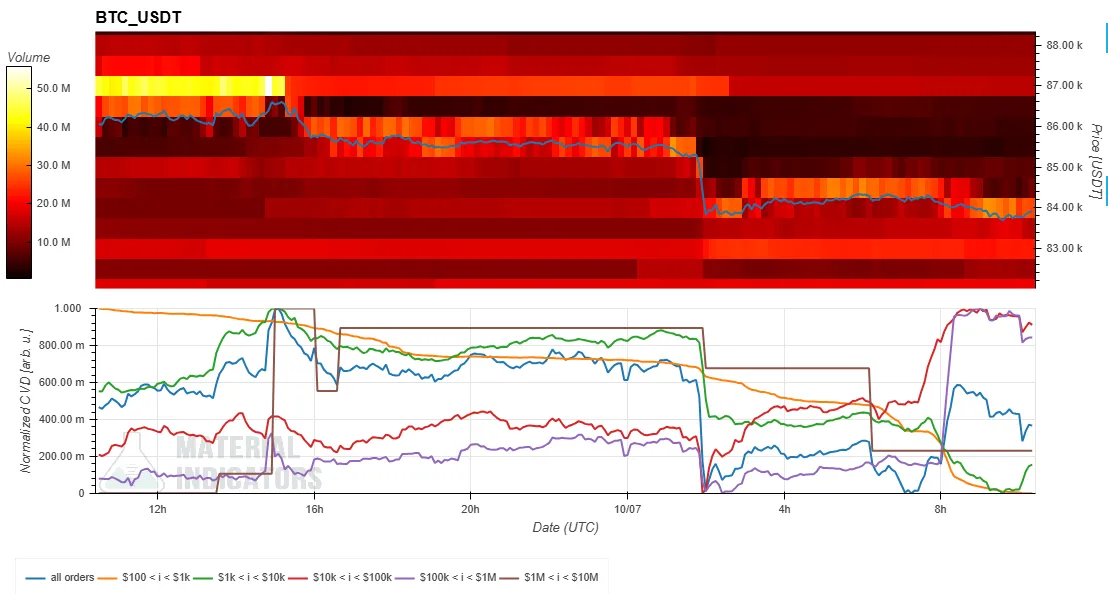
Spot CVD is an order-book analysis chart for the BTC/USDT spot trading pair. The upper panel shows a volume heatmap, while the lower panel shows cumulative volume delta, or CVD.
- The volume heatmap tracks trading volume at each price level. The background becomes brighter when the price stays in a specific range for an extended period or makes a large move. Brighter zones may act as support or resistance.
- The CVD indicator tracks buy and sell orders by order size. The line for each color rises as buy orders increase in that size band. The yellow line represents orders between $100 and $1,000, while the brown line reflects large orders between $1 million and $10 million.
10:27
Layer-1 blockchain Sui processed 40,614,180 transactions per second through “Sui tunnels” in a live test at its annual Sui Basecamp conference in Singapore today, breaking the previous TPS record of 6 million TPS.
Sui said the result far exceeded its pre-test target of 20 million TPS and also topped the 6 million TPS record set in July. The company said the test was designed to demonstrate the network’s stability and speed under extreme throughput conditions required for AI agents and machine commerce. It described “Sui tunnels” as programmable offchain state and payment channels similar to the Lightning Network’s offchain payment channels, offering high throughput while supporting payments and settlement on the Sui mainnet in a secure and verifiable way.
The test was led by Mysten Labs co-founder and Chief Product Officer Adeniyi Abiodun, while blockchain-focused audit firm CertiK handled real-time verification.
Previous related news
10:19
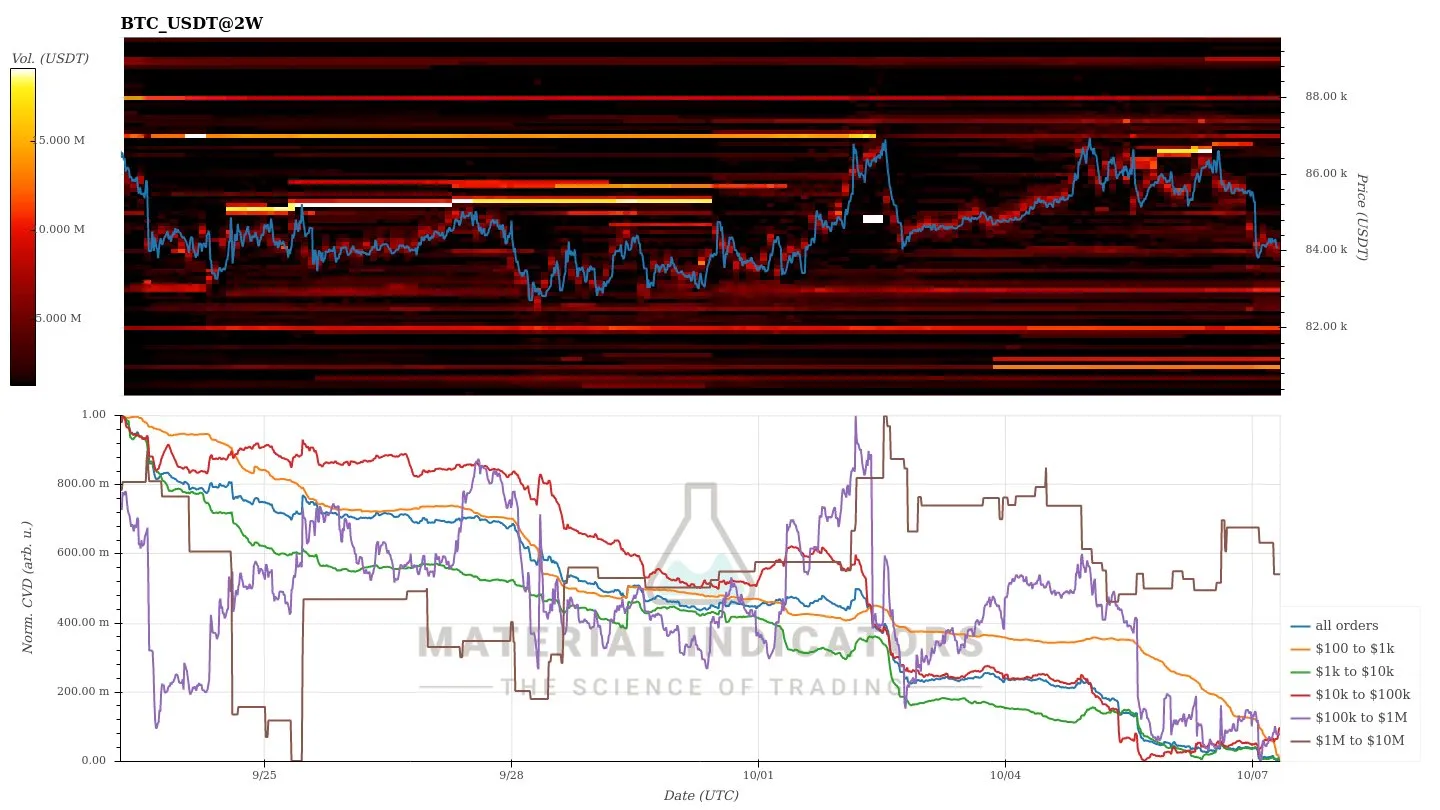
On-chain analyst CW said cumulative volume delta data showed the recent Bitcoin decline was marked by notable selling from “purple whales,” or mid-to-large holders placing orders worth $100,000 to $1 million. CW said BTC fell as selling from that group intensified, and flows later showed the same group turning back to buying after the decline. “Red whales,” referring to orders worth $10,000 to $100,000, have also kept buying after BTC fell, while retail investors continue to sell. According to CoinMarketCap, BTC was trading at $83,804, down 2.64%, at the time of writing.
10:19
Crypto analyst Gert Van Lagen said XRP could approach $50 if Bitcoin rises to around $450,000 and the XRP/BTC ratio repeats its 2017 surge, according to Finbold.
Van Lagen said XRP/BTC rose about 50-fold from current levels in just two months in 2017, and a similar move could put Bitcoin at $450,000 and XRP near $50. Van Lagen also said a bullish breakout from XRP’s long-term symmetrical triangle pattern would imply a target of roughly $45-$50, adding that $50 would correspond to a market capitalization of about $3 trillion and could fit within a typical bull-market move.
Finbold added that $50 would be about 33 times XRP’s chart-based level of around $1.5, and said a symmetrical triangle does not guarantee an upside breakout. The outlet assessed the scenario as highly speculative, saying it hinges on a sharp expansion in the broader crypto market and XRP’s market share.
09:55
Japan’s Financial Services Agency has published a list of 25 domestic and overseas operators that conducted cryptocurrency exchange business without registration, CoinPost reported. The list includes three Japan-based operators and 22 overseas operators.
The most recent addition was Hong Kong-based Izakaya Limited, which operates the crypto trading service IZAKA-YA, according to the report. Bybit Fintech Limited, which operates Bybit, appeared on the list three times, in May 2021, March 2023, and Nov. 2024. Under Japan’s Payment Services Act, operators must register as crypto exchange businesses to provide cryptocurrency trading, exchange, and custody services to residents of Japan.
Previous related news
09:35
Japan’s SBI Holdings said it is pursuing a joint venture with crypto infrastructure firm Mesh Connect and financial platform company Money Forward to simplify digital asset purchases, remittances and payment procedures in Japan.
The three companies plan to establish the joint venture within this year after signing a final agreement, completing internal procedures and responding to regulators. They are also reviewing whether to develop payment functions using cryptocurrencies and stablecoins, build related connectivity infrastructure, and pursue tokenized asset and digital payment infrastructure services for financial institutions and corporations.
09:34
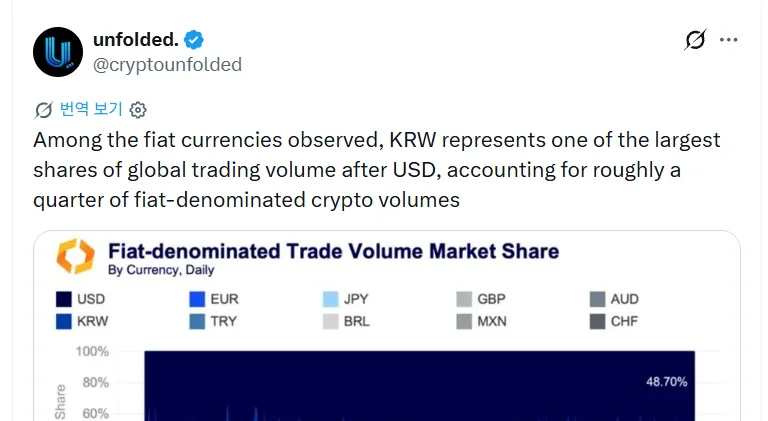
The South Korean won accounts for just under 25% of global fiat-based crypto trading volume, ranking behind the U.S. dollar and euro, according to Unfolded, which cited a recent report from crypto market analytics firm Kaiko.
Unfolded said the U.S. dollar held the largest share at 48.7%, while the euro accounted for about 27.58%. It added that South Korea’s crypto market is dominated by fiat-based trading, and that Upbit, the country’s largest exchange, showed high liquidity, with slippage of about 0.005% to 0.02% on a 10 million won market buy order. Unfolded also noted that favorable trading conditions in South Korea and several other countries and regions continue to support steady demand, although changes in South Korea’s crypto regulations and macroeconomic conditions could become key variables going forward.