Live Feed
New
Today, October 9, 2026
12:46
Nasdaq-listed Bitcoin miner CleanSpark said it sold a total of 702 BTC in September at an average price of $72,928. Of that amount, two BTC were sold on the spot market, while the remaining 700 BTC were sold through call option exercises.
As of the end of September, the company held 13,530 BTC, down 173 BTC from 13,703 BTC at the end of August. CleanSpark mined 529 BTC in September, or an average of 17.64 BTC per day. Its cumulative Bitcoin production for the year reached 5,432 BTC, while its operating hashrate stood at 50 EH/s at the end of September.
12:41
The European Central Bank is considering launching a digital euro in the second half of 2029, with plans to make it usable from the outset for all online merchants across the eurozone, some offline retail payments, and peer-to-peer transfers, according to internal ECB presentation materials.
The materials indicate offline retail payments and person-to-person transfers would be designed to work regardless of internet connectivity. The ECB is also reviewing whether to add offline in-store payments, which were not included in the initial launch plan. Specific timing and the final scope of services have not yet been determined.
12:38
On-chain analyst Specter said X and Reddit have seen a string of user complaints alleging unauthorized outflows of cryptocurrency from Ledger hardware wallet users’ wallets. After tracing the addresses that received the funds, Specter said the money appeared to have flowed in from hundreds of victim wallets across major blockchains including Bitcoin, Ethereum and Tron. Specter estimated losses at more than $86 million, although the specific theft method and whether any security vulnerability exists in Ledger devices have not been confirmed.
12:36
AguilaTrades, a well-known whale trader on Hyperliquid, was forcibly liquidated and lost $545,000 just a day after returning to trading following a break of more than six months, according to Lookonchain.
AguilaTrades previously drew attention in the on-chain community for managing leveraged BTC and ETH positions worth hundreds of millions of dollars. While the trader has posted major gains in some cases, AguilaTrades is also known for repeated liquidations. Lookonchain said the trader had previously been liquidated 33 times, logging about $37.64 million in losses.
12:31
Bitcoin mining company Bitdeer has signed a 10-year agreement to build a new 67 MW AI data center in Malaysia, The Block reported. The deal expands Bitdeer’s secured AI cloud infrastructure capacity to 273.5 MW in total. Bitdeer also said the potential value of contracts tied to its AI cloud business now exceeds $10 billion.
12:29
Ripple co-founder Chris Larsen donated at least $22.5 million to federal candidates and Super PACs during the current U.S. midterm election cycle and plans to increase his political giving further, Bloomberg reported. Bloomberg said Larsen’s main policy interests include artificial intelligence, clean energy, crypto and a wealth tax, adding that Larsen has previously been an active political donor in the U.S. tech and crypto industries.
12:20
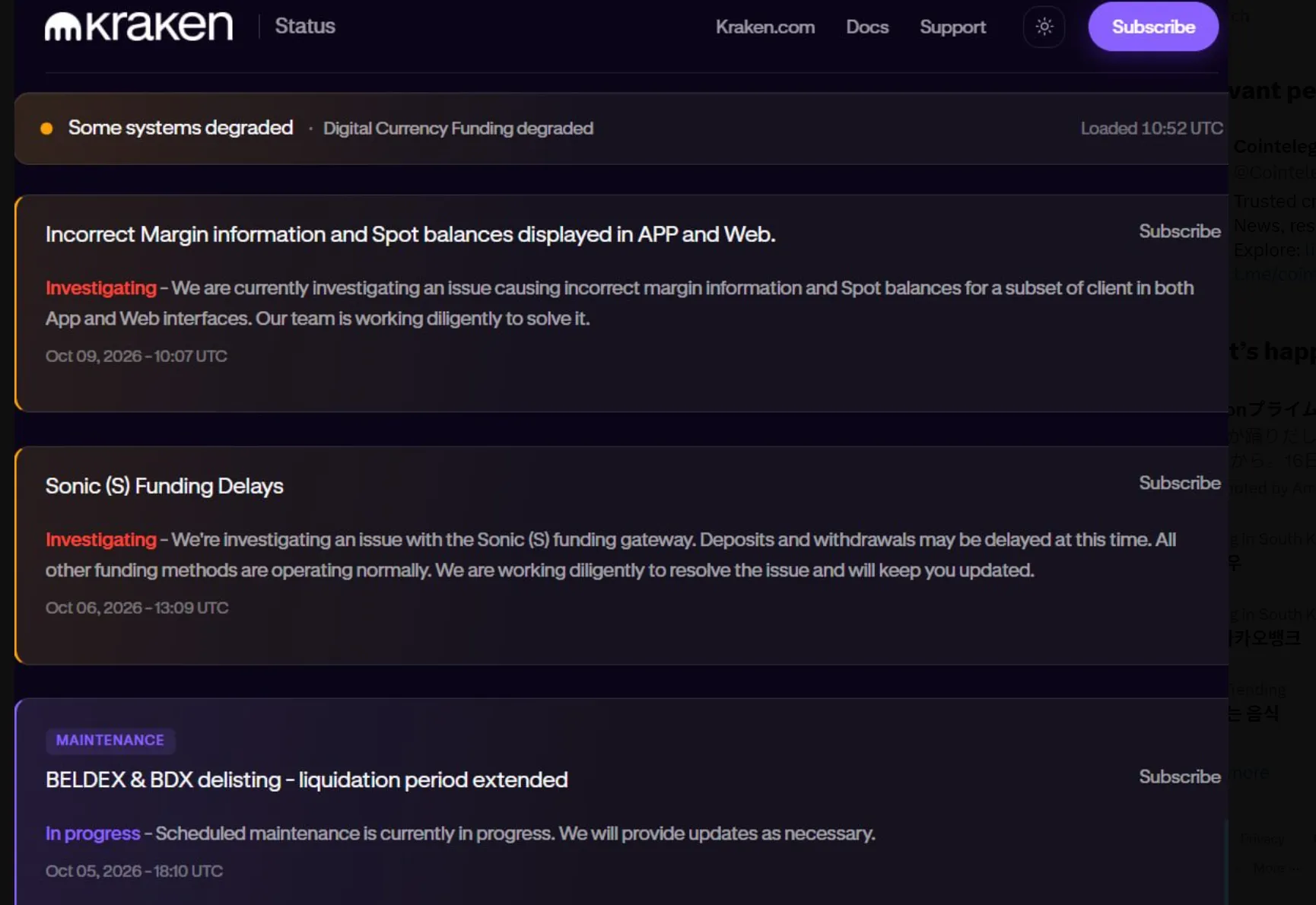
Kraken is investigating an issue that incorrectly displayed margin-related information for some app and web users, Cointelegraph reported. The exact cause of the error and the scope of any impact have not yet been confirmed.
12:19
Blockchain.com has applied to the U.S. Commodity Futures Trading Commission for two licenses to offer prediction market and cryptocurrency derivatives trading services in the United States, CNBC reported. The applications cover designated contract market and futures commission merchant status, which would allow the platform to provide those services to U.S. retail and institutional investors if approved.
Blockchain.com currently offers some overseas clients prediction market services through a partnership with Polymarket and perpetual futures trading based on Hyperliquid. Separately, the company is also pursuing an IPO this year with a target valuation of $4 billion to $6 billion, according to the report.
11:54
Zcash network software developer Zakura plans to introduce a new digital signature verification feature in January 2027 to help defend against quantum computer attacks, CoinDesk reported.
The technology aims to prevent asset theft through hash-based signatures even if quantum computers render existing cryptographic methods ineffective. However, the timeline for deployment on the live network has not been finalized. The update is intended for transparent transactions, where sending addresses and amounts are publicly visible. Of the roughly 16.98 million ZEC currently issued, about 11.96 million ZEC, or 70%, is held in those public addresses. Separately, the development team is also working on a technology designed to prevent wallet address information from being exposed to external servers when users check balances. Privacy transactions that conceal transfer details, however, still require separate quantum-resistant security measures.
11:52
A whale on Hyperliquid is holding about $320 million in BTC and ETH long positions across 10 addresses, according to on-chain analyst EmberCN. The positions total 1,400 BTC and 82,000 ETH, with average entry prices of $75,967 and $2,493, respectively. Unrealized profit was estimated at about $8.77 million. EmberCN said the whale has generated a total of $116.7 million in profit this year through multiple BTC and ETH long trades.
11:40
A wallet linked to the 2016 Bitfinex hack transferred 12,267 BTC, worth about $1.01 billion, to new addresses, according to Arkham data.
The Bitcoin was moved to addresses whose current owners have not been identified, and there were no signs afterward of deposits to exchanges. The large-scale BTC transfer has raised concerns about potential selling pressure, but no actual sales have been confirmed.
11:39
According to CoinNess market monitoring, BTC has risen above $83,000. BTC is trading at $83,017.3 on the Binance USDT market.
11:36
Barclays has raised its price target on Strategy (MSTR) to $175 and maintained its buy rating, according to Bitcoin Treasuries. The global investment bank also classified Strategy as a fintech company alongside Visa and Mastercard.
11:34
The U.S. said it plans to seize about $1 billion in Iran-linked cryptocurrency assets as part of a broader effort to increase economic pressure on Iran.
The move is part of “Operation Economic Fury,” aimed at Iran’s financial networks and overseas assets to cut off funding channels. The U.S. and Iran are also holding indirect talks through Qatar and Pakistan to end a conflict that has continued for seven months, but no formal agreement has been reached. Specific assets targeted for seizure and the enforcement timeline were not disclosed.
11:15
DeFi protocol Pendle has launched srnOPAL, a fixed-yield product backed by Brazilian credit card receivables. The product uses tokenized assets issued by BlackOpal Finance and offers an annual yield of 11.59% on Pendle.
The product launched on Sept. 15 and matures on Jan. 7, 2027. Returns are generated by purchasing Brazilian merchants’ credit card receivables at a discount and then collecting the actual settlement proceeds.
The investment structure is split into senior and junior tranches. In the event of losses, junior capital equal to about 15% of the total investment absorbs losses first. Even as a fixed-yield product, however, principal losses may still occur depending on defaults in the underlying assets or counterparty risk.
11:11
Polychain Capital is leading a new funding round for Network School at a $2 billion valuation, with a16z, Coinbase and Balaji Srinivasan participating, according to BlockBeats. The amount being raised was not disclosed.
At the Network State Conference on Oct. 9, Polychain founder and CEO Olaf Carlson-Wee announced the investment and said Polychain focuses on projects that solve problems through new business models or technologies rather than incremental improvements.
11:09
Vesu, a Starknet-based DeFi lending protocol, said it will offer STRK token rewards to users who borrow stablecoins against BTC collateral.
The eligible collateral assets are WBTC, LBTC, SolvBTC, tBTC, and strkBTC. Users who take out loans through Sats Terminal will receive weekly STRK rewards. Depending on the size of the rewards, the effective borrowing rate could fall to near 0% or turn negative. Vesu added that because the rewards are paid in STRK, the actual benefit will vary with the token’s price.
The program is part of a 100 million STRK incentive program set up by the Starknet Foundation to support BTC-based DeFi, or BTCFi.
11:04
The European Securities and Markets Authority is reviewing the use of tokenized stocks, bonds and other assets on blockchains as collateral, while gathering industry feedback on whether such collateral can actually be recovered and converted into cash during a financial crisis or a counterparty default.
ESMA said even assets that are readily liquid in traditional financial markets could face delays in liquidation once tokenized because of redemption procedures or trading restrictions. The authority also plans to examine whether token holders have legal rights to the underlying stocks or bonds. Based on the review, ESMA will decide whether existing EU regulations are sufficient to address the risks involved or whether additional rules are needed.
10:59
Japan’s Financial Services Agency on Oct. 9 urged financial institutions, including cryptocurrency exchanges, to phase out identity verification based on submitted ID photos before the current April 1, 2027 deadline and switch to reading data from IC chips embedded in identification cards.
The move follows a series of unauthorized access incidents and customer data leaks at financial institutions. Under the new method, institutions would verify users by reading information stored on an ID card’s IC chip through a smartphone or similar device, including a name, address, date of birth, and facial photo. The agency also called for checks on risk management related to outsourced service providers and on response systems for cyberattacks.
10:57
NEAR Protocol co-founder Illia Polosukhin said NEAR accounts can adopt quantum-resistant security against quantum-computing attacks through cryptographic key updates alone, Cointelegraph reported. Polosukhin said this would strengthen security for existing accounts without requiring a separate asset-transfer process.
10:50
Crypto hacking losses exceeded $1.17 billion in the third quarter of 2026, surpassing the $955 million recorded in the first half of the year, according to Finbold’s analysis of SlowMist data.
September posted the largest monthly losses at about $762 million, followed by $224 million in July and $188 million in August. The biggest hack of the quarter was the Bitget breach on Sept. 24, which caused $387.5 million in losses. The top five incidents accounted for a combined $952 million, or about 81% of the quarterly total. Cumulative hacking losses for the first three quarters of the year reached about $2.1 billion.
Finbold noted the figures were calculated based on the value of affected assets at the time of each incident, meaning the totals may differ from final loss estimates after returned, frozen, or recovered funds are reflected.
10:32
South Korean exchange Bithumb announced the addition of Doppler Finance (XDP) for KRW trading at 12:00 p.m. UTC today.
10:22
CryptoQuant contributor MAC.D analyzed that around $74,500 could become a key BTC price level if the asset falls further, based on the depth of corrections seen in past bull markets.
MAC.D said the average drawdown from peak levels across five past bull-market corrections was 14.39%. Applied to Bitcoin’s recent high of $87,027 reached on Oct. 5, that implies a level of about $74,500. BTC fell about 7.61% from $87,027 on Oct. 5 to $80,404 on Oct. 9, a move MAC.D said was similar to the 7.58% average correction seen in the previous bull market from 2022 to 2025. Citing the smaller pullbacks in the recent bull market than in earlier cycles, MAC.D suggested considering staggered buying around $80,000 and increasing buying exposure in the $74,000-$75,000 range.
10:20
Ajay Shinjin has been sentenced to two years and six months in prison for taking part in a SIM-swapping scam that stole about 200,000 pounds ($265,000) worth of cryptocurrency, The Block reported, citing the City of London Police.
Shinjin received more than 44,000 pounds (about $58,000) in criminal proceeds and used the money on luxury holidays in Dubai, a high-end apartment and gold-plated dental accessories, according to the report. SIM swapping is a method that hijacks a victim’s phone number to intercept text-based authentication messages and other communications.
10:07
Base founder Jesse Pollak said in an interview with The Block at TOKEN2049 in Singapore that the shutdowns of Ethereum layer-two networks Blast and Abstract do not mean the Ethereum L2 experiment is over.
Pollak said blockchain networks are similar to businesses in several respects and not every business can succeed. Pollak added that each network needs a specific product and a user acquisition strategy to secure long-term sustainability.
