Live Feed
Today, January 7, 2026
04:44
Spanish coffee brand Vanadi Coffee announced via its official X account that it held 173 BTC as of Jan. 6. The company stated last year that it would pivot from its coffee business to become a Bitcoin-focused enterprise, announcing plans to invest a total of $1.1 billion to build up its BTC reserves.
04:00
An address believed to belong to crypto market maker and ETF liquidity provider Flowdesk deposited 8.15 million ENA, worth approximately $2 million, to Binance and Bybit about an hour ago, according to The Data Nerd. Such deposits to exchanges are often seen as a precursor to selling.
03:43
U.S. spot Bitcoin ETFs recorded a total net outflow of $240 million on Jan. 6, according to data compiled by Trader T. The outflow follows two consecutive days of net inflows.
By fund, the flows were as follows:
- BlackRock (IBIT): +$231.89 million
- Fidelity (FBTC): -$312.24 million
- ARK Invest (ARKB): -$29.47 million
- VanEck (HODL): -$14.38 million
- Grayscale (GBTC): -$83.07 million
- Grayscale Bitcoin Mini: -$32.73 million
03:33
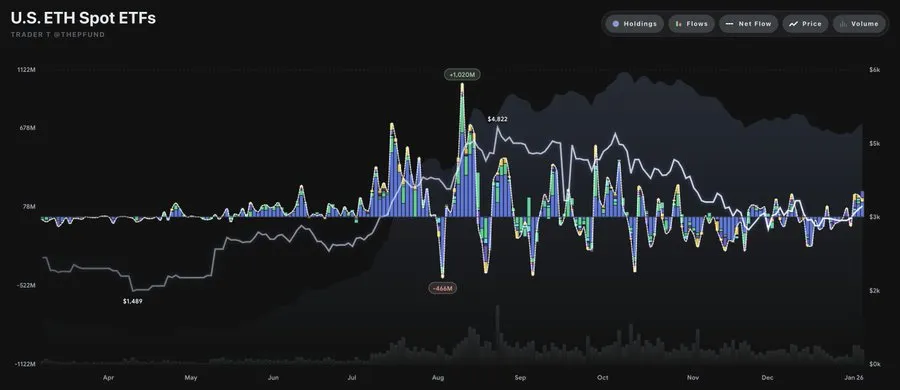
U.S. spot Ethereum ETFs recorded a net inflow of $113.64 million on Jan. 6, marking the third consecutive day of positive flows, according to data from Trader T. BlackRock's fund led the inflows.
By fund, the flows were as follows:
- BlackRock (ETHA): +$197.7 million
- Fidelity (FETH): -$1.62 million
- Bitwise (ETHW): +$1.39 million
- 21Shares (CETH): +$1.62 million
- Grayscale (ETHE): -$53 million
- Grayscale Mini ETH: -$32.45 million
03:32
River (RIVER), a chain abstraction stablecoin system, has recorded over $3.5 billion in trading volume across major global exchanges in the last 24 hours. The volume is concentrated in the Binance perpetual futures market, where its daily trading of approximately $2 billion has surpassed that of Sui (SUI), Dogecoin (DOGE), and Pepe (PEPE).
The token's price previously surged about 36% from $19 to around $26 after securing an investment on Jan. 5 from Maelstrom, the family office of BitMEX co-founder Arthur Hayes. Hayes has since mentioned on X that RIVER could be listed on more exchanges and noted in a recent blog post that he is pursuing an investment strategy in privacy and DeFi-focused altcoins. According to CoinMarketCap, RIVER is trading at $19.34, up 29.71% over the past 24 hours.
02:57
The following shows estimated liquidation volumes and position ratios for major crypto perpetual futures over the past 24 hours:
- BTC: $144 million liquidated (77.65% longs)
- ETH: $97.03 million liquidated (51.55% longs)
- SOL: $35.85 million liquidated (60.74% shorts)
02:53
The World Liberty Financial deployer address transferred 24 million WLFI, valued at $4.14 million, to Binance approximately five minutes ago, according to on-chain analyst ai_9684xtpa. Deposits to exchanges are typically interpreted as a precursor to selling.
02:37
An address presumed to belong to World Liberty Financial withdrew 162.69 WBTC, worth $15 million, from Aave, Onchain Lens reported. Of this amount, the address swapped 13.56 WBTC ($1.25 million) for ETH.
02:21
South Korean crypto exchange Upbit announced it will list Brevis (BREV) today at 6:00 a.m. UTC. The listing will include trading pairs for BREV against the South Korean won (KRW), BTC, and USDT.
01:57
Global Web3 security firm CertiK has announced a strategic partnership with YZi Labs, formerly Binance Labs. Through the collaboration, the two will establish a $1 million security audit fund for the EASY Residency, a global incubation program operated by YZi Labs. CertiK will also provide advanced security services, including Formal Verification, Skynet Boosting, and AI Scan. The companies stated that the initiative aims to introduce security capabilities from the incubation stage, raising the overall security standards of projects and promoting the sustainable development of the Web3 ecosystem.
01:52
Bitcoin has entered a short-term resistance zone between $92,000 and $94,000, but key on-chain indicators still suggest strong selling pressure, according to an analysis by CryptoOnchain, a contributor to CryptoQuant. The analyst noted that while technical indicators like the Relative Strength Index (RSI) currently favor buyers, a total of $4.75 billion in BTC and ETH has flowed into Binance over the past week. This suggests that whale investors may be preparing to sell or enter short positions at this resistance level. The analysis concludes that if Bitcoin fails to achieve a daily close above $94,000, it could trigger large-scale liquidations and a retest of the $85,000 support line.
01:50
South Korean crypto exchange Bithumb announced it will list Brevis (BREV) for trading against the won at 7:00 a.m. UTC on Jan. 7.
00:49
MARA Holdings has deposited 519.46 BTC, worth $48.3 million, to FalconX, Onchain Lens reported. Deposits to exchanges are typically interpreted as a precursor to selling.
00:27
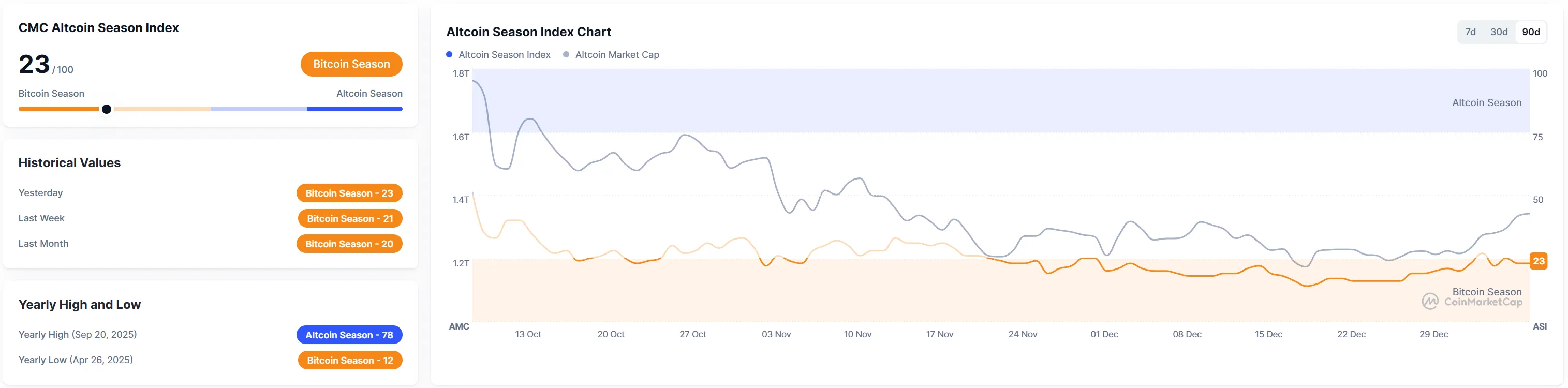
CoinMarketCap's Altcoin Season Index has fallen three points from yesterday to 23. The index determines an altcoin season has arrived when 75% of the top 100 cryptocurrencies, excluding stablecoins and wrapped coins, outperform Bitcoin over the preceding 90 days. A score closer to 100 indicates an altcoin season, while the opposite suggests a Bitcoin season.
00:16
Cryptocurrency exchange Crypto.com has partnered with South Korean digital life insurance company Kyobo Lifeplanet. The collaboration aims to promote the adoption of digital assets through a referral and point conversion program.
00:00
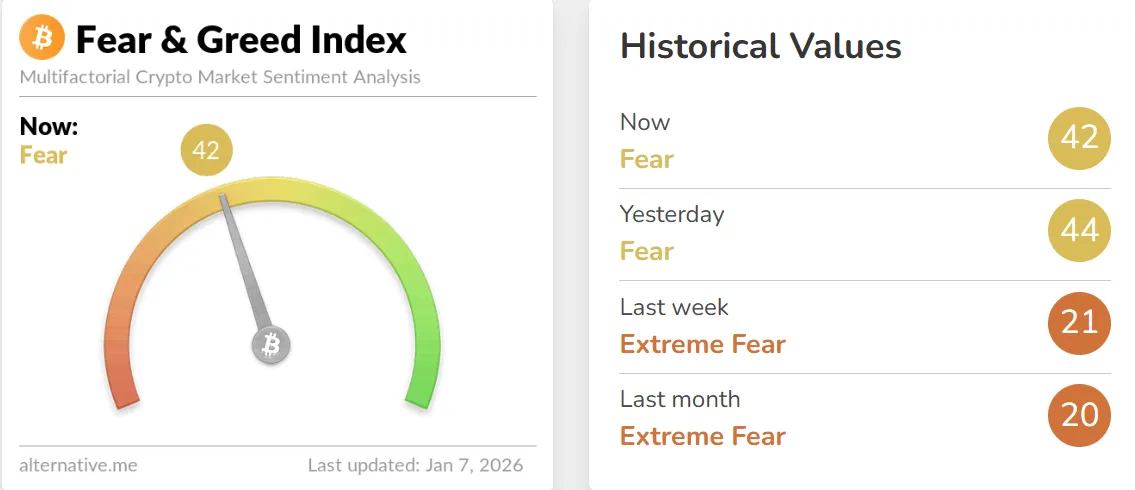
The Crypto Fear & Greed Index, compiled by data provider Alternative, has fallen two points from yesterday to 42, remaining in the fear category. The index measures market sentiment on a scale of 0, representing extreme fear, to 100, indicating extreme optimism. It is calculated based on several factors: volatility (25%), trading volume (25%), social media mentions (15%), surveys (15%), Bitcoin dominance (10%), and Google search volume (10%).
Yesterday, January 6, 2026
23:41
Foundry USA remains the top Bitcoin (BTC) mining pool, holding a 30% share of the global market, Unfolded reported, citing data from The Block. A subsidiary of the cryptocurrency investment firm Digital Currency Group (DCG), Foundry USA has grown to become the world's largest mining pool within five years of its establishment.
23:33
Benchmark analyst Mark Palmer views MSCI's recent decision as a positive signal for Strategy (MSTR), suggesting it reflects the company's argument against excluding firms with digital asset holdings from its indices, CoinDesk reports. However, Palmer cautioned that the move might only be a temporary reprieve. He noted that MSCI has stated it will re-evaluate the future inclusion of non-operating entities, such as companies established solely for holding Bitcoin without engaging in blockchain business operations.
23:09
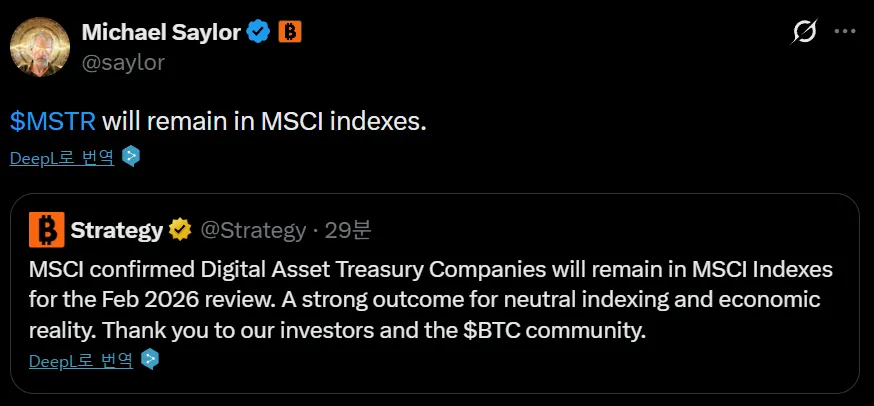
Strategy founder Michael Saylor stated on X that the company (MSTR) will remain in the Morgan Stanley Capital International (MSCI) index. His comment follows an earlier official announcement from MSCI that it was suspending plans to exclude companies holding digital assets in their treasuries from its indexes.
22:34
South Korea’s Financial Services Commission (FSC) plans to introduce a system to suspend payments from accounts suspected of virtual asset price manipulation, News1 reported. The measure, which will be included in the country's upcoming second-phase virtual asset legislation, would allow financial authorities to freeze suspicious accounts before law enforcement agencies take action. The system will target accounts believed to be used for market manipulation, with the FSC coordinating with financial companies and exchanges to lock the funds.
22:10
Coinbase has announced it will suspend trading for three pairs: ETH/DAI, FLOW/USDT, and MANA/ETH. The suspension is scheduled for 5:00 p.m. UTC on Jan. 7.
21:53
Morgan Stanley Capital International (MSCI) officially announced on Jan. 6 that it is postponing a plan to exclude companies holding digital assets in their treasuries from its indexes. MSCI stated that the proposal to remove these digital asset treasury (DAT) companies during its regular index review in February will not be implemented at this time. Instead, the index provider plans to launch a broader consultation process on non-operating companies in general. According to MSCI, this comprehensive review aims to maintain consistency with the fundamental purpose of its indexes, which is to measure the performance of companies with operating activities while excluding those that are primarily investment vehicles. The firm noted that some have suggested DATs may be more focused on investment activities than on core business operations. MSCI explained that distinguishing between companies that hold non-operating assets as part of their core business and those that are essentially investment firms will require further research and consultation with market participants.
21:19
Morgan Stanley Capital International (MSCI) plans to maintain the current composition of its indexes until its 2026 review, effectively shelving a proposal to exclude companies with significant digital asset reserves, AggrNews reported. Previously, MSCI had initiated market consultations in October of last year on a plan to remove companies whose balance sheets consist mostly of cryptocurrencies. The proposal had sparked industry concerns that such a move could trigger up to $15 billion in selling pressure on the crypto market. Matthew Sigel, Head of Digital Assets Research at VanEck, added that due to this decision, Strategy (Nasdaq: MSTR), a prominent company with a Bitcoin reserve strategy, will not be immediately removed from MSCI's indexes.
21:15
According to CoinNess market monitoring, BTC has risen above $93,000. BTC is trading at $93,020.55 on the Binance USDT market.
21:13
Ripple President Monica Long said in a Bloomberg interview on Jan. 6 that the company has no specific timeline for an initial public offering (IPO) and plans to remain private for the time being. She explained that while the main goal of an IPO is typically to secure investment and boost liquidity, Ripple is already in a very healthy financial state, capable of funding its own growth. Long added that she was quite satisfied with the company's fundraising performance in the fourth quarter of last year. Ripple raised $500 million last November in a funding round led by funds managed by affiliates of Fortress Investment Group and Citadel Securities, among others, which valued the company at $40 billion.
