Live Feed
Today, January 20, 2026
01:14
An address presumed to belong to Nasdaq-listed FG Nexus (FGNX), a company known for strategically accumulating Ethereum, sold 2,500 ETH ($8.04 million) four hours ago, according to a report from EmberCN. FG Nexus accumulated 50,770 ETH ($200 million) last year but later sold 13,475 ETH at a loss of $11.52 million after the price of the asset fell. The company's current holdings now stand at 37,594 ETH, valued at approximately $120 million.
01:07
A whale address that had been dormant for 13 years transferred 909.38 BTC, worth $84.62 million, to a new address four hours ago, Lookonchain reported.
01:02
The South Korean crypto exchange Coinone has announced it will delist Myro (MYRO) at 6:00 a.m. UTC on Feb. 19. The exchange explained that the decision was made to protect users, citing an insufficiently active community for the online content-based virtual asset. Coinone also noted shortcomings in the project's business viability and operational sustainability.
Additionally, Coinone has added Milkyway (MILK) to its delisting watchlist. The exchange stated this was due to concerns about the project's business viability and sustainability. It also pointed to a lack of transparency and rationality in the project's procedures for making significant changes, which it believes could potentially harm users.
01:01
Addresses associated with Druk Holdings, Bhutan's state-owned investment institution, are believed to be holding a long position in Ethereum (ETH), according to on-chain analyst Emmett Gallic. The analyst noted that an associated address withdrew 42,000 ETH and 54 million USDT from Binance. It then swapped the USDT for ETH and deposited the assets into the crypto lending protocol Aave. Subsequently, the address borrowed $275 million in USDT to purchase additional ETH. The addresses linked to Druk Holdings currently hold a long position of 117,000 ETH, valued at approximately $459 million.
01:01
The People's Bank of China announced it has held its one-year loan prime rate (LPR) at 3% and its five-year LPR at 3.5%. The LPRs function as the country's de facto benchmark lending rates.
00:59
A potential tariff war between the United States and the European Union over Greenland could push global GDP growth down to 2.6%, according to a report from Oxford Economics. The U.K.-based research firm analyzed a scenario in which the U.S. imposes an additional 25% tariff on six EU nations amid a dispute over acquiring the territory, prompting equivalent retaliatory measures.
Under this scenario, U.S. GDP is forecast to fall by up to 1% from its current outlook, with the Eurozone facing a similar impact over a more prolonged period. Oxford Economics stated that given the economic size of both parties, the effects would spread globally. The resulting 2.6% growth rate would fall below the stable 2.8% to 2.9% range of the last three years and would be the lowest figure since 2009, excluding the 2020 COVID-19 pandemic.
00:52
Shinhan Investment & Securities has entered into a strategic partnership with global real-world asset (RWA) platform Etherfuse to collaborate on issuing a Stablebond backed by South Korean government bonds, Money Today reported. Under the agreement, Etherfuse will issue the Stablebond, which will trade under the ticker KTB. Shinhan Investment & Securities will not act as the issuer or seller of the product but will instead provide government bond brokerage services and support the acquisition and management of the underlying assets.
00:34
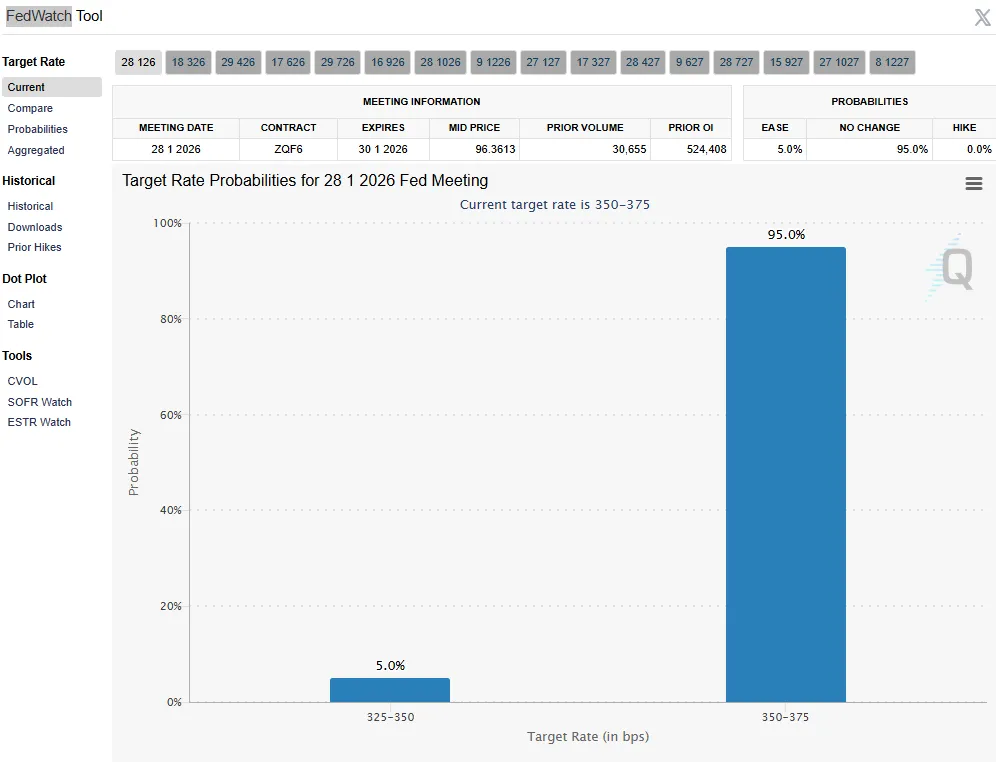
Traders are pricing in a 95% probability that the U.S. Federal Reserve (Fed) will hold interest rates steady at its upcoming Federal Open Market Committee (FOMC) meeting on Jan. 27-28, according to the CME FedWatch Tool.
00:31
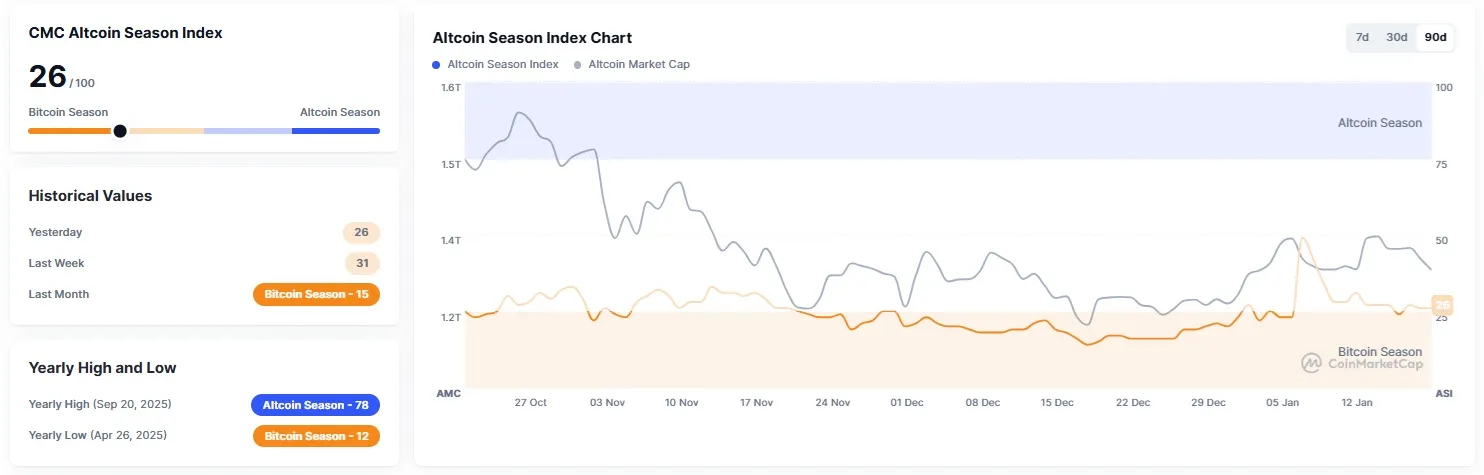
CoinMarketCap's Altcoin Season Index has risen one point from the previous day to 26. The index measures whether it is an "altcoin season" or a "Bitcoin season." An altcoin season is declared when 75% of the top 100 coins by market capitalization, excluding stablecoins and wrapped coins, outperform Bitcoin over a 90-day period. A score closer to 100 indicates a stronger altcoin season.
00:01
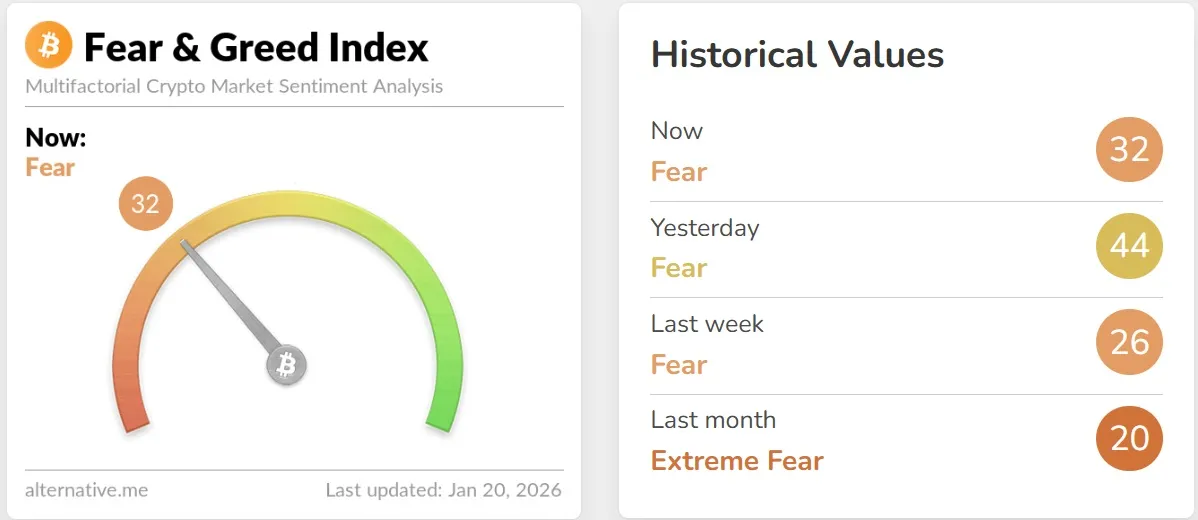
The Crypto Fear & Greed Index from data provider Alternative fell 12 points from the previous day to 32, continuing the fear stage. The index measures market sentiment on a scale where 0 indicates extreme fear and 100 represents extreme optimism. It is calculated based on volatility (25%), trading volume (25%), social media mentions (15%), surveys (15%), Bitcoin's market cap dominance (10%), and Google search volume (10%).
Yesterday, January 19, 2026
23:56
The yield on the 10-year U.S. Treasury note has reached 4.259%, its highest level since September of last year. An increase in the yield on this benchmark security, considered one of the world's safest investments, typically reduces investor appetite for risk assets.
23:52
Bitmine (BMNR), an entity strategically accumulating ETH, staked an additional 86,848 ETH ($279 million) approximately three hours ago, Onchainlens reported. The firm is now staking a total of 1,771,936 ETH, valued at $5.65 billion.
23:04
The recent correction in Bitcoin has reaffirmed the overall bearish trend in the cryptocurrency market, according to Matt Howells-Barby, a vice president at Kraken. He noted that since a sharp decline on Oct. 10 of last year, the market has consistently shown significant asymmetric downside risk, reacting sensitively to negative news while showing limited gains on positive developments. Howells-Barby explained that while BTC was recently positioned at a key support level with potential for further upside, its upward momentum was quickly broken by emerging geopolitical issues. However, he observed that the correction was limited to about 3.5%, suggesting some traders are maintaining their positions in anticipation that President Trump might ease tariff threats, similar to last year's tensions with China. He concluded that market volatility could increase with any statements suggesting either an escalation or de-escalation of the tariff conflict between the U.S. and the EU.
22:31
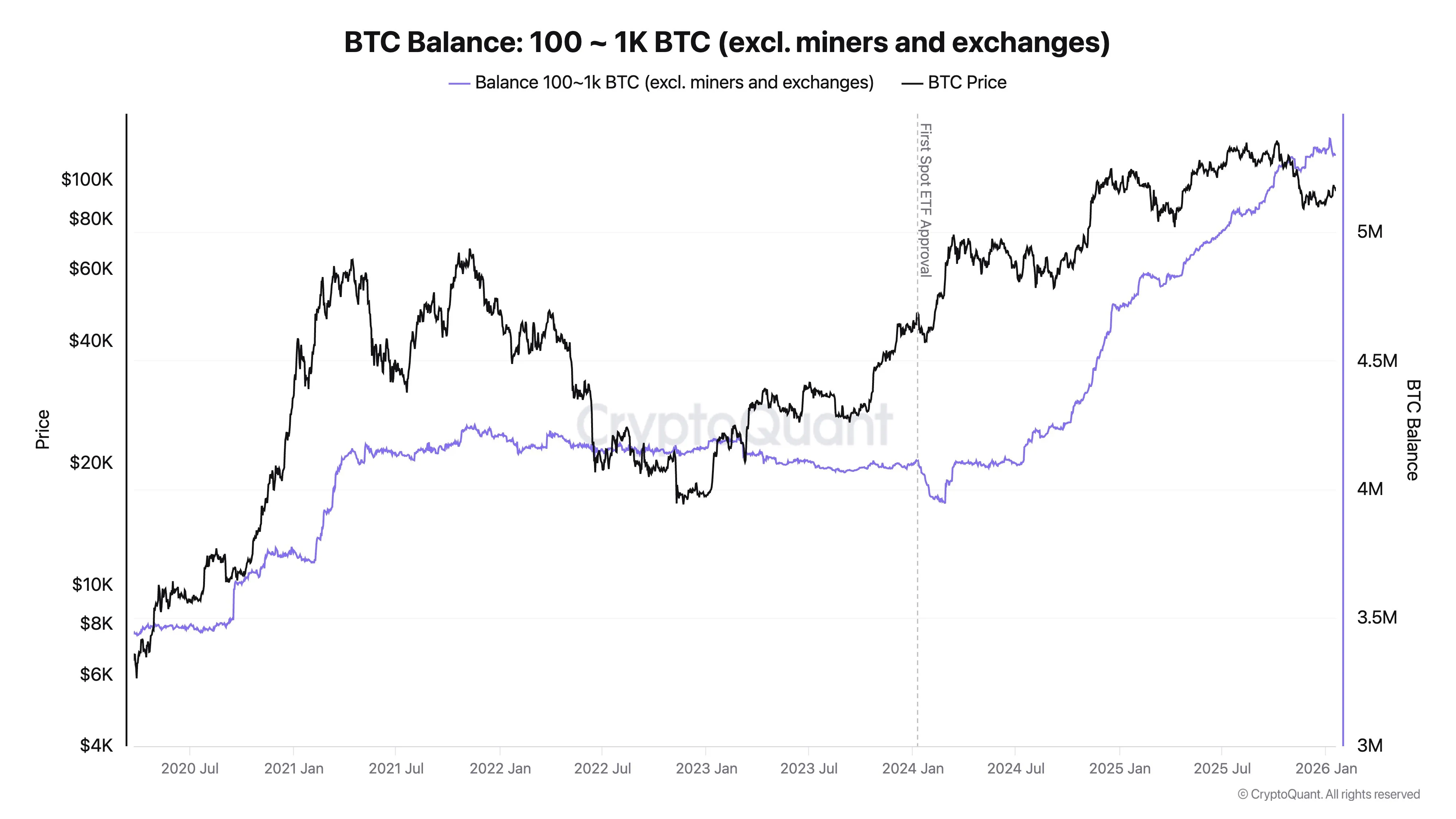
Institutional demand for Bitcoin (BTC) remains strong, according to CryptoQuant CEO Ju Ki-young. In a post on X, Ju stated that institutional addresses have recorded a net inflow of approximately 577,000 BTC, valued at around $53 billion, over the past year. He added that this net inflow trend is ongoing. Ju explained that this metric is derived by tracking U.S. custody wallets, which typically hold between 100 and 1,000 BTC. These wallets serve as a proxy for institutional demand once addresses belonging to exchanges and miners are excluded. He also noted that holdings from spot Bitcoin ETFs are included in this calculation.
21:37
A new market structure that deviates from the traditional halving cycle, institutional fund flows, and the macroeconomic environment are the three main variables that will influence Bitcoin's price movements this year, Coindesk reported, citing research from NYDIG and Wintermute. The analysis suggests the conventional four-year crypto cycle centered on the halving may now be over, with cryptocurrencies beginning a transition into a more stable asset class as institutional products like ETFs reshape the market. Consequently, key catalysts for Bitcoin's price this year could include the actions of institutional investors within this new structure, evolving geopolitical and macroeconomic risks, and whether retail investors shift capital from stock markets to crypto.
20:53
The amount of ETH staked on the Ethereum network has reached an all-time high, with approximately 30% of the total supply staked as of Jan. 18, Solid Intel reported. According to CoinMarketCap, ETH is currently trading at $3,214.79, down 3.83%.
19:36
The Injective (INJ) community has approved a governance proposal to reduce the INJ token supply and transition to a deflationary model, Crypto Briefing reported. The proposal passed with 99.9% of the vote. This allows Injective to implement an on-chain update to its token inflation parameters. The main goal is to permanently limit new INJ issuance while strengthening the burn mechanism to decrease the circulating supply. Injective has reportedly burned approximately 6.85 million INJ since its mainnet launch.
19:29
According to an analysis by crypto media outlet Cointelegraph, Bitcoin's short-term price drop of approximately 3.7% on the morning of Jan. 19 led to the liquidation of $233 million in long positions. This event has eased overheated leverage risk in the market without breaking the overall market structure. While investor sentiment has cooled rapidly, on-chain and derivatives data suggest the move is more of a structural adjustment than a bearish reversal. The analysis notes that an influx of buying pressure from investors looking to buy the dip will be crucial to halting the decline.
From a technical perspective, Cointelegraph pointed out that Bitcoin continues to make higher lows and higher highs on its daily chart. The $92,000 to $93,000 range aligns with a significant demand zone of concentrated buy orders and is also a test of the monthly volume-weighted average price support. Therefore, this price action is likely part of a process to establish a higher low before an attempt to reclaim the $100,000 level. Notably, approximately $250 million in net long positions were executed around the $92,000 mark on Jan. 19, which suggests that demand for dip-buying is outpacing panic selling.
19:11
The non-fungible token (NFT) market is not dead, according to Yat Siu, co-founder of Animoca Brands. In an interview with CoinDesk, Siu stated that while the market has entered a downturn, it is still being driven by a number of wealthy collectors. He compared this dynamic to heirs of prominent families collecting Picasso's works, who feel a sense of camaraderie with other collectors, effectively forming a club. Siu described NFTs as a digital version of this, representing a community. He also added that although the value of his personal NFT portfolio has declined by about 80%, he is unconcerned as he did not buy them with the intent to resell, viewing them instead as assets with long-term investment value.
18:58
The government of Bermuda is partnering with Coinbase and Circle to build a complete on-chain economy, a Coinbase representative told The Block at the World Economic Forum in Davos. The initiative aims to establish a digital asset infrastructure across government agencies, businesses, and consumers, transitioning the national economy to a system based on blockchain payments and financial tools. As part of the collaboration, Coinbase, the largest U.S. crypto exchange, and Circle, the issuer of the USDC stablecoin, will provide digital asset infrastructure and corporate tools to the government, local banks, insurers, small businesses, and consumers. The companies will also support nationwide digital finance education and technology onboarding.
18:51
On-chain analytics firm Glassnode has analyzed that while Bitcoin's upward momentum has weakened, the current price action is more indicative of a range-bound consolidation than a major trend reversal. The firm noted that Bitcoin fell from a recent high of $98,000 to the low $90,000s this week.
In its weekly market report, Glassnode explained that selling pressure in the spot market is gradually easing as trading volume slightly recovers, but demand remains uneven due to relatively low buying pressure. The derivatives market shows mixed signals, with a slight increase in futures open interest alongside a drop in funding rates. However, U.S. spot ETFs have seen a return to net inflows, and on-chain activity is stable. Overall, Glassnode suggests that while Bitcoin continues to move sideways, the market structure is gradually improving.
18:43
London-based neobank Revolut has obtained a banking license in Peru, enabling it to operate as a fully regulated bank in the country, Bloomberg reported. The move is set to spearhead the company's broader expansion across Latin America. This development comes as Revolut continues to expand its cryptocurrency and stablecoin services, having launched a feature in October of the previous year that allows users to exchange USDT and USDC with the U.S. dollar.
18:15
Kamino (KMNO), a Solana-based automated liquidity management protocol, announced via its official X account that it now supports the dollar-pegged stablecoin USD1. This allows users to deposit USD1 and use it as collateral for loans on the Solana network. USD1 is issued by World Liberty Financial (WLFI), a DeFi protocol led by the Trump family.
18:09
Finnish President Alexander Stubb stated that the European Union has several tools at its disposal to compel the United States to withdraw its tariff threats, Walter Bloomberg reported. He added that he does not believe the U.S. will use military means to take control of Greenland. The comments follow threats from U.S. President Donald Trump to impose 'Greenland tariffs' on eight European nations, without ruling out the possibility of military force. Meanwhile, some analysts have suggested that Bitcoin's short-term weakness on Monday morning could be linked to the escalating conflict between the U.S. and the EU over the territory.
17:46
CryptoQuant CEO Ju Ki-young stated that the New York Stock Exchange's (NYSE) tokenized settlement system will eventually expand to public blockchains. His comments follow reports that the NYSE plans to launch a 24/7 trading service for U.S. stocks via an on-chain tokenized exchange. Ju noted that while the NYSE's system will initially operate on a permissioned blockchain, he believes public chains will play a significant role over time. He drew a parallel with Bitcoin, which first gained indirect market exposure through trusts and corporate holdings like those of Strategy before spot ETFs were approved as regulations matured. Ju concluded that as rules for tokenization are established, compatibility with public chains must also be developed.
