Top

Blockchain Experts Gather at KBW 2023 Side Event to Discuss Future Prospects of South Korea

Web3 & Enterprise·September 06, 2023, 7:32 AM

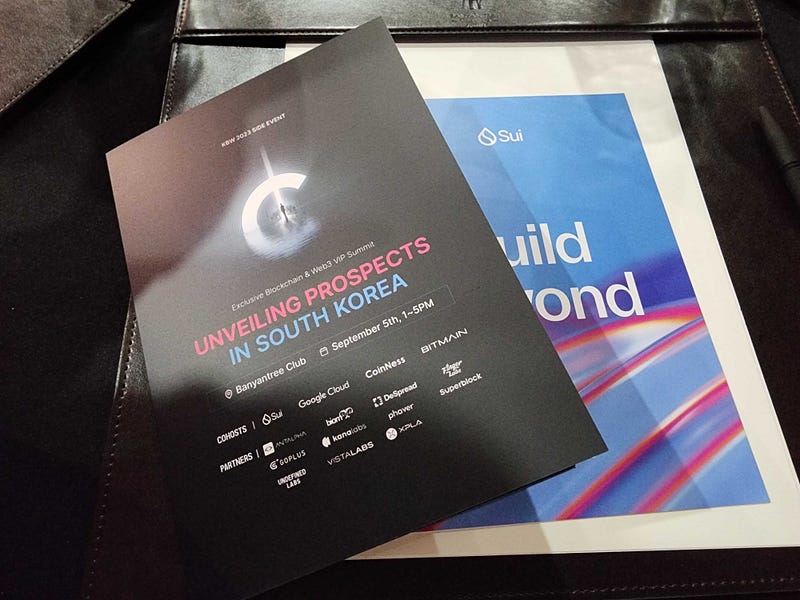
Blockchain experts from various corners of the industry converged to exchange insights on industrial and technological trends during “Unveiling Prospects in South Korea,” a side event affiliated with Korea Blockchain Week (KBW) 2023. This noteworthy gathering, co-hosted by Sui, Google Cloud, CoinNess, and Bitmain, took place on September 5 at Banyan Tree Club and Spa Seoul.
 

Blockchain compatibility and Web3 adoption

Among the distinguished speakers at the event, Derik Han, Head of APAC Partnerships at Mysten Labs, the team behind the layer-1 blockchain project SUI, discussed how the SUI project plans to enhance blockchain compatibility through a zero-knowledge (ZK) login feature, similar to single sign-on (SSO). SSO enables users to use a single set of login credentials to gain access to various applications.

Han underscored the significance of reducing technical barriers for the widespread adoption of Web3 in our daily lives, and he pointed out that SUI’s ZK login feature would contribute to this goal. Additionally, Han shed light on SUI’s intention to add on-chain features highly favored among Korean gamers.


Security tokens and RWAs

Jo Dong-hyeon, the CEO of Undefined Labs, a developer specializing in on-chain risk rating solutions, emphasized that the Korean decentralized finance (DeFi) market is poised for growth, driven by security tokens and real-world assets (RWAs). He highlighted the significant attention received by the Financial Services Commission’s announcement regarding guidelines for security token offerings (STOs) in February.

Jo observed that tokens backed by real-world assets (RWAs) would serve as a bridge between the DeFi space and traditional financial markets, facilitating the development of the former. He also noted that this development would follow the pattern seen in the Korean cryptocurrency market whose liquidity has been supported by young investors.


NFT ecosystems

Meanwhile, Kim Min-gu, Head of Web3 Business Development Lab at LG Uplus, a telecom company, expressed their commitment to expanding the Moono NFT ecosystem. This venture, anchored around their octopus character, intends to advance through collaborations with similar NFT projects like Lotte Homeshopping’s pink bear character, Bellygom. Kim highlighted that the company’s primary goal for this year is to make NFTs accessible even to customers who are unfamiliar with cryptocurrencies.

Kim further explained that LG Uplus aims to delve into the differences between Web3 NFT communities and their Web2 counterparts. The company’s focus lies in improving the overall usability of its services, without narrowing down its target audience. They are particularly intrigued by the potential of wallets and decentralized applications (dApps) in this pursuit.


Banks’ entry into the virtual asset landscape

Following this, Leem Min-ho, an analyst at Shinyoung Securities, predicted a strategic expansion by Korean banks, with an emphasis on offering digital asset custody services. This endeavor has been catalyzed by recent developments, including the introduction of security token guidelines in February and the passage of the Virtual Asset User Protection Act in June. These regulatory milestones are gradually shaping a more defined legal framework for virtual assets within South Korea. Leem went on to say that banks, known to favor engaging in business activities within established regulatory boundaries, are poised to concentrate their forthcoming initiatives on approved security tokens, ensuring compliance and adherence to regulatory standards.


More to Read
View All
Web3 & Enterprise·

Nov 23, 2023

Com2uS’ partnership with Thailand’s SHIN-A to boost Web3 gaming presence in Southeast Asia

Com2uS’ partnership with Thailand’s SHIN-A to boost Web3 gaming presence in Southeast AsiaCom2uS Holdings, a South Korean game developer, announced on Thursday that its subsidiary, Com2uS Platform, has forged a reselling partnership with SHIN-A, a Bangkok-based marketing and game service firm. This collaboration aims to bolster the expansion of Com2uS Platform’s all-in-one gaming platform, Hive, marking a significant step in its global outreach and growth strategy.Photo by Lisheng Chang on UnsplashBlockchain-powered, all-in-one platformHive offers a comprehensive suite of services, including authentication, payments, promotions, customer support, analytics, and Web3 integrations, all integrated within a single software development kit (SDK). Since opening its services to external game companies in 2021, the blockchain-powered platform has secured contracts with 51 games from 39 different publishing clients, demonstrating its growing influence and utility in the gaming industry.Against this backdrop, the newly established partnership between Com2uS Platform and SHIN-A paves the way for cooperative marketing and sales efforts aimed at promoting the Hive platform to a broader range of global gaming companies. To facilitate this goal, SHIN-A is planning to establish a dedicated support team in Thailand, which will focus on the resale of Hive products.SHIN-A, a key player in game publishing and global marketing, covers a wide range of business areas, including Web2 and Web3, across mobile, desktop and console platforms. The company has forged game publishing contracts with global giants like HoYoverse and Tencent, and has successfully conducted local marketing for Com2uS’ game, Birdie Crush: Fantasy Golf. Additionally, SHIN-A collaborates with major Thai firms like mobile phone network AIS and is involved in entertainment ventures, including organizing large-scale K-pop concerts.Thailand’s growing gaming marketWith almost 40% of its 70 million population engaging in games, Thailand presents a significant market opportunity. This is further underscored by the fact that the country boasts the highest average in-app purchase spending per person in Southeast Asia. It is also witnessing rapid growth in the gaming sector as the second-largest gaming market in Southeast Asia, trailing only behind Indonesia.In this vibrant market, Com2us’ action RPG, Summoners War: Chronicles, has achieved notable success, becoming one of the top-grossing games on the Steam platform in Thailand. This success signals a promising landscape for the introduction of Com2uS Platform’s Hive, which is likely to further enhance customer engagement and expand the company’s footprint in the region’s booming gaming market.Com2uS Platform’s Business Director, Kim Jong-moon, stated that the reselling partnership with SHIN-A is poised to significantly enhance Hive projects in the Southeast Asian market, a region known for its dynamic gaming and blockchain sectors. Kim highlighted the company’s plans to earmark the upcoming year as a pivotal period for Hive, marking the beginning of its global strategy implementation.

news
Markets·

Aug 28, 2025

Crypto rally drives surge in South Koreans’ offshore disclosures

Fueled by a crypto rally and higher overseas stock balances, South Korea’s National Tax Service (NTS) reported a sharp jump in disclosures of offshore accounts. On Aug. 26, the agency said 6,858 taxpayers declared overseas financial accounts this year, with a combined balance of 94.5 trillion won ($67.6 billion), up 38.3% in filers and 45.6% (29.6 trillion won or $21.2 billion) in value from last year.Photo by Piotr Łaskawski on UnsplashCrypto gains drive offshore filingsWithin that, reports of overseas bank deposits and cryptocurrency accounts rose to 46.4 trillion won ($33.2 billion) this year, more than 12% above 2024. That figure excludes stock accounts, which alone totaled 48.1 trillion won ($34.4 billion). Tax officials attributed the increase largely to the surge in crypto prices and higher balances in overseas stock holdings. The trend is underscored by CoinMarketCap data: the crypto market cap now stands roughly at $3.87 trillion, up 86% from $2.08 trillion a year ago. By asset type, the largest share of filers reported overseas bank deposits (3,197 people), followed by cryptocurrency (2,320) and stocks (1,992). By value, stock accounts dominated with 48.1 trillion won ($34.4 billion), compared with 23.5 trillion won ($16.8 billion) in bank deposits and 11.1 trillion won ($7.94 billion) in cryptocurrencies. Korean law requires residents and domestic corporations to disclose foreign financial accounts if their combined balance exceeds 500 million won ($358,000) on any month-end date during the year. Reports must be filed with the local tax office by June of the following year. The NTS said it will step up enforcement against suspected non-filers, using cross-border information-exchange data to verify offshore holdings. Penalties will include administrative fines, penalty notices, criminal referrals, public naming of violators and the collection of back taxes. The agency added that it is preparing to share crypto transaction data under the OECD’s Crypto-Asset Reporting Framework (CARF) and urged anyone subject to the rules to promptly file amended or late reports for overseas crypto accounts. The recent bullish sentiment in crypto, which fueled the uptick in foreign financial disclosures, has also been driving public interest in digital assets and boosting expectations for altcoins. A survey by CoinNess and Kratos conducted between Aug. 18 and 22 with 2,000 respondents found that 38.5% expect a limited bull run in a handful of altcoins, either with strong real-world use cases or serving as the underlying assets of launched ETFs. Another 28.5% predicted gains would remain centered on Bitcoin and Ethereum, while 20.7% anticipated a broader altcoin season reminiscent of past cycles. The remaining 12.3% forecast the end of the rally and the start of a downturn. Won stablecoins: policy and risksPolicy momentum around stablecoins is also picking up in South Korea. The Financial Services Commission (FSC) plans to introduce a bill in October governing won-pegged stablecoins as part of the second phase of the Virtual Asset User Protection Act. The legislation is expected to set rules for issuance, collateral management and internal controls. Amid these changes, companies are showing growing interest in launching won-based stablecoins. Kaia, an EVM-compatible, layer-1 blockchain, recently signed a memorandum of understanding (MOU) with blockchain solutions provider Open Asset to collaborate on projects tied to Korean won–backed stablecoins. The partnership will focus on issuance, distribution, service launches and developing practical use cases. Circle President Heath Tarbert has recently joined calls for a won-backed stablecoin. In an interview with The Korea Economic Daily, he underscored South Korea’s world-class payments infrastructure and said a digital won could help the country play a leading role in blockchain finance. Blockchain transactions, he noted, operate differently from traditional payment rails, making some form of digital currency, whether a stablecoin or a central bank digital currency (CBDC), a necessity. Meanwhile, at a recent meeting with top executives from the country’s four major financial groups, Tarbert ruled out collaborations on won-denominated stablecoins. Instead, he promoted Circle’s dollar-pegged stablecoins and suggested exploring joint initiatives centered around them. Not everyone sees stablecoins as a net positive. NICE Investors Service, a local credit rating agency, warned in a recent report that if banks issue won-based stablecoins, their interest income could suffer. The agency said adoption would likely weigh on banks, benefit securities firms and leave credit card companies largely unaffected. It added that a large shift of funds into stablecoins could shrink banks’ deposit base and weaken their intermediary role. Still, banks that issue stablecoins directly could soften the blow by tapping new fee-based revenue streams. 

news
Policy & Regulation·

Aug 09, 2023

Hong Kong’s SFC Issues Warning Against Unlicensed Crypto Platforms

Hong Kong’s SFC Issues Warning Against Unlicensed Crypto PlatformsIn a move to safeguard its financial ecosystem, the Hong Kong Securities and Futures Commission (SFC) issued a stern warning recently, cautioning against the activities of unlicensed cryptocurrency exchanges involved in what it termed “improper practices.”In a statement published to its website on Monday, the regulatory authority underscored the gravity of engaging in unlicensed operations within the crypto trading sphere, categorizing such activities as a “criminal offense” under Hong Kong jurisdiction.Photo by Chi Hung Wong on UnsplashDeceptive tacticsFurthermore, the SFC exposed the deceptive tactics employed by certain unlicensed crypto trading platforms, which misleadingly assert that they have submitted license applications to the commission. The reality, however, is quite the opposite, as these platforms remain unregulated.The warning coincides with the SFC's ongoing establishment of a novel regulatory framework for overseeing retail crypto trading. Notably, the SFC made it clear that applicants who fail to adhere to pertinent regulations might find themselves ineligible for licensing under the newly instituted regime.This initiative from the SFC aligns with the broader efforts undertaken by Hong Kong authorities to instill effective oversight and regulation within the cryptocurrency market. The primary objective remains the protection of investors’ interests and the preservation of the integrity of the overall financial system.Platforms must demonstrate ability to complyThe SFC emphasized, “VATPs (Virtual Asset Trading Platforms) which consider themselves eligible for deeming under the transitional arrangements are reminded that the SFC may decide that deeming is inapplicable if it does not see a reasonable prospect for the VATPs to successfully show that they are capable of complying with the applicable legal and regulatory requirements.”This development follows closely on the heels of Hong Kong’s recent announcement outlining plans to grant licensed cryptocurrency platforms the permission to cater to retail investors within the new regulatory framework.These comprehensive guidelines encompass critical facets such as cybersecurity protocols, asset custody safety standards, and the segregation of client assets. This regulatory evolution commenced on June 1, synchronizing with the launch of the novel licensing regime for virtual asset platforms.Drawing attention to the growing influence of the sector, it’s worth noting that in April, cryptocurrency exchange OKX registered an astonishing surge of over 10,000 new user sign-ups within a mere month of launching its operations in Hong Kong.Web3 implementationIn a recent tweet, Chris Lee, former CEO of both the Huobi and OKX crypto exchanges, said that “if Hong Kong wants to implement Web3 well, it still needs to complete the basic requirements, such as Web3 foundation laws and bills.” Lee added that “Hong Kong’s competitors will always be itself, not New York or Singapore.”The Hong Kong SFC’s warning to unlicensed crypto platforms is another step in creating the right foundation for Web3 in the city. It underscores the concerted effort to maintain a regulated and secure environment for cryptocurrency transactions within the Chinese autonomous territory.As the regulatory landscape continues to evolve, industry participants are gradually being compelled to adhere to the stipulated legal and compliance requirements in an effort to foster a robust crypto ecosystem.

news
Loading