Top

North Gyeongsang Province launches metaverse platform to become digital hub

Policy & Regulation·November 20, 2023, 9:49 AM

North Gyeongsang Province has officially launched its integrated metaverse platform Metaport, which aims to expand access to the metaverse — a key component of the digital economy — for the region’s citizens. It also serves to showcase the region’s cutting-edge technologies and establish it as a hub for emerging industries.

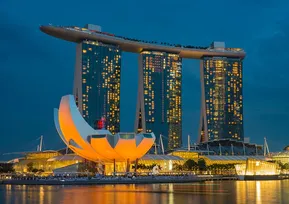
Photo by Mimi Thian on Unsplash

“We will focus on a strategy to solidify our position not only as a metaverse capital but also as a global digital hub,” said the province’s Governor Lee Cheol-woo.


Offering a hybrid metaverse experience

Touted as the nation’s first scalable hybrid metaverse platform, Metaport utilizes Web3 technology to provide both web and app services. In particular, it leverages open APIs to integrate features such as login and avatars into one service, which allows users to enjoy metaverse content provided by local governments, public institutions, businesses, schools and more.


Bridge to the future

The platform also connects reality and the virtual realm with a virtual model of the Daegu-Gyeongbuk Integrated New Airport as the main space within the realm. The Daegu-Gyeongbuk Integrated New Airport is a joint military-civilian airport that is set to be built by 2030 in the Uiseong and Gunwi counties.

Users can access MetaPort through a website without downloading a separate program. The mobile app is also available for Android smartphones on the Google Play Store.

More to Read
View All
Markets·

Sep 29, 2023

Hong Kong’s HashKey Adds AVAX Trading

Hong Kong’s HashKey Adds AVAX TradingHashKey Hong Kong, the Chinese autonomous territory’s first licensed retail crypto exchange, has unveiled an addition to its platform with the launch of Avalanche (AVAX) trading.According to an announcement published to its website on Wednesday, HashKey has listed Avalanche on Thursday with the caveat that access to AVAX trading will be reserved for professional investors, as defined by Hong Kong’s Securities & Futures Commission (SFC).Photo by Wance Paleri on UnsplashAccessible to professional investorsTo meet the criteria as a professional investor in Hong Kong, individuals must possess an investment portfolio valued at a minimum of 8 million Hong Kong dollars, roughly equivalent to $1 million. This decision sets AVAX apart from other widely traded cryptocurrencies, such as Bitcoin and Ether, which remain accessible to retail investors in Hong Kong. While Tether (USDT) enjoys retail status, the majority of altcoins on HashKey will remain the preserve of professional investors.This move is a direct result of the SFC’s proactive stance on regulating the rapidly expanding crypto market in Hong Kong. Since the introduction of regulated retail crypto trading in the Chinese autonomous territory in August, the SFC has imposed rigorous requirements on exchanges. HashKey mandates users to deposit a minimum of 10,000 Hong Kong dollars or $1,500 into their exchange accounts as part of the Know Your Customer (KYC) verification process.Low trading volumeAmid these regulatory challenges, HashKey Hong Kong currently reports a 24-hour trading volume of approximately $5.3 million, significantly lower than its global peers. This lower trading volume suggests that stringent regulations may be affecting the exchange’s ability to attract retail investors effectively.The path to regulatory compliance in Hong Kong has been anything but smooth for crypto exchanges. Reports indicate that these platforms have collectively invested over $25 million in establishing the requisite infrastructure for obtaining a Hong Kong Virtual Asset Service Provider (VASP) license. It was reported earlier this year that crypto firms are forking out between $2.55 million and $25.5 million in order to secure a VASP trading license.Despite the challenges, HashKey is looking at various avenues in bringing its offering forward. Earlier this month the firm signed a memorandum of understanding (MOU) with insurer OneDegree. That collaboration could be significant as it should lead to the assets of HashKey users being protected and insured on the platform. That would solve a major issue for participants in the crypto space amid the backdrop of ongoing platform failures and hacks.JPEX collapseEven as regulatory efforts intensify, the crypto industry in Hong Kong has not been impervious to bad actors. The recent collapse of the JPEX crypto exchange earlier this month serves as a stark reminder of the ongoing risks associated with the industry. Described as the largest financial fraud in Hong Kong’s history, JPEX faced allegations of embezzling over $178 million of investors’ funds. Notably, JPEX was operating without SFC registration at the time of the alleged embezzlement.In response to such incidents, the SFC has taken proactive measures by publishing a warning list of crypto exchanges considered non-compliant within the Chinese autonomous territory.

news
Policy & Regulation·

Jun 01, 2023

Hong Kong and the UAE Collaborate on Crypto Regulation

Hong Kong and the UAE Collaborate on Crypto RegulationHong Kong and the United Arab Emirates’ (UAE) central banks have announced a collaboration to work on cryptocurrency regulations and financial technology development. The move is significant insofar as both territories have been making headway in developing global crypto hubs over the course of the past six months.Photo by Nick Fewings on UnsplashStrengthening cooperationFollowing a meeting on Monday, the Hong Kong Monetary Authority (HKMA) and the Central Bank of the UAE published a statement on Tuesday, in which they set out the areas of cooperation between them. They agreed to strengthen cooperation on “virtual asset regulations and developments.”The central banks also expressed their commitment to facilitating discussions on joint fintech development initiatives and the sharing of knowledge through their respective innovation hubs.Financial infrastructureDuring the meeting, the officials highlighted the importance of financial infrastructure and financial market connectivity between the two jurisdictions. The Governor of the Central Bank of the UAE, H.E. Khaled Mohamed Balama, expressed his anticipation for an ongoing and long-term relationship with the HKMA.HKMA’s Chief Executive Eddie Yue echoed this sentiment, emphasizing that both regions share many complementary strengths and mutual interests, which will contribute to the economic benefits of the collaboration.In addition to the meeting, a seminar was organized for senior executives from banks in Hong Kong and the UAE. The seminar covered various topics, including improving cross-border trade settlement and exploring how UAE corporations can leverage Hong Kong’s financial infrastructure platforms to gain access to Asian markets.This collaboration comes at a time when the Securities and Futures Commission (SFC) in Hong Kong is allowing virtual asset service providers (VASPs) to cater to retail investors starting from June 1. Christopher Hui, the Treasury Chief of Hong Kong, emphasized that virtual assets are here to stay and acknowledged the fundamental value they bring. Hui also stressed the importance of regulation to harness the positive elements of cryptocurrencies while mitigating potential risks.Since the announcement of the application process by the SFC, several cryptocurrency exchanges, including CoinEx, Huobi, BitMEX, and OKX, have filed applications to provide dedicated crypto trading services in Hong Kong.FAFT travel ruleThe collaboration between the central banks of Hong Kong and the UAE marks a significant step in the global development of cryptocurrency regulations and fintech innovation. The move is demonstrative of ever improving levels of international cooperation on digital assets worldwide.Both jurisdictions are moving forward with the implementation of the Financial Action Task Force’s (FATF) travel rule. The UAE issued new guidelines in that respect on Tuesday. Hong Kong has gotten a head start in this respect, with the implementation of the travel rule through the introduction of the Anti-Money Laundering and Counter-Terrorist Financing (Amendment) Bill in December 2022.By leveraging their respective strengths and knowledge-sharing efforts, these regions aim to foster a conducive environment for the growth and adoption of digital assets. With increased financial infrastructure connectivity and joint initiatives, both jurisdictions are poised to benefit economically from this collaboration in the long run.

news
Policy & Regulation·

Oct 23, 2023

Bithumb Live Files for Bankruptcy

Bithumb Live Files for BankruptcySouth Korean cryptocurrency exchange Bithumb’s live commerce platform Bithumb Live — an attempt at business diversification — has filed for bankruptcy. The platform entered bankruptcy proceedings last year, brought on by business difficulties and various suspicions of embezzlement involving its CEO.Photo by Melinda Gimpel on UnsplashAccording to legal sources on Monday, the Seoul Bankruptcy Court declared Bithumb Live’s bankruptcy last Monday. The court plans to hold creditor meetings and inspections on November 28 to incorporate creditors’ opinions into the bankruptcy proceedings and assess the status of the company. Major companies like LG Uplus, SK Telecom, SK Magic, and Lotte Card are among the platform’s creditors.Bithumb Live’s backgroundBithumb Live was founded in September 2021 by Bithumb and Bucket Studio, who each invested KRW 6 billion (approximately $4.4 million). Bucket Studio is a content distribution company that gained considerable attention with the global success of the Netflix original series “Squid Game” last year because it holds a 15% stake in Artist Company, an entertainment planning agency co-founded by “Squid Game” lead actor Lee Jung-jae and actor Jung Woo-sung. In particular, Bucket Studio’s CEO Kang Ji-yeon is the sister of Kang Jong-hyun, who is embroiled in allegations related to the ownership of Bithumb.Bithumb and Bucket Studio each hold a 37.5% share of Bithumb Live, making a combined ownership of over 75%. Bithumb Live, led by Kang Ji-yeon, had been established with the intent to create a commerce platform with various features like a metaverse, non-fungible tokens (NFTs), and cryptocurrency payments. After its establishment, it announced that it would challenge its key competitor Naver’s prominent live shopping platform by preparing to sign deals with 15 different companies.Financial hardshipsHowever, the platform hit a roadblock just one year after its establishment and found itself unable to escape financial difficulties. According to last year’s business report, Bithumb Live’s liabilities exceeded its assets by approximately KRW 248 million and the platform recorded a net loss of KRW 10.2 billion. Unable to withstand such losses, it announced an indefinite temporary closure via its internal messenger to employees in October of last year. The employees ended up working only four hours a day, resulting in a more than 50% reduction in working hours. Subsequently, the number of employees, which was 73 in September, plummeted to just four in January of this year, essentially signaling a total stop to business operations. In the first half of this year, Bithumb Live’s net loss amounted to almost KRW 1.1 billion.Management entanglementsOn top of these financial strains, the company was also plagued by Kang Ji-yeon and her brother Kang Jong-hyun’s owner’s risk, which encompassed allegations of embezzlement and misappropriation. In July of this year, Kang Ji-yeon was sent to trial on charges of embezzlement and misappropriation at Bucket Studio. Along with her brother and former Chorokbaem (CRB) Group Chairman Won Young-sik, she was accused of granting call options on convertible bonds held by Bithumb affiliates Vidente and Bucket Studio for free to companies controlled by Won’s children between December 2021 and July 2022, inciting damages worth approximately KRW 58.7 billion to the respective companies. In the process, she was also found to have received KRW 32.2 billion in acquisition payments. Kang Jong-hyun had been detained and on trial since February of this year.Bithumb Live’s largest shareholder, Bucket Studio, is also in a tight spot. Back in June, the Korea Exchange imposed a penalty of three points on Bucket Studio for reversing its disclosure. The company had been penalized five points the previous month after withdrawing its decision to issue convertible bonds. In particular, the studio also recorded an operating loss of KRW 7 billion and a net loss of KRW 195.6 billion last year based on consolidated financial statements. In the first half of this year alone, it suffered an operating loss of KRW 896 million, raising red flags for its management.

news
Loading