Top

Iran caps stablecoin transactions amid currency devaluation and sanctions

Policy & Regulation·October 02, 2025, 3:37 AM

Iranian authorities last week introduced new restrictions on stablecoin transactions, limiting individuals to an annual purchase cap of $5,000 and a total holding limit of $10,000. According to a report from Iran International, licensed digital platforms have one month from the effective date to enforce these new regulations on all users.

https://asset.coinness.com/en/news/7308de6e3dc51c68635cd0c68e22cf0f.webp
Photo by Hadis Malekie on Unsplash

Rial decline fuels stablecoin uptake

The move coincides with the continued devaluation of the national currency, with the Iranian rial reaching an all-time low of 1,136,500 per U.S. dollar on Sept. 27. This currency plunge occurred just before the reimposition of United Nations sanctions, which took effect at 00:00 UTC on Sept. 28. Since then, the rial has weakened further, reaching a new low of 1,170,000 per U.S. dollar as of publication, as per data from Bonbast. 


For many Iranians, stablecoins like USDT have become an essential financial tool, providing a hedge against inflation and a means to transfer funds internationally, bypassing the traditional banking system. The adoption of these U.S. dollar-pegged digital assets has reportedly grown since the escalation of conflicts with Israel and the U.S. earlier in the year.


These new financial controls follow recent actions by the U.S. to counter what it describes as Iranian "shadow banking" networks. On Sept. 16, the U.S. Department of the Treasury’s Office of Foreign Assets Control (OFAC) sanctioned two Iranian financial operatives and their network of companies in Hong Kong and the United Arab Emirates (UAE). A press release stated these entities used cryptocurrency and front companies to transfer funds from oil sales, benefiting Iran’s IRGC-Qods Force (QF) and its Ministry of Defense and Armed Forces Logistics (MODAFL). The U.S. Treasury asserts these funds are funneled into regional proxy groups and the development of advanced weapons programs.
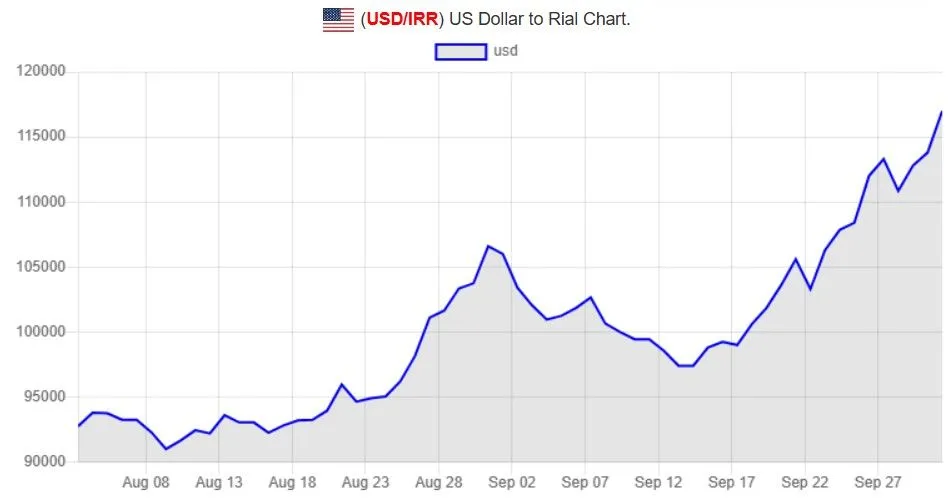
https://asset.coinness.com/en/news/be931ce65df2ae5e897f3935ee58667d.webp
U.S. dollar to rial chart Source: Bonbast

Hack on Iran’s top crypto platform

Iran’s private digital currency sector has also faced mounting security pressures. In June, Nobitex, the country’s largest crypto exchange, was hit by a major exploit that drained about $90 million in assets, including Bitcoin (BTC), Ethereum (ETH), Dogecoin (DOGE), Ripple (XRP), Solana (SOL), Tron (TRX), and TON. A pro-Israel hacker group known as Predatory Sparrow, or Gonjeshke Darande, later claimed responsibility in a post on X. The attack took place during heightened military tensions that began with Israeli strikes on Iranian military and nuclear facilities on June 18, 2025.


According to analysis by TRM Labs, digital assets are increasingly integral to Iran's efforts to navigate international sanctions and advance its geopolitical interests. Iranian exchanges, including Nobitex, process billions in cryptocurrency transactions. These platforms have been noted for permitting large withdrawals without stringent Know Your Customer (KYC) protocols and for employing sophisticated methods to obscure the origins and destinations of funds.


At the same time, these exchanges are not used solely for state-level purposes. For many ordinary Iranians, grappling with inflation and economic isolation, digital assets represent a practical tool for safeguarding savings and maintaining limited access to the global economy, underscoring the dual role that cryptocurrency plays in the country.


 

More to Read
View All
Web3 & Enterprise·

Jul 29, 2025

Grab extends crypto payment options to the Philippines

Grab Holdings, the Singapore-based operator of the Grab super app, has extended its facility for crypto payments to its customer base in the Philippines. The company, which offers ride-hailing, food and grocery delivery and digital payments within a range of services to customers throughout Southeast Asia, introduced the option of crypto payments to service users within its home market of Singapore last year. Photo by Kiko Ferranco on UnsplashAt the time, the company expressed the view that enabling crypto payments “added flexibility and convenience” for platform users, providing them with “a seamless and efficient way to access the company’s wide range of services.” Philippine online news portal Philstar.com reported that Filipino users of the platform can now top up their GrabPay digital wallets with a range of cryptocurrencies, including Bitcoin (BTC) and Ethereum (ETH), as well as U.S. dollar stablecoins USDC and USDT. In Singapore, Grab rolled out the offering in partnership with Triple-A, a company that enables businesses to pay and get paid in digital currencies. Singapore-based Crypto.com also partnered with the firm last year to enable direct crypto payments. Financial inclusionIn extending the service to the Philippines, Grab has again partnered with Triple-A, alongside Philippine crypto exchange platform PDAX. CJ Lacsican, Grab Philippines’ vice president for cities, said that “integrating cryptocurrency as a cash-in option for GrabPay reflects [Grab’s] commitment to advancing financial inclusion in the Philippines.”  She added that the move aims to empower a broader spectrum of Filipinos, particularly those who prefer the convenience of digital currencies and others who have limited access to traditional banking. Triple-A CEO Eric Barbier said that the launch of GrabPay crypto top-ups went well in Singapore, with a fantastic response from Singaporean platform users. Following that rollout, Barbier believes that the Philippines is a market that’s ready for digital currencies. “This is a big step in making digital currencies easier to use in everyday life across Southeast Asia,” he added. Driving crypto adoptionPDAX CEO Nichel Gaba suggested that the Philippines “has one of the largest crypto user bases globally,” adding that through this partnership, accessible use cases are being offered “that will both support the existing crypto community and drive greater adoption of cryptocurrency.”  Grab first pivoted to Web3 with the integration of a Polygon-based crypto wallet in September 2023, with a view towards making crypto more accessible and usable for ordinary people. The super app, which is considered by many to be the “Uber of Southeast Asia,” has 42 million monthly transacting users (MTUs) across Cambodia, Indonesia, Malaysia, Myanmar, the Philippines, Singapore, Thailand and Vietnam.  The development of the Grab Web3 Wallet came about as a consequence of a collaboration with USDC stablecoin issuer Circle. As part of a strategic partnership, Circle’s Web3 services platform was integrated into the Grab app. More recently, Grab partnered with NATIX Network, a Solana ecosystem decentralized physical infrastructure network (DePIN) project, in an effort to collaborate on autonomous driving technology and mapping. 

news
Policy & Regulation·

Aug 02, 2023

Nomura’s Crypto Subsidiary Secures Dubai VARA License

Nomura’s Crypto Subsidiary Secures Dubai VARA LicenseLaser Digital Middle East FZE, the digital asset subsidiary of Japanese global financial services group Nomura, has successfully obtained an operating license from Dubai’s Virtual Asset Regulatory Authority (VARA).This significant development, announced via a statement published to Laser Digital’s website on Tuesday, comes as part of Nomura’s strategic efforts to make a strong presence in the digital asset space.Photo by Paul MARSAN on UnsplashOpportunity to expand servicesThe newly acquired Virtual Asset Service Provider (VASP) license empowers Laser Digital to offer broker-dealer services and provide virtual asset management and investment solutions within the emirate. Additionally, the license will enable the company to carry out trading and asset management operations in the near future. This could potentially include the provision of over-the-counter (OTC) services, together with a diverse range of digital asset investment products.Jez Mohideen, the CEO of Laser Digital, expressed his confidence in VARA’s meticulous and collaborative process, which assures institutional investors looking to get involved in this emerging asset class. “We are very grateful to VARA for approving our Operating License. VARA’s thorough and consultative process provides institutional investors with the assurance they require to engage in this asset class. With the license now in place, we are looking forward to Laser’s growth over the coming years,” he stated.Established in September 2022 under the guidance of Nomura, Laser Digital was the brainchild of Steven Ashley, the former head of Nomura’s wholesale division, alongside Mohideen, who served as the firm’s former Chief Digital Officer and Co-Head of Global Markets for Europe, Middle East, and Africa (MENA). The company is headquartered in Switzerland, with sub-offices located in Dubai and London.Dubai’s rapidly growing crypto ecosystem has garnered global attention, especially after the establishment of its own virtual asset rules and the formation of VARA in March 2022. In February, the regulatory body issued the “Full Market Product Regulations,” comprising four compulsory rulebooks and activity-specific guidelines that delineate the framework for Virtual Asset Service Providers (VASPs).Following in Binance’s footstepsLaser Digital’s recent achievement coincides with Binance’s continuous efforts to solidify its presence in the United Arab Emirates. Its license award comes hot on the heels of Binance having achieved the same milestone. On Monday, Binance’s Dubai subsidiary, Binance FZE, received an operational Minimum Viable Product (MVP) from VARA, granting it permission to operate cryptocurrency exchange and virtual asset broker-dealer services locally.Apart from Binance, only two other entities, digital asset custodians Komainu MEA and Hex Trust MENA FZE, currently hold operational MVP permits in the region. Notably, crypto exchange BitOasis also secured a conditional license but it has faced a suspension from VARA for non-compliance with mandated conditions.Laser Digital’s successful licensing and entry into Dubai’s crypto landscape further enrich the diversity of players in the region’s digital asset market. The involvement of reputable financial institutions like Nomura contributes to the establishment of a robust and well-regulated ecosystem in the United Arab Emirates. The license paves the way for Laser Digital to serve institutional investors and individual clients alike, offering innovative digital asset solutions while complying with the region’s regulatory standards.

news
Web3 & Enterprise·

Oct 27, 2023

Triple-A Secures Series A Funding to Advance Crypto Payments

Triple-A Secures Series A Funding to Advance Crypto PaymentsTriple-A, the Singaporean digital currency payments firm founded by Eric Barbier, has announced the successful closure of its $10 million Series A funding round.Photo by Towfiqu barbhuiya on Unsplash$10 million raiseIn a statement on its website on Wednesday, the firm outlined that the raise had been led by Peak XV Partners (formerly known as Sequoia India & South East Asia), who had previously invested in the company. In addition, the round received support from Abu Dhabi-based venture firm Shorooq Partners, alongside other undisclosed repeat backers.The company offers white-label solutions for businesses, facilitating the seamless integration of cryptocurrency payments with quick conversion to fiat money in their bank accounts within just one day. Triple-A currently supports various cryptocurrencies, including Bitcoin, Ether, Tether, and USD Coin.According to Barbier, stablecoins are a game-changer in payments, as they enable real-time settlements, in contrast to traditional payment methods like SWIFT transfers, which may take several days to clear. He stated: “With stablecoins, individuals and businesses worldwide, even in emerging countries, can now easily own and use a USD-denominated currency.”Barbier is known for his earlier success in founding the cross-border payments platform Thunes. The idea for Triple-A was born while Barbier was working at Thunes and recognized the potential of cryptocurrencies in resolving chargeback fraud issues.Barbier saw cryptocurrencies as a more efficient payment method for businesses engaged in cross-border transactions. He explained:“Cryptocurrency payments not only shield businesses from chargeback fraud risks but also help to streamline B2B cross-border payments. With instant settlements and no middlemen required, I realized we could solve many pressing issues in the payments industry today.”Expanding operations globallyThis funding round follows Triple-A’s $4 million seed round, bringing the total funds raised to date to $14 million. The new capital injection will be directed towards expanding Triple-A’s operations in key regions, including the Middle East, North America, and South America.Moreover, the company plans to enhance its cryptocurrency solutions and offerings in its crypto payments and payout products. Currently headquartered in Singapore, Triple-A boasts a global presence with offices in Miami, Hong Kong, Paris, and Barcelona, supported by a team of over 70 professionals.Regulatory compliant pathTriple-A is trying to differentiate itself through adherence to regulation. The company holds licenses that permit it to operate globally, including one from the Monetary Authority of Singapore (MAS) as a payments institution and a payments institution license from the central bank of France, allowing it to execute payment transactions across all EU member states.The company is registered with the United States Financial Crimes Enforcement Network (FinCEN) and is actively looking to expand its regulatory footprint. In line with the regulatory path the business is treading, Triple-A’s target clientele primarily consists of enterprises that value compliance, regulation, and licensing and seek to engage in cryptocurrency payments without the associated risks and complexities.Triple-A has already gained traction, serving more than 20,000 businesses, including prominent names such as iStudio, Farfetch, Charles and Keith, Singapore Red Cross, Razer, and Reap, along with other large enterprises. In July, it partnered with universal payments platform Optty to enable crypto payments. The onboarding process is swift, with Triple-A completing the Know Your Customer (KYC) procedure and onboarding within one to two business days. The integration methods offered include API and no-code integration.

news
Loading