Live Feed
New
Today, October 30, 2026
23:39
Walmart-backed fintech firm One Pay has launched USDC deposit support for some U.S. customers, Crypto Briefing reported. Users can generate a USDC deposit address in the One Pay app and send USDC to that address, after which the deposited tokens are automatically converted into U.S. dollars and reflected in the balance of an existing One Pay checking account.
23:30
U.S. crypto lobbying group The Digital Chamber urged Congress to quickly advance stronger crypto exchange regulation in the wake of the Binance hack, CryptoTimes reported. In a letter to congressional leaders, The Digital Chamber emphasized that the Commodity Futures Trading Commission's oversight authority over crypto exchanges should be clarified, and that lawmakers should not wait for the CLARITY Act before prioritizing separate legislation focused on customer asset protection and cybersecurity. The group also stressed the need for real-time security monitoring and stricter incident reporting requirements.
23:19
Blockchain analytics firm Chainalysis said its internal systems were compromised in a cyberattack that used AI, exposing customer information, Bitcoin News reported. Chainalysis said hackers gained unauthorized access to its internal systems and tools through an attack method that abused AI agents, resulting in the exposure of customer names, email addresses, user IDs and organizational job titles.
The company said there was no indication that passwords, secrets related to multi-factor authentication, session tokens or sensitive investigative materials were exposed. Chainalysis added the incident was unrelated to the recent $6 billion Binance hack.
23:13
U.S. President Donald Trump said he was monitoring the Binance hack early today, according to Bloomberg. Asked whether he believed the attack was carried out by a North Korean hacker group, Trump said he did not know. On prospects for recovering the stolen funds, Trump said he had heard the assets would be recovered.
22:06
Whale Alert reported that 261,739,220 USDC has been transferred from an unknown wallet to Coinbase. The transaction is valued at about $262 million.
20:24
Canton, a privacy blockchain for institutional finance, said cSOL, a token wrapped 1:1 with SOL, has launched on the Canton network. cSOL is operated by onRails.
20:08
DeFi protocol Balancer said most of its pools have shifted to withdrawal-only mode, as approved in BIP-928. Users retain control of their funds and can withdraw at any time. Partner pools granted an extended operating period will remain active through Nov. 30.
19:16
Uber has completed the first pilot of an onchain liquidity and payments solution on Canton, a public network, according to Canton, a privacy blockchain for institutional finance.
Working with HSBC, Franklin Templeton, Tradeweb and Fireblocks, Uber converted part of its holdings into cash over the weekend and earned yield until the funds were paid out, Canton said.
19:14
Maple Finance’s decentralized lending protocol SYRUP has released an updated proof of reserves verified by The Network Firm, with total collateral of $2.05 billion and outstanding loans of $1.23 billion.
Collateralization ratios by asset were 172.1% for syrupUSDC, 144.1% for syrupUSDT and 166.8% for syrupUSDG. Maple Finance added that no collateral is held on Binance.
18:48
Matt Cole, CEO of Bitcoin treasury company Strive (ASST), said in an interview with Cointelegraph that Bitcoin’s price held up surprisingly well after the Binance hack, which Cole sees as a very positive signal for BTC.
Cole added that even the largest crypto hack on record would not change the investment case for Bitcoin over a reasonable investment horizon. Cole also said the market is now in an early spring-like phase and expects Bitcoin to keep rising over the next six to nine months as it overcomes multiple concerns.
18:47
Liquid staking protocol Marinade (MNDE) said that starting with the Epoch 1072 auction, its staking auction marketplace, or SAM, will recognize only validator bonds that can actually be paid out to stakers.
Marinade said the final stake account in a bond must keep about one SOL, and that minimum balance cannot be deducted. A bond holding only the minimum balance cannot cover unpaid rewards and will therefore be treated as having no bond. The validator will not receive SAM stake allocations and will be prioritized for unstaking.
18:40
The Recall Foundation, the organization behind the AI agent evaluation infrastructure project RECALL, said on Oct. 31 via its official X account that it had decided to end operations and liquidate the project, citing a lack of commercial viability.
Under the plan, around 358.65 million RECALL tokens held directly by or under the control of the foundation will be burned, representing 35.86% of total supply. The foundation said there will be no buyback for token holders and no distribution of remaining assets. About $3.7 million held by the foundation will be used to repay creditors and cover liquidation costs. The foundation’s operating web application will switch to read-only mode starting Nov. 30, while staked tokens will be excluded from the burn. According to CoinMarketCap, RECALL was trading at $0.02925, down about 24.26%.
18:29
Polymarket has expanded its partnership with official oracle infrastructure provider Chainlink and broadened its prediction markets beyond cryptocurrencies with 15-minute gold and silver price markets, according to Chainlink.
The markets have already launched on Polymarket, and the platform plans to extend support to more commodities, stocks and foreign exchange markets. Polymarket had previously said it would introduce Chainlink price data across all prediction markets, from Bitcoin to gold.
18:19
According to CoinNess market monitoring, BTC has fallen below $77,000. BTC is trading at $76,996.16 on the Binance USDT market.
18:19
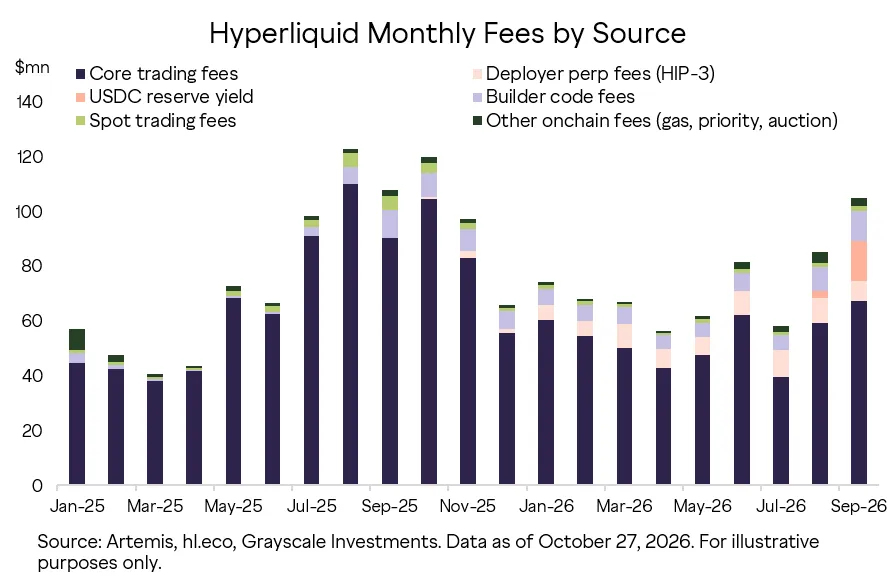
Hyperliquid generated $38 million in revenue last month through an external partner-based outsourced revenue model, according to a Grayscale analysis.
Grayscale said major institutions using Hyperliquid appear to be increasing their participation. Intercontinental Exchange, the parent of the New York Stock Exchange, has recently been working with TradeXYZ to build a U.S. perpetual futures market based on Hyperliquid, Grayscale added.
Grayscale said notable examples of Hyperliquid’s outsourced revenue model include HIP-3, which allows third parties to launch perpetual futures markets tied to commodities, stocks and private company assets; builder codes, under which external platforms such as Phantom route orders to Hyperliquid and earn fees; reserve interest income, under which Coinbase pays Hyperliquid 90% of income generated from about $6 billion in USDC reserves; and fees from spot trading and token listing auctions.
17:51
U.S. real estate investment firm Cardone Capital, which has been accumulating Bitcoin, bought an additional 15 BTC at an average purchase price of $78,494, bringing the transaction value to about $1.17 million.
17:20
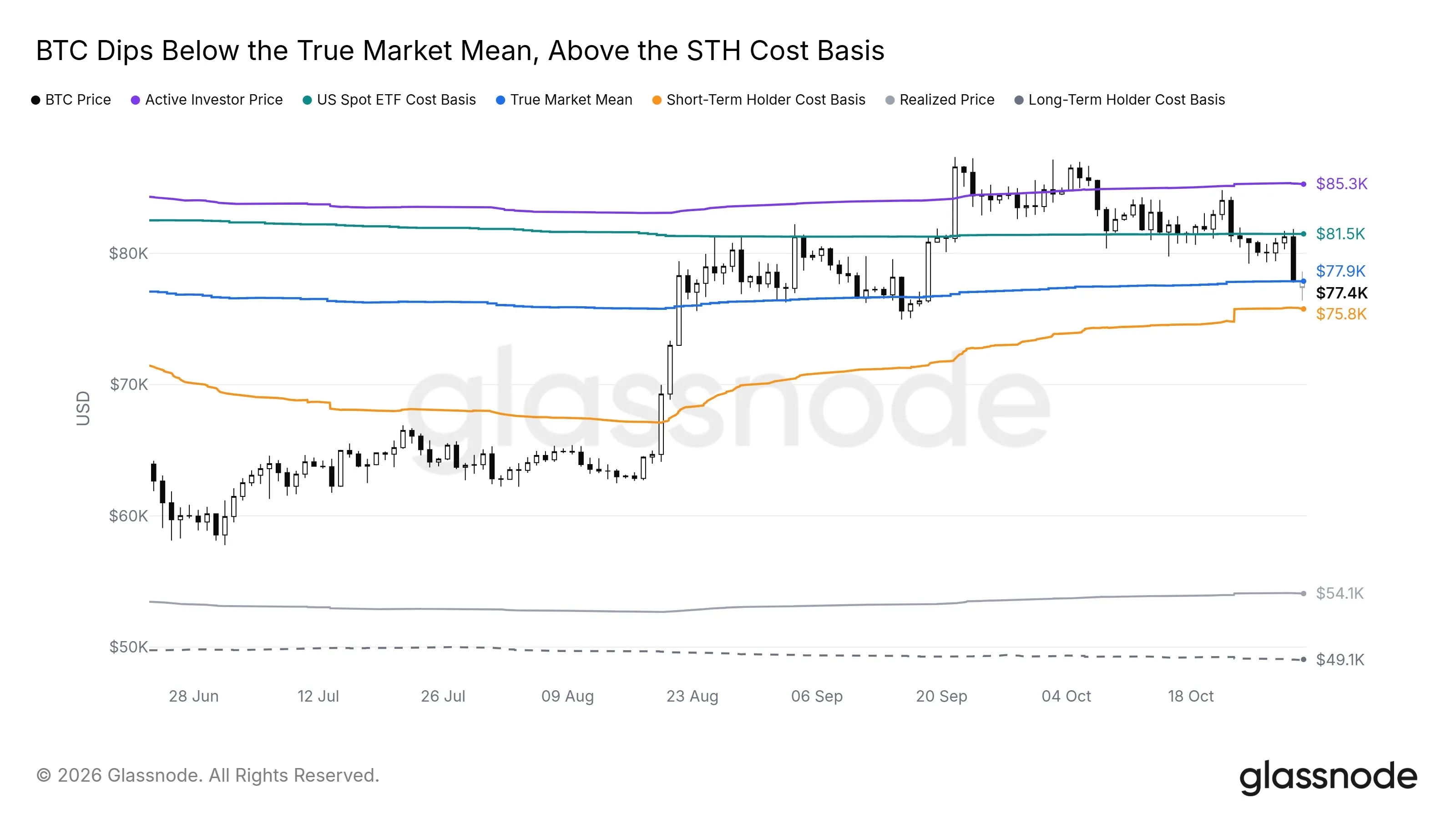
A pullback in Bitcoin to $75,800, the short-term holder realized price, would still count as a healthy correction within an ongoing uptrend, according to on-chain analytics firm Glassnode.
Glassnode said Bitcoin is currently retesting the True Market Mean, an on-chain metric, as resistance. If BTC fails to reclaim that resistance and falls to the average entry price of short-term holders, that would still fit a typical retest pattern, Glassnode said. The firm added a similar correction occurred in mid-September after Bitcoin failed to overcome resistance, though BTC went on to break above its previous high again within days.
The True Market Mean is an on-chain indicator that estimates the average on-chain purchase price of investors who are actively participating in the Bitcoin market.
17:05
Decentralized lending protocol Benqi (QI) said it has fully resumed all services after temporarily suspending operations on Oct. 30, following the completion of a security review.
17:03
Privacy computing network ARPA said it is aware of the hacking incident at Binance and that the ARPA team’s assets are safe. Citing the Newton Foundation, ARPA added that some of the stolen tokens were transferred into the Newton (NEWT) token contract, where the ARPA-linked amount has been permanently frozen and cannot be recovered or sold. Binance is working to fully compensate for the losses and replenish affected assets, ARPA said.
16:53
Tether, the issuer of the world’s largest U.S. dollar-pegged stablecoin USDT, said in an official blog post that third-quarter operating profit reached $1.5 billion.
According to Tether’s third-quarter reserves attestation report prepared by accounting firm BDO, cumulative net operating profit for the first three quarters of the year totaled about $4.5 billion. Over the same period, USDT issuance remained at around $184 billion. As of Sept. 30, according to the report, Tether held $191.4 billion in total reserve assets against $183.5 billion in total liabilities, leaving about $7.95 billion in excess reserves. That was nearly double from $4.1 billion at the end of the second quarter. The report also showed Tether’s direct and indirect holdings of U.S. Treasuries stood at $132.4 billion.
16:42
AI computing-focused layer-one network Qubic said an attacker stole assets from 1,404 Qubic wallets in October, but all of the stolen coins were frozen before they could be moved or cashed out. Qubic said the attacker ultimately took no assets.
16:30
Federal Reserve official Musalem said the Fed may need to raise interest rates again soon. Musalem said inflation remains too high and is unlikely to ease unless the Fed acts, adding that the degree of policy accommodation should be reduced further so inflation converges to 2% within 18 months. Musalem also said the rise in long-term bond yields reflects expectations for higher policy rates and that raising rates earlier could reduce the risk of shocks across the broader economy.
16:27
Binance founder Changpeng Zhao said on X that the Binance hack was the largest ever in dollar terms, but smaller than the Mt. Gox hack when measured by the amount of BTC stolen and its share of Bitcoin’s total supply.
Zhao added that about 650,000 BTC was stolen in the Mt. Gox hack and said the market impact of a hack should be assessed by considering the loss as a share of Bitcoin’s total supply, the number of affected users and their asset share, and whether the victims and the platform are fully compensated. Zhao said that in the Mt. Gox and FTX hacks, nearly all users and assets were effectively affected, whereas if an exchange fully covers losses, as Binance does, the damage is limited to the exchange itself.
Meanwhile, Binance co-founder He Yi said the net losses from the latest hack exceeded $3 billion, representing more than 2% of Binance user assets and assets held in its disclosed reserves.
15:51
U.S. CFTC Chairman Michael Selig said in a CNBC interview on the Binance hack that the agency will create an institutional option for cryptocurrency exchanges to come under federal-level regulation and oversight.
Selig added that when FTX collapsed, some exchanges were licensed at the state level but were not subject to federal market regulation. The CFTC is trying to introduce a market-based regulatory framework that includes protections against market manipulation and fraud, segregation of customer assets, and separation among broker, exchange and clearing functions, he said. While the agency does not have the authority to require all exchanges to register with the CFTC, it plans to let them choose a federal registration and regulatory regime.
15:45
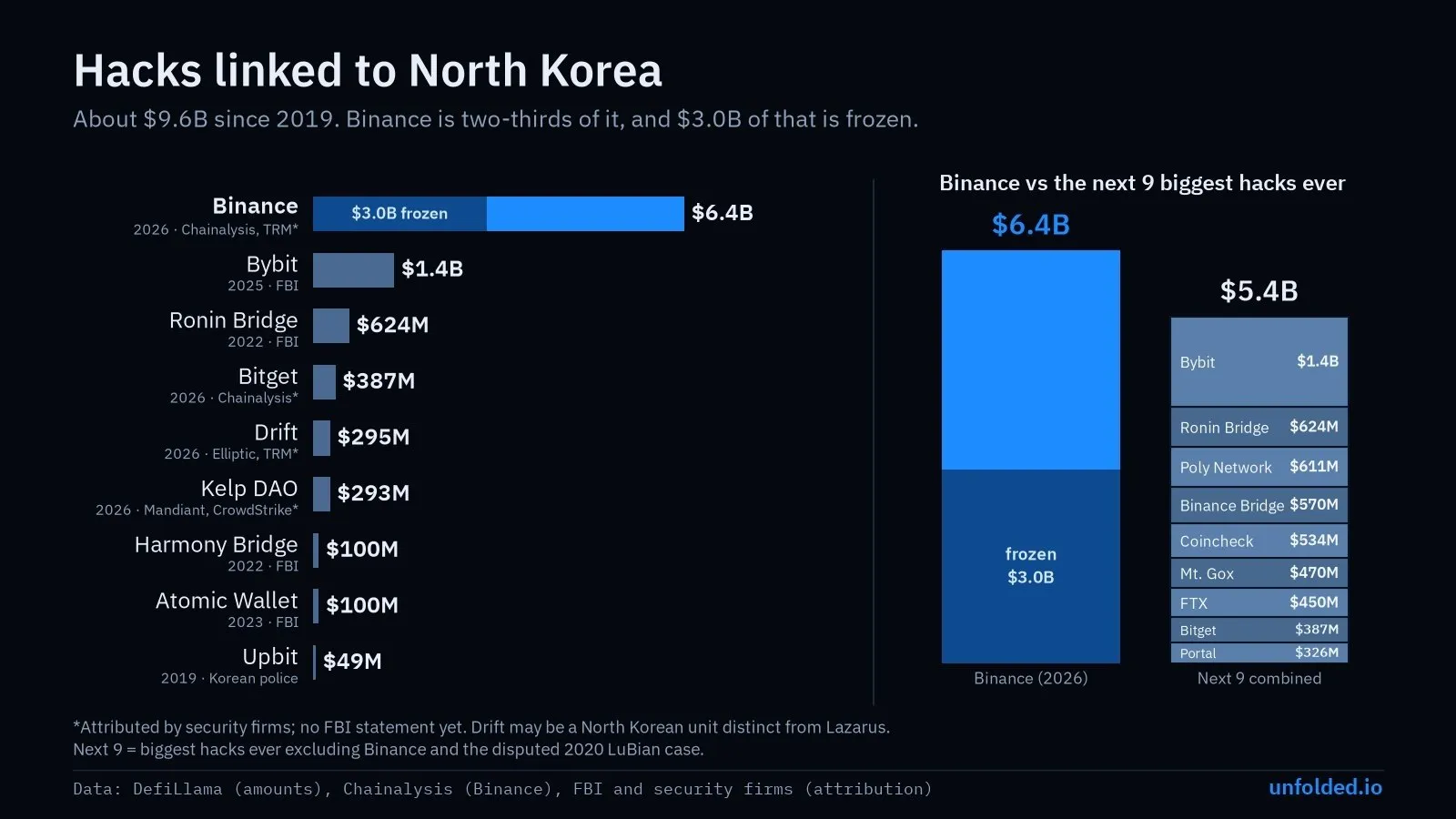
Losses from the Binance hack were larger than the combined total from the second- through 10th-largest hacking incidents historically attributed to North Korean actors, according to Unfolded.
Unfolded said total losses from North Korea-linked hacks since 2019 have reached $9.6 billion, with the Binance hack accounting for about $6.3 billion.