Live Feed
Today, December 20, 2025
00:42
The possibility remains for Bitcoin to reach a new all-time high next year, according to a new forecast. In its annual prediction report, Galaxy Research, the research arm of U.S. digital asset firm Galaxy Digital, stated that Bitcoin could reach $250,000 by the end of 2027, Cointelegraph reported. While acknowledging some uncertainty in making the prediction, the report maintained that the potential for a new peak next year is still valid.
The report also projected that stablecoin transaction volume will surpass that of the U.S. Automated Clearing House (ACH) system by 2026. Galaxy Research noted that stablecoin volume has already exceeded that of major credit card networks like Visa and is at half the level of ACH transactions. The report added that the Genius Act, set to be implemented in early 2026, will contribute to the expanded use of stablecoins.
00:33
U.S. digital asset manager Grayscale stated on X that the tokenized asset market has the potential to grow approximately 1,000 times its current size by 2030. The firm noted that tokenized assets today account for just 0.01% of the global stock and bond markets. However, Grayscale explained that the market will expand as blockchain infrastructure matures and a clear regulatory environment is established. This shift could drive meaningful activity on networks such as Ethereum (ETH), BNB Chain (BNB), Solana (SOL), and Avalanche (AVAX), while also affecting key middleware like Chainlink (LINK).
00:26
An analysis of XRP's daily Bollinger Bands indicates a pessimistic outlook, making a recovery to the $2 level by the end of the year unlikely, according to U.Today. The report notes that on the XRP/USDT daily chart, the price remains below the middle line of the Bollinger Bands, suggesting a lack of the capital inflow needed for a significant rally. While it is too early to confirm a complete downtrend, the analysis concludes that a return to $2 this year is improbable. For a bullish reversal, XRP must reclaim the middle line, currently at approximately $2.0189. If the daily candle closes below this level, it is expected to become a strong technical resistance.
00:20
BitMEX co-founder Arthur Hayes has stated that while altcoins are currently ailing and will take time to recover, now is the time for investors who understand capital preservation and exchange mechanics to seek out opportunities. In an essay published on Dec. 20, he argued that even in a battered market, there are valuable assets to be found at low prices. Hayes added that Bitcoin could experience a sharp recovery once the market recognizes that the U.S. Federal Reserve's Reserve Management Purchases (RMP) plan is effectively a form of quantitative easing. He also identified Ethena (ENA) as his most preferred altcoin, noting that he has invested in the project through his family office, Maelstrom.
00:05
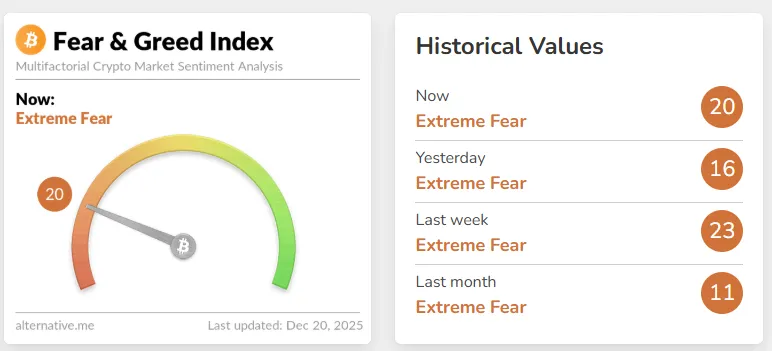
The Crypto Fear & Greed Index rose four points from the previous day to 20, according to data provider Alternative. Despite the slight improvement in investor sentiment, the market remains in the "Extreme Fear" stage. The index, which measures market sentiment on a scale of 0 (Extreme Fear) to 100 (Extreme Greed), is calculated based on volatility (25%), trading volume (25%), social media mentions (15%), surveys (15%), Bitcoin's market cap dominance (10%), and Google search volume (10%).
Yesterday, December 19, 2025
23:51
Veteran U.S. trader Peter Brandt has predicted that the passage of the U.S. crypto market structure bill, the CLARITY Act, by Congress next January would have a minimal impact on the price of Bitcoin. In an interview with Cointelegraph, Brandt stated that while the legislation is a necessary measure, it is not an event that would redefine Bitcoin's value. He acknowledged the bill is positive as it would bring greater clarity to the regulatory framework for cryptocurrencies. However, he suggested its passage might only slightly mitigate bearish outlooks and is unlikely to serve as a complete bullish catalyst. Brandt previously predicted in October that BTC could fall to $60,000, comparing its price action to the soybean market of the 1970s.
23:44
Coinbase, the largest cryptocurrency exchange in the U.S., has projected that crypto will play a larger role in the core financial system in 2026, according to its '2026 Crypto Market Outlook' report. The exchange anticipates continued market growth, driven by clearer regulations and accelerating institutional adoption. The report states that the crypto industry is moving beyond a theoretical phase into real-world implementation, but noted the need for improvements in product quality, regulatory compliance, and user-centric design. The outlook focused on key themes including the macroeconomic environment, technological innovation, and tokenization. In the technology sector, the report highlighted privacy, the convergence of AI and crypto, application-specific blockchains, real-world asset tokenization, prediction markets, and stablecoin payments.
23:35
U.S. Senator Cynthia Lummis, a prominent pro-cryptocurrency Republican from Wyoming, has officially announced she will not run for re-election after her current term ends. In a post on X, she stated that serving Wyoming in the Senate has been the honor of her life and that she made the decision not to seek another term after careful consideration. Lummis currently chairs the Senate Banking Committee's Subcommittee on Digital Assets and is considered a leading advocate for the crypto industry. She previously promoted legislation related to a Bitcoin strategic reserve for the Trump administration.
23:27
Bitcoin and Ethereum prices tend to move in the opposite direction of prevailing retail investor sentiment on social media, according to an analysis by crypto social data firm Santiment. The firm noted a historical pattern where prices for the two largest cryptocurrencies have typically fallen when social media sentiment is bullish and risen when it is bearish. Santiment added that this pattern has held true for various investment strategies, including swing trading as well as long- and short-term investing.
23:21
Coinbase announced via its official X account that it has added Brevis (BREV) to its listing roadmap.
19:37
According to CoinNess market monitoring, BTC has risen above $88,000. BTC is trading at $88,005.99 on the Binance USDT market.
18:32
The U.S. Securities and Exchange Commission (SEC) is pursuing sanctions to prohibit former FTX co-founder Gary Wang, former Director of Engineering Nishad Singh, and former Alameda Research CEO Caroline Ellison from serving as officers or directors of public companies for several years, The Block reported. According to the SEC, the executives, while not admitting to the allegations, have consented to legal orders that would bar them from committing securities fraud and restrict certain activities for the next five years. The measures require court approval to be finalized.
18:14
18:11
BitMEX co-founder Arthur Hayes has projected that Bitcoin could first recover to $124,000 and then rise to $200,000 if the market begins to perceive the U.S. Federal Reserve's Treasury purchase policy (RMP) as equivalent to quantitative easing (QE). Hayes noted that while the Fed's RMP is supplying $40 billion in liquidity each month, this amount is low relative to the total U.S. dollar supply compared to 2009, making a significant credit ripple effect unlikely at current financial asset prices. He suggested that due to a misconception that RMP is weaker than QE in creating credit and uncertainty over whether the policy will continue past April of next year, Bitcoin will likely remain in a range between $80,000 and $100,000 through the end of the year. However, Hayes argued that the moment the market accepts RMP as a liquidity provision policy on par with QE, Bitcoin could experience a rapid surge. He anticipates that expectations for the RMP's effect on asset price inflation will peak in March of next year. Following this, even if Bitcoin undergoes a correction, it is likely to establish a strong support level around $124,000. Hayes emphasized that this trend will continue as long as New York Fed President John Williams does not halt the liquidity supply.
17:43
Monad (MON) has added support for USD1, a stablecoin issued by World Liberty Financial (WLFI), according to an announcement from WLFI on X.
17:36
The Lido (LDO) community has introduced a Whitehat Safe Harbor Agreement to protect its approximately $26 billion in assets, according to DL News. The agreement permits white-hat hackers to intervene for the purpose of asset recovery in the event of a hack. This new policy provides an institutional safeguard for ethical hackers, who previously faced the risk of legal punishment for such unauthorized interventions.
17:33
According to CoinNess market monitoring, BTC has fallen below $87,000. BTC is trading at $86,993.64 on the Binance USDT market.
17:27
DLP Labs, an insurance company specializing in electric vehicle (EV) data, is introducing a rewards system based on the Sui (SUI) blockchain. Sui announced on X that DLP Labs will use the Walrus (WAL) protocol to securely store EV data and compensate drivers. The system will allow drivers to reduce costs and earn rewards for charging during off-peak hours, supporting the power grid, and generating carbon credits.
17:24
Whale Alert reported that 348,000,000 USDC has been transferred from Coinbase Institutional to Coinbase. The transaction is valued at about $348 million.
17:17
The Tron (TRX) DAO has integrated with Base, Coinbase's proprietary Layer 2 network, CryptoBriefing reported. Users can now bridge TRX to Base via LayerZero (ZRO), allowing them to access and trade on decentralized exchanges native to the Base ecosystem.
17:11
Swedish fintech firm Klarna has partnered with Coinbase to add stablecoins to its funding options, Walter Bloomberg reported.
17:08
Selling pressure on XRP remains strong despite the potential approval of a U.S. spot ETF, according to an analysis by CryptoQuant contributor PelinayPA. The contributor noted that most recent XRP inflows to Binance originated from wallets holding between 100,000 and one million XRP, as well as those with over one million XRP, indicating that whales, not retail investors, are depositing funds onto the exchange. Historically, such spikes in exchange inflows have preceded sustained price declines, signaling that supply is overwhelming demand. PelinayPA identified a key support zone between $1.82 and $1.87 but warned that continued large-scale transfers by whales could push the price down to the $1.50-$1.66 range. The analysis also highlighted that the chart currently shows no signs of a bullish trend reversal and that XRP faces repeated selling pressure each time it approaches $1.95. A significant rebound is considered unlikely until these exchange inflows decrease.
16:52
The EigenLayer Foundation has introduced a governance proposal to overhaul its EIGEN token incentive system, CoinDesk reported. The proposal's central aim is to restructure incentives based on network activity and fee generation. Under the plan, a new incentives committee would be formed to adjust token issuance. The system is designed to reward users who contribute to securing Actively Validated Services (AVS) and expanding the EigenCloud ecosystem.
16:41
The U.S. Federal Reserve is seeking public comment on a proposal to introduce a new type of account, known as a payment account, that would allow access to the central bank's payment network without complex requirements, CoinDesk reported. These accounts would be a scaled-down version of the Fed's master accounts. The rigorous process for obtaining a master account has historically served as a barrier to entry for some cryptocurrency firms.
16:22
A group of Republican members of the U.S. House of Representatives is urging the administration to repeal tax regulations on cryptocurrency staking, according to Decrypt. The lawmakers emphasized that the rules must be withdrawn before they take effect for the 2026 tax year. In 2023, the Internal Revenue Service (IRS) introduced a rule classifying rewards from crypto staking as taxable income upon receipt. For years, the crypto industry has argued that staking rewards should be treated as newly created assets and taxed only when they are sold.
