Live Feed
New
Today, October 10, 2026
12:15
BTC is showing a price pattern similar to moves seen from late 2025 to early 2026, with $80,500 potentially serving as a key near-term support level, according to CryptoQuant contributor Darkfost.
In a post on X, Darkfost said BTC has been fluctuating around its capital-weighted cost basis, the average purchase price calculated based on the amount of capital invested by holders. Darkfost said that price zone marks the threshold where the average profit and loss of market participants splits between gains and losses, which could materially influence investors’ trading decisions. Darkfost added that whether BTC holds $80,500 as support will be a key variable in assessing its next price move.
12:11
The tokenized commodities market, long centered on gold, is expanding into silver and oil, CoinDesk reported. According to CoinGecko, the sector’s market capitalization rose from $1.43 billion at the start of 2025 to $5.55 billion at the end of March 2026. About 90% of that increase came from gold-backed tokens issued by Paxos and Tether. Iggy Ippolito, chief investment officer at Theia, projected the tokenized commodities market could reach tens of billions of dollars within five years and exceed $100 billion within 10 years. Still, physical asset custody and transportation were cited as challenges to broader market growth.
12:07
Tron founder Justin Sun said on X Tron has deployed quantum-resistant cryptography on its testnet to respond to potential attacks from quantum computers. Sun said Tron is closely monitoring advances in quantum computing and artificial intelligence and is ready to introduce quantum-resistant technology to the mainnet at any time.
Sun added Tron aims to become one of the major blockchains with quantum resistance in place before "Q-Day," the point at which quantum computers could render existing cryptographic systems ineffective. A timeline for deploying the technology on the mainnet was not disclosed.
11:49
Global fintech companies are increasingly using cryptocurrencies as core infrastructure for payments, settlement and financial services rather than simply as investment assets, crypto investment firm IOSG said in a report.
Comparing the business strategies of major fintech companies including Visa, Mastercard, Stripe, PayPal and Robinhood, the report said stablecoins are emerging as a key tool linking traditional finance with blockchain-based finance. IOSG added that securing competitiveness in future financial markets will require a large user base, regulatory compliance capabilities and control over financial infrastructure. The report also projected that DeFi is more likely to be used as infrastructure supporting existing financial products than as a service used directly by mainstream consumers.
11:33
Large-scale investors accumulated around 15,000 BTC and more than 166,000 ETH over the past 72 hours as prices fell, crypto analyst Ali Martinez said on X. Over the same period, the investors also bought about 45 million XRP.
11:29
Crypto trading fee revenue in Hong Kong’s securities industry fell 13.5% to HK$99.3 million ($12.8 million) in the first half of 2026 from HK$114.8 million in the second half of last year, according to a financial report on the securities industry released by Hong Kong’s Securities and Futures Commission, or SFC.
11:26
A media outlet reported, citing Bitcoin Treasuries data analysis, that Bitcoin treasury company Strive is estimated to have raised about $55 million this week through a preferred stock issuance of SATA. That would be enough to buy around 638 BTC. The estimate was based on SATA trading volume and past disclosures, while the actual issuance size and whether the company bought BTC have not been confirmed.
11:23
Orbio, an AI project in the Robinhood ecosystem, has raised $1.2 million in seed funding. The participating investors were not disclosed.
Orbio plans to use the funding to build a system that allows AI agents to independently secure computing resources, hardware and dedicated infrastructure. The project is also developing a marketplace where access to more than 400 AI models can be traded at discounted prices.
The ORBIO token was issued through a liquidity pool based on tokenized Nvidia shares. According to GMGN, ORBIO has a market capitalization of around $53.42 million and is up 26% over the past 24 hours. Low trading volume has made the token highly volatile.
11:19
China’s Communist Party Central Committee and State Council have formally unveiled an advanced-industry development policy that includes building a national blockchain network, Xinhua reported.
In a joint opinion issued on Oct. 9, Chinese authorities said they would build a nationwide integrated computing network and a national blockchain network to promote the integration of the real economy and the digital economy. The policy centers on developing “new quality productive forces,” a national strategy aimed at raising productivity and creating new growth drivers through advanced technologies including AI, blockchain and robotics.
Chinese authorities also said they plan to improve systems covering data ownership, trading and revenue distribution, while expanding support for future industries such as AI, quantum technology and 6G. The document did not present a detailed timeline for the blockchain network or any plan to ease cryptocurrency trading regulations.
11:12
The U.S. Department of Justice is investigating whether Binance may have violated Iran-related sanctions, a media outlet reported. The DOJ is reviewing whether Binance processed fund transfers tied to Iranian oil transactions under sanctions and whether it complied with the terms of its $4.3 billion settlement with the U.S. government in 2023.
Binance previously agreed in 2023 to pay $4.3 billion after admitting to anti-money laundering, or AML, violations and other compliance failures, and it pledged to strengthen its internal compliance systems. More recently, U.S. prosecutors moved to seize $61 million tied to illegal Iranian oil sales, while allegations also surfaced that about $850 million from Iran-linked accounts was traded through Binance.
The DOJ has only confirmed that the investigation is underway and has not concluded Binance violated the earlier settlement terms.
11:09
A wallet that had been dormant for four years lost all 59 ETH, worth about $146,800, on Oct. 9 after transferring the funds to a Ledger hardware wallet about a month earlier, according to Lookonchain. It has not been confirmed whether the theft was linked to a recent series of asset thefts involving Ledger users.
Previous related news
11:06
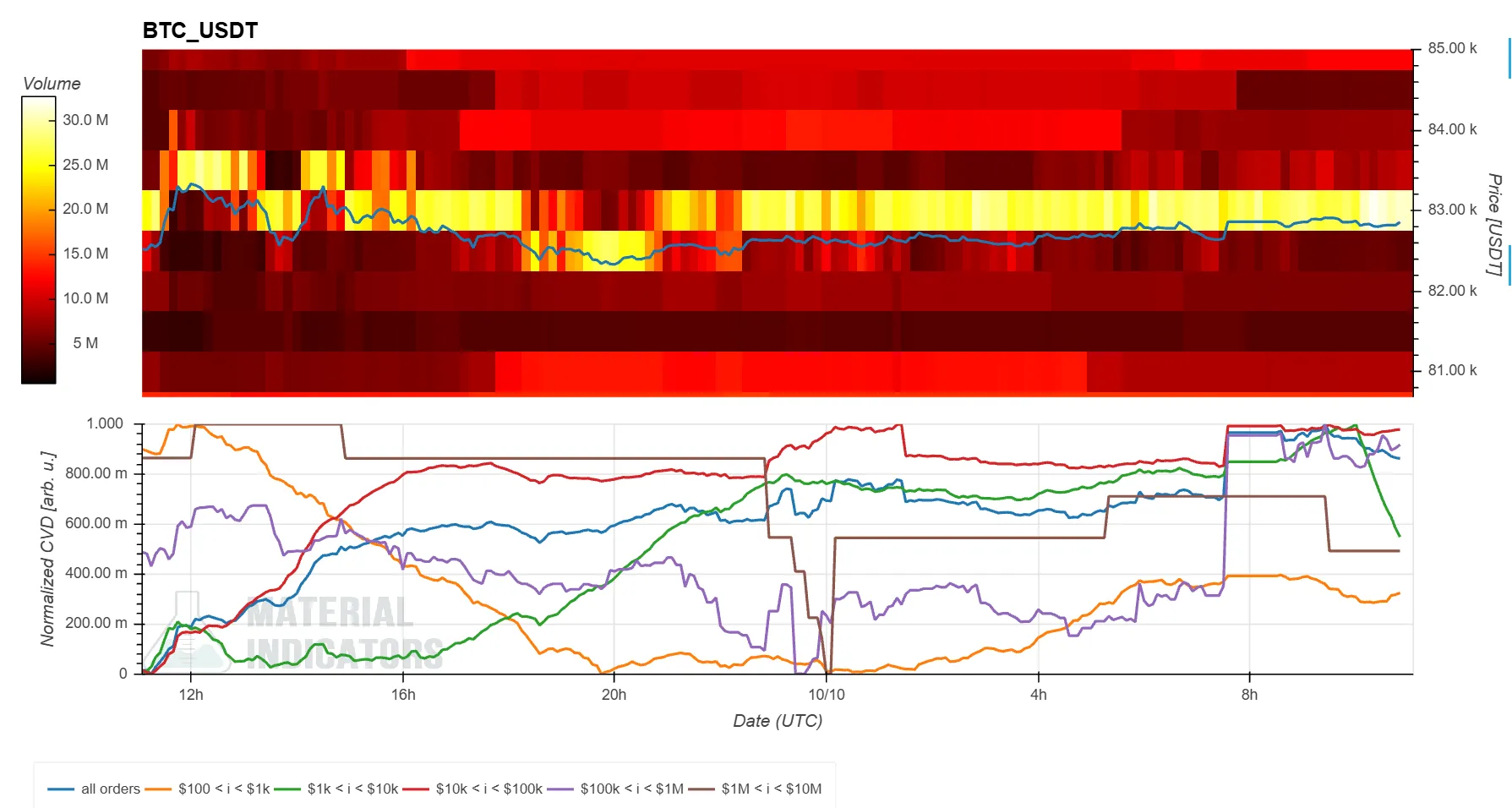
Spot CVD is an order-book analysis chart for the BTC/USDT spot trading pair. The upper panel shows the Volume Heatmap, while the lower panel shows cumulative volume delta, or CVD.
- The volume heatmap in the upper panel tracks trading volume at each price level. The background color becomes brighter when the price stays in a specific range for an extended period or moves sharply. Brighter zones may act as support or resistance.
- The cumulative volume delta indicator in the lower panel reflects buy and sell orders by capital size. As buy orders increase, the line for the corresponding color rises. The yellow line represents orders between $100 and $1,000, while the brown line is based on large orders between $1 million and $10 million.
11:03
Yishi, founder of hardware wallet maker OneKey, said a recent theft targeting Ledger users may have involved a supply chain attack in which malicious components were inserted into devices.
In a post on X, Yishi said one likely cause was the interception of unencrypted data while a recovery phrase was being displayed on screen. Yishi stressed, however, that any link between that attack method and the latest incident has not been confirmed.
Yishi added OneKey plans to soon introduce a backup feature that does not display recovery phrases on screen and instead uses encrypted communication to counter similar attacks. The company is also pursuing encryption for internal device communications, stronger tamper-evident packaging, and tighter oversight of vendors.
Ledger previously said it was investigating a theft case tied to devices sold through Southeast Asian retailer CryptoBilis. On-chain analysts estimate the losses at around $90 million.
Previous related news
08:40
The attacker behind the Triple-A hack transferred about 4,970 ETH worth $12.4 million to Tornado Cash, blockchain security firm Salus said. In July, the attacker hacked Triple-A and stole assets worth about $11.8 million at the time.
06:55
Brazil’s Santa Catarina Civil Police seized about $1,708,534 in virtual assets from a self-custody wallet tied to a phishing ring, Crypto Briefing reported. The seizure was the largest case of its kind by Brazil’s civil police involving crypto held in a self-custody wallet.
The seized assets included four cryptocurrencies — Bitcoin (BTC), Ethereum (ETH), TRON (TRX), and Tether (USDT) — worth about 8.78 million reais at the time. Investigators tracked a total of 13 transactions using Chainalysis blockchain tracing tools, and the assets were transferred to an institutional account at Brazilian crypto exchange Foxbit, where they are now being held under state authorities’ control.
06:36
Lithuania’s State Tax Inspectorate has revised reporting procedures for user information at crypto-asset service providers, Bitcoin.com reported. The changes are intended to align the rules with the EU’s Directive on Administrative Cooperation in the field of taxation (DAC8) and the OECD’s Crypto-Asset Reporting Framework (CARF).
Under the revised rules, regulated crypto-asset service providers must strengthen customer due diligence procedures for collecting and reporting client identity information, transaction records, and tax residency details. The update also clarifies detailed guidance on how to determine whether individual and corporate clients are subject to reporting, as well as on customer identification numbers, transaction histories, and account balances.
06:32
Two newly created wallets withdrew 280.75 million 龙虾 worth $12.21 million from exchanges over the past three days, equal to 28.08% of total supply, according to Lookonchain.
Exchange withdrawals are typically interpreted as a sign of holding intent.
06:16
Wang Chun, co-founder of F2Pool, the world’s fourth-largest Bitcoin mining pool, bought more ETH after adding to his holdings yesterday, according to ai_9684xtpa. Wang had been buying BTC and ETH since late May and withdrew 5,173.41 ETH worth $12.86 million from Binance today.
06:09
Bitdeer said it sold all 300.6 BTC it mined this week. The company said its Bitcoin holdings had been reduced to zero as of Feb. 20, and it has continued converting all newly mined BTC into cash since then.
06:05
Ripple fixed a software vulnerability discovered in 2015 that could have led to the unauthorized minting of billions of XRP, Crypto Briefing reported. The flaw was not exploited in practice.
06:01
Trading activity on Ethereum layer-2 network Robinhood Chain is slowing as enthusiasm for memecoin investing fades, Crypto Briefing reported.
Transaction volume on Robinhood Chain surged after its July 1 launch, then recently fell by more than 40%. Daily network fees peaked at about $8 million in early September before dropping 97% to about $230,000 on Sept. 16. Daily transaction count also declined to 8.9 million from 13.1 million. Weekly memecoin trading volume on Pons, a Robinhood-based memecoin launch platform, fell 37%, according to the report. The outlet added there was no clear sign that departing users were moving in large numbers to rival networks.
05:58
A Visa survey of 14,250 consumers ages 18 to 65 across 14 Asia-Pacific markets in June and July 2026 found 46% said they would be willing to use stablecoins within the next five years, while only 16% said they had used them in the past 12 months.
Awareness of stablecoins outpaced actual understanding, according to Crypto Briefing. While 66% of respondents said they were familiar with stablecoins, only 6% said they accurately understood how they work. The survey also found 41% mistakenly believed stablecoin prices always rise.
Among respondents who were aware of stablecoins but had not used them, 38% cited concerns about fraud or financial crime as the reason. By market, Hong Kong posted the highest awareness at 84%, followed by India at 80% and Thailand at 77%. Vietnam and India showed the strongest intent to use stablecoins over the next five years, both at 67%. In addition, 49% of respondents said stablecoins could be used for cross-border remittances within the next five years.
05:56
A whale that began accumulating UNI, LTC and BNB on Sept. 23, buying a combined $11.6 million worth of the three tokens, may have fully sold its BNB holdings, according to ai_9684xtpa.
The analyst said the whale transferred 2,380 BNB, worth $1.85 million, to Binance today, and a sale would lock in a $73,000 loss. The whale’s unrealized losses on UNI and LTC stand at $1.409 million and $54,000, respectively.
05:52
Unusually large Bitcoin price moves have become more frequent than in the past even as overall volatility has declined, CoinDesk reported.
Bitcoin has logged 10 three-sigma moves so far in 2026, above the eight recorded during the 2018 bear market. A three-sigma move refers to a price change that falls well outside the normal range based on recent volatility. Bitcoin’s annualized volatility fell to around 46% this year from about 84% in 2018, while the average size of three-sigma moves narrowed to about 7% from 10%. In other words, average price fluctuations have eased, but sharp moves relative to recent volatility have occurred more often.
Market participants cited macroeconomic shocks and leverage and crowded positioning in derivatives markets as the main drivers. They said concentrated option-selling strategies built on expectations of persistently low volatility can amplify sudden price swings through position liquidations when unexpected news emerges.
05:48
Former Mt. Gox CEO Mark Karpelès said he found a suspected spy module inside a Ledger Nano X hardware wallet delivered from Malaysia, as Ledger investigates large-scale crypto theft affecting users who bought products through Southeast Asian authorized reseller CryptoBilis.
Karpelès said the device’s shrink wrap appeared intact, but a hidden module had been installed where the internal display pad should have been. The device was said to include a SIM chip. Karpelès also released photos comparing a genuine circuit board with the suspected module and argued tampering devices have evolved from manually wired modifications to circuit-board-style components that can be mistaken for authentic parts. He added that even when a device’s exterior and packaging appear undamaged, internal tampering may be difficult to detect visually.
Ledger has not officially confirmed the module’s function or any link between the device and the recent crypto theft cases involving CryptoBilis buyers. It therefore remains unclear whether the device actually had information-stealing capabilities or was used in the recent theft incidents.
Previous related news
