Live Feed
New
Today, August 27, 2026
13:48
According to CoinNess market monitoring, BTC has fallen below $79,000. BTC is trading at $78,920.05 on the Binance USDT market.
13:46
Hyperliquid’s policy arm, the Hyperliquid Policy Center, submitted a comment letter tied to the first meeting of the U.S. Commodity Futures Trading Commission’s Innovation Advisory Committee held on Aug. 20.
In the letter, the group argued perpetual futures should be treated as a key CFTC innovation priority as the product has expanded beyond digital assets into equities and commodities. It also said perpetual futures can reduce costs and risk by eliminating the need to repeatedly roll over futures contracts when hedging long-term risk, and said the CFTC is drawing the market into the U.S. regulatory fold as it works on guidance for listing perpetual futures in the United States. The group added real-time management of orders, positions, and collateral on public blockchains could reduce counterparty and settlement risk, and could be introduced within existing laws and regulatory frameworks.
13:37
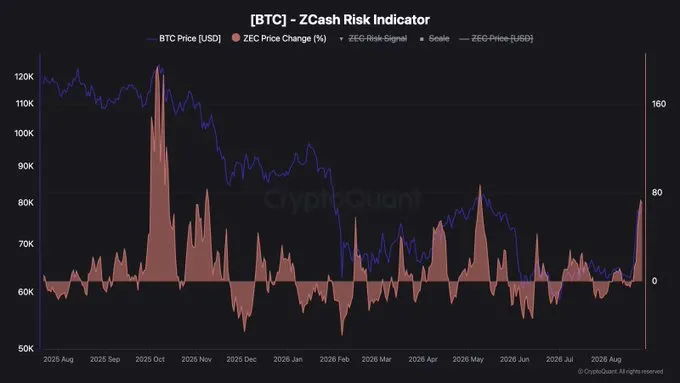
A sharp rise in ZEC may be a sign of a Bitcoin correction, CryptoQuant analyst Maartun said. Maartun described surprise spikes in ZEC as a representative leading bearish indicator that has historically appeared before major market pullbacks.
13:31
The three major U.S. stock indices opened mixed today.
- S&P 500: +0.39%
- Nasdaq: +0.87%
- Dow Jones: -0.11%
13:29
Avalanche Foundation economists have proposed scrapping the current model of paying validator rewards through new token issuance and shifting to a zero-inflation model that would reward validators based on value actually generated by the network, Crypto Briefing reported.
Avalanche validators currently receive annual rewards of around 6% to 7% through newly issued AVAX tokens, but the structure dilutes the value of existing holders. The report added that all transaction fees on Avalanche’s C-Chain are burned, creating a structural limitation under which validators do not directly share in fee revenue even as network activity increases. Against that backdrop, the proposal aims over the long term to halt new token issuance and move to a revenue-sharing model that would redistribute part of network fees and protocol revenue to validators, bringing inflation toward 0%.
13:27
Alphamodus Holdings, an AI company focused on in-store customer analytics and listed on Nasdaq under AMOD, said it is pursuing a plan to add 3,170 BTC to its balance sheet, worth more than $200 million at current prices. The company said the move, if completed, could significantly increase shareholders’ equity and help address a shortfall under Nasdaq’s listing maintenance standards related to shareholder equity.
It added actual recognition will depend on securing the BTC, the accounting treatment, and whether Nasdaq determines the company meets its continued listing requirements. Alphamodus said it reviewed a similar plan in May last year but did not move forward at the time because Bitcoin was near an all-time high.
13:26
The combined market capitalization of the 50 public companies with the largest Bitcoin holdings has fallen by $83 billion, to $67 billion from $150 billion in July 2025, as shares of Bitcoin-accumulating firms declined, the Financial Times reported, citing an FT analysis.
Among the 50 companies, 43 are trading below their share prices from before announcing their Bitcoin buying strategies, while 35 have lost more than half their value from those levels. Strategy’s market capitalization alone has dropped by $79 billion from its peak in 2025. With BTC down about 30% over the past year, companies that funded purchases through borrowing or new share issuance posted steeper stock declines, and the top 50 companies as a group turned net sellers in July, selling 2,500 BTC more than they bought. Strategy also sold about 7,000 BTC for $430 million from late June to mid-August to raise cash needed for interest payments and other obligations.
13:25
13:21
Coinbase’s wrapped Bitcoin asset cbBTC will be supported on Robinhood Chain, Robinhood’s layer-two network, through Chainlink’s Cross-Chain Interoperability Protocol (CCIP), Crypto Briefing reported.
13:19
Charles Schwab will soon let SCHW Crypto customers trade SOL, AVAX and LINK, BWE News reported. The major U.S. financial firm began offering BTC and ETH trading earlier this year.
13:12
XRP spot ETFs drew $28.14 million on Aug. 26, marking the second-largest daily inflow of the year, The Crypto Basic reported. Since Aug. 20, the funds have recorded total net inflows of $97.45 million over five trading days. Cumulative net inflows since the launch of XRP ETFs reached $1.62 billion, while total net assets hit a record high of $1.4 billion.
13:12
Solana governance proposal SGP-0002, which would double the pace of SOL’s annual inflation reduction to cut new issuance, has reached quorum, with yes votes holding a wide lead over no votes.
Current votes stand at 112.03 million SOL in favor (25.84%), 24.01 million SOL against (5.54%), and 11.50 million SOL abstaining (2.65%). Voting is still under way and is set to end in about one day and two hours. If quorum holds and yes votes retain a majority, the proposal will move into the implementation process.
13:05
Bitcoin’s Realized Cap Impulse, a gauge tracking changes in BTC’s realized market capitalization, has turned positive after 93 straight days in negative territory, crypto analyst Crazzyblockk said on X, citing Alphractal data.
Crazzyblockk said the shift means realized market capitalization, which had been shrinking for an extended period, has started rising again. Similar reversals in September 2015, March 2019 and January 2023 were followed by sharp gains in BTC, Crazzyblockk said. The analyst added the metric turned positive on Aug. 20, when BTC was around $73,000, and has remained positive for eight days. Crazzyblockk also noted the uptrend did not continue after similar positive turns in 2018 and early 2022, adding that it will be important to see whether the reading stays positive and whether the BTC price rises alongside it.
12:53
Nasdaq-listed DeFi Development (DFDV) has resumed buying Solana (SOL), increasing its holdings to about 2.33 million SOL, according to Crypto Briefing. The company did not disclose the size of the latest purchase.
12:50
If the CLARITY Act under discussion in the U.S. Senate does not sufficiently limit stablecoin rewards, deposits could flow out of regional banks and reduce their lending capacity, Nate Franzen, head of agricultural finance at First Dakota National Bank, argued in a CoinDesk opinion piece. Citing an estimate from the American Bankers Association, Franzen said as much as $4.7 billion of roughly $47 billion in deposits at South Dakota regional banks could shift into stablecoins, cutting lending capacity by up to $3.7 billion. Franzen added exchanges or wallet providers offering rewards akin to interest could allow stablecoins to replace bank deposits and weaken local lending, and called for tighter regulation.
12:30
U.S. initial jobless claims totaled 203,000 last week, below market expectations of 208,000. Weekly jobless claims are one indicator the Federal Reserve uses to gauge labor market conditions when setting interest rates. A reading above forecasts can signal rising layoffs and a cooling labor market, potentially supporting the case for a rate cut, while a reading below estimates can point to labor market resilience and give the Fed room to keep rates unchanged or raise them while focusing on curbing inflation.
12:29
JAN3 CEO Samson Mow argued the term "Bitcoin Signing Device" should be used instead of "Bitcoin hardware wallet."
Mow said Bitcoin is not stored inside a device but exists on the blockchain, while the device uses keys generated from a seed to sign transactions. He said the device should not be framed as a long-term storage tool and described securely backing up the seed as the more important issue.
He added that while some have pointed out sales fell when Trezor and others tried a similar name change in 2016, the industry and users now have a better understanding and the idea should be tried again. Mow also said devices differ in how they generate and store keys, but their common function is signing.
12:18
Core Lightning developers have identified multiple serious vulnerabilities in Bitcoin Lightning Network payment software after reviewing a large batch of AI-generated security reports, CoinDesk reported. The team strongly urged node operators who cannot apply updates immediately to restart in --offline mode, which blocks routing connections, rather than shutting nodes down entirely.
Specific details on the vulnerabilities and their potential impact will remain undisclosed for two weeks to prevent attackers from reverse-engineering the patched code and exploiting the flaws. CoinDesk reported a signed patch release is expected once developer verification is complete, and users should update promptly.
12:16
Lido said it will revise the fee structure for its EarnETH vault from a 1% assets-under-management fee and a 10% performance fee to a model that charges up to 0.5% of AUM and a 20% performance fee. Under the revised structure, the initial fees will be set at 0.2% of AUM and a 15% performance fee.
The change means the fixed management fee paid during periods of weaker returns will decline, while the share of fees tied to actual performance will increase. The fees currently in effect are displayed on the EarnETH vault page.
12:08
CoinGecko analyzed 245 security incidents at crypto platforms between January 2025 and July 2026 and found that $3.63 billion was stolen. More than 72.5% of total losses came from the 10 largest attacks, while losses tied to infrastructure and supply-chain vulnerabilities alone exceeded $1.8 billion.
Among centralized exchanges, private key compromise was the most common vulnerability, according to the analysis. In dApps, smart contract attacks led to $546 million in losses. Losses also stemmed from oracle and market manipulation or internal mechanism failures, with Bitget, Binance, and Hyperliquid cited as examples.
CoinGecko said 147 of the total incidents occurred at platforms that had undergone external security audits in advance, accounting for 88.44% of the total amount stolen. However, many of the attacks on audited platforms occurred in areas beyond the usual scope of audits, including external infrastructure and code added after the audit. Incidents caused by smart contract flaws that were within audit scope accounted for about 11%, with related losses totaling $396 million.
11:47
DeFi lending protocol Moonwell said it is investigating an issue in the Base-based MAMO Core market and has cut borrowing caps across all Core markets on Base to one wei to halt new lending and prevent further damage. Moonwell also lowered the supply caps for MAMO and WELL to one wei, while leaving supply caps for other assets unchanged.
The move follows an earlier attack that caused about $6 million in losses through suspected MAMO price manipulation.
11:43
Ripple Prime, Ripple’s institutional brokerage unit, has officially launched its Delta One business, marking the company’s entry into stock trading, Bloomberg reported. The offering will allow institutional investors to execute total return swaps tied to U.S. stocks, major indices and digital assets, with Ripple aiming to provide a unified trading channel spanning equities, indices and digital assets.
11:40
Polymarket’s U.S. unit has filed a self-certification with the U.S. Commodity Futures Trading Commission for the listing of Bitcoin, Ethereum and Solana price event contracts, CoinGape reported. Through QCEX, the operator of Polymarket US that it acquired, the company self-certified a new set of rules for crypto price event contracts under federal regulations. Unless a separate stay is imposed, U.S. users could begin trading as early as Aug. 28, according to the report.
11:37
A call spread is drawing attention as a way to position for further Bitcoin gains while limiting losses with BTC at $80,000, CoinDesk reported.
The strategy involves buying a call option with a lower strike price and selling one with a higher strike price, capping both maximum losses and potential profits. Deribit CCO Jean-David Pekelny said call spreads look attractive for September bullish bets ahead of variables including Fed policy and inflation data. 10x Research founder Markus Thielen suggested buying BTC while selling a $90,000 September call option, and as an alternative proposed a call spread that buys an $85,000 September call and sells a $95,000 September call. Still, BTC has shown seasonal weakness in September, posting an average return of -3% for the month since 2013.
11:24
PenguinSwap, a DeFi platform built on the Creditcoin mainnet, has officially launched its new token distribution service, PenguinSwap Launchpad, Creditcoin said on Aug. 27. The first project on the platform, the MINI token sale, sold out and had raised about $1.22 million by the end of the sale. Following MINI, PenguinSwap is preparing token sales for additional projects including Dungeoncoin and Attestcoin, as it moves to expand liquidity supply across the Creditcoin ecosystem.
