Live Feed
New
Today, September 28, 2026
05:33
According to CoinNess market monitoring, BTC has fallen below $83,000. BTC is trading at $82,971.85 on the Binance USDT market.
05:03
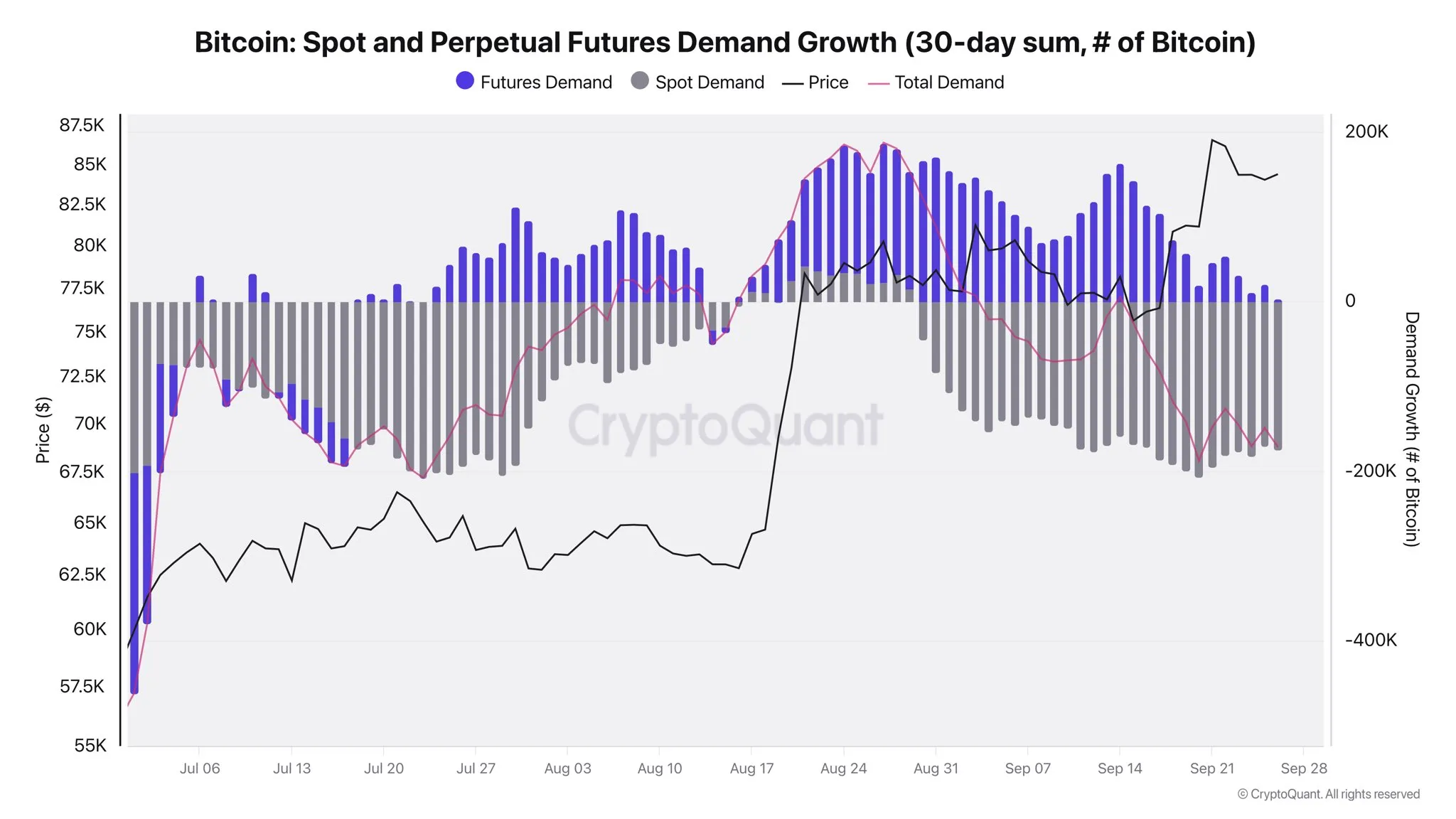
CryptoQuant analyst Darkfost said demand indicators have yet to show a meaningful recovery despite Bitcoin’s recent price rebound. Darkfost said BTC futures demand had dropped sharply to around 3,000 BTC from 164,000 BTC, while spot demand remained in negative territory at -174,000 BTC despite inflows into spot BTC ETFs. As a result, the estimated 30-day cumulative BTC demand across futures and spot fell to -171,000 BTC. Over the past 15 days, however, BTC rose about 13.5% from $74,000 to $84,000, widening the gap between price action and underlying demand indicators.
04:18
Binance Wallet now supports gas fee payments in Tether (USDT) on four networks: BNB Chain (BNB), Ethereum (ETH), Solana (SOL), and Tron (TRX). Users can now pay transaction fees in USDT without separately holding each network’s native token.
03:57
Amid delays in drafting South Korea’s Basic Digital Asset Act, Reform Party lawmaker Lee Jun-seok called for a cryptocurrency regulatory framework compatible with those of major overseas jurisdictions and said South Korea also needs a proper commodity market and a futures market system, News1 reported.
Speaking at East Point 2026 in Seoul’s Gangnam district today, Lee said the priority is not to create South Korea-only standards that no one understands, but to maintain compatibility with systems that are widely recognized and used internationally. Lee also said South Korea needs a proper commodity market and lacks a sufficiently developed futures market system.
03:29
Hong Kong’s Securities and Futures Commission has signed a new memorandum of understanding with the Accounting and Financial Reporting Council to broaden the scope of regulatory cooperation, BlockBeats reported.
The expanded cooperation covers financial and regulatory compliance reporting, as well as related audit work, for SFC-licensed virtual asset service providers and other licensed entities. The two agencies also plan to cooperate on information sharing, case referrals and joint investigations.
03:18
Stablecoin issuer Circle is moving to expand its stablecoin ecosystem in South Korea, Digital Asset reported.
According to a job posting reviewed on Sept. 28, the company is hiring a Senior Director, Ecosystem Growth, South Korea. A notable focus of the role is work tied to stablecoins and the South Korean market.
Applicants are expected to have a strong understanding of stablecoins, decentralized finance, or DeFi, and institutional financial flows. The role also calls for tracking market trends centered on payments in South Korea, digital-asset capital markets, and institutional use cases.
03:07
South Korea’s cryptocurrency trading activity has become highly concentrated among the top 10% of users, who accounted for more than 96% of total trading volume in the first half of 2026, Digital Asset reported.
According to data the office of Democratic Party lawmaker Park Hong-bae received from South Korea’s Financial Supervisory Service, the concentration ratio in the first half stood at 95.6% for Upbit, 97.41% for Bithumb, 99.2% for Coinone, 99.43% for DigitalX, and 97.61% for Gopax. The ratio refers to the share of each exchange’s total trading volume accounted for by the top 10% of users by trading value.
The report comes as domestic virtual asset trading volume has fallen by more than half over the past year, and concerns are also being raised that such concentration among a small group of users could increase the risk of price manipulation.
03:00
U.S. spot Bitcoin ETFs recorded net inflows of $2.386 billion last week, the largest weekly intake in about a year, according to SoSoValue. BlackRock’s IBIT led with $1.158 billion, followed by Fidelity’s FBTC with $702 million.
02:51
BCH has fallen by 3.58% in the past five minutes on the COINNESS market. Currently, BCH is trading at $313.09.
02:46
An anonymous whale deposited 177,518 HYPE worth $16.08 million into OKX and Bybit about an hour ago, according to Lookonchain. Lookonchain added that an address believed to belong to Hypersphere Ventures also appears to have sold 62,869 HYPE worth $5.78 million, which it bought a month ago, for an estimated profit of $2.13 million.
02:25
South Korea’s Financial Services Commission is reviewing whether to introduce a market-making framework for digital assets, Digital Asset reported.
Yu Young-jun, the commission’s director-general for digital finance policy, said at the The Bridge Summit 2026 in Seoul on Sept. 28 that authorities also plan to examine the need for systems including market-making activity to improve the efficiency and stability of the digital asset market. Such activity is currently banned under South Korea’s Virtual Asset User Protection Act, suggesting the issue could be taken up during the second phase of legislation.
01:56
South Korean exchange Upbit announced it will temporarily suspend PROS deposits and withdrawals at 6:00 a.m. UTC on Sept. 29 to support the Pharos hard fork.
01:36
An anonymous address deposited 6,100 ETH worth $16.38 million into Coinbase eight hours ago, according to ai_9684xtpa. The ETH appears to have been bridged from the Robinhood network to the Ethereum mainnet about six days earlier. Exchange deposits are typically interpreted as a sign of intent to sell.
01:36
Jamie Coutts, a cryptocurrency analyst at global financial research and media platform Real Vision, said on X that NEAR Protocol is a layer-one project that could stand out in a new market environment marked by rising cryptocurrency demand and well-managed token supply.
Coutts said he conducted in-depth research during the first half, when the crypto market was at its most sluggish, and found that NEAR is focused on addressing interoperability and privacy, two major unresolved issues in the industry. He added that the team also has additional growth potential in inference and private AI, given its AI expertise, and said NEAR is building a structure in which the success of other leading layer-one projects also contributes to NEAR’s success rather than putting it in direct competition with them.
01:32
China’s Ministry of State Security said via its official WeChat account that cryptocurrency anonymity is effectively an illusion and that transactions can be traced when digital assets are used for illegal crimes. The ministry said blockchain transaction records are public and difficult to tamper with, allowing authorities to track on-chain fund flows, while device information, IP addresses and other traces remain during fiat currency conversion. It added that in February, Chinese authorities reaffirmed their existing position that BTC, ETH and USDT cannot circulate as currencies in China and that related financial activities are illegal.
01:22
Privacy-focused layer-one blockchain Zano rolled back about a month of blockchain history after a vulnerability in its gateway address feature led to the unauthorized circulation of ZANO and Freedom Dollar (fUSD), Cointelegraph reported.
Zano’s core team restored the network to block 3,833,000, before the affected feature was introduced. As a result, assets created through the vulnerability and legitimate transactions processed during that period were invalidated, and some transactions may require separate settlement. Payments already completed on other blockchains are not included in the rollback.
01:19
A whale address that moved 4,500 BTC to an external address for the first time in four years on Sept. 25 has transferred another 4,500 BTC, worth about $378.79 million, to an external address, according to Lookonchain.
01:08
QNT has risen by 4.46% in the past five minutes on the COINNESS market. Currently, QNT is trading at $267.22.
01:06
According to CoinNess market monitoring, BTC has fallen below $84,000. BTC is trading at $83,981.59 on the Binance USDT market.
00:33
According to data from Dropstab, the major token unlocks scheduled for this week (Sept. 28–Oct. 4) are as follows:
- FF: 247 million tokens ($32.42 million), representing 10.58% of circulating supply, at 12:00 a.m. UTC on Sept. 29
- EIGEN: 36.82 million tokens ($10.17 million), representing 3.97% of circulating supply, at 8:00 a.m. UTC on Oct. 1
- Q: 241 million tokens ($7.66 million), representing 5.38% of circulating supply, at 12:00 a.m. UTC on Oct. 2
- BTW: 101 million tokens ($124 million), representing 3.62% of circulating supply, at 6:00 a.m. UTC on Oct. 2
- ENA: 94.19 million tokens ($25.60 million), representing 0.93% of circulating supply, at 8:00 a.m. UTC on Oct. 2
00:29
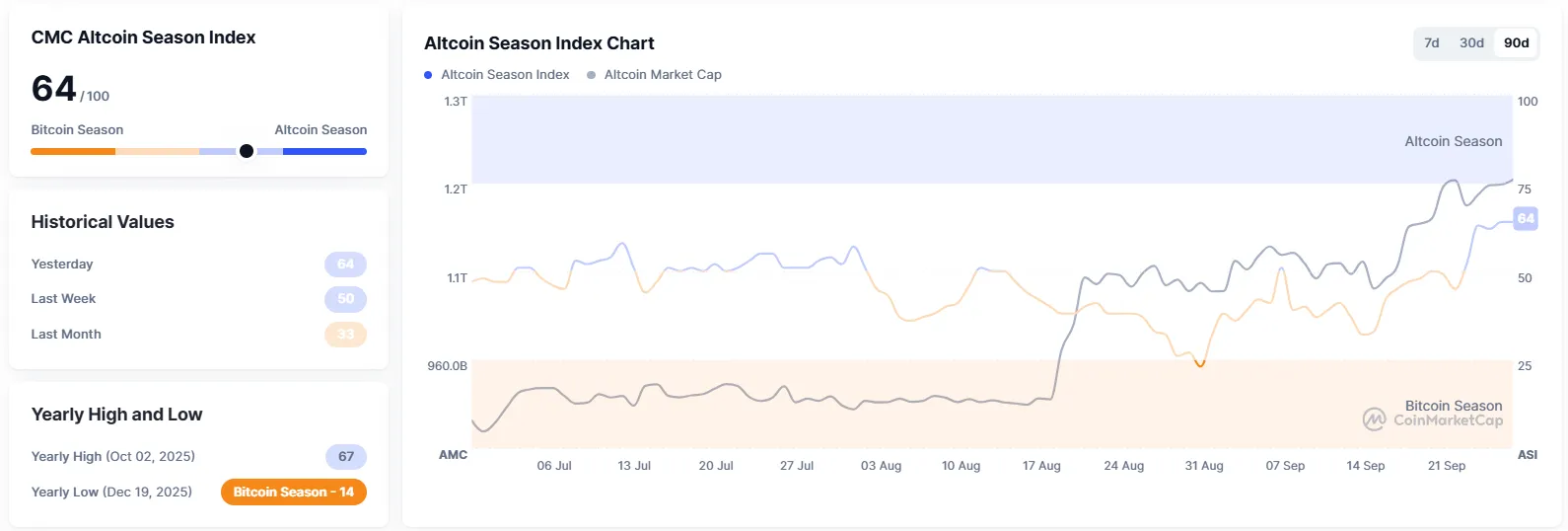
CoinMarketCap’s Altcoin Season Index stood at 64. The index is calculated by comparing the price performance of Bitcoin with that of the top 100 coins by market capitalization, excluding stablecoins and wrapped coins. If 75% of the top 100 coins outperform Bitcoin over the past 90 days, the market is considered to be in altcoin season; the opposite is considered Bitcoin season. A reading closer to 100 indicates stronger altcoin season conditions.
00:14
Cross-chain decentralized exchange THORChain (RUNE) has drawn industry criticism after refusing a request to block addresses linked to funds stolen in last weekend’s hack of crypto exchange Bitget, Cointelegraph reported.
Bitget disclosed the hack on Sept. 25 and initially reported about $351.6 million in stolen cryptocurrency, later revising the figure to $387.5 million. According to the outlet, Bitget asked THORChain to block addresses tied to the hacked funds, but THORChain declined, citing decentralization principles. The report said the crypto community remains divided between those who argue decentralized protocols should preserve censorship resistance and those who say the movement of illicit funds should not be left unchecked.
Previous related news
00:12
The key global macro events for the fifth week of September are as follows, in UTC:
- Sept. 28, 1:15 p.m. UTC: Speech by FOMC Governor Bowman
- Sept. 29, 2:00 p.m. UTC: August JOLTS job openings and labor turnover report
- Sept. 30, 12:15 p.m. UTC: U.S. September ADP nonfarm employment change
- Sept. 30, 12:30 p.m. UTC: U.S. August core personal consumption expenditures
- Oct. 2, 12:30 p.m. UTC: U.S. September nonfarm payrolls, unemployment rate, and initial jobless claims
00:03
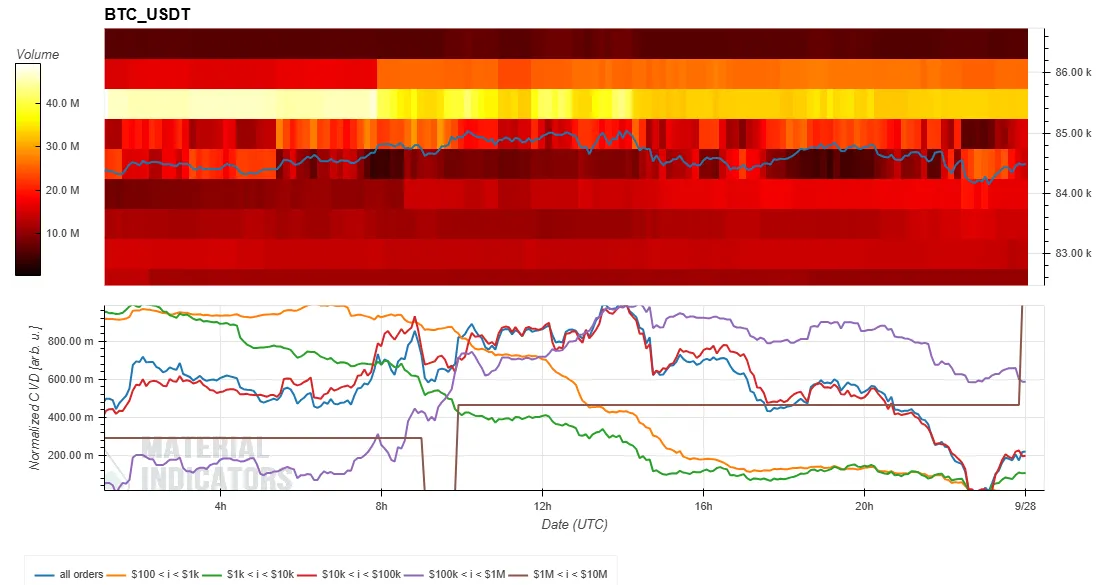
Spot CVD is an order-book analysis chart for the BTC/USDT spot trading pair. The upper section shows the Volume Heatmap, while the lower section shows cumulative volume delta, or CVD.
- The upper volume heatmap tracks trading volume at each price level. The background becomes brighter when the price stays within a specific range for an extended period or makes a large move. Brighter zones may act as support or resistance.
- The lower CVD indicator reflects buy and sell orders by capital size. The line for each color rises as buy orders increase. The yellow line represents orders between $100 and $1,000, while the brown line is based on large orders between $1 million and $10 million.
00:01
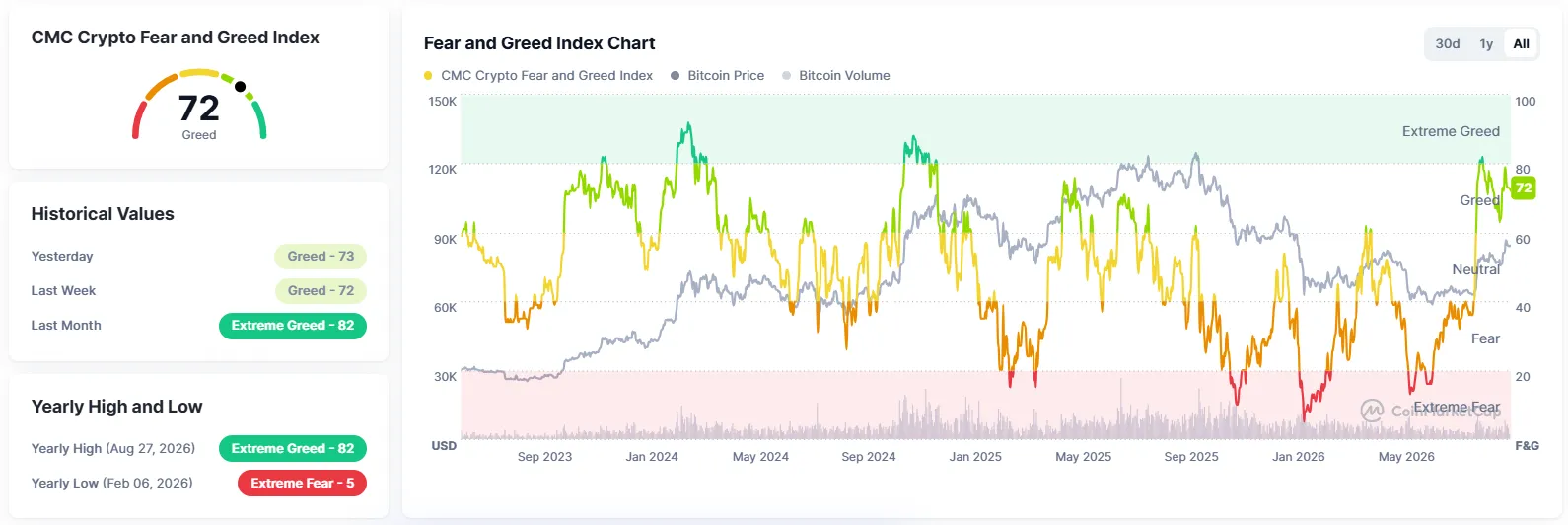
CoinMarketCap’s in-house crypto Fear and Greed Index came in at 72, indicating the market remained in the greed zone. The index signals extreme fear as it approaches zero and extreme optimism as it approaches 100. CoinMarketCap calculates the gauge based on price moves among the top 10 cryptocurrencies by market capitalization, market volatility, derivatives-market indicators including the put/call ratio, the stablecoin supply ratio (SSR), and CoinMarketCap’s own search data.