Live Feed
New
Today, October 10, 2026
05:48
Former Mt. Gox CEO Mark Karpelès said he found a suspected spy module inside a Ledger Nano X hardware wallet delivered from Malaysia, as Ledger investigates large-scale crypto theft affecting users who bought products through Southeast Asian authorized reseller CryptoBilis.
Karpelès said the device’s shrink wrap appeared intact, but a hidden module had been installed where the internal display pad should have been. The device was said to include a SIM chip. Karpelès also released photos comparing a genuine circuit board with the suspected module and argued tampering devices have evolved from manually wired modifications to circuit-board-style components that can be mistaken for authentic parts. He added that even when a device’s exterior and packaging appear undamaged, internal tampering may be difficult to detect visually.
Ledger has not officially confirmed the module’s function or any link between the device and the recent crypto theft cases involving CryptoBilis buyers. It therefore remains unclear whether the device actually had information-stealing capabilities or was used in the recent theft incidents.
Previous related news
05:04
U.S. spot Ethereum ETFs recorded a net outflow of $56.1 million on Oct. 9, marking a ninth straight trading day of net withdrawals, according to Farside Investors.
- BlackRock ETHA: -$56.1 million
04:23
U.S. spot Bitcoin ETFs recorded $21.1 million in net inflows on Oct. 9, reversing the previous day’s net outflows, according to Farside Investors.
- BlackRock IBIT: +$22.4 million
- Fidelity FBTC: -$3.6 million
- VanEck HODL: +$2.3 million
02:58
MoonPay said on its official X account that it has added support for Arc, Circle’s layer-one blockchain. MoonPay users can now buy USDC through payment methods including credit and debit cards, Apple Pay, Google Pay and bank transfers for use on the Arc network.
02:57
The following shows estimated liquidation volumes and position ratios for major crypto perpetual futures over the past 24 hours:
- BTC: $57.82 million liquidated (76.33% shorts)
- ETH: $25.64 million liquidated (61.84% shorts)
- SOL: $7.38 million liquidated (52.52% shorts)
02:38
Franklin Templeton is reviewing whether U.S. SEC exemptive relief could allow tokenized money market funds and ETFs to trade on blockchain-based platforms, Bitcoin.com reported.
The asset manager met with officials from the SEC’s crypto task force on Oct. 9 and discussed regulatory issues tied to pricing tokenized fund trades, fees for liquidity providers, and the legal status of liquidity pools. The talks also covered potential structures for swapping tokenized MMF shares for tokenized stocks and trading tokenized ETFs against stablecoins and other tokenized assets.
02:03
U.S. federal prosecutors have charged the founder of memecoin KISHU with an alleged rug-pull scam involving about $9 million, Bitcoin.com reported.
According to prosecutors, KISHU’s market capitalization surpassed $1.6 billion after its launch in April 2021. Prosecutors allege the founders promoted the project as having no separately allocated team tokens, but in fact assigned 12% of the total supply to wallets under their control before the public sale.
01:30
U.S. treasury firm Evernorth, which manages XRP as its core asset, has completed its merger with a special purpose acquisition company, Cointelegraph reported. Following the deal, Evernorth is set to enter the Nasdaq market with 473 million XRP and $300 million in cash. The stock is scheduled to begin trading under the ticker XRPN on Monday.
01:01
SkyAI, formerly Sharp Technology and known for accumulating Solana, transferred 468,000 SOL worth $51.1 million out over the past 24 hours, according to on-chain analyst EmberCN. Of that amount, 218,000 SOL was sent to multiple centralized exchanges, while the remaining 250,000 SOL was moved to BitGo, an institutional digital asset services platform.
00:37
Brazil’s B3, the country’s largest stock exchange, is pushing to launch a tokenized asset trading platform in the first half of next year, Bitcoin.com reported.
The outlet said the platform is designed to issue tokens backed by existing shares so they share the same pricing and liquidity as ordinary stocks. Tokenized shares are expected to trade on the same order book as conventional shares, while settlement would follow the current T+2 cycle, or two business days after the trade date. However, 24-hour trading and instant settlement would require separate approval from Brazilian regulators or broader regulatory changes. B3 is also reviewing whether to include Brazilian depositary receipts, or BDRs, and exchange-traded funds, or ETFs, among the assets to be tokenized.
00:29
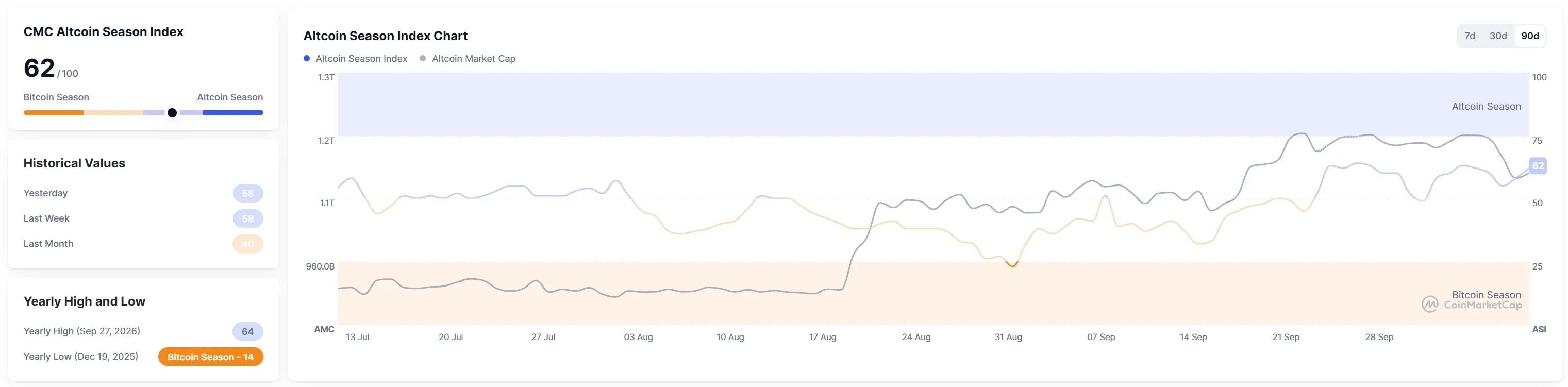
CoinMarketCap’s Altcoin Season Index rose four points from yesterday to 62. The index is calculated by comparing the price performance of Bitcoin with that of the top 100 coins by market capitalization, excluding stablecoins and wrapped coins. A reading is considered altcoin season when 75% of the top 100 coins have outperformed Bitcoin over the past 90 days, while the opposite is considered Bitcoin season. The closer the reading is to 100, the more it indicates altcoin season.
00:02
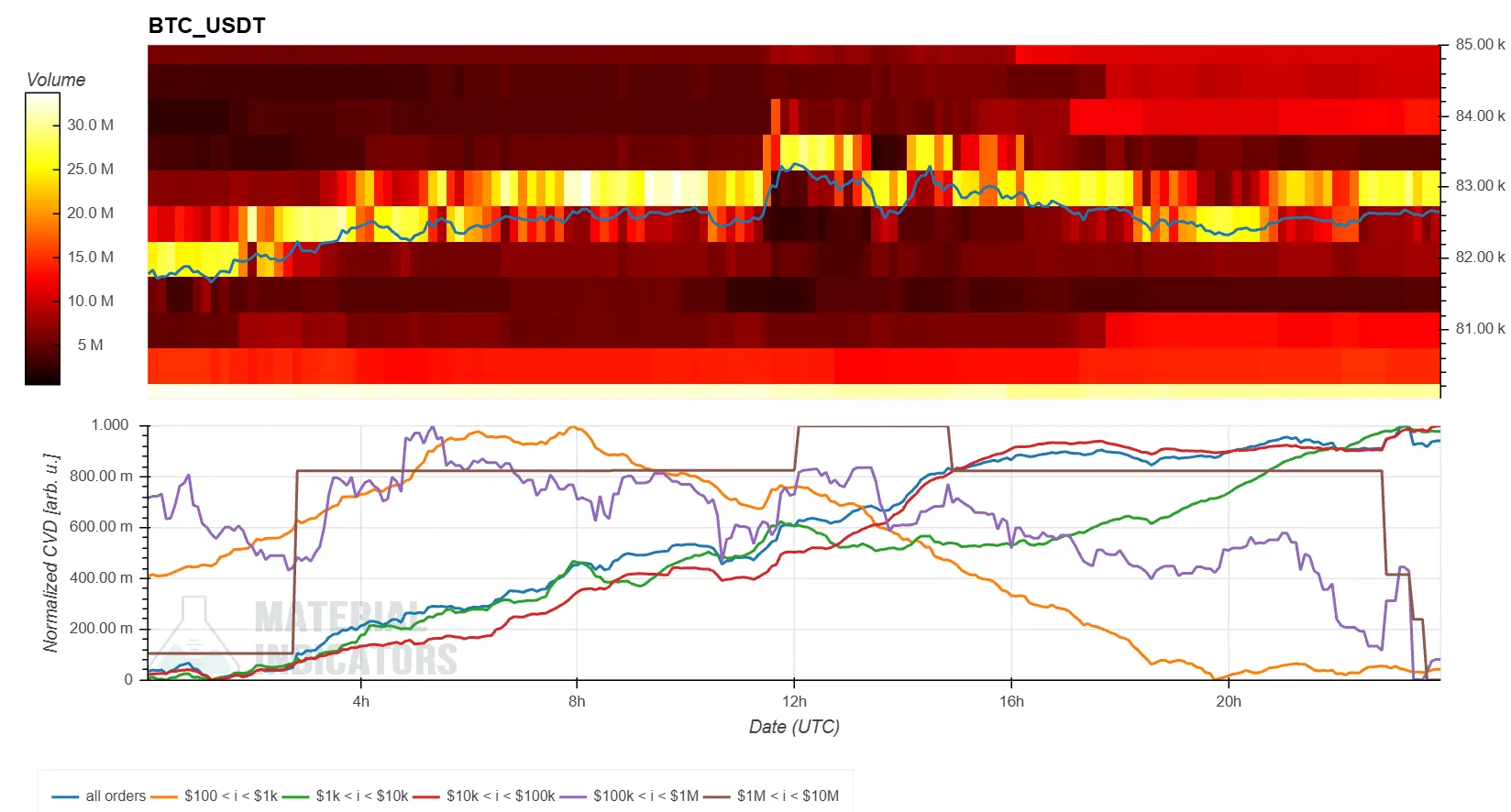
The spot CVD chart is an order-book analysis chart for the BTC/USDT spot trading pair. The upper panel shows the volume heatmap, while the lower panel shows cumulative volume delta, or CVD.
- The upper volume heatmap tracks trading volume at each price level. The background color becomes brighter when the price stays in a specific range for an extended period or makes a large move. Brighter zones may act as support or resistance.
- The lower cumulative volume delta indicator reflects buy and sell orders by order size. As buy orders increase, the line for the corresponding color moves higher. The yellow line represents orders between $100 and $1,000, while the brown line represents large orders between $1 million and $10 million.
00:00
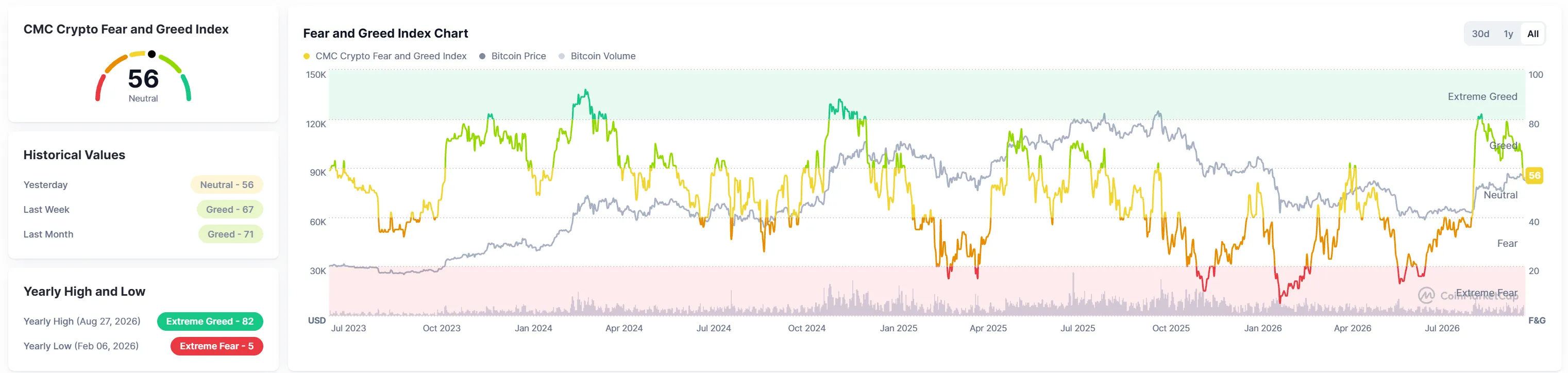
CoinMarketCap’s in-house crypto fear and greed index rose one point from yesterday to 56, remaining in neutral.
A reading closer to zero signals extreme market fear, while a reading closer to 100 indicates extreme optimism. CoinMarketCap said the index is calculated based on price moves among the top 10 cryptocurrencies by market capitalization, market volatility, derivatives market data such as put/call ratios, the stablecoin supply ratio, or SSR, and CoinMarketCap’s own search data.
Yesterday, October 9, 2026
23:59
Sui said via its official X account that the initial deposit process for Sui-based SlushWallet has been simplified.
Users can now fund the Sui network with a bank card or through 25 blockchains, while asset bridging and token swaps can also be completed within SlushWallet.
23:22
Kalshi is investigating suspicious trades linked to President Donald Trump’s selection of Katie Zacharia as White House press secretary, Reuters reported, citing The Wall Street Journal.
Before news of Zacharia’s appointment became public, at least three small bets were placed, and the traders could stand to make profits worth thousands of dollars, according to the report. A $19 bet is expected to pay out $1,896, while bets of about $74 and $80 placed on Friday are expected to return $3,689 and $4,023, respectively. Kalshi declined to comment on the report.
23:12
Coinbase and global fintech firm Gennius are pursuing a service that would let users access Gennius’ dollar-pegged stablecoin ONED through banks in Latin America, The Defiant reported.
The initiative is set to begin in Argentina and aims to let users convert eligible bank deposits into ONED, transfer funds 24/7, or make payments through Visa.
21:15
Heather Maurer, executive director of the National Council on Problem Gambling (NCPG), resigned effective Sept. 26 after controversy over a $2 million donation from Kalshi, Crypto Briefing reported.
Maurer, who took the NCPG post in January, signed an agreement with Kalshi without prior board approval, according to the report. As part of the deal, Kalshi was named the first platinum member of NCPG’s newly created financial services and trading membership category. Board members later questioned how the donation would be used but did not receive sufficient answers, the report said.
20:03
The three major U.S. stock indices closed higher today.
- S&P 500: +0.59%
- Nasdaq: +0.64%
- Dow Jones: +0.83%
20:02
Former FTX COO Constance Wang said Netflix’s first trailer for “The Altruists,” a drama inspired by the rise and fall of FTX founder Sam Bankman-Fried, was enough to make Wang feel sick, The Block reported. Wang criticized the series for focusing only on the romance between Bankman-Fried and his then-girlfriend Caroline Ellison, the former Alameda CEO, and said it distorted Wang’s experience at FTX. Wang added the actual workplace atmosphere at FTX was nothing like the party culture often cited in discussions of the company’s collapse.
Previous related news
18:58
Robinhood is considering adopting Arbitrum’s fee-based transaction priority technology for the Robinhood Chain infrastructure, CoinDesk reported, citing sources.
Arbitrum had previously offered a paid transaction-ordering system called Time Boost. More recently, it replaced the legacy Time Boost system with a Priority Gas Auctions (PGA) model, under which individual transactions are processed ahead of others if traders pay higher fees. Robinhood Chain currently uses a first-come, first-served transaction processing model and has not adopted Arbitrum’s Time Boost feature.
18:46
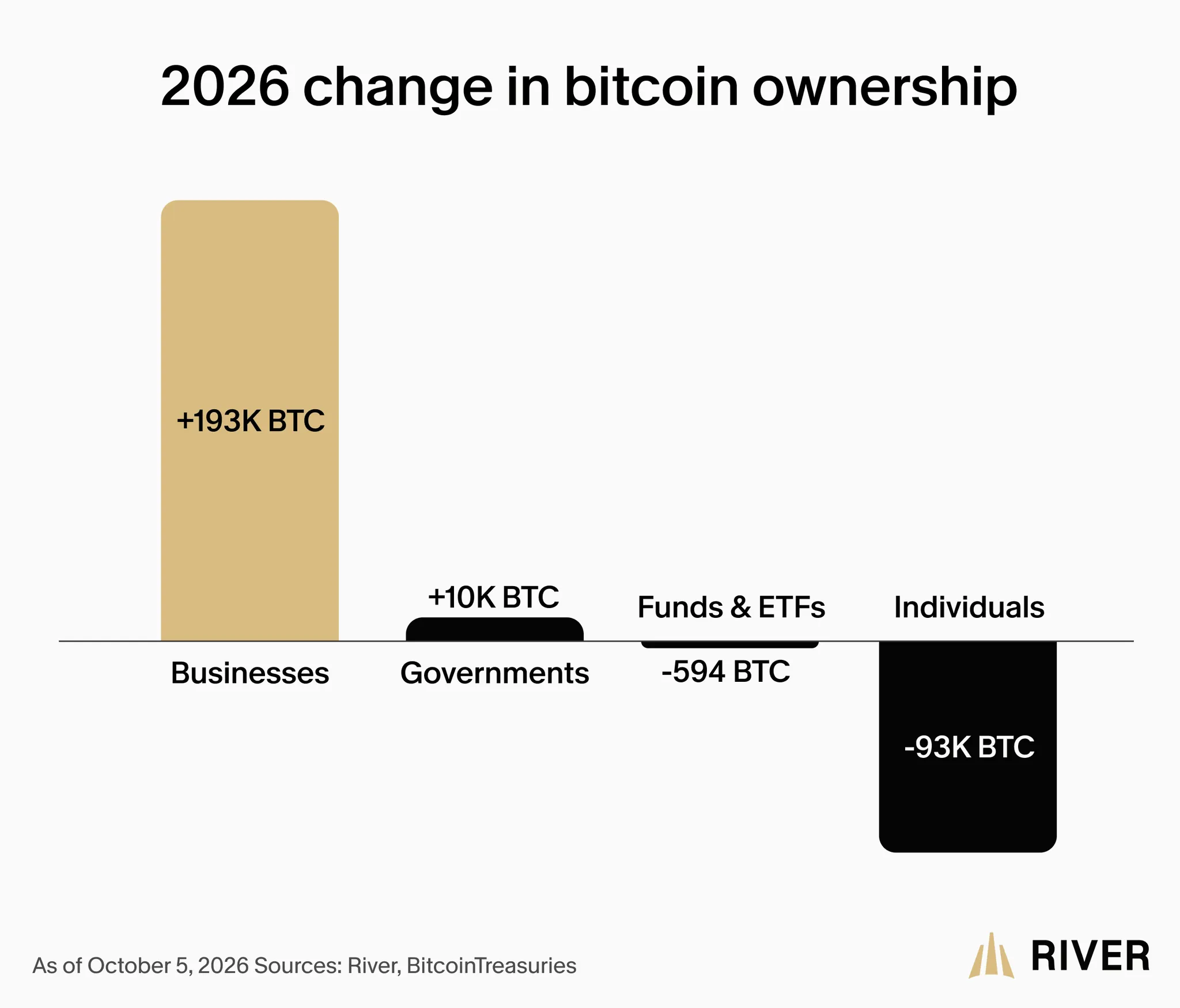
Companies have added 193,000 BTC so far this year, while individual holdings have fallen by 93,000 BTC, according to data from Bitcoin financial services firm River as of Oct. 5.
17:59
Tether blacklisted four THORChain vault addresses and froze about 1.45 million USDT, then lifted the restrictions three hours later, according to Crypto Briefing. The fund freeze on THORChain has been reversed and swap functionality has resumed. No hacking or fund theft on THORChain was reported during the freeze and unfreeze process.
Previous related news
17:54
HSBC has tested AI agent payments using tokenized deposits with Ant Digital Technologies, according to Crypto Briefing.
For the test, HSBC integrated its Tokenized Deposit Service (TDS) with Ant Digital’s Anvita Flow network, while the transactions were executed on the Jovay testnet, a layer-two blockchain environment. The payments were processed in real time and were generally under $2. Ant Digital Technologies is the blockchain-focused subsidiary of Ant Group, China’s largest fintech company.
17:15
Barclays raised its price target on Strategy (MSTR) to $175 from $160 while maintaining an Overweight rating, according to CoinGape. The UK investment bank also classified Strategy as a U.S. payments and fintech company. CoinGape said the move suggested Strategy’s market position may be worth assessing based not only on its Bitcoin holdings but also on other factors.
17:10
An Iran-linked financial network is suspected of using Binance to evade U.S. sanctions and transfer funds tied to the Islamic Revolutionary Guard Corps, with the transactions said to total about $850 million, The Wall Street Journal reported.
