Top

MUFG pushes into tokenized finance as Japan enters a new political chapter

Web3 & Enterprise·October 10, 2025, 8:08 AM

Japan’s largest bank is stepping deeper into digital assets at a moment of political change. Mitsubishi UFJ Financial Group (MUFG) and its securities arm Mitsubishi UFJ Morgan Stanley Securities (MUMSS) have launched a blockchain-based business, according to CoinDesk Japan. The move puts the country’s biggest lender at the center of a fresh push to bring regulated finance onto distributed ledgers while retail investors gain a new way to buy and trade tokenized products.


MUMSS has begun offering bond security tokens, marking its formal entry into the security token market. At the same time, the firm introduced ASTOMO, a trading venue for retail investors built with Japanese fintech company Smartplus. The system will debut with real estate-backed security tokens. Individuals can invest from 100,000 yen (about $655) through a smartphone app. Under the partnership MUMSS will select and source the digital securities. Smartplus will run account management and build and operate the trading system using its Brokerage as a Service (BaaS) platform.


MUFG also revealed that it has started preparing a public offering of subordinated bonds in token form. The bank intends the instruments to qualify as Tier 2 capital under international rules. The offering is expected to be the first of its kind for Japan’s banking sector. MUFG has submitted an amended securities registration statement to the Director General of the Kanto Local Finance Bureau in advance of the sale.

https://asset.coinness.com/en/news/be06f1046e701aec74df006d47cae03e.webp
Photo by Asm Arif on Pexels

Takaichi’s victory sparks interest in Japan’s crypto path

The corporate steps arrive as conservative lawmaker Sanae Takaichi rises to lead the ruling Liberal Democratic Party. She won the party election on Oct. 4 and is set to become Japan’s first female prime minister, with lawmakers expected to make the formal choice in the middle of this month. 


Several industry voices see her leadership as supportive of digital assets, according to Cointelegraph. Elisenda Fabrega, general counsel at tokenization platform Brickken, said Takaichi’s victory might reshape how Japan perceives and regulates digital assets, reinforcing the country’s commitment to clear and reliable crypto laws.


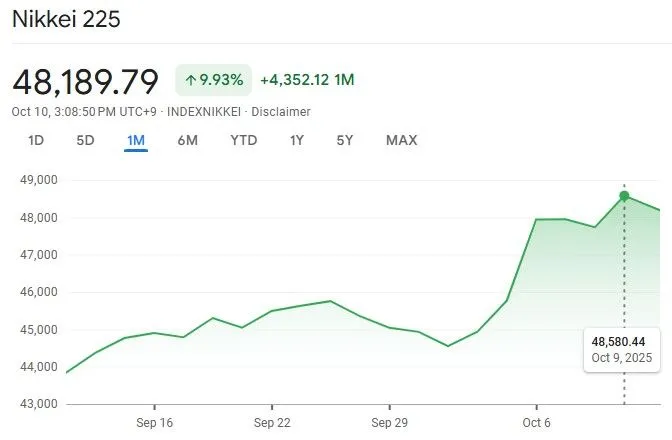
Maarten Henskens, chief operating officer at Startale Group and head of the Astar Foundation, chimed in to say that a looser monetary stance under Takaichi could keep liquidity flowing and drive greater investor interest in alternative assets such as cryptocurrencies. That optimism has already spilled into Japan’s equity markets. The Nikkei index has continued to soar since the leadership vote, reaching a record high of 48,580.44 on Oct. 9.


Not all signals point in the same direction. A BeInCrypto report published before the election noted market predictions that Takaichi might also back tighter oversight. The report cited her March proposal to build a framework that lets financial institutions, including crypto exchanges, share information on suspicious transactions. That system would support faster account freezes.
https://asset.coinness.com/en/news/6e7246730a2833f909aa086f96680fe2.webp
 Nikkei 225 Index Source: Google Finance

Loose fiscal tone brings new pressures for Bitcoin

From a broader economic view, the picture looks more complex. CoinDesk reported that Takaichi’s preference for easy Abenomics-style policies could weigh on Bitcoin in the short term. Expansionary fiscal measures tend to increase bond supply and drive yields higher, which often curbs risk appetite by raising borrowing costs and making assets like stocks and cryptocurrencies less appealing. Her stance has also reduced expectations for a Bank of Japan rate hike, weakening the yen and strengthening the U.S. dollar. The stronger dollar has cooled Bitcoin’s momentum, while gold has continued to attract investors seeking stability.


MUFG’s blockchain venture arrives at a turning point for Japan. The bank’s push into tokenized assets shows how traditional finance is adapting to digital change just as new leadership tests the balance between innovation and control. Whether this marks the start of a broader transformation will depend on how policy, regulation, and investor confidence evolve together in shaping Japan’s financial future.

 

More to Read
View All
Policy & Regulation·

Aug 04, 2025

Hong Kong taxis likely test case for stablecoin payments

With the Chinese autonomous territory of Hong Kong having introduced its new Stablecoins Ordinance on August 1 and local taxi operators required to facilitate two forms of digital payment from April 1, 2026, a case is being made that this eventuality lends itself to an ideal test case for stablecoin payments.Photo by The Transport Enthusiast DC on UnsplashA perfect test caseIn an opinion piece published by Bloomberg on Aug. 3, columnist Andy Mukherjee asserted that Hong Kong taxis would be “a perfect stablecoin test case,” suggesting that the timing is ideal for stablecoins, given that a new licensing regime has come into effect via the city’s Stablecoins Ordinance.  In an interview, Franz Bergmueller, CEO of Switzerland-headquartered crypto bank AMINA Bank, said that “stablecoins for me are a killer use case.” On social media, AMINA Bank claimed that it would be “a major step in the right direction” if Hong Kong taxis start to accept stablecoin payments from customers. It emerged last December that the city’s taxi drivers would be required to install both electronic payment facilities and navigation systems, based on a filing made to Hong Kong’s Legislative Council. The filing outlined that while some taxi drivers currently offer electronic payment options, many insist on cash payment. The city’s Transport and Logistics Bureau suggested that “drivers offer at least two electronic payment options, including both QR code and non-QR code methods.” Stablecoin payments overseasThere has been some limited use of stablecoins as a payment method by taxi services in places with unstable currencies such as Argentina and Venezuela. The world’s most popular ride-hailing service, Uber, is understood to be studying the feasibility of offering stablecoin-based payments. In 2024, Asian rival Grab commenced accepting crypto, including the USDT and USDC stablecoins, as a means of payment for ride-sharing and food delivery services in Singapore. Last month, it extended that facility to its platform users in the Philippines.In June it emerged that Tawasul Transport, a taxi service in Abu Dhabi in the United Arab Emirates (UAE), had partnered with Al Maryah Community Bank (Mbank) and Abu Dhabi’s Department of Municipalities and Transport to launch a pilot program implicating the use of AE Coin, a UAE dirham-pegged stablecoin, as a means of payment. Bloomberg’s Mukherjee suggests that for entities now applying for stablecoin licensing, this new digital payment requirement for Hong Kong’s taxi services could provide an immediate segue to onboard users and make a new stablecoin product popular. Mukherjee places specific emphasis in this regard on what actions Ant Group may take. It emerged recently that Ant Group, an affiliate of the Alibaba Group, intends to apply for stablecoin licensing across Asian markets, including Hong Kong. The company is already a leader in Asia in digital payments through Alipay, which serves 1.3 billion users.Although Ant Group is based in mainland China, Hong Kong would offer the company the opportunity to test the establishment of a stablecoin for retail payments.

news
Markets·

Oct 31, 2024

HKEX to launch digital asset index with real-time pricing within Asian time zone

Hong Kong Exchanges and Clearing Limited (HKEX), the operator of the Hong Kong stock exchange, has announced plans to launch a digital asset price index. The index which the company is marketing as the HKEX Virtual Asset Index Series, will aim to provide for the developing asset class, while complimenting Hong Kong’s overarching efforts to transform itself into a regional digital assets hub. The company announced details of the new product offering in a press release published to its website on Oct. 28. HKEX indicated that the product will go live on Nov. 15, outlining that the product “provides investors with transparent and reliable benchmarks for Bitcoin and Ether pricing in the Asian time zone.”Photo by Kanchanara on UnsplashReference index for Bitcoin (BTC) and Ether (ETH)The firm claims that the Index Series will include a Reference Index for Bitcoin (BTC) and Ether (ETH) while providing a Reference Rate for the two leading digital assets. The Reference Index will be formulated using a 24-hour volume-weighted reference spot price, with that pricing coming from leading virtual asset exchanges. The Reference Rate has been devised with the settlement of financial products in mind. As a result, it will be calculated on a daily basis at 16:00 Hong Kong time. From a compliance perspective, the product complies with the European Union’s (EU) Benchmark Regulation (BMR), being the first such product to be developed in Hong Kong. Additionally, the Index Series will be administered by CCData, a UK-headquartered data and index solutions firm formerly known as CryptoCompare.  Taking to the X social media platform, CCData outlined that the product is underpinned by its data selection process, leveraging its “Exchange Benchmark methodology to provide highly robust real-time and EOD  [end-of-day] reference rates.” The firm added that the offering will introduce “essential benchmarks for the Asian market,” while enhancing transparency and reliability within the digital assets sector, broadening opportunities for market participants across the region. Enabling informed investment decisionsHKEX CEO Bonnie Chan said that the company was pleased to introduce the HKEX Virtual Asset Index Series to meet the region's growing demand for this fast-emerging asset class. “By offering transparent and reliable real-time benchmarks, we seek to enable investors to make informed investment decisions,” she added.Like many other financial services firms in TradFi, HKEX has been getting itself acquainted with the blockchain and digital assets sector. In October of last year, the firm launched a blockchain-based settlement platform called Synapse. The platform relies upon DAML-based smart contracts. Earlier this year, a number of asset management firms launched spot Bitcoin and Ethereum exchange-traded funds (ETFs) on the exchange. In April, a report published by HKEX suggested that the true potential of crypto ETFs had yet to be fully realized, pointing out that a number of regulatory tweaks would be necessary to better support digital asset-based products. HKEX itself could have a greater role to play in the expansion of the digital assets sector in Hong Kong. Last month Hong Kong Legislative Council member Lee Wai-hung called on the platform to expand its range of derivatives, including crypto derivatives.

news
Markets·

May 06, 2025

3 UAE-based firms sign $3B tokenized real estate deal

MultiBank Group, a global financial derivatives company headquartered in Dubai, has partnered with two other United Arab Emirates (UAE)-based firms, real estate giant MAG and tokenized real-world asset (RWA)-focused blockchain infrastructure provider Mavryk, in a $3 billion tokenized real estate deal.Photo by Tierra Mallorca on UnsplashWhile a large proportion of MAG's business activities center around the Dubai real estate market, MAG Group is a multinational conglomerate with a portfolio that includes commercial and residential developments and high-end luxury real estate projects.  According to a press release published on May 1, this $3 billion deal implicates MAG’s luxury developments, such as The Ritz-Carlton Residences in Dubai and other properties located within the Keturah Resort and Keturah Reserve in the UAE’s most populous city. These properties will be tokenized and hosted on the blockchain through MultiBank.io’s regulated tokenized RWA marketplace. Mavryk will provide the necessary infrastructure, with the tokenized assets running on its blockchain network. The deal provides another indication of the growing role of tokenization, with it being the largest tokenized RWA deal to have been put together to date. The Mavryk Network testnet was launched in February, with Mavryk Network developer Mavryk Dynamics securing $5 million in funding to establish a tokenized RWA network economy. In this instance, Mavryk will provide support in terms of on-chain asset issuance and DeFi integrations. Not just a real estate dealTalal Moafaq Al Gaddah, senior executive vice chairman of MAG, said that the project “marks a milestone in broadening access to high-value developments and unlocking liquidity via blockchain.” Al Gaddah also commented on the MBG token, stating:“$MBG token provides ecosystem utility, including trading discounts, early access to properties, and a deflationary buyback-and-burn model.” MBG is a MultiBank utility token which features deflationary tokenomics. It will be used to enable staking and lower trading fees. The token is scheduled to be launched on June 2. MultiBank.io Founder and CEO Zak Taher highlighted the importance of the token launch alongside this tokenized real estate deal. He stated:“This isn’t just a real estate deal — it is a flagship use case for the $MBG token. By enabling seamless access to $3B in tokenized property, MultiBank becomes the bridge between regulated finance and next-generation investment infrastructure.” Dual utilityAl Gaddah referred to the duality of the tokenized real estate offering:“Tokenized assets issued by MultiBank will have dual utility. Within the MultiBank Group, they can be used as collateral for derivatives, creating a seamless bridge between traditional finance and tokenized assets.” RWA tokenization has been gaining momentum within the UAE recently. It emerged last month that the Dubai Land Department (DLD), a government agency responsible for the registration of real estate in Dubai, had signed an agreement with local regulator the Virtual Assets Regulatory Authority (VARA) to integrate tokenized real estate within existing systems.  Around the same timeframe, blockchain technology firm Serenity signed a partnership with Dubai’s MTA Real Estate to develop a tokenized real estate platform. Last year RWA-focused layer-1 blockchain project MANTRA Chain announced that it would tokenize $500 million in real estate assets in Dubai.

news
Loading