Top

Iran caps stablecoin transactions amid currency devaluation and sanctions

Policy & Regulation·October 02, 2025, 3:37 AM

Iranian authorities last week introduced new restrictions on stablecoin transactions, limiting individuals to an annual purchase cap of $5,000 and a total holding limit of $10,000. According to a report from Iran International, licensed digital platforms have one month from the effective date to enforce these new regulations on all users.

https://asset.coinness.com/en/news/7308de6e3dc51c68635cd0c68e22cf0f.webp
Photo by Hadis Malekie on Unsplash

Rial decline fuels stablecoin uptake

The move coincides with the continued devaluation of the national currency, with the Iranian rial reaching an all-time low of 1,136,500 per U.S. dollar on Sept. 27. This currency plunge occurred just before the reimposition of United Nations sanctions, which took effect at 00:00 UTC on Sept. 28. Since then, the rial has weakened further, reaching a new low of 1,170,000 per U.S. dollar as of publication, as per data from Bonbast. 


For many Iranians, stablecoins like USDT have become an essential financial tool, providing a hedge against inflation and a means to transfer funds internationally, bypassing the traditional banking system. The adoption of these U.S. dollar-pegged digital assets has reportedly grown since the escalation of conflicts with Israel and the U.S. earlier in the year.


These new financial controls follow recent actions by the U.S. to counter what it describes as Iranian "shadow banking" networks. On Sept. 16, the U.S. Department of the Treasury’s Office of Foreign Assets Control (OFAC) sanctioned two Iranian financial operatives and their network of companies in Hong Kong and the United Arab Emirates (UAE). A press release stated these entities used cryptocurrency and front companies to transfer funds from oil sales, benefiting Iran’s IRGC-Qods Force (QF) and its Ministry of Defense and Armed Forces Logistics (MODAFL). The U.S. Treasury asserts these funds are funneled into regional proxy groups and the development of advanced weapons programs.
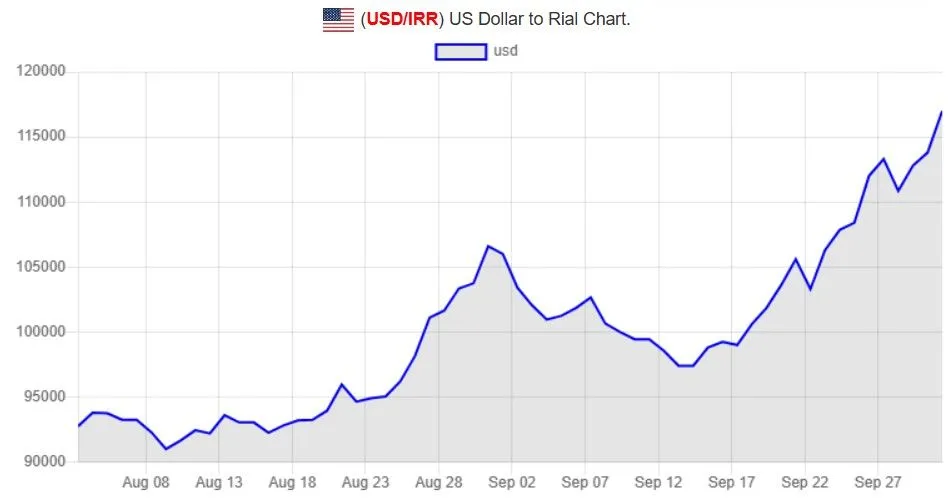
https://asset.coinness.com/en/news/be931ce65df2ae5e897f3935ee58667d.webp
U.S. dollar to rial chart Source: Bonbast

Hack on Iran’s top crypto platform

Iran’s private digital currency sector has also faced mounting security pressures. In June, Nobitex, the country’s largest crypto exchange, was hit by a major exploit that drained about $90 million in assets, including Bitcoin (BTC), Ethereum (ETH), Dogecoin (DOGE), Ripple (XRP), Solana (SOL), Tron (TRX), and TON. A pro-Israel hacker group known as Predatory Sparrow, or Gonjeshke Darande, later claimed responsibility in a post on X. The attack took place during heightened military tensions that began with Israeli strikes on Iranian military and nuclear facilities on June 18, 2025.


According to analysis by TRM Labs, digital assets are increasingly integral to Iran's efforts to navigate international sanctions and advance its geopolitical interests. Iranian exchanges, including Nobitex, process billions in cryptocurrency transactions. These platforms have been noted for permitting large withdrawals without stringent Know Your Customer (KYC) protocols and for employing sophisticated methods to obscure the origins and destinations of funds.


At the same time, these exchanges are not used solely for state-level purposes. For many ordinary Iranians, grappling with inflation and economic isolation, digital assets represent a practical tool for safeguarding savings and maintaining limited access to the global economy, underscoring the dual role that cryptocurrency plays in the country.


 

More to Read
View All
Web3 & Enterprise·

Jun 19, 2023

Mitsui & Co. and Animoca Brands to Drive Web3 Innovation in Japan’s Digital Landscape

Mitsui & Co. and Animoca Brands to Drive Web3 Innovation in Japan’s Digital LandscapeTokyo-based trading and investment company Mitsui & Co. (Mitsui) has announced today a strategic partnership with Hong Kong-based Web3 gaming firm Animoca Brands. This new partnership aims to utilize Mitsui’s extensive business network to foster new ventures that contribute to the distribution and advancement of Web3 technology in Japan. The companies will particularly focus on utilizing blockchain technology to address issues such as wellness and carbon credits.Mitsui expects this collaboration to strengthen its presence in the blockchain and digital assets space. The goal is to promote the development of a digital society and improve the lives of Mitsui’s customers.Photo by Shubham’s Web3 on UnsplashAnimoca Brands’ Web3 expertiseAnimoca Brands, a well-known company specializing in digital entertainment, blockchain, and gamification, has an impressive portfolio of over 450 Web3 investments. This includes popular non-fungible token (NFT) based online video game Axie Infinity and NFT marketplace OpenSea. Animoca Brands actively promotes digital property rights and the establishment of the open metaverse, a blockchain-based virtual space that ensures permissionless access and user ownership of data.Mitsui’s blockchain initiativeMitsui also initiated a blockchain-related project through its affiliate Mitsui & Co. Digital Asset Management (MDM). Just last month, MDM launched Alterna, a security token platform that grants retail investors access to previously inaccessible real-world assets (RWAs), such as large-scale real estate properties and infrastructure. To expand the reach of Alterna, MDM has partnered with Sony Bank, a member of the Sony Financial Group, to introduce the platform to the Tokyo-based online bank’s clients.

news
Policy & Regulation·

Jul 27, 2023

Ripple and the Republic of Palau Collaborate to Mint First PSC Stablecoin

Ripple and the Republic of Palau Collaborate to Mint First PSC StablecoinIn a groundbreaking partnership, the Republic of Palau has teamed up with Ripple Labs to introduce its inaugural stablecoin, the Palau Stablecoin (PSC).This occasion was shared by Jay Hunter Anson, the Director of Palau’s Digital Residency Program and a member of Palau’s Ministry of Finance, who took to Twitter on Wednesday to shed light on the collaboration between the Palau National Treasury and Ripple Labs.The event unfolded at the National Capitol in Ngerulmud, Palau, where representatives from both the Palau National Treasury and Ripple gathered to celebrate the successful launch of the Palau Stablecoin. Anson emphasized that this marks a significant step in their joint exploration of the stablecoin’s potential use cases within the Micronesian island nation.Photo by Kanchanara on UnsplashReducing payment costsPalau’s Ministry of Finance initiated the Stablecoin project to address specific needs within the nation’s financial landscape. By sponsoring this project, the ministry aims to reduce payment costs within the Republic of Palau and enhance access to financial services, especially for underserved communities and various socio-economic groups, utilizing digital solutions.Notably, the Palau Stablecoin operates on the XRP Ledger (XRPL), demonstrating Ripple’s technology as the backbone of this financial initiative.Anson’s tweets also shed light on the meticulous approach taken in developing the Palau Stablecoin. Controlled and limited PSC pilot tests have been conducted to assess the effectiveness and efficiency of the solution co-designed with Ripple. These pilot experiments provide valuable insights into the stability and usability of the Palau Stablecoin before its potential public release.Extensive testingAlready, the Palau Stablecoin pilot program has seen volunteer users actively participating in the testing phase. Videos shared by Anson on Twitter showcased smooth transactions at partner vendors in Palau, promptly confirming the transaction receipts.The successful implementation of the Palau Stablecoin pilot program has drawn attention from the XRP community, and anticipation is building for the official joint press release scheduled for July 27, Thursday morning in Ngerulmud, Palau, as Anson revealed.The collaboration between Ripple and the Republic of Palau was initiated at the end of 2021, with launch originally scheduled to take place in 2022. Ripple has claimed to be in dialogue with in excess of twenty governments relative to enabling central bank digital currency (CBDC) issuance.Given that the island state lacks a functioning central bank and the US dollar is recognized as the primary medium of exchange throughout the country, the creation of a USD-backed stablecoin is a significant achievement resulting from the national stablecoin initiative. The president described this as a “step towards our own central bank digital currency.”There has been plenty of activity in Micronesian nations relative to cryptocurrency in recent times. Tonga is understood to be considering introducing bitcoin as legal tender. The Marshall Islands is considering issuing a CBDC although it is being discouraged by the International Monetary Fund (IMF) in that endeavor. Meanwhile, the government of Vanuatu announced its support for the Satoshi Island project.With a strategic focus on addressing financial needs and enhancing accessibility within Palau, this partnership sets the stage for a new era of digital financial solutions for the Micronesian nation.

news
Policy & Regulation·

Aug 27, 2025

Japan’s finance minister acknowledges crypto investment merits

Katsunobu Katō, a Liberal Democratic Party politician and Japan's Minister of Finance under Prime Minister Shigeru Ishiba's government since October 2024, has said that cryptocurrency assets can play a role in a diversified investment portfolio. Katō made the remarks while speaking at an event that was held in Tokyo related to the subject of crypto assets on Aug. 25, according to Bloomberg. Katō stated:''Crypto assets run the risk of high volatility, but if an appropriate investment environment is created, they can become targets for diversified investment.''Photo by JJ Ying on UnsplashGrowing crypto user baseKatō acknowledged that there is a growing user base in Japan related to digital assets. With that, he intends to work towards the provision of a healthy trading environment in Japan for stakeholders within the digital assets sector. The finance minister added that he has been trying to balance regulation with a need to leave the digital assets sector with sufficient freedom so as to enable the development of innovation. Crypto tax reformIt emerged over the weekend that the Japanese financial regulator, the Financial Services Agency (FSA), intends to include tax reform measures in respect of the crypto sector in 2026 tax revision proposals that it will bring to the Japanese government. It’s expected that the proposals, scheduled for submission by the end of this month, will call for a separate taxation category for digital assets and the implementation of a flat 20% tax rate. Under Japan’s existing tax regimen, crypto trading gains must be reported under the categorization of “miscellaneous income,” with those gains subject to tax rates of up to 55%. The move would bring taxation on crypto trading gains in line with the tax treatment that’s currently in place for equity trading gains. Equities have been given their own category and are taxed at a flat rate of 20%. Reclassifying cryptocurrenciesAdditionally, the FSA plans to propose legislation next year that would result in the reclassification of cryptocurrencies, removing them from their current treatment as a means of payment under the Payment Services Act. The regulator wants crypto to come under the Financial Instruments and Exchange Act, reclassifying it as a financial product. Katō has outlined his party’s commitment to the consideration of reviewing crypto asset taxation. That item was incorporated into his government’s tax reform plan for 2025, while the Japanese cabinet approved a proposal to amend the Payment Services Act back in March. As part of plans to have digital assets categorized as financial products, the FSA is also understood to be interested in broadening the scope of insider trading restrictions. Kato’s remarks are being interpreted as positive for the crypto sector. According to International Monetary Fund (IMF) data, Japan is the world’s fifth-largest economy, with a gross domestic product (GDP) exceeding $4.1 trillion.Source: World Economic Outlook (April 2025)In further positive news for the sector in Japan, it was reported on Aug. 18 that the FSA is likely to approve the issuance of JPYC, a Japanese yen-backed stablecoin, over the course of the coming months.

news
Loading