Top

Asia-Pacific leads a wider crypto uptake as legal and security risks persist

Markets·September 08, 2025, 12:22 AM

A new report indicates that the global use of cryptocurrency is not only growing but also quickening, with the Asia-Pacific (APAC) region setting the pace. According to the sixth Chainalysis Global Crypto Adoption Index, released on Sept. 2, India has emerged as the new leader in overall adoption across 151 countries. The index analyzes where value is being transferred, how new users are entering the ecosystem, and which areas are experiencing the most rapid expansion.

https://asset.coinness.com/en/news/c9648faf8aca5c5ec2d477de452bb449.webp
Photo by Naveed Ahmed on Unsplash

India leads global crypto adoption

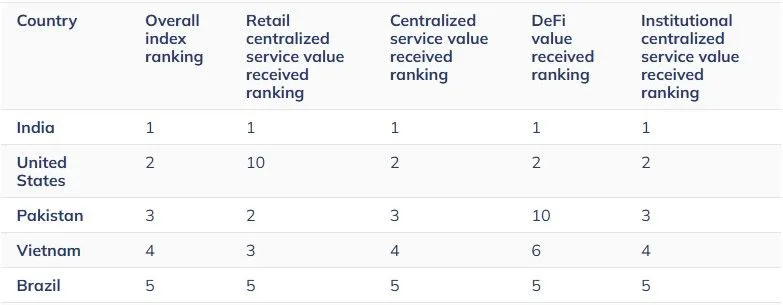
India now holds the top spot in the overall index, with the U.S. following in second place. The APAC region demonstrates significant momentum, with Pakistan (3rd), Vietnam (4th), Indonesia (7th), and the Philippines (9th) all securing positions in the top ten. Further down, South Korea and Japan are ranked 15th and 19th, respectively.
https://asset.coinness.com/en/news/519be038ed3cf599185eea1151ab10e2.webp
2025 Global Crypto Adoption Index Top 20 Source: Chainalysis

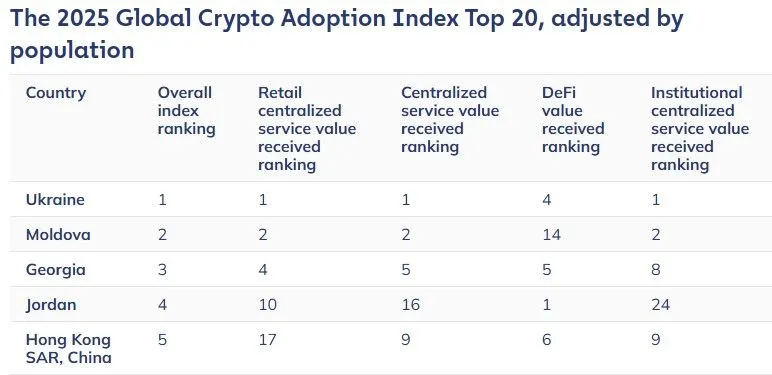
The picture changes when the data is adjusted for per capita GDP, which highlights grassroots movements. By this measure, Ukraine ranks first, followed by Moldova, Georgia, and Jordan. Hong Kong comes in fifth, Vietnam sixth, while Singapore and South Korea rank 16th and 18th, respectively.
https://asset.coinness.com/en/news/0b943ed6bf741d298814dda5ca151e6e.webp
2025 Global Crypto Adoption Index Top 20 (Pop. adjusted) Source: Chainalysis

Regional transactions surge as APAC gains ground

On-chain transaction data confirms a shift in economic gravity. In the year ending June 2025, APAC's transaction value soared by 69% year-over-year, climbing from $1.4 trillion to $2.36 trillion. While Europe ($2.6 trillion) and North America ($2.2 trillion) still handle larger absolute volumes, growth is accelerating nearly everywhere. APAC's growth rate more than doubled from 27% to 69%, while Latin America's rose from 53% to 63%.


In terms of capital entering the crypto market via centralized exchanges, the U.S. leads as the largest fiat on-ramp, processing over $4.2 trillion. This is approximately four times the volume of South Korea (over $1 trillion), while the EU recorded just under $500 billion. Asset preferences also show regional variations; Bitcoin accounted for 47% of purchases in the U.K. and 45% in the EU, but just over 20% in South Korea. 


India's top ranking aligns with the latest domestic developments, such as the Independence Day launch of the Bitcoin Policy Institute India, which aims to focus on sovereign mining, policy, and education.


Legal and security challenges in India

However, this rapid growth is accompanied by notable legal and security hurdles. In a high-profile case, an Indian anti-corruption court sentenced 14 individuals, including 11 police officers, to life in prison for a 2018 kidnapping and crypto extortion scheme.


In another development, creditors of India's crypto exchange WazirX approved a new restructuring plan over a year after a $234 million hack allegedly linked to North Korea’s Lazarus Group. An earlier proposal was rejected by the Singapore High Court in April. The revised plan shifts oversight of recovery tokens—representing outstanding balances—from WazirX’s Singapore entity to Zanmai India, regulated by India’s financial authority, with repayments funded by profits and recovered assets. Some 150,000 creditors, representing $206 million in claims, voted between July 30 and Aug. 6 as WazirX also moved operations to a Panama-based unit called Zensui. Separately, on April 16, India’s Supreme Court dismissed a petition from 54 hack victims, ruling it lacked authority to legislate on crypto policy.


While India’s headlines highlight the frictions of rapid growth, the broader picture is clearer. The Chainalysis index illustrates a global crypto market expanding across all income levels for varied reasons. In developed nations, clearer regulations and institutional involvement are key drivers. In many emerging economies, factors like remittances and access to U.S. dollars via stablecoins are more prominent.

 

More to Read
View All
Web3 & Enterprise·

Aug 23, 2023

Coinone Boosts Crypto Account Security with Naver Two-Factor Authentication

Coinone Boosts Crypto Account Security with Naver Two-Factor AuthenticationCoinone, one of South Korea’s leading crypto exchanges, announced on Wednesday that it has added Naver as another channel for two-factor authentication (2FA) when signing up for an account. This move aims to enhance security and convenience for users by introducing another option for the second step of authentication in addition to KakaoTalk and one-time password (OTP) authentication.Photo by Franck on UnsplashCombatting social engineering attacks“As the popularity of investing in virtual assets is on the rise, attempts to gain unauthorized access to accounts through smishing and phishing have also increased. We hope that users can use Coinone services in a safer, more convenient manner by using Naver as an easy authentication channel,” said Cha Myunghun, CEO of Coinone.All users are required to go through 2FA when signing up for a Coinone account in order to simultaneously protect their credentials and conduct deposits, withdrawals, and transactions. Users must verify themselves with their phone number first, then once more through an additional channel like KakaoTalk, Naver, or OTP authentication.Using KakaoTalk or Naver is easy and convenient since most Koreans already have both of these apps on their phones, and it takes a relatively short amount of time to complete.Extra benefitsUsers can register for Naver authentication on both the Coinone website and the app. Once they do, they can verify themselves through the Naver app without a separate login. These users can be granted more benefits such as increased withdrawal limits, the exchange said. Those who have verified their bank accounts for storing Korean won can have a withdrawal limit of up to 500 million won (approximately $373,000).

news
Web3 & Enterprise·

Nov 28, 2023

SK C&C to provide ChainZ Security Token service for Hana Securities

SK C&C to provide ChainZ Security Token service for Hana SecuritiesSK C&C, a comprehensive digital solutions provider and the affiliate of South Korean conglomerate SK Group, announced Tuesday (local time) that it will provide the blockchain-based ChainZ Security Token service to Hana Securities for the securities firm’s construction of a security token system.Security tokens enable the conversion of assets such as real estate, art and carbon credits into digital tokens. These digital representations open up opportunities for retail investors to make fractional investments in assets that were previously beyond their reach due to high minimum investment requirements.Hana Securities’ involvement in security tokens emerged when its parent company, Hana Financial Group, joined a consortium called the Next Finance Initiative (NFI) in June to expand the security token ecosystem. In this collaborative effort, Hana Securities is set to develop infrastructure that will enable the establishment of extensive security token services. This infrastructure will support functions such as the issuance, distribution and procurement of security tokens.Photo by Shubham Dhage on UnsplashSecurity tokens on EthereumThe ChainZ platform allows the creation, issuance and trading of tokenized assets on the Ethereum network by simply calling an application programming interface (API). The company explained that being compatible with several Ethereum standards, including ERC-20, ChainZ enables users to create diverse token-related services with just a few clicks.SK C&C will leverage the ChainZ platform, which supports distributed ledger services, to manage token offerings and allocations. Additionally, the company will offer security token-related services, which will include processing investor orders and facilitating the buying and selling of tokens.Choi Cheol, Head of SK C&C’s Web3 and Convergence Group, said that the security token system of Hana Securities will lay a foundation for securities firms to adopt security token services and engage in business collaborations with each other. According to Choi, SK C&C is committed to providing secure trading services for security tokens, catering not only to securities companies but also to a broader range of enterprises and general investors. The tech company is also planning to take an active role in NFI and other consortiums with securities firms as a part of its strategy to enhance these efforts further.

news
Markets·

Jun 13, 2024

Turkish lira becomes third largest fiat currency in crypto trading

The Turkish Lira (TRY) has become the third largest fiat currency by volume in the cryptocurrency market, according to a report by Kaiko. This milestone was reached as TRY's share of the crypto market hit an all-time high of 19% in early June. The increase in volume is attributed to the country's economic challenges, notably its high inflation rate, which has surpassed 70%, making the lira one of the most volatile fiat currencies globally.Photo by Afdhallul Ziqri on UnsplashFactors influencing the increaseThe shift in the Turkish lira's position in the crypto market is partly due to increased foreign exchange volatility and currency devaluation, common catalysts for cryptocurrency adoption in developing economies. Additionally, geopolitical factors such as a record number of elections and diverging monetary policies have intensified market fluctuations. This environment has favored cryptocurrencies like Bitcoin, which reached new highs against the lira in recent months. For instance, Bitcoin escalated to 2.3 million TRY in March from 979,000 TRY in October 2023. The recent adjustments in cryptocurrency trading platforms, particularly Binance's delisting of certain fiat trading pairs due to banking issues, have also increased the dominance of TRY in crypto transactions. This series of events underscores the growing interconnection between traditional and digital finance markets, highlighting the increasing role of cryptocurrencies in regions facing economic instability. 

news
Loading