Top

MUFG pushes into tokenized finance as Japan enters a new political chapter

Web3 & Enterprise·October 10, 2025, 8:08 AM

Japan’s largest bank is stepping deeper into digital assets at a moment of political change. Mitsubishi UFJ Financial Group (MUFG) and its securities arm Mitsubishi UFJ Morgan Stanley Securities (MUMSS) have launched a blockchain-based business, according to CoinDesk Japan. The move puts the country’s biggest lender at the center of a fresh push to bring regulated finance onto distributed ledgers while retail investors gain a new way to buy and trade tokenized products.


MUMSS has begun offering bond security tokens, marking its formal entry into the security token market. At the same time, the firm introduced ASTOMO, a trading venue for retail investors built with Japanese fintech company Smartplus. The system will debut with real estate-backed security tokens. Individuals can invest from 100,000 yen (about $655) through a smartphone app. Under the partnership MUMSS will select and source the digital securities. Smartplus will run account management and build and operate the trading system using its Brokerage as a Service (BaaS) platform.


MUFG also revealed that it has started preparing a public offering of subordinated bonds in token form. The bank intends the instruments to qualify as Tier 2 capital under international rules. The offering is expected to be the first of its kind for Japan’s banking sector. MUFG has submitted an amended securities registration statement to the Director General of the Kanto Local Finance Bureau in advance of the sale.

https://asset.coinness.com/en/news/be06f1046e701aec74df006d47cae03e.webp
Photo by Asm Arif on Pexels

Takaichi’s victory sparks interest in Japan’s crypto path

The corporate steps arrive as conservative lawmaker Sanae Takaichi rises to lead the ruling Liberal Democratic Party. She won the party election on Oct. 4 and is set to become Japan’s first female prime minister, with lawmakers expected to make the formal choice in the middle of this month. 


Several industry voices see her leadership as supportive of digital assets, according to Cointelegraph. Elisenda Fabrega, general counsel at tokenization platform Brickken, said Takaichi’s victory might reshape how Japan perceives and regulates digital assets, reinforcing the country’s commitment to clear and reliable crypto laws.


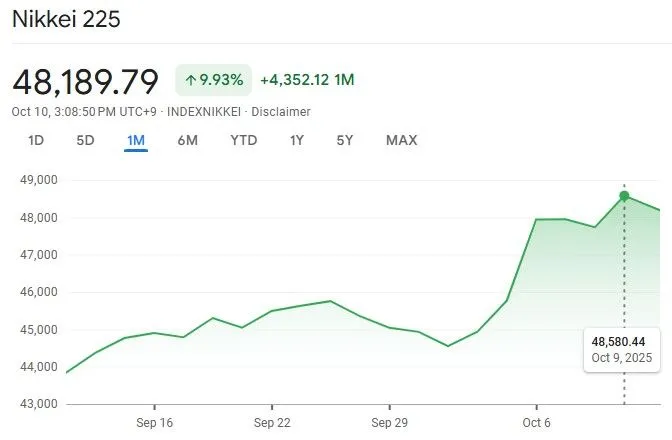
Maarten Henskens, chief operating officer at Startale Group and head of the Astar Foundation, chimed in to say that a looser monetary stance under Takaichi could keep liquidity flowing and drive greater investor interest in alternative assets such as cryptocurrencies. That optimism has already spilled into Japan’s equity markets. The Nikkei index has continued to soar since the leadership vote, reaching a record high of 48,580.44 on Oct. 9.


Not all signals point in the same direction. A BeInCrypto report published before the election noted market predictions that Takaichi might also back tighter oversight. The report cited her March proposal to build a framework that lets financial institutions, including crypto exchanges, share information on suspicious transactions. That system would support faster account freezes.
https://asset.coinness.com/en/news/6e7246730a2833f909aa086f96680fe2.webp
 Nikkei 225 Index Source: Google Finance

Loose fiscal tone brings new pressures for Bitcoin

From a broader economic view, the picture looks more complex. CoinDesk reported that Takaichi’s preference for easy Abenomics-style policies could weigh on Bitcoin in the short term. Expansionary fiscal measures tend to increase bond supply and drive yields higher, which often curbs risk appetite by raising borrowing costs and making assets like stocks and cryptocurrencies less appealing. Her stance has also reduced expectations for a Bank of Japan rate hike, weakening the yen and strengthening the U.S. dollar. The stronger dollar has cooled Bitcoin’s momentum, while gold has continued to attract investors seeking stability.


MUFG’s blockchain venture arrives at a turning point for Japan. The bank’s push into tokenized assets shows how traditional finance is adapting to digital change just as new leadership tests the balance between innovation and control. Whether this marks the start of a broader transformation will depend on how policy, regulation, and investor confidence evolve together in shaping Japan’s financial future.


 

More to Read
View All
Web3 & Enterprise·

Feb 15, 2024

Game company behind XPLA blockchain witnesses growth in revenue last year

Com2uS Holdings, the South Korean game publishing company behind Layer 1 blockchain XPLA, disclosed today that its revenue last year saw a 22.5% increase from 2022, reaching KRW 142.3 billion ($106.7 million). On the back of the revenue growth, the company's consolidated operating loss narrowed to KRW 14 billion, improving from 2022’s KRW 26.4 billion. Additionally, the net loss decreased to KRW 16.5 billion, down from the previous year’s KRW 70.6 billion. The operating loss for the fourth quarter stood at KRW 16.5 billion, showing an improvement from 2022 Q4's KRW 20.9 billion. During the same period, revenue reached KRW 21.4 billion, and the net loss was recorded at KRW 8 billion.Photo by Andrey Metelev on UnsplashGame sales and marketing expensesCom2uS Holdings attributed the increase in profits to game sales growth, which was encouraged by the release of more games. However, the company also noted a decrease in income from investments in associates and an increase in marketing expenses, which were driven by the launch of new games. Last year's operating expenses totaled KRW 156.4 billion. Labor costs, which constitute the largest portion of operating expenses, experienced a year-on-year decrease of 6.2%, amounting to KRW 46.7 billion. In contrast, there was an increase in spending across three areas: commissions rose by 43.8% to KRW 30.7 billion, loyalty expenses increased by 26.6% to KRW 25.1 billion and marketing saw a jump of 134.9% to KRW 21.1 billion. According to a report from local news agency Yonhap, Jung Chul-ho, CEO of Com2uS Holdings, emphasized at the earnings presentation today that the company is committed to growth in game publishing, blockchain projects and platform initiatives, all directed towards enhancing the company's value.Triple-A games on XPLA blockchainAs part of the company’s blockchain endeavors, the XPLA platform is set to focus on improving user convenience and incorporating major content, including a variety of triple-A games. Looking ahead, Com2uS Holdings anticipates that its idle role-playing game, Soul Strike, will contribute to the company's revenue for the first quarter. Since its debut last month, Soul Strike has been attracting attention not only in Korea but across Asia. The game publisher also outlined its global release plans for the MMORPG, Zenonia Chronobreak. Gamers in Taiwan can expect access to the game in the second quarter, while those in Japan and others will be able to play in the fourth quarter.

news
Markets·

May 15, 2025

Japanese firms expand Bitcoin holdings amid growing institutional interest

Several Japanese companies, including Remixpoint and Metaplanet, have been increasing their Bitcoin (BTC) holdings, underscoring the growing institutional interest in cryptocurrencies in the region.Photo by Kanchanara on UnsplashRemixpoint, an energy consulting firm listed on the Tokyo Stock Exchange, recently announced an additional purchase of 32.83 BTC valued at 500 million yen ($3.4 million), according to local news outlet CoinPost. This acquisition took place on May 13 at an average price of 15.23 million yen ($104,270) per BTC, bringing the company's total BTC holdings to 648.82 BTC. Remixpoint's crypto portfolio, including BTC, is now valued at 11.1 billion yen ($76 million) and also comprises Ethereum (ETH), Solana (SOL), XRP and Dogecoin (DOGE). The firm began actively accumulating BTC late last year, motivated by multiple factors, including the positive price trend following the latest Bitcoin halving event, increased market activity after the latest U.S. presidential election and the growth in institutional participation, particularly after the approval of spot crypto ETFs in the U.S. Metaplanet becomes a major BTC holderAnother notable player, Metaplanet, a publicly traded Japanese company specializing in Bitcoin investment, has positioned itself as one of the largest BTC holders globally. As of May 12, Metaplanet’s Bitcoin yield reached 170%, with total holdings of 6,796 BTC. This places it as the 11th largest Bitcoin holder worldwide and the largest in Asia, surpassing El Salvador, which currently holds 6,177 BTC, according to data from Arkham. Metaplanet's ongoing Bitcoin accumulation aligns with CEO Simon Gerovich's advocacy for Bitcoin. In a March podcast, Gerovich said he encourages his friends to allocate "100% of their net worth into Bitcoin." The company’s strategic goal is to amass 10,000 BTC by the end of 2025 and 21,000 BTC by 2026. Reinforcing its influence, Metaplanet appointed Eric Trump, the second son of pro-crypto U.S. President Donald Trump, to its newly formed Strategic Board of Advisors in January. Evolving crypto policies, including national reservesBefore Trump's second term, Gerovich expressed his expectation that other countries would follow the U.S. once it established a national Bitcoin strategic reserve—a move formalized by President Trump through an executive order in March. In a related development, Ukraine is reportedly drafting a bill to create a similar reserve in collaboration with Binance. Meanwhile, in Taiwan, lawmaker Ko Ju-Chun has been advocating for adding Bitcoin to the country's national reserves. In a similar trend, another Japanese firm, Value Creation, disclosed plans last month to acquire 100 million yen ($660,000) worth of Bitcoin, further reflecting the growing interest among Japanese companies in crypto investments. Complementing this corporate adoption trend, Japan's Financial Services Agency (FSA) has been shaping its regulatory framework for cryptocurrencies. The agency aims to redefine digital assets as financial products under the Financial Instruments and Exchange Act, a move viewed as an attempt to balance innovation with investor protection. Building on this approach, an FSA discussion paper released on April 10, which remained open for public feedback until May 10, proposed classifying crypto assets into two categories: those used for fundraising and business activities, and those that are not—such as BTC and ETH. This regulatory evolution, alongside increasing corporate investment in BTC, reflects Japan's efforts to adapt to the evolving global crypto landscape.

news
Policy & Regulation·

May 11, 2023

3AC Founder Secures Restraining Order in Singapore

3AC Founder Secures Restraining Order in SingaporeSu Zhu, the Co-Founder of the defunct crypto hedge fund Three Arrows Capital (3AC) has successfully obtained a restraining order against BitMEX Co-Founder and former CEO, Arthur Hayes, in a Singaporean court.Photo by Monstera on PexelsNo communication “by any means”Crypto publication CoinDesk stated on Wednesday that it had seen a copy of the court order, which was originally issued on May 5. According to the details of the order, Hayes is prohibited from “making any threatening, abusive or insulting communication that would cause the Applicant harassment, alarm or distress.”Additionally, the former CEO of crypto trading platform BitMEX is forbidden from using “threatening, abusive or insulting words” in relation to Su Zhu. The order, which was issued by Judge Sandra Looi Ai Lin, clarifies that the BitMEX Co-Founder is not permitted to publish “any identity information” relative to Zhu or to communicate with him “by any means.”$6 million owedIt’s an understatement to say that Zhu, alongside fellow 3AC founder Kyle Davies, are not on Hayes’ list of favorite people in recent times. Following the 3AC collapse, Hayes has maintained that he is owed $6 million by the duo. Since the collapse of the hedge fund, Hayes has been tweeting out at the pair, calling them out relative to his claim that the duo have a debt obligation to him to the tune of $6 million.While both Hayes and Zhu have blemishes on their records, Hayes is much better regarded within the crypto community than Zhu. The BitMEX Co-Founder narrowly avoided a prison sentence in 2022 with the much lesser sanction of six months home detention being applied. That arose due to federal charges brought against him on the basis that he didn’t implement anti money laundering (AML) compliance procedures and checks at BitMEX while he was CEO of the firm.Despite this failure, Hayes remains popular within the crypto space, with his insightful commentary being lauded given that since he left BitMEX he has taken to writing blog articles relative to crypto and the broader economic situation. However, blog site Medium has taken to disabling access to his most recent blog article. The blog page states that the post “is under investigation or was found in violation of the Medium Rules.”Lacking a welcomeIn contrast with Hayes, commentary relative to the 3AC duo of Zhu and Davies has lacked warmth. Neither of the duo had jumped on social media for a number of months following the collapse of 3AC. More recently they have both tried to rehabilitate themselves, with many commentators within the space seeing it as a cynical move.In February the duo launched Open Exchange, more commonly known as OPNX, a trading platform for crypto-related bankruptcy claims. At that time, Hayes tweeted out that he interpreted the news as the return of the crypto bull market.Earlier this month, OPNX claimed that it had the backing of several credible entities in the crypto space. However, immediately afterwards, a number of those firms clarified that they had nothing to do with the startup.Meanwhile, crypto-focused venture capital investor Michael Arrington tweeted out his disdain in relation to the 3AC founder’s successful fund raise:“Three f***ing arrows dip****s successfully raising a new fund is the saddest bulls**t I’ve heard in a long time.”The regulator in Dubai has also failed to roll out the red carpet for the duo’s new venture. In April, it issued an investor alert in relation to OPNX. Subsequently, it has followed up with a formal written reprimand issued to Zhu and Davies, given that the business is not registered with the regulator although operating out of Dubai.

news
Loading