Korean banks and card firms advance digital won payments ahead of legislation
South Korea is building payment rails for a tokenized won on two tracks, one led by banks extending a central bank digital currency pilot, the other by card issuers testing stablecoins, with no law yet to govern either.
The Korea Internet & Security Agency and the Ministry of Science and ICT said last week they had begun a project to extend the Bank of Korea's CBDC pilot, Project Hangang, into retail payments, according to a report by local outlet Digital Asset.
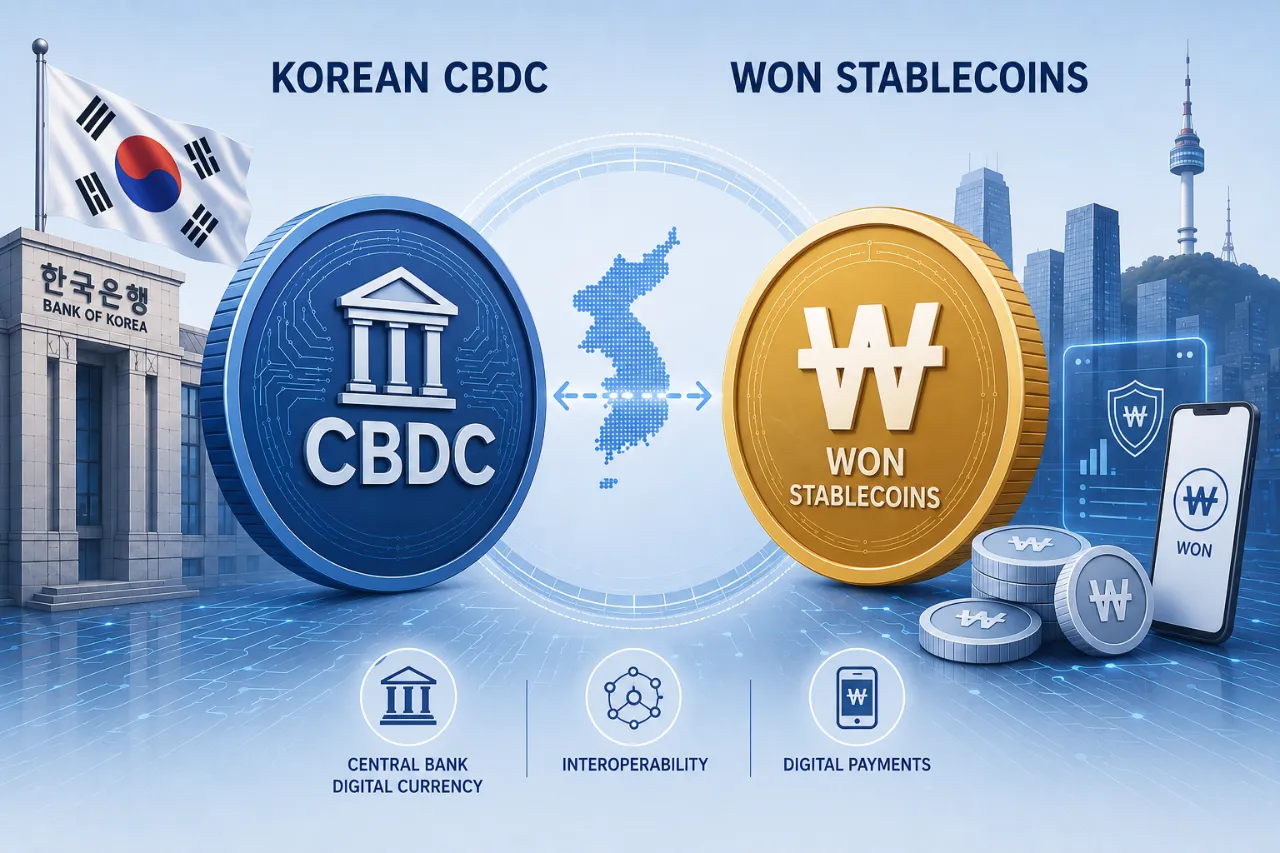
The Korea Financial Telecommunications and Clearings Institute, which operates the country's interbank payment network, will lead the consortium of nine commercial banks, eight payment gateways and two large organizations that will pilot the payments. It will connect existing payment infrastructure to Project Hangang on a 9.6 billion won ($6.6 million) budget. The pilot tested deposit tokens, a tokenized form of commercial bank deposits backed by a wholesale CBDC.
The design avoids building anything new. Consumers would pay through bank-issued deposit token wallet apps, with a physical card under consideration, and merchants would keep their existing terminals. The stated aim is faster settlement and lower fees for small merchants.
The government also plans to use deposit tokens for public spending, starting with a pilot for official expenses and later a treasury model linked to dBrain, the nation’s digital budget accounting system.
Card issuers defend the rails
Separately, Newspim reported the Credit Finance Association and nine card issuers, including Samsung Card, Shinhan Card, KB Kookmin Card and Hyundai Card, on July 22 concluded a joint proof of concept for won-denominated stablecoins. Run on a test network, it examined whether authorization, settlement and cancellation functioned when a won stablecoin was routed through existing card rails, and whether smart contract-based terminals and QR payments could also handle loyalty points and government-issued vouchers.
The tests come as the card business faces mounting pressure. Net income at the eight card companies fell 8.9% last year to 2.36 trillion won ($1.6 billion), as merchant fee income declined despite rising card spending. With 3.09 million merchants, or 95.7% of the total, on preferential fee rates in the first half, and wallet-based stablecoin payments raising the prospect of transactions that bypass card networks altogether, issuers have reason to secure a role in whatever comes next.
Their pitch is that they already own the hard part. "Issuers would have to build payment infrastructure from scratch to circulate a stablecoin," a card industry official said. Bolting a settlement function onto existing card rails, the industry argues, would also let issuers apply the fraud detection and anti-money laundering systems already running on those networks.
Legislation still stalled
Digital assets featured in a reform agenda announced last week by Kim Min-seok, a lawmaker and former prime minister running for leadership of the Democratic Party.
"I believe we need financial reform, and one of its key aims should be to establish our sovereignty over digital assets," Kim told a news conference, according to another Digital Asset report. His agenda included passage of the Digital Asset Basic Act, a legal framework for won stablecoins, rules for issuing and trading security tokens, and investor protection.
The act, covering stablecoin issuance and digital asset service providers, is targeted for passage this year. Work on the bill had been due to start after party and government consultations in March but was postponed indefinitely, with the crisis in the Middle East among the reasons cited.