Live Feed
New
Today, September 19, 2026
08:27
Blockchain security firm SlowMist said a joint investigation with the OKX security team found malware in versions 1.1 to 1.2 of the FomoPeek app that could lead to the theft of users’ crypto assets. Multiple recently reported cases confirmed private key leaks, and some victims were found to have used the app.
SlowMist said the malware exploits an iOS vulnerability to escape the sandbox and access keychain data and files from other apps. That could expose private keys, seed phrases, login credentials and chat records, it said.
SlowMist advised users who had installed those versions to generate new private keys and seed phrases on a secure device, transfer assets immediately, and stop using FomoPeek.
08:23
Seventy percent of Binance-listed altcoins have regained their 200-day moving average, a key trend indicator, and are showing stronger momentum than BTC, according to a CryptoQuant analysis by contributor Darkfost. The share marks the highest level since October 2025, when the market peaked. Altcoin market capitalization excluding ETH, or TOTAL3, has also surpassed $800 billion for the first time in about eight months. BTC, meanwhile, has been moving sideways in the recent $75,600-$82,000 range, with trading volume shifting toward altcoins, Darkfost said. Darkfost added that while the altcoin market is showing positive momentum, caution is needed as conditions can change quickly.
07:06
ChinaAMC Hong Kong said it has completed a digital asset investment using the Hong Kong dollar stablecoin HKDAP in collaboration with Standard Chartered Bank and others. The asset manager described it as the first case in Hong Kong of HKDAP being used for a digital asset investment.
HKDAP is a Hong Kong dollar-pegged stablecoin designed under the leadership of Standard Chartered Bank Hong Kong and issued by licensed stablecoin issuer Anchor Financial. ChinaAMC Hong Kong said the case shows Hong Kong dollar stablecoins can be linked with digital financial assets within a regulatory framework.
06:49
A whale address said to be linked to BIT.com, the cryptocurrency exchange under Matrixport, deposited another 1,000 BTC worth about $81.06 million to Binance, according to Lookonchain.
06:11
Oracle protocol Switchboard said it is winding down operations and will fully discontinue its existing services starting Sept. 25. Core developer Switchboard Technology Labs said it decided to wind down the remaining business after reviewing all possible alternatives.
Switchboard said it will immediately deprecate related services following a recent security vulnerability incident and the departure of other contributors and node operators. It urged protocols using Switchboard to migrate immediately to other oracles, including Pyth and RedStone, to avoid service disruptions.
Switchboard previously raised $7.5 million in a Series A funding round led by Tribe Capital and RockawayX in May 2024.
06:06
The Cronos community has unveiled a governance proposal to use all product revenue from Cronos Labs for CRO buybacks and burns. Under the proposal, all revenue generated by Ult and Cronos Launch would be used to buy CRO on the market each month and then burn it, with the on-chain transaction hash for each purchase also to be disclosed. Operating, infrastructure, and growth-related costs would be covered with existing capital, while strategic reserves are planned for future Cronos POS staking rewards. The measure remains at the proposal stage.
05:46
Brazil’s Securities and Exchange Commission, or CVM, plans to conduct a simulated test of tokenized securities using distributed ledger technology. The test will review the full trading process from issuance to settlement for assets including stocks, bonds, receivables certificates and investment fund shares. No actual securities or investors will take part. The test will run for 60 days and may be extended by 30 days if needed. A related draft is currently awaiting approval from the CVM board.
05:45
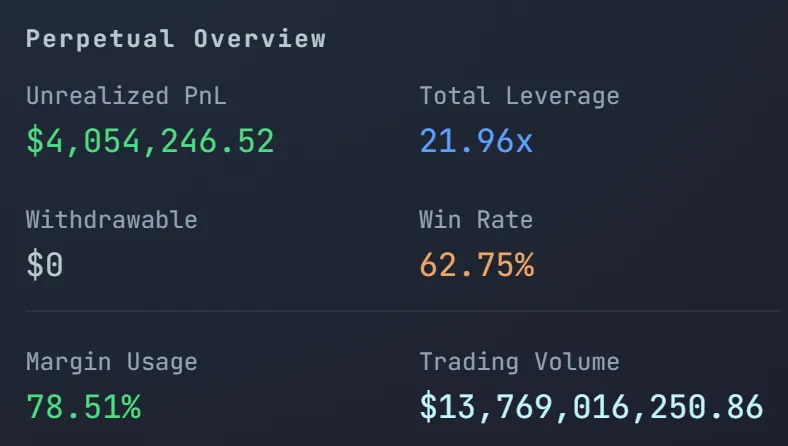
Taiwanese singer Jeffrey Huang, better known as Machi Big Brother, has seen unrealized profit on his ETH long position widen to $4.05 million, according to TradingBits. The ETH long position is currently valued at $88.76 million, while the BTC long position is showing an unrealized profit of $135,000. Huang also recently added a 10,000 HYPE long position with 10x leverage at an entry price of $92.21.
Previous related news
05:36
Bitdeer mined a total of 287.2 BTC this week and sold the entire amount into the market over the same period, leaving its net Bitcoin position increase at 0 BTC. The company reduced its BTC holdings to zero as of Feb. 20 and has since continued to liquidate all newly mined Bitcoin.
05:34
Coinbase CEO Brian Armstrong pushed back on what he said was an upcoming Wall Street Journal report that would blame him and Coinbase for the failure of the CLARITY Act, saying on X the claim was false.
Armstrong said he opposed a committee vote on the bill’s draft in January because it included issues involving DeFi, tokenization, the Commodity Futures Trading Commission’s authority and stablecoin rewards. Coinbase publicly opposed that draft at the time, and negotiations over those provisions continued afterward. Armstrong said all four issues he had raised were later revised, and an improved version of the bill passed committee about four months later. He added that he strongly supported the final bill. Earlier, the CLARITY Act failed to secure 60 votes in a Senate procedural vote on Sept. 15, halting further progress.
05:32
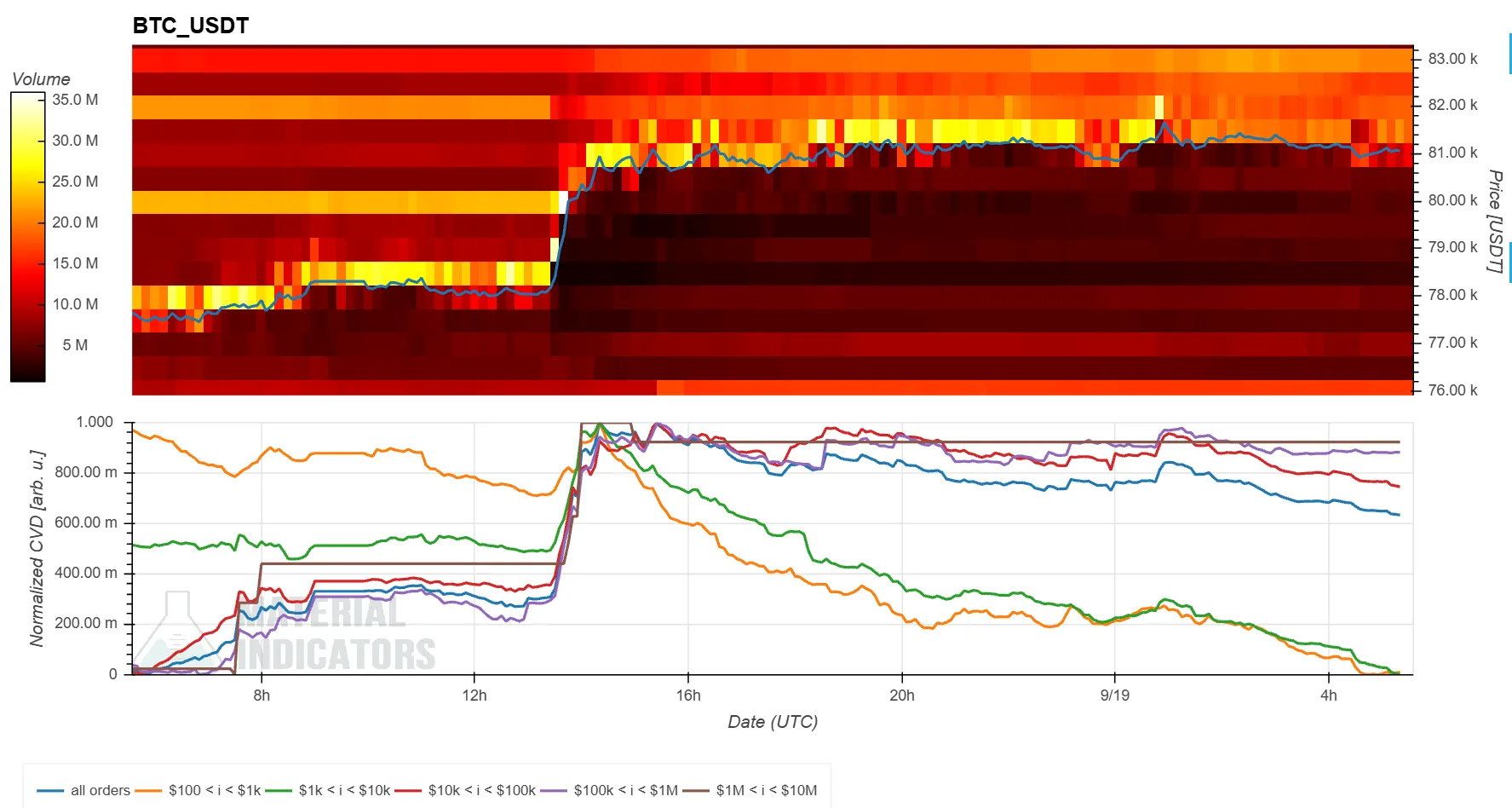
Spot CVD is an order book analysis chart for the BTC/USDT spot trading pair. The upper section shows the Volume Heatmap, while the lower section represents cumulative volume delta, or CVD.
- The volume heatmap tracks trading volume at each price level. The background color becomes brighter when the price stays within a certain range for an extended period or makes a large move. Brighter areas may act as support or resistance levels.
- The cumulative volume delta indicator shows buy and sell orders by order size. As buy orders increase, the line in the corresponding color moves higher. The yellow line is based on orders worth $100 to $1,000, while the brown line is based on large orders worth $1 million to $10 million.
05:29
Partior, a blockchain-based interbank payments network jointly founded by JPMorgan, DBS and Temasek, said it will work with LSEG DiSH, a payment infrastructure unit of London Stock Exchange Group, to build a 24/7 international settlement system.
The companies are developing a solution that combines LSEG DiSH trust accounts with Partior’s multi-currency clearing and settlement network to move liquidity across multiple settlement banks on a near real-time basis, 24 hours a day, 365 days a year. The plan is to reduce the need to prefund nostro and vostro accounts for interbank settlements while lowering reliance on traditional cross-border transfer cutoff times.
05:27
Robinhood plans to use stock, cryptocurrency and prediction market trading to attract customers, then expand into services such as retirement accounts and investment advisory to manage client assets over the long term, CNBC reported, citing CEO Vlad Tenev.
Tenev said active trading is the engine and foundation of Robinhood’s business, adding that the company’s goal is to bring in customers through trading and then move them into longer-term financial products such as retirement accounts. Robinhood has recently expanded into asset management, banking and credit cards, and plans to eventually offer mass-market access to wealth-focused financial services such as trusts, estate planning and private banking.
05:25
BitMine Chairman Tom Lee said some investors who followed his recommendation to allocate 2% of their portfolios to cryptocurrencies now have crypto exposure of more than 85%, according to an interview with Wealthion. Lee said the shift was not driven by additional purchases, but by Bitcoin’s sharp price gains.
Lee added that over the next 10 years, cryptocurrencies could offer relatively low correlation with other assets, benefit from AI-driven growth, and become a key pillar in the restructuring of the financial services industry.
05:20
The U.S. Office of the Comptroller of the Currency has conditionally approved Bastion Platforms Trust Company’s conversion into a federal trust bank, according to Crypto Briefing.
Under the approval, Bastion will convert into Bastion Platforms National Trust Company and will be able to provide institution-focused services under federal regulation, including digital asset custody, stablecoin issuance and redemption, wallet and payments, and fiat currency exchange. The entity will not be allowed to accept deposits, however, and will not be covered by Federal Deposit Insurance Corp. insurance. OCC also conditionally approved the establishment of federal trust banks for Catena and Agora the same day.
05:05
Argentine cryptocurrency exchange Lemon said it will withdraw from Brazil, citing steep capital requirements tied to obtaining a local license. Lemon said securing a crypto service provider license from Brazil’s central bank would require capital levels disproportionate to the size of its local business.
Lemon Card services will end on Sept. 30, and Brazilian user accounts are scheduled to be automatically closed on Oct. 16.
04:37
According to CoinNess market monitoring, BTC has fallen below $81,000. BTC is trading at $80,991.9 on the Binance USDT market.
04:33
U.S. spot Ether ETFs recorded about $143.7 million in net inflows on Sept. 18, reversing course after three trading days of net outflows, according to data compiled by Farside Investors and SoSoValue.
- BlackRock ETHA: +$114.3 million
- Fidelity FETH: +$26.2 million
- Bitwise ETHW: +$1.3 million
- VanEck HODL: +$1.9 million
04:32
U.S. spot Bitcoin ETFs recorded about $433 million in net inflows on Sept. 18, according to Farside Investors.
- BlackRock IBIT: +$108.4 million
- Fidelity FBTC: +$310.7 million
- Bitwise BITB: +$9.7 million
- ARK Invest ARKB: +$1.9 million
- VanEck HODL: +$2.3 million
03:02
The following shows estimated liquidation volumes and position ratios for major crypto perpetual futures over the past 24 hours:
- BTC: $283.09 million liquidated (96.75% shorts)
- ETH: $133.03 million liquidated (89.31% shorts)
- SOL: $44.08 million liquidated (95.29% shorts)
02:43
Polygon has completed preparations to permanently burn 100 million POL, worth about $10.77 million, co-founder Sandeep Nailwal said on X.
Nailwal said the POL burn contract is now running on testnet and will be deployed to mainnet once the final Security Council signature is completed. After that, any community member will be able to execute the burn, and 100 million POL will be permanently removed immediately.
He added that after the burn, any community member will be able to carry out additional POL burns each quarter. Polygon has generated $24.5 million in cumulative revenue in 2026, while POL accumulated from network fees currently stands at 121 million POL. Nailwal also said POL turned deflationary in January this year, and transaction throughput has scaled to 5,000 transactions per second.
Previous related news
02:35
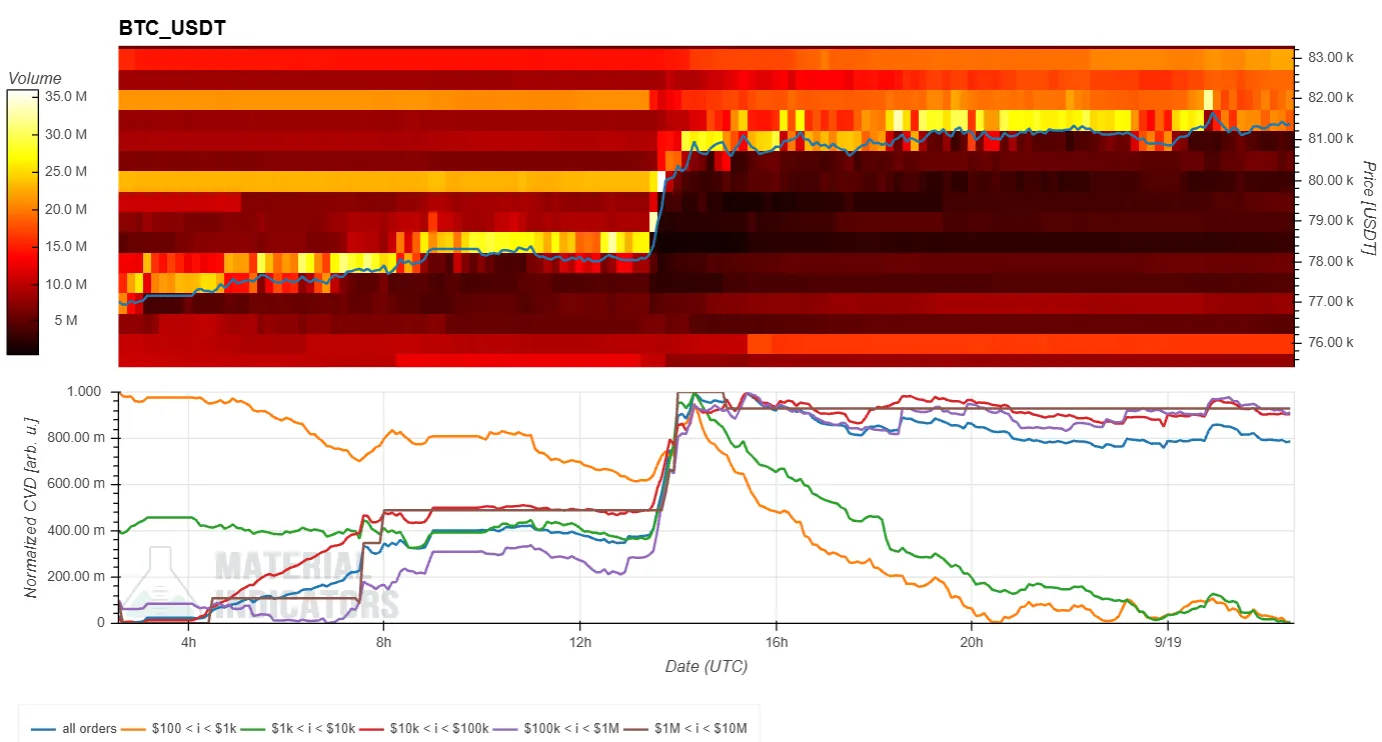
Spot CVD is an order book analysis chart for the BTC/USDT spot trading pair. The upper panel shows a Volume Heatmap, while the lower panel shows cumulative volume delta, or CVD.
- The volume heatmap tracks trading volume at each price level. The background color becomes brighter when the price stays in a specific range for longer or moves sharply. Brighter areas may act as support or resistance levels.
- The cumulative volume delta indicator shows buy and sell orders by order size. As buy orders increase, the line for the corresponding color rises. The yellow line reflects orders worth $100 to $1,000, while the brown line reflects large orders worth $1 million to $10 million, among other categories.
01:34
An address believed to belong to an ETH whale or institution that held Ethereum for about three years sold part of its holdings today and is now sitting on a gain of about 29%, according to on-chain analyst EmberCN.
The whale withdrew 112,066 ETH, worth about $227 million at the time, from Bitfinex around three years ago and held the tokens through Sept. 19. The address’s average ETH purchase price was about $2,030. About two hours ago, the whale deposited 21,229 ETH, worth about $55.93 million, back to Bitfinex. Exchange deposits are typically interpreted as being intended for a sale. According to CoinMarketCap, ETH was trading at $2,608.28, up 6.47%, at the time of writing.
01:22
Visa plans to block a payment-processing loophole that had allowed cardholders to earn rewards on memecoin purchases made with credit cards, Crypto In America reported, citing sources familiar with the matter.
The issue stemmed from memecoin purchases processed through crypto payments infrastructure firm Crossmint being classified under a merchant category code for digital goods and media, such as e-books, movies, and music, rather than as cryptocurrency transactions. As a result, some purchases qualified for standard credit card rewards including points and cashback. Visa told payment processors the category code was not appropriate for memecoin transactions, and said the purchases will instead be processed as crypto transactions subject to its crypto-related rules and restrictions. Payment processors were given a grace period to end the existing method, with the change expected to take effect as early as next week.
00:56
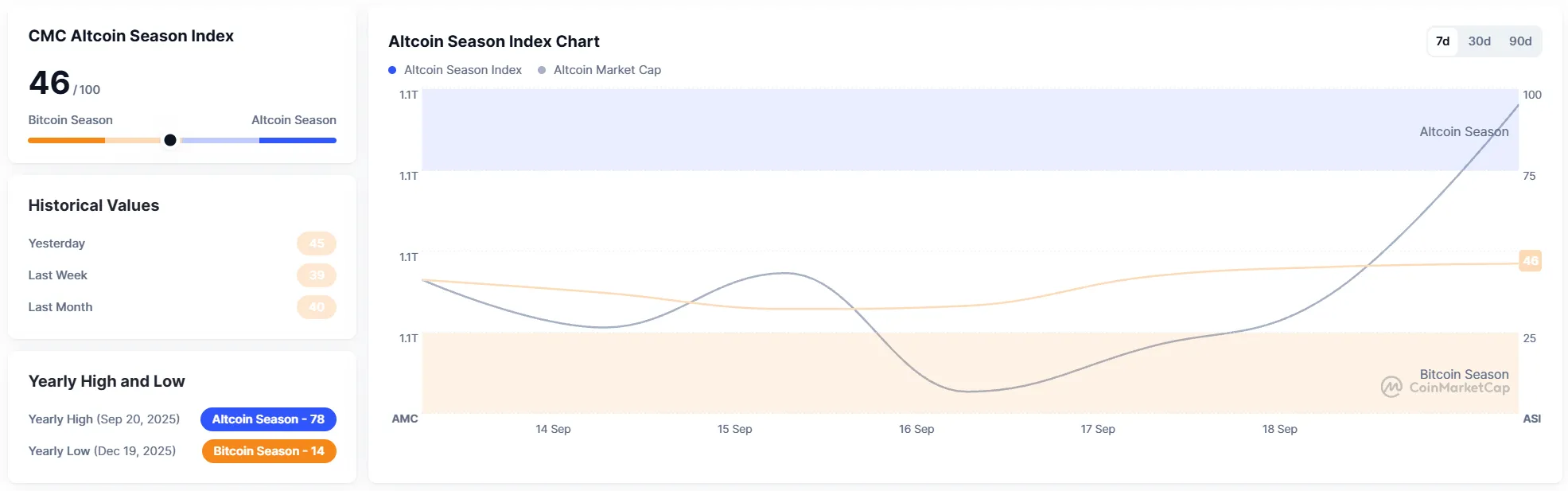
CoinMarketCap’s Altcoin Season Index rose four points from yesterday to 46. The index is calculated by comparing the price performance of Bitcoin with that of the top 100 coins by market capitalization, excluding stablecoins and wrapped coins. A market is considered to be in altcoin season when 75% of the top 100 coins have outperformed Bitcoin over the past 90 days. The opposite is considered Bitcoin season. A reading closer to 100 indicates stronger altcoin season conditions.
Previous related news