Live Feed
New
Today, September 2, 2026
10:08
Grayscale, Andreessen Horowitz and the Crypto Council for Innovation have urged the U.S. SEC not to regulate new types of exchange-traded products under a one-size-fits-all framework and instead review them on a case-by-case basis, Cointelegraph reported. They argued crypto-based products should not be classified simply as "new products" in ways that trigger additional regulation or delay launches, and also opposed automatically subjecting products holding non-securities assets to the Investment Company Act. Instead, they proposed improving the approval process by setting clearer review timelines and introducing procedures such as private pre-filing consultations.
10:00
CryptoQuant contributor Darkfost said buying momentum in the BTC futures market is weakening. Darkfost said the 30-day average net taker volume recently plunged to $97.8 billion from $213.7 billion, while the taker buy/sell ratio, which had risen to 1.21 on Aug. 19, shifted to seller dominance starting Aug. 30. The analyst added optimism seen when BTC broke above $65,000 has faded and short positions are increasing, indicating market conditions appear to be deteriorating in the near term.
09:52
Crypto-related stocks were broadly lower in U.S. premarket trading, with Circle (CRCL) down 2.48%, Strategy (MSTR) down 2.08%, and Coinbase (COIN) down 1.83%.
09:43
LD Capital founder Jack Yi said on X that BTC had recently failed to break through the $81,000 resistance level, and Yi expects a pullback to $75,500-$76,000 before it rises again to test the next resistance level at $86,000.
08:40
Bitcoin rose about 25% in August, marking its strongest August performance since 2017, but investor sentiment did not strengthen at the same pace as prices, according to on-chain analytics firm Santiment.
Santiment said Bitcoin surged from around $64,700 on Aug. 18 to about $78,300 on Aug. 21. Even so, the average sentiment balance, a gauge of investor sentiment, stood at just +32 from Aug. 19 to 31, lower than the +72 recorded in July when Bitcoin had traded sideways at around $63,000. Santiment said the Coldcard hack in early August appears to have weighed on sentiment. The indicator fell to -540 on Aug. 1 in the wake of the incident and recovered to around zero only near Aug. 19, when the rally began. Santiment added that no signs of overheating emerged even after the uptrend started. During the rally, the daily peak in sentiment balance was +73, versus +183 in July during the extended sideways market. Bitcoin has entered an uptrend, Santiment said, but investor sentiment has yet to catch up.
08:39
Blockchain-based lending platform Figure said it has completed its $717 million acquisition of U.S. real estate lender Kiavi.
The deal brings Kiavi’s lending technology and operating platform into Figure’s blockchain-based lending marketplace. Kiavi is expected to add more than $7 billion in annual new loan volume to Figure Connect, the company’s lending platform, and supply more than $100 million in loans each month to its on-chain lending platform, Democratized Prime.
08:32
DeFi Technologies, the parent of Swiss crypto ETP provider Valour, is facing a Nasdaq delisting review after failing to meet the exchange’s minimum share price requirement, CryptoSlate reported.
Nasdaq told the company in March that its stock had traded below $1 for 30 consecutive trading days and required it to stay at or above $1 for at least 10 straight trading days by Sept. 1. DEFT, however, closed at $0.6032 on Aug. 31, making it impossible to meet the requirement by the deadline. Nasdaq may now review whether the company meets additional listing standards and either grant up to 180 more days to regain compliance or issue a delisting notice. The company also has not yet implemented a reverse stock split approved by its board.
08:32
Sui said it will hold the Sui Basecamp conference during Token2049 in Singapore in October. Sui described Basecamp as the largest annual global conference in the Sui ecosystem, where it plans to present the rollout of native BTC (Hashi), gas-free payments, and roadmaps for developers and the broader ecosystem.
At the same time, Sui is running an event for the Korean community with the Telegram channel Coin Gachi Invest to support attendance at Sui Basecamp. Winners selected by lottery will receive flights to Singapore, hotel accommodations, and passes to the conference.
08:19
An anonymous whale bought 155,980 HYPE worth $12.91 million, according to Onchain Lens. The tokens are staked.
08:08
Raphael Zagury, CEO of U.S.-listed Bitcoin accumulation company Twenty One Capital (XXI), said Bitcoin is going through its first-ever hash-rate bear market, according to Wu Blockchain.
Zagury said the Bitcoin network’s hash rate climbed to nearly 1.3 ZH/s late last year and has declined steadily since then. He said the current stretch is already the longest period so far for the hash rate to recover after hitting a record high.
He added the current situation differs from the hash-rate decline that followed China’s 2021 ban on cryptocurrency mining. At the time, mining companies mainly relocated to other regions and the hash rate gradually recovered, he said. Zagury said the Bitcoin mining industry is now competing with new infrastructure tied to AI and high-performance computing, and almost all publicly listed miners are shifting away from Bitcoin mining and toward AI.
07:59
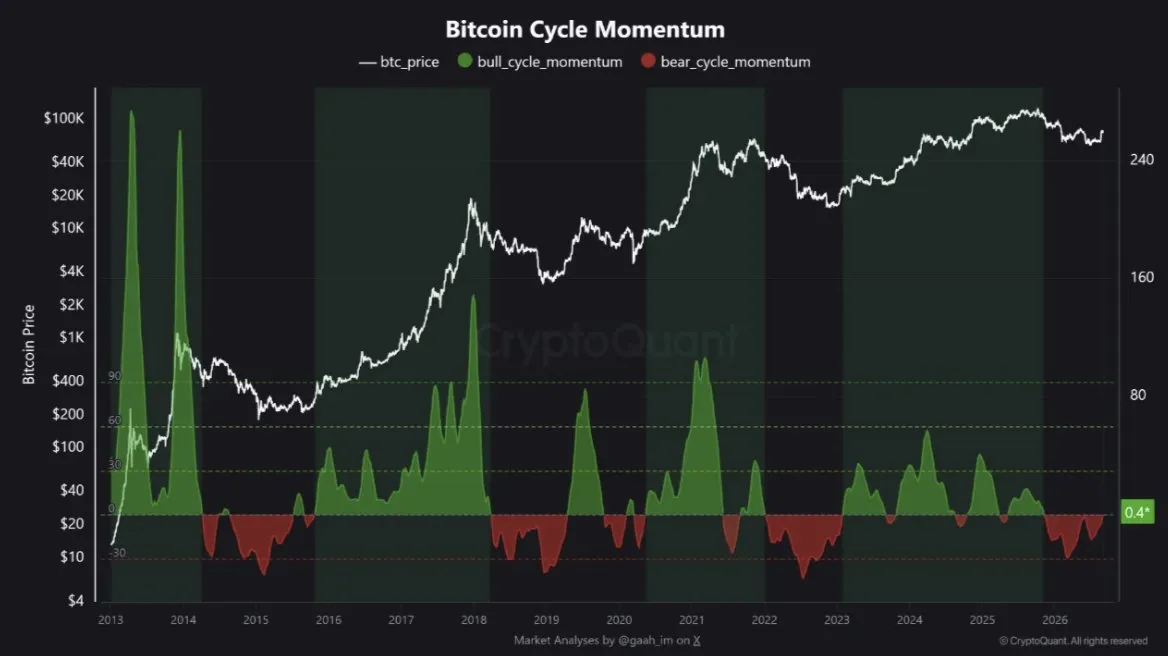
A CoinNess analysis by CryptoQuant contributor @gaah_im said Bitcoin’s cycle momentum indicator has moved back into positive territory after eight months in a bearish phase, raising the likelihood that BTC could break out of its downtrend.
The analyst said the signal suggests BTC is more likely to break its downtrend and reverse the bear market, although confirmation would require the indicator to climb to the 20-30 range over the coming weeks as the price recovery continues. According to the chart shared by the analyst, the momentum reading currently stands at 0.4.
07:56
South Korea’s Democratic Party and People Power Party have agreed to hold regular joint policy committee meetings every two weeks, with non-contentious bills to be processed first and disputed measures such as the Framework Act on Digital Assets to be reviewed through further deliberation at the policy committee level, Digital Asset reported.
The two parties held a joint policy committee meeting at the National Assembly’s main building on Sept. 1, but did not discuss specific bills including the digital asset law, according to the report. Kwon said no concrete bills were discussed at the meeting and the two parties agreed their policy committees would serve as a venue for bipartisan deliberation on contentious issues where views differ.
07:51
Europe-listed Capital B, which has been strategically buying Bitcoin, said it is pursuing a capital increase to raise €7.6 million ($8.79 million) from Blockstream CEO Adam Back and could use the proceeds and existing operating funds to buy up to 376 more BTC. If the purchases are completed in full, the company’s holdings would rise to as much as 3,521 BTC.
The share sale would involve issuing 13,181,030 new shares at €0.58 per share, along with four subscription rights for each new share.
07:49
AI agent platform Almanak announced the launch of an agentic DeFi strategy platform that lets users turn ideas described in natural language into quantitative strategies executed on-chain.
The company said the platform covers the full strategy workflow, from capturing market signals and designing strategies to backtesting, deployment and real-time monitoring. Strategies are deployed through users’ Safe wallets and run on a non-custodial basis without requiring users to hand over assets, while the strategy code is publicly available for anyone to verify.
At launch, Almanak supports seven blockchain networks: Ethereum, Arbitrum, Base, BNB Chain, Polygon, Optimism and Avalanche. Available strategies include liquidity provision, yield optimization, delta-neutral trading, and tokenized stocks and commodities.
07:46
The number of holders trading tokenized stocks, which convert real-world shares into blockchain-based tokens, surged by more than 928,000 in August, up about 120% from the previous month, Cryptopolitan reported. The gain meant more investors entered the market in a single month than over the entire prior period combined.
BNB Chain and Robinhood Chain led the growth, accounting for about 73% of total holders. The surge came amid Binance’s zero-fee promotion and Robinhood’s listing of more than 100 new stock tokens. Still, the tally is based on individual wallet addresses rather than actual users, raising the possibility of distortion, as fee waivers and reward events may have prompted a single user to create multiple wallets. The market’s real test is likely to come after October, when the no-fee benefit ends, to see whether actual capital remains in place.
07:32
U.S. spot XRP ETFs have posted net inflows for 11 straight trading sessions, drawing a total of $170 million since Aug. 18, CoinDesk reported, citing SoSoValue.
Net inflows totaled $14.38 million on Sept. 1, according to the report, while cumulative net inflows since the products launched in November last year rose to $1.68 billion. As of 13F filings at the end of the second quarter, Goldman Sachs was the largest institutional holder of XRP ETFs at about $87.4 million, although the position may have included market-making, basis trading, and client order inventory, making it difficult to conclude the holdings were a directional bet on XRP price gains.
Previous related news
07:30
London-listed Smarter Web Company (SWC) has bought 35 more BTC, bringing its total holdings to 2,747 BTC. The company now ranks 29th among major listed companies by Bitcoin holdings.
07:11
Slowing growth in new Chinese credit could act as a downside factor for Bitcoin and other risk assets, CoinDesk said in an analysis.
CoinDesk said China’s credit impulse, which tracks new credit flows relative to the size of the economy, is falling, while a recent Bloomberg index dropped to 20.84, the lowest level since 2008. Societe Generale investment strategist Albert Edwards warned slower Chinese credit creation may signal a broader global economic slowdown, which could pressure corporate earnings and U.S. stocks. That would suggest BTC may also struggle to avoid the impact if risk aversion spreads.
CoinDesk added that the influence of China’s credit conditions may be weaker than in the past, and gains could continue if U.S. institutional capital keeps driving the market. Still, if U.S. stocks lose momentum, BTC may also come under pressure.
07:10
Bitcoin is hovering below $78,000 and showing a weak near-term trend, with downside correction risks gaining traction after repeated failures to break through the $80,000-$82,000 resistance zone, CryptoPotato analyzed.
According to Binance’s one-week BTC/USDT liquidation heatmap, large liquidation clusters are concentrated in the $74,000-$77,000 range below the current price. If short-term support breaks, that zone could act as a strong magnet and accelerate downside liquidations. While liquidation volume also remains near $80,000 on the upside, the downside liquidity sweep scenario appears more convincing as upward momentum has faded. If buying interest fails to quickly reclaim the $80,000 level, Bitcoin could correct into the mid-$70,000 range before testing support at $72,000-$74,400.
06:55
Strategy CEO Phong Le said the company’s decision to sell Bitcoin in the low-$60,000 range and repurchase it in the low-$80,000 range were both the right calls at the time, according to Wu Blockchain, which cited a Bloomberg TV interview.
Le said Strategy bases its Bitcoin trading decisions on funding costs rather than BTC’s price itself. Selling about 7,000 BTC to fund preferred stock dividends was the right trade at the time, Le said, adding the company cut net debt to zero from about $7 billion over the past two months and built its U.S. dollar reserves to about $7 billion. With MSTR trading at a premium, Le said, selling shares to fund additional BTC purchases now makes financial sense.
He added Strategy could sell BTC again if it is financially justified, while maintaining a net-buying stance and continuing to buy even at higher prices if the economics work.
Earlier, Strategy sold about 6,916 BTC at an average price of $62,500 from June 22 through early August, then bought back 4,603 BTC last week at an average price of $80,318.
Previous related news
06:44
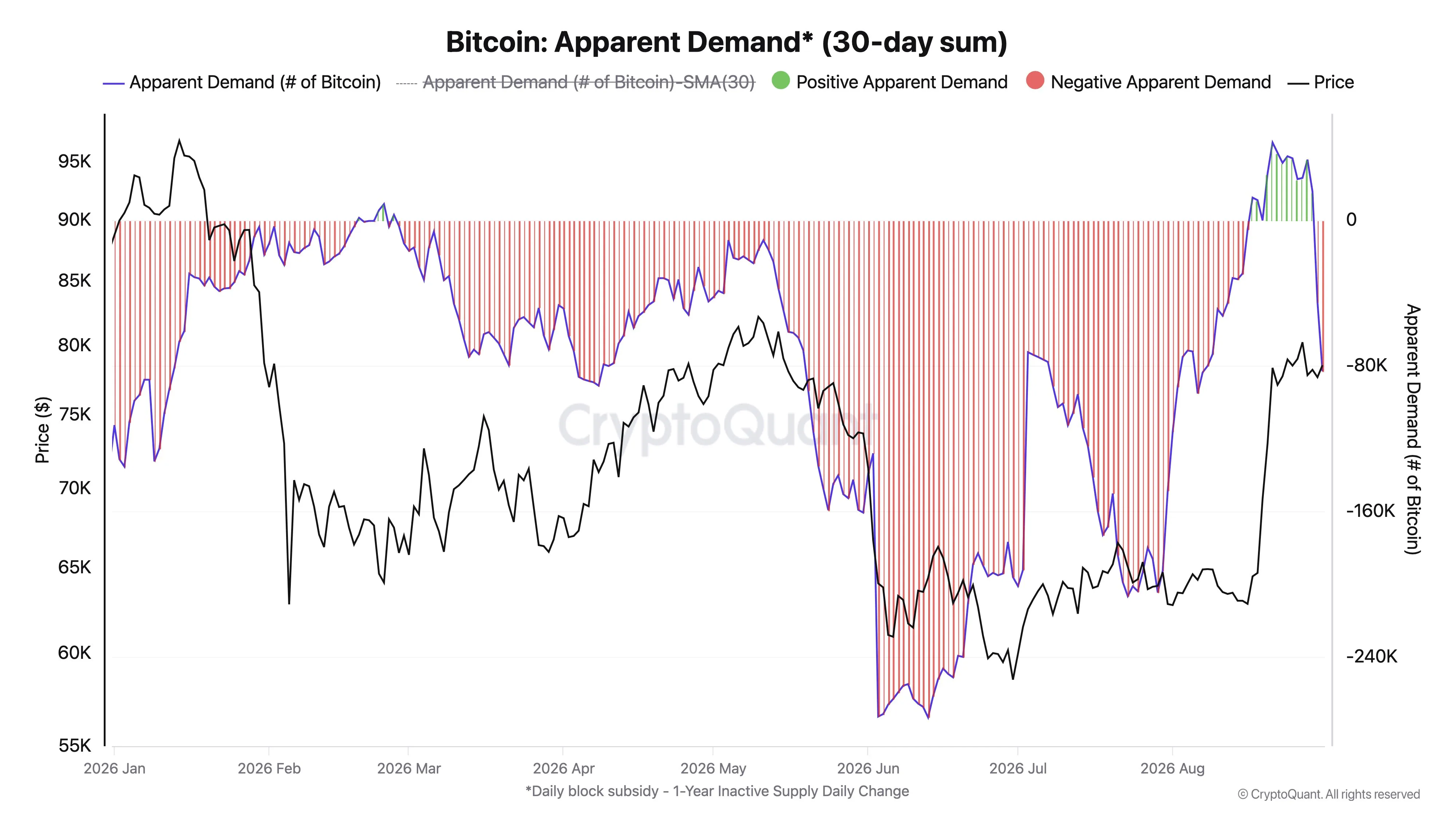
Bitcoin’s apparent demand has turned negative again as selling pressure persists from short-term holder profit-taking, signaling a sharp weakening in demand over the past few days, crypto analyst Darkfost said on X. Darkfost added that BTC’s price action is also losing strength and could face another leg down if demand does not recover in the near term.
06:37
Malware targeting cryptocurrency wallets across multiple networks, including Solana, Ethereum, Polygon, BNB Chain, Avalanche, Arbitrum, Base and Phantom, was found on a fake website claiming to offer a downloadable leak of Rockstar Games’ upcoming title 'GTA 6,' U.Today reported.
According to cybersecurity firm Malwarebytes, the site asks users to pay either $50 or 1 SOL for access to the alleged leak and then prompts them to connect a wallet. If users approve a fraudulent transaction, they could lose not only the purchase amount but also the cryptocurrency held in the wallet.
Earlier, an anonymous hacker who had leaked unreleased 'GTA 6' footage promoted a Solana-based memecoin called CYBERLEEK and sold the entire holding just before official gameplay footage was released.
Previous related news
06:24
Major layer-1 blockchain MultiversX (EGLD) plans to implement its “Supernova” upgrade on Sept. 10, cutting block generation time to 0.6 seconds from six seconds.
The core of the overhaul is a redesigned consensus structure. It introduces parallel transaction processing, lowering intra-shard finality to under 0.25 seconds and reducing cross-shard settlement time to about 2.4 seconds. At activation, new transactions will stop being accepted for about 24 minutes under the existing six-second standard and will enter a queue. With more than 95% of over 5,000 nodes still running the previous version, the success of the migration is seen as key to achieving the speed improvement.
06:18
An attacker has been seen trying to seize control of Yam Finance through a governance vote, potentially putting about $337,000 at risk, according to Defimon Alerts.
Defimon Alerts said the attacker delegated 504,000 YAM to an address under the attacker’s control, slightly above the quorum threshold, using about 3.3% of total YAM supply, and then submitted governance proposal 45. If the proposal passes and is executed, the attacker would gain admin control of the YAM timelock contract, enabling control over the protocol’s contracts and DAO treasury, with roughly $337,000 potentially vulnerable to theft, the security firm said.
The protocol is effectively no longer operating, Defimon Alerts added, with about 34 hours remaining until the vote ends, and urged YAM holders to vote against the proposal.
06:08
South Korea’s Financial Services Commission said it will operate a digital asset task force through 2028 to prepare subordinate regulations and other legislative measures ahead of the enactment and implementation of a basic law on digital assets.
In a report titled "2026 policy measures and trends for the creation and development of a financial hub" released on Sept. 1, the FSC said South Korea’s domestic digital asset regulatory framework has prioritized illegal activity and investor harm prevention, leaving industry and market issues such as business conduct, disclosure, and distribution inadequately addressed, according to Digital Asset. The commission added it plans to outline the main provisions of the basic law on digital assets within 2026 after consultations with the Virtual Asset Committee and through party-government coordination.
