Top

Myanmar Government in Exile Backs Crypto Bank Launch

Policy & Regulation·July 21, 2023, 12:36 AM

Myanmar is on the cusp of a financial revolution as the National Unity Government (NUG), the country’s exiled shadow government, introduces the Spring Development Bank (SDB), a crypto-based financial institution.

With a mission to bestow long-awaited financial freedom and digitized sophistication upon the nation’s citizens, the SDB aspires to reshape Myanmar’s financial landscape.


Built on Polygon

The bank derives its name from the Spring Revolution, an opposition movement that bravely challenges the ruling military junta. The goal of the SDB is to bring “freedom and democracy to the 55 million citizens of Myanmar,” a lofty ambition that reflects the NUG’s determination to empower its people through innovative means.

Constructed on the Polygon Network, the SDB aims to revolutionize domestic and international payments, making them faster and more efficient. But the bank’s vision extends beyond just payments. Following a recent press conference, bank officials revealed plans to offer a diverse range of financial products, including fixed deposits, currency exchange services, cross-country remittances, and even digital gold savings options.


Reaching the Burmese diaspora

Notably, the SDB’s reach extends beyond Myanmar’s borders to the two-million-strong Burmese diaspora residing abroad. This diaspora frequently sends money back to their homeland, but the current remittance fees can soar as high as 30%. The bank intends to alleviate this burden, reducing the costs associated with sending money back to Myanmar.

The Spring Development Bank operates under the licensing and regulation of the Interim Central Bank of Myanmar, which is under the control of the NUG. U Calvin, the bank’s CEO, emphasized that this launch marks the initial step towards restoring financial independence to Myanmar.

The bank’s emergence comes amid Myanmar’s complex relationship with cryptocurrencies. While there is no specific legislation addressing cryptocurrencies, the Central Bank of Myanmar issued a ban on them in 2020, and the military junta later proposed a cybersecurity law that criminalized their usage in January 2022.
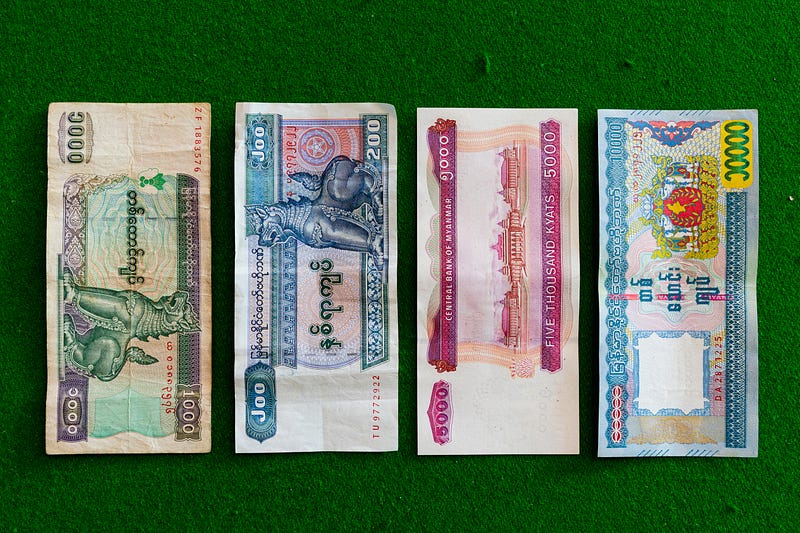
Photo by Dan Gold on Unsplash


July soft launch

A soft launch of the SDB is scheduled for July 22, with 1,000 private beta users and 100 relationship managers. The bank expects to achieve a full launch in late August, with the goal of attracting 100,000 active users within the first six months of operation.

Despite these regulatory challenges, Myanmar’s people have turned to cryptocurrencies as an escape from their dire financial situation. Since the February 2021 coup, the country’s economy has suffered significantly, with the World Bank estimating an alarming 18% annual contraction. Fading trust in the traditional banking system, controlled by the military, has further crippled the financial market.

The Myanmar kyat (MMK) plummeted to an all-time low of 2,200 against the US dollar (USD) in September 2021, down from 1,330 in February 2020 (currently 1 USD = 2,100 MMK).

The SDB’s arrival signals a glimmer of hope amidst these trying times, offering a beacon of financial opportunity for the citizens of Myanmar. With the support of the NUG, the bank is looking to take an innovative approach to better serve Burmese citizens, both at home and abroad.


More to Read
View All
Web3 & Enterprise·

Jun 27, 2023

Netmarble’s Blockchain Platform Plans Tokenomics Overhaul for MBX Token

Netmarble’s Blockchain Platform Plans Tokenomics Overhaul for MBX TokenNetmarble, a South Korean gaming company, announced today that its blockchain subsidiary MARBLEX revealed a plan to revamp the tokenomics of its native MBX token.Fate of 670 million MBXAs part of this overhaul, MARBLEX will conduct a vote to determine whether to burn 670 million MBX tokens, which do not belong to the distribution plan. The total number of issued MBX tokens amounts to 1 billion.The vote will be held on its Discord channel and the decentralized governance platform Snapshot. Participants eligible to vote are holders of Marbleship NFTs and MBX tokens. The final decision will be reached on July 10. If consensus is reached to burn the tokens, the specific burn schedule will be disclosed at a later date.Photo by Sergio Vilches on UnsplashEnhancing MBX utilityStarting from the third quarter of this year, MARBLEX plans to introduce an improved token burn policy and system. The aim is to expand the utility of the MBX token and establish an ecosystem that is sustainable, transparent, and reliable.MARBLEX is a gaming blockchain ecosystem that offers users the opportunity to play games while earning and trading cryptocurrencies. The platform currently supports games such as A3: Still Alive, a battle royale MMORPG; Ni no Kuni: Cross Worlds, a fantasy MMORPG; and The King of Fighters ARENA, a fighting game.According to Coinmarketcap, the MBX token is listed on six centralized cryptocurrency exchanges (Bithumb, Huobi, Bybit, Gate.io, MEXC, and Indodax) and Klayswap, a Klaytn-based decentralized exchange. Klaytn is an open source public blockchain developed by Korean social media giant Kakao Corp.

news
Policy & Regulation·

Oct 02, 2025

Iran caps stablecoin transactions amid currency devaluation and sanctions

Iranian authorities last week introduced new restrictions on stablecoin transactions, limiting individuals to an annual purchase cap of $5,000 and a total holding limit of $10,000. According to a report from Iran International, licensed digital platforms have one month from the effective date to enforce these new regulations on all users.Photo by Hadis Malekie on UnsplashRial decline fuels stablecoin uptakeThe move coincides with the continued devaluation of the national currency, with the Iranian rial reaching an all-time low of 1,136,500 per U.S. dollar on Sept. 27. This currency plunge occurred just before the reimposition of United Nations sanctions, which took effect at 00:00 UTC on Sept. 28. Since then, the rial has weakened further, reaching a new low of 1,170,000 per U.S. dollar as of publication, as per data from Bonbast.  For many Iranians, stablecoins like USDT have become an essential financial tool, providing a hedge against inflation and a means to transfer funds internationally, bypassing the traditional banking system. The adoption of these U.S. dollar-pegged digital assets has reportedly grown since the escalation of conflicts with Israel and the U.S. earlier in the year. These new financial controls follow recent actions by the U.S. to counter what it describes as Iranian "shadow banking" networks. On Sept. 16, the U.S. Department of the Treasury’s Office of Foreign Assets Control (OFAC) sanctioned two Iranian financial operatives and their network of companies in Hong Kong and the United Arab Emirates (UAE). A press release stated these entities used cryptocurrency and front companies to transfer funds from oil sales, benefiting Iran’s IRGC-Qods Force (QF) and its Ministry of Defense and Armed Forces Logistics (MODAFL). The U.S. Treasury asserts these funds are funneled into regional proxy groups and the development of advanced weapons programs.U.S. dollar to rial chart Source: BonbastHack on Iran’s top crypto platformIran’s private digital currency sector has also faced mounting security pressures. In June, Nobitex, the country’s largest crypto exchange, was hit by a major exploit that drained about $90 million in assets, including Bitcoin (BTC), Ethereum (ETH), Dogecoin (DOGE), Ripple (XRP), Solana (SOL), Tron (TRX), and TON. A pro-Israel hacker group known as Predatory Sparrow, or Gonjeshke Darande, later claimed responsibility in a post on X. The attack took place during heightened military tensions that began with Israeli strikes on Iranian military and nuclear facilities on June 18, 2025. According to analysis by TRM Labs, digital assets are increasingly integral to Iran's efforts to navigate international sanctions and advance its geopolitical interests. Iranian exchanges, including Nobitex, process billions in cryptocurrency transactions. These platforms have been noted for permitting large withdrawals without stringent Know Your Customer (KYC) protocols and for employing sophisticated methods to obscure the origins and destinations of funds. At the same time, these exchanges are not used solely for state-level purposes. For many ordinary Iranians, grappling with inflation and economic isolation, digital assets represent a practical tool for safeguarding savings and maintaining limited access to the global economy, underscoring the dual role that cryptocurrency plays in the country. 

news
Policy & Regulation·

May 30, 2025

Kazakhstan plans CryptoCity as pilot project for crypto payments

The Central Asian republic of Kazakhstan is planning to establish a pilot project that will enable the use of crypto as a means of exchange for goods and services within a specific zone. That’s according to a statement published on Akorda.kz, the official website of the President of Kazakhstan. The statement incorporates the text of a keynote speech delivered by President Kassym-Jomart Tokayev at the Astana International Forum. Tokayev stated: “We are planning to create a pioneering pilot zone called CryptoCity where cryptocurrencies might be used for purchasing goods, services, and even beyond.”Photo by Engin Akyurt on PexelsWorking towards digital transformationThe initiative forms part of Kazakhstan’s efforts to make progress in terms of digital transformation, as well as an aspiration to become an IT hub within the Eurasia region.  For the purposes of the pilot program, the use of cryptocurrencies for the payment of goods and services has been authorized by the government within a pre-defined sandbox environment. Alatau City, an urban development located north of the Kazakhstani city of Almaty, has been chosen for the pilot scheme. Alatau has been established as a special economic zone and planned to become a hub for new technology and knowledge, alongside global tourism. It hosts the Innovation Technology Park together with the Kazakhstan National Nuclear Center, Institute of Nuclear Physics and the Physics & Technology Institute.It’s envisaged that the existing technology and knowledge base within Alatau will support its expansion into the area of crypto payments and blockchain development. In addition to crypto payments, other blockchain-based technologies related to taxation systems, investment and decentralized identity systems will be nurtured and encouraged within the Alatau special economic zone. Potential Eurasian crypto hubIn a recent opinion piece published by the Russian-language government-backed newspaper Kazakhstanskaya Pravda, Kanysh Tuleushin, Kazakhstan’s vice minister of digital development, suggested that the Central Asian republic has the potential to position itself as the region’s leading crypto hub.  Tuleushin also suggested that crypto mining operators could help to modernize the country’s energy sector, playing a role in stabilizing the country’s power grid, while making use of surplus electricity. Kazakhstan had proven to be a popular destination for Bitcoin miners in the past. However, the sudden influx of miners following a ban on the activity in China in 2021 was unplanned for.  The surge in electricity demand put the country’s electricity grid under pressure, leading to blackouts in some cases. In 2023 President Tokayev signed legislation into law that limited the energy use of domestic crypto miners. Despite that negative experience, it appears that Tuleushin has seen the benefits that the activity can bring when regulated and planned for. Back in March, it emerged that lawmakers in Kazakhstan had proposed the creation of a crypto bank. One obstacle to the creation of the bank is a lack of a crypto regulatory framework. According to a report published earlier this month, the National Bank of Kazakhstan is now in the process of preparing a regulatory framework for digital assets.

news
Loading