Top

Asia-Pacific leads a wider crypto uptake as legal and security risks persist

Markets·September 08, 2025, 12:22 AM

A new report indicates that the global use of cryptocurrency is not only growing but also quickening, with the Asia-Pacific (APAC) region setting the pace. According to the sixth Chainalysis Global Crypto Adoption Index, released on Sept. 2, India has emerged as the new leader in overall adoption across 151 countries. The index analyzes where value is being transferred, how new users are entering the ecosystem, and which areas are experiencing the most rapid expansion.

https://asset.coinness.com/en/news/c9648faf8aca5c5ec2d477de452bb449.webp
Photo by Naveed Ahmed on Unsplash

India leads global crypto adoption

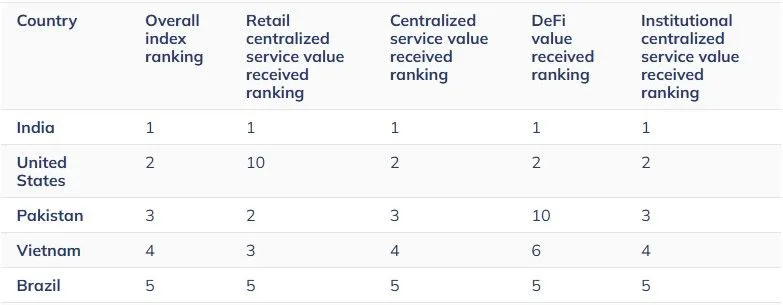
India now holds the top spot in the overall index, with the U.S. following in second place. The APAC region demonstrates significant momentum, with Pakistan (3rd), Vietnam (4th), Indonesia (7th), and the Philippines (9th) all securing positions in the top ten. Further down, South Korea and Japan are ranked 15th and 19th, respectively.
https://asset.coinness.com/en/news/519be038ed3cf599185eea1151ab10e2.webp
2025 Global Crypto Adoption Index Top 20 Source: Chainalysis

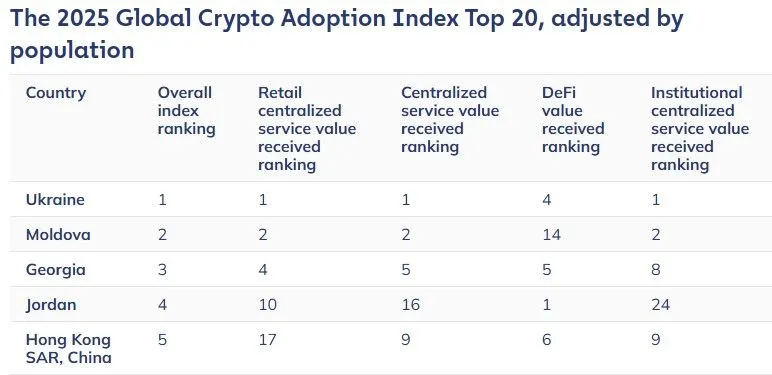
The picture changes when the data is adjusted for per capita GDP, which highlights grassroots movements. By this measure, Ukraine ranks first, followed by Moldova, Georgia, and Jordan. Hong Kong comes in fifth, Vietnam sixth, while Singapore and South Korea rank 16th and 18th, respectively.
https://asset.coinness.com/en/news/0b943ed6bf741d298814dda5ca151e6e.webp
2025 Global Crypto Adoption Index Top 20 (Pop. adjusted) Source: Chainalysis

Regional transactions surge as APAC gains ground

On-chain transaction data confirms a shift in economic gravity. In the year ending June 2025, APAC's transaction value soared by 69% year-over-year, climbing from $1.4 trillion to $2.36 trillion. While Europe ($2.6 trillion) and North America ($2.2 trillion) still handle larger absolute volumes, growth is accelerating nearly everywhere. APAC's growth rate more than doubled from 27% to 69%, while Latin America's rose from 53% to 63%.


In terms of capital entering the crypto market via centralized exchanges, the U.S. leads as the largest fiat on-ramp, processing over $4.2 trillion. This is approximately four times the volume of South Korea (over $1 trillion), while the EU recorded just under $500 billion. Asset preferences also show regional variations; Bitcoin accounted for 47% of purchases in the U.K. and 45% in the EU, but just over 20% in South Korea. 


India's top ranking aligns with the latest domestic developments, such as the Independence Day launch of the Bitcoin Policy Institute India, which aims to focus on sovereign mining, policy, and education.


Legal and security challenges in India

However, this rapid growth is accompanied by notable legal and security hurdles. In a high-profile case, an Indian anti-corruption court sentenced 14 individuals, including 11 police officers, to life in prison for a 2018 kidnapping and crypto extortion scheme.


In another development, creditors of India's crypto exchange WazirX approved a new restructuring plan over a year after a $234 million hack allegedly linked to North Korea’s Lazarus Group. An earlier proposal was rejected by the Singapore High Court in April. The revised plan shifts oversight of recovery tokens—representing outstanding balances—from WazirX’s Singapore entity to Zanmai India, regulated by India’s financial authority, with repayments funded by profits and recovered assets. Some 150,000 creditors, representing $206 million in claims, voted between July 30 and Aug. 6 as WazirX also moved operations to a Panama-based unit called Zensui. Separately, on April 16, India’s Supreme Court dismissed a petition from 54 hack victims, ruling it lacked authority to legislate on crypto policy.


While India’s headlines highlight the frictions of rapid growth, the broader picture is clearer. The Chainalysis index illustrates a global crypto market expanding across all income levels for varied reasons. In developed nations, clearer regulations and institutional involvement are key drivers. In many emerging economies, factors like remittances and access to U.S. dollars via stablecoins are more prominent.


 

More to Read
View All
Web3 & Enterprise·

Sep 06, 2024

WazirX hack: Hacker launders $10M through Tornado Cash amid legal disputes and partial withdrawals

In the aftermath of the massive $235 million hack of the WazirX cryptocurrency exchange on July 18, users and stakeholders are grappling with its devastating consequences. The breach, which compromised a significant portion of the exchange’s reserves, has led to a series of legal, financial and security-related challenges, leaving millions of users uncertain about the future of their funds. The hack and its aftermathWazirX, once a leading Indian cryptocurrency exchange, lost approximately $235 million due to a breach in one of its multi-signature wallets. This included significant amounts of Shiba Inu (SHIB), Ethereum (ETH) and other assets. The hack crippled the exchange, forcing it to temporarily shut down operations and seek a restructuring process under Singapore's insolvency laws. The WazirX hacker has since begun laundering the stolen assets through Tornado Cash, a crypto mixer known for obscuring transaction details. According to blockchain security firm Cyvers, the hacker transferred over 5,000 ETH (approximately $12 million) to a new wallet and laundered $10 million in Ethereum through Tornado Cash. This mirrors the tactics of the North Korea-backed Lazarus Group, which has used similar methods in past high-profile crypto thefts. Photo by GuerrillaBuzz on UnsplashUsers seeking redress and government interventionAs the victims of the hack face uncertainty, over 4 million active WazirX users are expected to suffer a loss of at least 43% of their funds due to the restructuring process. Frustrated by the lack of action from Indian authorities, many users have sought help from Indian Prime Minister Narendra Modi, who was visiting Singapore at the time. Users took to social media to air their grievances and demand justice, urging the government to intervene. WazirX co-founder Nischal Shetty, who is based in Dubai, added to the confusion by stating that he does not know who is responsible for safeguarding user crypto funds on the platform. His statement has fueled outrage among users, who feel abandoned by the exchange’s management. Legal and ownership disputesAmid the chaos, WazirX is also battling a legal dispute over its ownership with Binance, the world’s largest cryptocurrency exchange. Shetty has repeatedly claimed that Binance acquired WazirX, granting it significant control over the platform's operations. However, Binance founder Changpeng Zhao (CZ) refuted these claims in 2022, stating that the acquisition deal was never completed. The uncertainty surrounding the ownership of WazirX has further aggravated users, many of whom are demanding a clear statement from Binance. So far, Binance has remained silent, neither confirming nor denying its involvement. This ambiguity has intensified calls for clarification, with users fearing that a lack of transparency may worsen their chances of recovering their funds. Partial withdrawals and restructuring effortsIn response to the crisis, WazirX has initiated phased withdrawals for users, allowing them to access 66% of their Indian Rupee (INR) token balances. Initially set for September 9, the withdrawal window was moved forward, offering some relief to users. However, many are dissatisfied with the partial access to their funds and are questioning when full crypto withdrawals will resume. WazirX’s legal team has indicated that users may recover only 55% to 57% of their crypto holdings, sparking further discontent. Meanwhile, the exchange has filed a moratorium application in the Singapore High Court, seeking a six-month reprieve from legal actions as it works on a restructuring plan. Looking aheadAs the WazirX saga unfolds, the future of the exchange and its users remains uncertain. The legal battles, ownership disputes and the ongoing laundering of stolen assets pose significant challenges to the platform's recovery. For now, users can only hope that the restructuring process will bring them closer to recovering their lost funds and that authorities will step in to provide clarity and resolution. 

news
Web3 & Enterprise·

Jun 30, 2023

Hang Seng Ponders Crypto Product Offering

Hang Seng Ponders Crypto Product OfferingHang Seng Investment Management Co., the largest exchange-traded fund (ETF) manager in Hong Kong, is considering entering the decentralized ecosystem.According to a report in local news media in Hong Kong on Wednesday, Li Peishan, the firm’s Director and Executive President, stated that Hang Seng is paying close attention to the development of digital assets. She clarified that the company is examining the possibility of including digital assets within its existing investment product offering.Photo by Jonathan Borba on UnsplashCrypto ETF expansionThis news comes shortly after HSBC, one of the largest banks in Hong Kong, introduced Bitcoin (BTC) and Ethereum (ETH) ETFs to its customers, becoming the first bank in the region to do so. This development has opened up possibilities for greater cryptocurrency adoption in the area.While most people in the space recognize that the authorities in the US have gone too far in their clampdown on the digital assets space, it’s interesting to note that recent weeks have seen a plethora of established TradFi players filing Bitcoin spot ETF applications. That list includes the world’s largest asset manager, BlackRock, multinational financial services firm Fidelity Investments, WisdomTree, VanEck, and others.Assessing potentialPeishan stated that while the company does not have a specific plan to develop a crypto ETF, Hang Seng is actively assessing the potential of incorporating digital assets into their existing investment products. She highlighted the remarkable growth in the average daily asset management scale, which has surged by 80% since December and has surpassed HK$12 billion.On June 24, Leung Fung Yee, the CEO of the Securities and Futures Commission of Hong Kong (SFC), emphasized the importance of crypto service providers embracing the next generation of the web and finance. He expressed Hong Kong’s ambition to establish itself as the central hub for crypto companies, fostering innovation within the region.Responding to Yee’s statement, the Hong Kong Virtual Assets Consortium (HKVAC) announced the inclusion of XRP, SHIB, and ADA in its newly developed HKVAC index. The creation of the HKVAC index aims to assist investors in analyzing the potential of cryptocurrencies and gaining insights into their prospects.The digital assets landscape in Hong Kong is evolving rapidly, driven by increasing interest in the asset class and the recognition of their transformative potential. Hang Seng Investment Management’s exploration of the decentralized ecosystem signifies the growing demand for exposure to cryptocurrencies among traditional financial institutions.TradFi IntegrationThe introduction of Bitcoin and Ethereum ETFs by HSBC represents a significant milestone in the adoption of cryptocurrencies within the traditional banking sector. This recent indicator from Hang Seng suggests that we are likely to see more developments unfold within the ETF space in Hong Kong in the not-too-distant future where digital assets are concerned. That view is further endorsed by the findings of a recent report produced by the Hong Kong Stock Exchange, pointing to the yet-to-be-realized potential of crypto ETFs.As the industry continues to mature, the integration of digital assets into traditional investment products is likely to become increasingly common, leading to a more diversified and inclusive financial ecosystem.

news
Web3 & Enterprise·

Nov 03, 2023

Korean crypto exchange Upbit adds one-second interval charts

Korean crypto exchange Upbit adds one-second interval chartsSouth Korea’s largest cryptocurrency exchange, Upbit, now offers one-second interval charts for its users.Dunamu, the blockchain and fintech company behind Upbit, announced on Friday (local time) that it has introduced a one-second interval feature to Upbit’s “original” charts. This makes Upbit the first Korean cryptocurrency exchange to offer this functionality.Photo by m. on UnsplashResponding to user demandUpbit has rolled out this one-second interval feature in response to user demand. This addition facilitates a broader range of investment strategies, allowing Upbit users to fine-tune their decisions based on their investment preferences. Now, the time frames available on Upbit are 1 second, 1 minute, 3 minutes, 5 minutes, 10 minutes, 15 minutes, 30 minutes, 1 hour, 4 hours, 1 day, 1 week and 1 month.A representative from Upbit said that they have incorporated the one-second interval feature into their original charts to provide users with quick and easy access to virtual asset price information for their investments. The official added that the company will remain committed to fostering a user-friendly and comfortable trading environment.Available on both web and mobileUsers can access the one-second interval feature on both the web and app versions of Upbit. To utilize this feature, they can select the “1s” time frame on the original charts found under the “Exchange” tab of Upbit.

news
Loading